High school students showing us SharePoint consultants how it’s done
Hi all
Once in a while, you can come across a case study that not only showcases innovative and brilliant solutions, but tells a much deeper story that both inspires and teaches. I am writing this post to tell you such a story – a story about genuine collaboration and what it can enable when the right conditions exist to foster it.
To explain this story, I first need to talk about the work of an academic named Richard Hackman. Here is a guy who spent most of his working life examining the factors that make teams work really well. Over the years he studied hundreds of high performing teams, trying to distil the magical ingredients that would lead to success for other teams. He would come up with theories, then create models that looked great on a whiteboard, but when applied to real teams in the real world, reality never fitted the models.
From causes to conditions…
After years of doing this, Hackman started to wonder whether he was leaning the ladder against the wrong wall. In other words, he wondered if trying to determine the causes of team efficacy by looking at successful teams retrospectively was the wrong approach. In the end, he changed his focus and asked himself a different question. What are the enabling conditions that need to exist that give rise to great teams?
He came up with six conditions arguing that irrespective of what else you did or what methodology you used, usually led to better results. I will give you a super brief summary below:
- A real team: Interdependence among members, clear boundaries distinguishing members from non-members and moderate stability of membership over time
- A compelling purpose: A purpose that is clear, challenging, and consequential. It energizes team members and fully engages their talents
- Right people: People who had task expertise, self organised and skill in working collaboratively with others
- Clear norms of conduct: Team understands clearly what behaviours are, and are not, acceptable
- A supportive organisational context: The team has the resources it needs and the reward system provides recognition and positive consequences for excellent team performance
- Appropriate coaching: The right sort of coaching for the team was provided at the right time
Now my interest in Hackman and his conditions stemmed from reviewing the published “models” for SharePoint governance. Whether it is the 7 “pillars”, the 5 “steps”, or the 6 “focus areas”, all are developed in a retrospective way – by looking at a mythically perfect SharePoint solution and then breaking it down into all the things that need to be done to enable it. You see, for a long time now, I have deliberately not started with one of the models up front and Hackman offered me a reason why. Instead I first strive to create the conditions that Hackman lists above and develop governance as it is needed, rather than follow a fixed model.
Meet Louis Zulli Jr and his students
Earlier this year, I met Louis Zulli Jnr – a teacher out of Florida who is part of a program called the Centre of Advanced Technologies. We were co-keynoting at a conference and he came on after I had droned on about common SharePoint governance mistakes. Louis then gave a talk that blew me away, and at the same time proved Hackman completely right. The majority of Lou’s presentation showcased a whole bunch of SharePoint powered solutions that his students had written. The solutions themselves were very impressive, as this was not just regular old SharePoint customisation in terms of a pretty looking site with a few clever web parts. Instead, we were treated to examples like:
- IOS, Android and Windows Phone apps that leveraged SharePoint to display teacher’s assignments, school events and class times;
- Silverlight based application providing a virtual tour of the campus;
- Integration of SharePoint with Moodle;
- An Academic Planner web application allowing students to plan their classes, submit a schedule, have them reviewed, track of the credits of the classes selected and whether a student’s selections meet graduation requirements;
- An innovative campus Hall Pass system that leveraged jQuery, HTML5, CSS3, XML, JSON, REST, List Data Web Services and features integration with IOS, Windows 8 and swipe card hardware.
All of this and more was developed by 16 to 18 year olds and all at a level of quality that I know most SharePoint consultancies would be jealous of. To any of Lou’s students who read this – and I have consulted and delivered SharePoint since 2006, as well as speaking to people around the world on SharePoint – the work quality that I saw is world-class and you all have lucrative careers ahead of you in the SharePoint space and beyond.
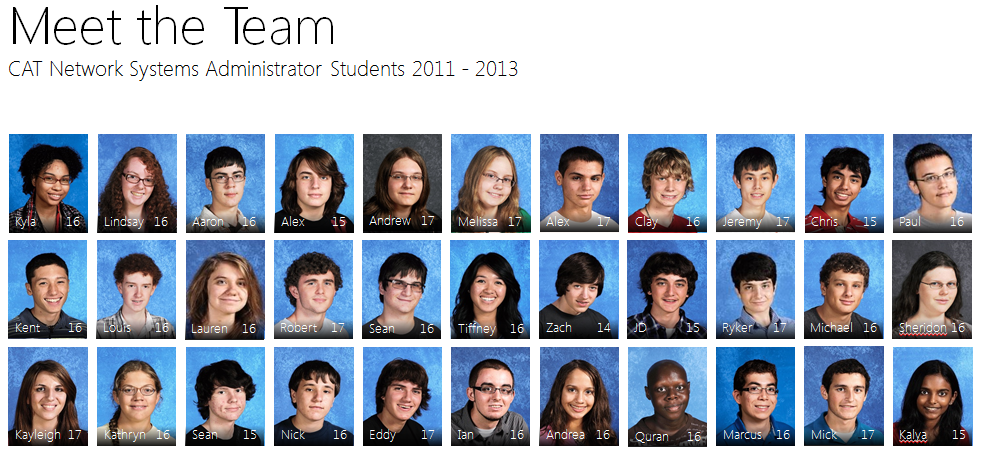
So the demos themselves were impressive enough, but that is actually not what impressed me the most. In fact, what had me hooked was not on the slide deck. It was the anecdotes that Lou told about the dedication of his students to the task and how they went about getting things done. He spoke of students working during their various school breaks to get projects completed and how they leveraged each other’s various skills and other strengths. Lou’s final slide summed his talk up brilliantly, and really spoke to Hackman’s six conditions. The slide made the following points:
- Students want to make a difference! Give them the right project and they do incredible things.
- Make the project meaningful. Let it serve a purpose for the campus community.
- Learn to listen. If your students have a better way, do it. If they have an idea, let them explore it.
- Invest in success early. Make sure you have the infrastructure to guarantee uptime and have a development farm.
- Every situation is different but there is no harm in failure. “I have not failed. I’ve found 10,000 ways that won’t work” – Thomas A. Edison
If you look at the above 5 points and think about Hackman’s conditions of compelling direction, supportive context, real team and coaching in particular, you can see that Lou ensured those conditions were present. The results of course spoke for themselves.
About halfway through Lou’s talk, I decided that whether he liked it or not, he was coming out to Australia to tell this story. So we sat down together and talked for a long while and I asked him all sorts of questions about his students, the projects, how he coached his students and how his own teaching style developed. I ended up showing him Hackman’s six conditions for great teams performance and he said “that’s what we do”.
The real lesson…
So as I write this, Lou is on his long journey home after similarly blowing away the attendees of the Australian SharePoint conference with his story about what he and his students have done. His talk was the hit of the conference and I hope that the staff and students of Lakewood High School read this post because it’s important for them to know that their story and examples were the topic of much conversation amongst attendees and highly inspiring. I also hope that people in the SharePoint community read this because CAT shows precisely why SharePoint can be such an amazing enabler within organisations when the right conditions are in place for it. Governance models are great and all, but without these enabling conditions in place, cannot deliver great outcomes on their own.
This leads me onto one final cautionary point – directed at Lou’s students, but applicable to all readers who aspire to improve collaboration in their organisations and their projects.
There are plenty of clever people in this world – in fact most IT people from my experience are intellectually very clever (IQ), but some have all the emotional maturity (EQ) of a baseball bat. IQ is what you are born with, but EQ is caught and lived. What makes great SharePoint practitioners (and in fact great leaders) is EQ, not just IQ and the CAT program shows what happens when clever people are given discretionary freedom with supportive conditions in place. My advice is to never forget that it is the conditions in which a team or organisation finds itself that a strong predictor of outcome. Take the same clever people and change the conditions (for example, from a supportive educational institution to an organisation with a blame culture and silo based fiefdoms) and you will get very different outcomes indeed.
What students may not realise is that what the CAT program is really teaching them is the experience of living those enabling conditions and therefore teaching them EQ. These students will eventually move into organisations that do not necessarily have the same enabling conditions as what exists for them now. So look past the cool API’s, the development tools, technical whitepapers, the certifications, endless debates as to whether X vs Y is the best practice, and understand the conditions like Hackman did. Strive to (re)create those conditions in all your future work and you will go further than a SharePoint laden CV ever will.
This of course, took me around 18 years of working in IT before I figured it out and have been making amends ever since. So whatever you do, wise up earlier than I did!
Thanks for reading
Paul Culmsee