“If Jeff ever leaves…”
I’m sure you have experienced the “Oh crap” feeling where you have a problem and Jeff is on vacation or unavailable. Jeff happens to be one of those people who’s worked at your organisation for years and has developed such a deep working knowledge of things, it seems like he has a sixth sense about everything that goes on. As a result, Jeff is one of the informal organisational “go to guys” – the calming influence amongst all the chaos. An oft cited refrain among staff is “If Jeff ever leaves, we are in trouble.”
In Microsoft’s case, this scenario is quite close to home. Jeff Teper, who has been an instrumental part of SharePoint’s evolution is moving to another area of Microsoft, leaving SharePoint behind. The implications of this are significant enough that I can literally hear Bjorn Furuknap’s howls of protest all the way from here in Perth.
So, what is Microsoft to do?
Enter the discipline of knowledge management to save the day. We have SharePoint, and with all of that metadata and search, we can ask Jeff to write down his knowledge “to get it out of his head.” After all, if we can capture this knowledge, we can then churn out an entire legion of Jeffs and Microsoft’s continued SharePoint success is assured, right?
Right???
There is only one slight problem with this incredibly common scenario that often underpins a SharePoint business case… the entire premise of “getting it out of your head” is seriously flawed. As such, knowledge management initiatives have never really lived up to expectations. While I will save a detailed explanation as to why this is so for another post, let me just say that Nonaka’s SECI model has a lot to answer for as it is based on a misinterpretation of what tacit knowledge is all about.
Tacit knowledge is expert knowledge that is often associated with intuition and cannot be transferred to others by writing it down. It is the “spider senses” that experts often seem to have when they look at a problem and see things that others do not. Little patterns, subtleties or anomalies that are invisible to the untrained eye. Accordingly, it is precisely this form of knowledge that is of the most value in organisations, yet is the hardest to codify and most vulnerable to knowledge drain. If tacit knowledge could truly be captured and codified in writing, then every project manager who has ever studied PMBOK would have flawless projects, because the body of knowledge is supposed to be all the codified wisdom of many project managers and the projects they have delivered. There would also be no need for Agile coaches, Microsoft’s SharePoint documentation should result in flawless SharePoint projects and reading Wictor’s blog would make you a SAML claims guru.
The truth of tacit knowledge is this: You cannot transfer it, but you acquire it. This is otherwise known as the journey of learning!
Accountants are presently scratching their heads trying to figure out how to measure tacit knowledge. They call it intellectual capital, and the reason it is important to them is that most of the value of organisations today is classified on the books as “intangibles”. According to the book Balanced Scorecard, a company’s physical assets accounted for 62% of its market value in 1982, 38% of its market value in 1992 and only 21% in 2003. This is in part a result of the global shift toward knowledge economies and the resulting rise in the value of intellectual capital. Intellectual capital is the sum total of the skills, knowledge and experience of staff and is critical to sustaining competitiveness, performance and ultimately shareholder value. Organisations must therefore not only protect, but extract maximum value from their intellectual capital.
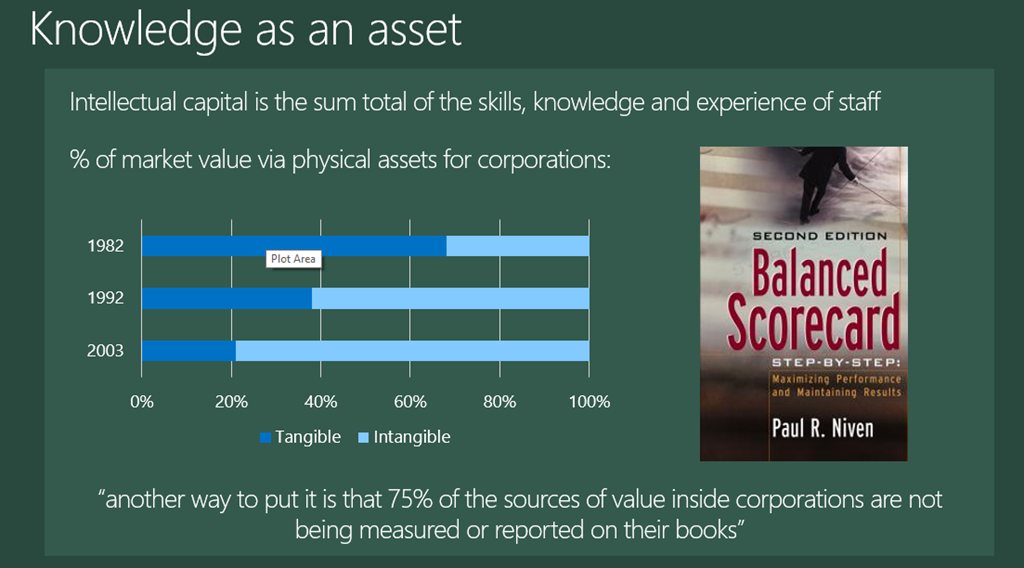
Now consider this. We are in an era where baby boomers are retiring, taking all of their hard-earned knowledge with them. This is often referred to as “the knowledge tsunami”, “the organisational brain drain” and the more nerdy “human capital flight”. The issue of human capital flight is a major risk area for organisations. Not only is the exodus of baby boomers an issue, but there are challenges around recruitment and retention of a younger, technologically savvy and mobile workforce with a different set of values and expectations. One of the most pressing management problems of the coming years is the question of how organisations can transfer the critical expertise and experience of their employees before that knowledge walks out the door.
The failed solutions…
After the knowledge management fad of the late 1990’s, a lot of organisations did come to realise that asking experts to “write it down” only worked in limited situations. As broadband came along, enabling the rise of rich media services like YouTube, a digital storytelling movement arose in the early 2000’s. Digital storytelling is the process by which people share stories and reflections while being captured on video.
Unfortunately though, digital storytelling had its own issues. Users were not prepared to sit through hours of footage of an expert explaining their craft or reflecting on a project. To address this, the material was commonly edited down to create much smaller mini-documentaries lasting a few minutes – often by media production companies, so the background music was always nice and inoffensive. But this approach also commonly failed. One reason for failure was well put by David Snowden when he said “Insight cannot be compressed”. While there was value in the edited videos, much of the rich value within the videos was lost. After all, how can one judge ahead of time what someone else finds insightful. The other problem with this approach was that people tended not to use them. There was little means for users to find out these videos existed, let alone watch them.
Our Aha moment
In 2007, my colleagues and I started using a sensemaking approach called Dialogue Mapping in Perth. Since that time, we have performed dialogue mapping across a wide range of public and private sector organisations in areas such as urban planning, strategic planning, process reengineering, organisational redesign and team alignment. If you have read my blog, you would be familiar with dialogue mapping, but just in case you are not, it looks like this…
Dialogue Mapping has proven to be very popular with clients because of its ability to make knowledge more explicit to participants. This increases the chances of collective breakthroughs in understanding. During one dialogue mapping session a few years back, a soon-to-be retiring, long serving employee relived a project from thirty years prior that he realised was relevant to the problem being discussed. This same employee was spending a considerable amount of time writing procedure manuals to capture his knowledge. No mention of this old project was made in the manuals he spent so much time writing, because there was no context to it when he was writing it down. In fact, if he had not been in the room at the time, the relevance of this obscure project would never have been known to other participants.
My immediate thought at the time when mapping this participant was “There is no way that he has written down what he just said”. My next thought was “Someone ought to give him a beer and film him talking. I can then map the video…”
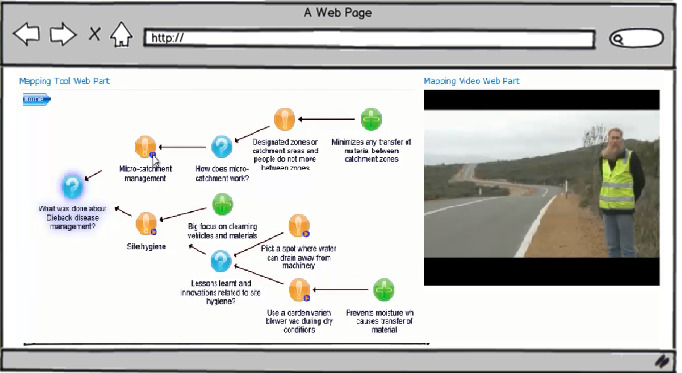
This idea stuck with me and I told this story to my colleagues later that day. We concluded that the value of asking our retiring expert to write his “memoirs” was not making the best use of his limited time. The dialogue mapping session illustrated plainly that much valuable knowledge was not being captured in the manuals. As a result, we seriously started to consider the value of filming this employee discussing his reflections of all of the projects he had worked on as per the digital storytelling approach. However, rather than create ‘mini documentaries’, utilise the entire footage and instead, visually map the rationale using Dialogue Mapping techniques. In this scenario, the map serves as a navigation mechanism and the full video content is retained. By clicking on a particular node in the map, the video is played from the time that particular point was made. We drew a mock-up of the idea, which looked like the picture below.
While thinking the idea would be original and cool to do, we also saw several strategic advantages to this approach…
- It allows the user to quickly find the key points in the conversation that is of value to them, while presenting the entire rationale of the discussion at a glance.
- It significantly reduces the codification burden on the person or group with the knowledge. They are not forced to put their thoughts into writing, which enables more effective use of their time
- The map and video content can be linked to the in-built search and content aggregation features of SharePoint.
- Users can enter a search from their intranet home page and retrieve not only traditional content such as documents, but now will also be able to review stories, reflections and anecdotes from past and present experts.
- The dialogue mapping notation when stored in a database, also lends itself to more advanced forms of queries. Consider the following examples:
- “I would like any ideas from lessons learnt discussions in the Calgary area”
- “What pros or cons have been made about this particular building material?”
- The applicability of the approach is wide.
- Any knowledge related industry could take advantage of it easily because it fits into exiting information systems like SharePoint, rather than creating an additional information silo.
This was the moment the vision for Glyma (pronounced “glimmer”) was born…
Enter Glyma…
Glyma (pronounced ‘glimmer’) is a software platform for ‘thought leaders’, knowledge workers, organisations, and other ‘knowledge economy participants’ to capture and trade their knowledge in a way that reduces effort but preserves rich context. It achieves this by providing a new way for users to visually capture and link their ideas with rich media such as video, documents and web sites. As Glyma is a very visually oriented environment, it’s easier to show Glyma rather than talk to it.
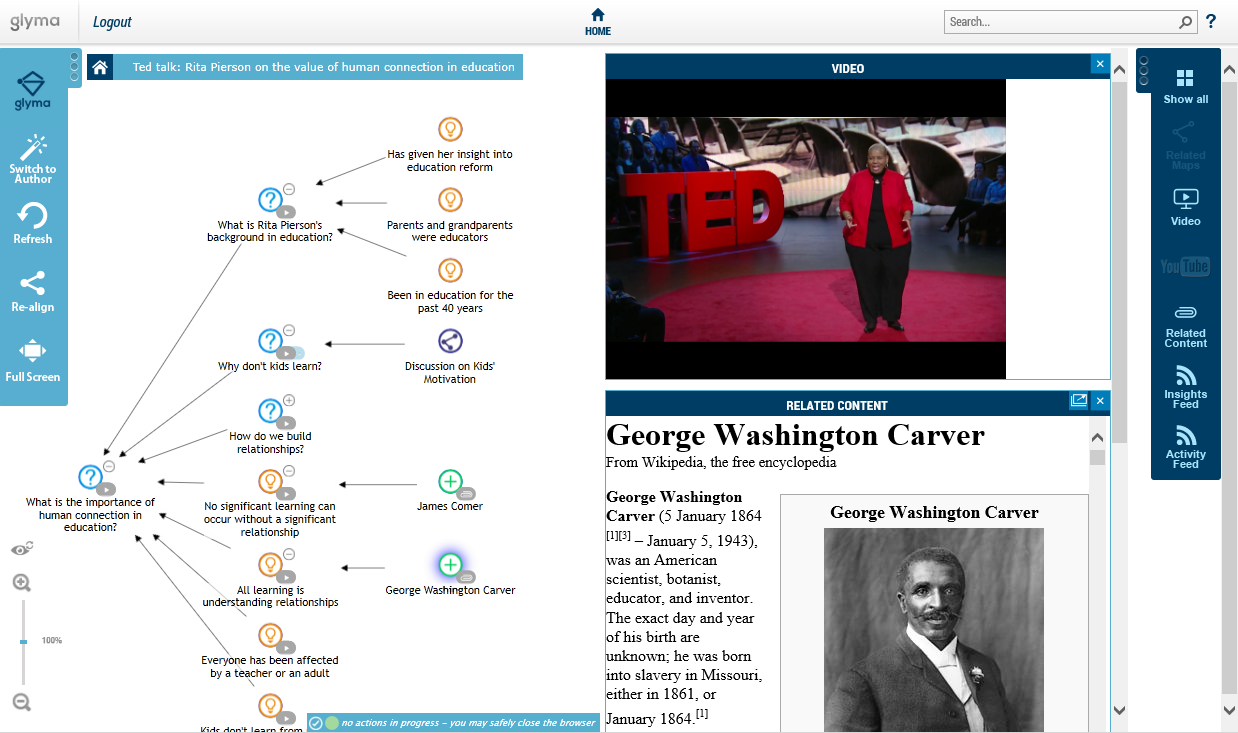
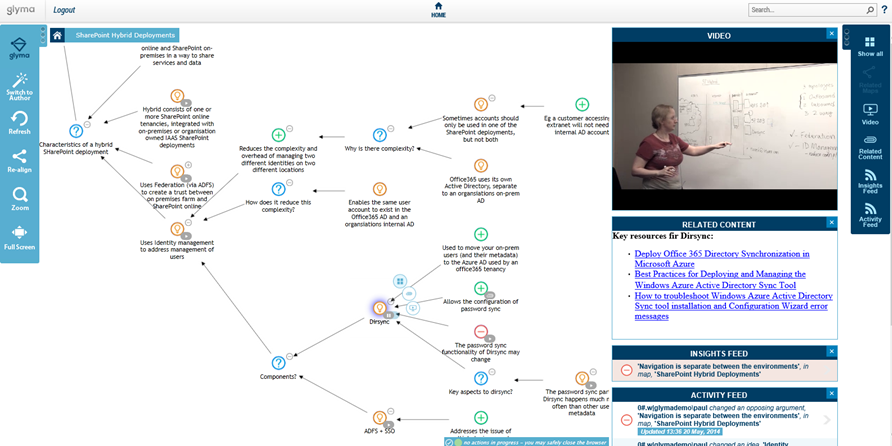
What you’re looking at in the first image above are the concepts and knowledge that were captured from a TED talk on education augmented with additional information from Wikipedia. The second is a map that brings together the rationale from a number of SPC14 Vegas videos on the topic of Hybrid SharePoint deployments.
Glyma brings together different types of media, like geographical maps, video, audio, documents etc. and then “glues” them together by visualising the common concepts they exemplify. The idea is to reduce the burden on the expert for codifying their knowledge, while at the same time improving the opportunity for insight for those who are learning. Glyma is all about understanding context, gaining a deeper understanding of issues, and asking the right questions.
We see that depending on your focus area, Glyma offers multiple benefits.
For individuals…
As knowledge workers our task is to gather and learn information, sift through it all, and connect the dots between the relevant information. We create our knowledge by weaving together all this information. This takes place through reading articles, explaining on napkins, diagramming on whiteboards etc. But no one observes us reading, people throw away napkins, whiteboards are wiped clean for re-use. Our journey is too “disposable”, people only care about the “output” – that is until someone needs to understand our “quilt of information”.
Glyma provides end users with an environment to catalogue this journey. The techniques it incorporates helps knowledge workers with learning and “connecting the dots”, or as we know it synthesising. Not only does it help us with doing these two critical tasks, it then provides a way for us to get recognition for that work.
For teams…
Like the scenario I started this post with, we’ve all been on the giving and receiving end of it. That call to Jeff who has gone on holiday for a month prior to starting his promotion and now you need to know the background to solving an issue that has arisen on your watch. Whether you were the person under pressure at the office thinking, “Jeff has left me nothing of use!”, or you are Jeff trying to enjoy your new promotion thinking, “Why do they keep on calling me!”, it’s an uncomfortable situation for all involved.
Because Glyma provides a medium and techniques that aid and enhance the learning journey, it can then act as the project memory long after the project has completed and the team members have moved onto their next challenge. The context and the lessons it captures can then be searched and used both as a historical look at what has happened and, more importantly, as a tool for improving future projects.
For organisations…
As I said earlier, intangible assets now dominate the balance sheets of many organisations. Where in the past, we might have valued companies based on how many widgets they sold and how much they have in their inventory, nowadays intellectual capital is the key driver of value. Like any asset, organisations need to extract maximum value from intellectual capital and in doing so, avoid repeat mistakes, foster innovation and continue growth. Charles G. Sieloff summed this up well in the name of his paper, “if only HP knew what HP knows”.
As Glyma aids, enhances, and captures an individual’s learning journey, that journey can now be shared with others. With Glyma, learning is no longer a silo, it becomes a shared journey. Not only does it do this for individuals but it extends to group work so that the dynamics of a group’s learning is also captured. Continuous improvement of organisational processes and procedures is then possible with this captured knowledge. With Glyma, your knowledge assets are now tangible.
Lemme see it!
So after reading this post this far, I assume that you would like to take a look. Well as luck would have it, we put out a public Glyma site the other day that contains some of my own personal maps. The maps on the SP2013 apps model and hybrid SP2013 deployments in particular represent my own learning journey, so hopefully should help you if you want a synthesis of all the pros and cons of these issues. Be sure to check the videos on the getting started area of the site, and check the sample maps! 
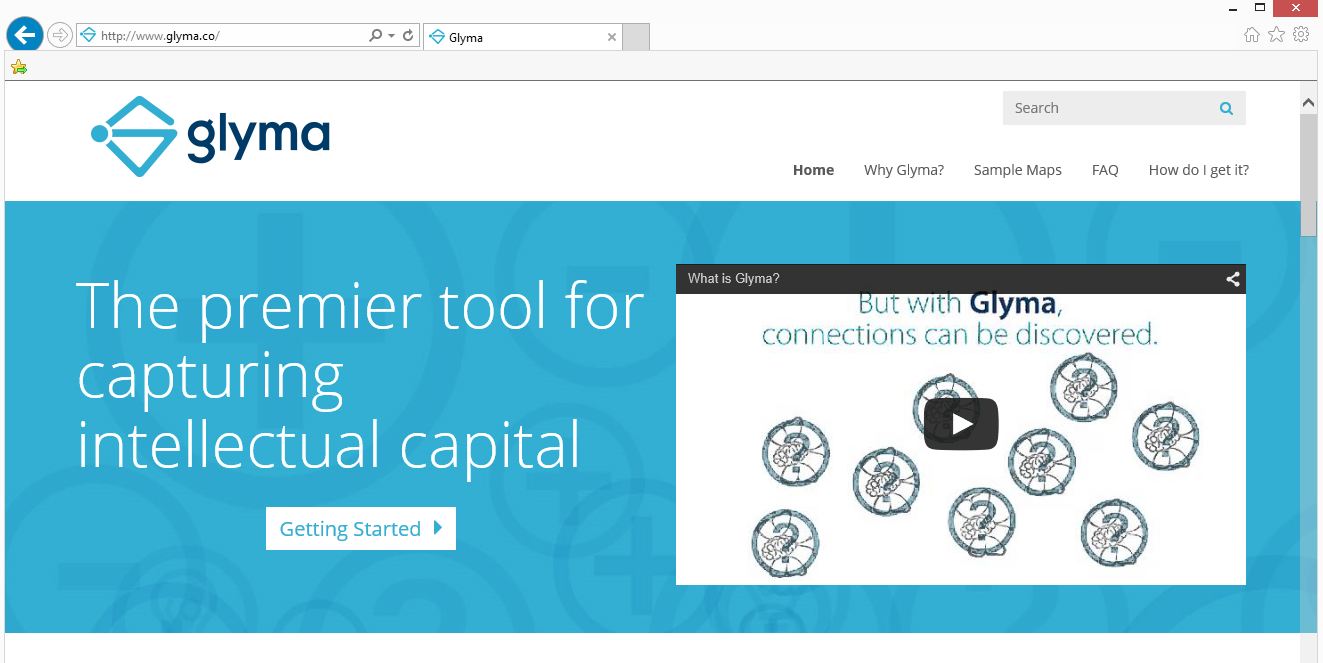
I hope you like what you see. I have a ton of maps to add to this site, and very soon we will be inviting others to curate their own maps. We are also running a closed beta, so if you want to see this in your organisation, go to the site and then register your interest.
All in all, I am super proud of my colleagues at Seven Sigma for being able to deliver on this vision. I hope that this becomes a valuable knowledge resource for the SharePoint community and that you all like it. I look forward to seeing how history judges this… we think Glyma is innovative, but we are biased! 🙂
Thanks for reading…
Paul Culmsee