Back to Cleverworkarounds mainpage
Visit - A Seven Sigma Initiative
 

Sep 27 2009

The practice of Dialogue Mapping – Part 4

Three weeks ago my plasma TV broke, freeing the family from the magic spell of hi-def television. My family took the loss in different ways. My four year old was devastated at the lack of Nintendo Wii, and constantly whined about being bored. My ten year old is a bookworm anyway, and continued to be one. I suddenly found mountains of time to write, churning out three Dialogue Mapping articles that I had been meaning to write for ages.

Today the repair man came and fixed the TV. I expect that the glow of the plasma screen will once again induce that zombie-like state, where my work-rate is dependant on what show happens to be on at the time (NCIS as I write this). Luckily, this is the last article of this particular series on Dialogue Mapping for now and I might have enough active brain cells to hang on long enough to squeeze this article out.

This article builds on the last section of part three that was entitled “Nurture the holding environment”. In that section, I introduced the concept of the “holding environment” and I offered a basic example (the bus trip that was conducted prior to the Dialogue Mapping session). This concept is so fundamental and important to the success of Dialogue Mapping and projects more broadly that I want to do it proper justice here in part four.

The paradox of individuality

Put a bunch of right-brained geeks in a room to solve a problem and you will probably find that they get on relatively well. Put a bunch of creative left-brained marketing people in a room to solve a problem and you might expect the same thing. The solutions offered, when compared to each other, are likely to be quite different and will also likely be sub-optimal. For a truly good solution, we need diversity in perspectives and, although this pains me to say, marketing people are therefore actually needed. This creates a bit of a problem though with the paradox of individuality because, as geeks, we all know the notion of marketing people being needed goes against everything we stand for.

I first read about the paradox of individuality in a book called Team Talk: The Power of Language in Team Dynamics and it was described as follows:

The only way for a group to become a group is for individuals to express their individuality, yet the only way for individuals is to become fully individuated is to accept and develop more fully, their connections to the group.

What? Geeks and marketing people accepting each other as equals? Unifying the laws of physics will come sooner and this is a classic example of what Conklin calls “social complexity”. Of course, social complexity goes much deeper than geeks vs. marketing people, but one of the effects of social complexity is a distinct lack of direct communication between parties. This is because conflict is not fun and avoidance is a natural reaction to situations that are not fun.

The idea of the “holding environment” is best summed up with the image below. Here, you can see that we have an area set aside for kids to play in a safe, controlled environment.

image

A holding environment for an organisation or a team is actually not that dissimilar to the example above. You are attempting to create a state where participants can step out of their comfort zones, but at the same time, are shielded from counter productive tensions that cause paralysis, chaos and pullback.

For this reason I maintain that beer is one of the best holding environments available and it forms a key part of my professional skill set ;-)

As I stated in part 1 of this series, Dialogue Mapping is a very useful holding environment on its own, but it can be augmented with other things as well and you should always be on the lookout for complimentary tools and techniques. In the following sections, I will outline where Dialogue Mapping has augmented another method, or where we have augmented Dialogue Mapping itself with another method.

Information gathering for 40+ people

There are practical limits to how many people should be involved in a standard Dialogue Mapping session. Mind you, there are practical limits for how many people should attend a meeting too and that limit seems to be any more than one person :-) .

By “standard”, I mean the sort of session illustrated below. The exact number that test the limits of Dialogue Mapping varies because it really depends on the wickedness of the problem being discussed and the past history of the group. For example, one of the teams I map for consists of around fifteen to eighteen members. They are working on a particularly wicked problem, yet I can work with this group alone quite easily. This is because over time, the group has worked out their decorum for the Dialogue Mapping sessions that work for all concerned. I also know everybody on a first name basis and some of the group have become personal friends of mine outside of work. In short, people are comfortable with each other and the process, and despite things getting heated people know that it is not personal. This is a simple, yet effective, example of a working holding environment.

image

A while back, my client invited representatives from academia, charities as well as various public sector government departments, to a half day workshop on the topic of social sustainability as part of a significant redevelopment project. There were approximately 40-45 attendees who were there for the first time. There was no way we would be able to cover off the required topics using a standard Dialogue Mapping set-up. With so many people, it would be hard for all attendees to have a say in the allotted time, let alone set up the room to handle that number of people for the process.

The way we got around this issue was to run a pre-workshop session among a much smaller group, to create a series of “seed maps” for each of the sub-areas of social sustainability. By the end of this process, we had around a dozen maps on various subtopics with a few questions, ideas, pros and cons. These maps were not complete at all, but that was not the aim. Instead they were well formed IBIS argumentations.

We then printed each of these maps out at large size. Initially each map was pinned to display boards, and when the attendees arrived they spent time wandering from map to map, examining the argumentation while mingling with other attendees. Below is a photo showing some of the seed maps prior to the attendees arriving.

image

Below is a diagram representing the table arrangement for the workshop. We started with a half hour overview and introduction as to the purpose of the workshop and why they had been invited. At this point, we removed four of the maps from the display boards above, and put a map on each table. We explained to the group that each table had a unique map on it and each map was on a particular topic. At this point attendees had the opportunity to move to a table where the topic was of most relevance or interest to them.

image

Each table contained copious amounts of marker pens. I then took the stage and explained the basics of IBIS grammar to the attendees and explained to them that we wanted them to start adding ideas to the existing maps. I did not belabour the grammar, nor did I expect them to suddenly know how to do IBIS properly, but what I made clear, was that I was going to walk from table to table and interrupt if I felt the additions to the map made no sense or were ambiguous in some way.

The group had just under an hour to work on each map and at the end of the hour, we removed the updated paper maps and replaced them with the next four from the display boards. The process was then repeated and I walked from table to table, asking for clarification or calling out implied questions on parts of the maps that made no sense to me. Interestingly, IBIS novices seemed to have little problems with the usage of ideas, pros and cons, but they would forget to make the underlying question explicit. I would ask them what was the question being answered by a particular idea and would write the question into the map and redraw the lines.

After the third iteration of this process we were done. The last half an hour was a “Where to from here?” session and an opportunity for the group to provide feedback to the organisers of the workshop.

After the workshop was completed, I took all of the updated paper maps and added the additional rationales into the seed maps in Compendium. The process was surprisingly quick because the majority of the additional argumentations that were added were actually pretty good IBIS form. I think that having existing argumentations on the seed maps made it easier for attendees to add rationales that looked similar to what was there already. It wasn’t perfect IBIS by any means, but it was not a difficult task for me to refactor the additional information without losing any of the intent behind the rationales.

For the record, additional workshops were conducted, but these reverted to standard Dialogue Mapping workshops with a subset of the attendees who had specialised skills and knowledge in the topic area. But what this particular process demonstrated was that with a little planning a single Dialogue Mapper could still manage to capture quality rationales from a very large group in a short space of time.

Dialogue Mapping with a facilitator

Dialogue mapping for a large group can be augmented with a facilitator and I have done this a few times. For a large group, this can be very helpful because the mapper can concentrate on capturing the dialogue and less on directing the meeting. Equally though, a facilitator can actually make the process more difficult. The key to a facilitator situation working is when the facilitator either knows IBIS or has been present in a number of Dialogue Mapping workshops and understands how the process works. This is because the facilitator is usually facing the group like the mapper, asking probing questions, directing the course of conversation and therefore is not looking at the map or listening in terms of IBIS translation of the dialogue. As a Dialogue Mapper, it is important for participants to verify what you have captured is correct, and if the facilitators are not following the map, they can easily get in the way of this verification process.

Facilitators can also get you into trouble at times because they can sometimes be conditioned to traditional meeting decorum where topics are allocated at particular times with an agenda that can preclude deeper exploration of a topic. Dialogue Mapping is a rich enough container to allow a group that deeper exploration, but this is not something that some facilitators are used to. One prime example that sticks out in my mind to this day was a workshop where we had a lot of options to explore. Conscious of the agenda, in an attempt to make the process more efficient, the facilitator asked the group whether any of the options had any “fatal flaws” that enabled that option to be quickly discounted. It soon became apparent (in a negative way) that one person’s “fatal flaw” was diametrically opposed to another person’s “fatal flaw”. This attempt to shortcut deliberations backfired badly and resulted in this line of question being completely abandoned.

This is a great example of the importance of nurturing the holding environment (lesson nine from part 3). After this “fatal flaws” episode, I deliberately stopped mapping while the group resolved the fatal flaw issue and resolved to try a different approach. This subsequent approach proved to be much more successful and we never deviated from it after that. “No fatal flaws” became a bit of a mantra among this group.

A key to working with a facilitator is to remember the lesson on confidence and assertiveness from part 3. Just because a facilitator is directing the meeting and influencing the direction of the conversation, it doesn’t mean that the mapper is purely a scribe. Work out a system with the facilitator where, if you raise your hand or signal in some way, you are not ready to move on straight away. Another technique that I have used in a large group situation was to assign someone else the traffic warden role, where if I am having trouble keeping up with the various conversations, and my eyes are on the map, they can call the group to order.

Dialogue Mapping, in tandem with another Dialogue Mapper ,can work very well and I have done many times with my colleagues at Seven Sigma. In this situation, you are both thinking in the IBIS grammar and both of you are mentally unpacking the conversation, although only one of you is actually performing the mapping. We have used this technique with particularly good results in SharePoint requirement gathering workshops, where one of us asks the questions and the other performs the mapping.

Dialogue Mapping and Debategraph

Compendium is one of several tools that can be used to create and render argument grammar like IBIS. For me, Compendium is the absolute best for Dialogue Mapping. Being a desktop application, I do not need internet access and once you are proficient with it, Compendium is very fast. This is of course, the biggest factor for Dialogue Mapping live. You do not want to be hindered by the limitations of the software tool that you are using.

I noticed that some CleverworkArounds readers created IBIS maps in Visio and were also using mind mapping tools after I published the “One best practice” series. But the problem is, although you can technically make an IBIS map, those tools would never work in a live session because of how slow it would be to add rationales to the map. Seriously guys, it might be technically possibly but do not attempt to use those tools live.

One size does not fit all and this is especially true of sense making tools. There are actually two main audiences for maps like this. Those who create the maps and those who consume the maps. The key point is that the ultimate audience for any map is quite often not the group creating the map in the first place. The whole point of capturing rationale is to make visible the process that a group went through when working on a problem, which ultimately shows why a particular decision was made or why a course of action was taken. Those who want to review the rationales are a very different audience to those who made the decision and wish to demonstrate justification. Just because the tool works well for the problem solving process, does not automatically assume that the tool is then best suited to the communication of that rationale to a wider audience.

Compendium maps work brilliantly well during the Dialogue Mapping process and from a broader communication point of view, work exceptionally well when detailed maps are printed onto large sized paper. But as a communication and distribution tool, Compendium is weaker than some of the alternatives. Compendium maps do not translate overly well to the web at this point, and asking all interested parties to install compendium is out of the question. For the sake of article length, I will not go into detail why this is, but to appease the Compendium fanbois, this is direct feedback from my clients and not just my opinionated rant.

For communicating the rationale that has come from Dialogue Mapping sessions to a wider audience, Debategraph is ideal. Unlike Compendium, Debategraph is a cloud based argument visualisation tool, designed to leverage the freeform updating capabilities of a wiki, along with the rigor of an argument grammar much like IBIS. Debategraph does not use a top down or left to right visualisation method. Instead each node is at the centre of the screen and surrounding issues, ideas, pros and cons surround the node, requiring the user to click nodes to explore further argumentation.

The beauty of Debategraph is the combination of its argument navigation, along with the streaming view of related content as shown below. My clients absolutely love the stream view because it is so simple for people to explore and work with. The ability to embed a map at any point in the debate on any web site is also pretty handy and I have pasted a sample map below to illustrate this. Click a node on the left pane (the “*” means there are sub arguments) and the content in the right window will change, based on which argument node is currently being examined.

Compare this to Compendium maps, where additional rich content like images, documents and the like are treated as additional nodes in the map. As you can see in the example below, it is possible to integrate rich content into the map very easily, but that rich content is linked in the same manner as the argumentation itself. Debategraph on the other hard, separates the argumentation from the supporting content and I think that this works much better and supports a richer form of argument based content delivery.

image

But once again, use the best tool that fits the purpose. From a dialogue and rationales collection point of view, Debategraph is an excellent way for a bunch of geographically dispersed people to debate a particular issue because the map will refactor on the fly as people self-contribute to it. But I personally would not use Debategraph for the Dialogue Mapping process, because it is not as fast as compendium and it is not as easy to view the map in full context as shown above. The over-arching point with all of this is that if the rationale has been captured in the first place, there are many ways to make creative use of it.

Note: To be fair on the Compendium makers there are many excellent examples of Compendium being used for some pretty impressive things. I am talking here specifically about online collaboration and communication to a wider audience.

Conclusion

This series of posts has examined the practical aspects of Dialogue Mapping, explored some of the techniques that I have used to augment it. Although I do not intend to write any more articles on this topic right now, the series is by no means complete. This is an ongoing learning process for all practitioners of this craft and I am sure that other Dialogue Mappers have tried different techniques than those that I have covered. (Some interesting things are happening on the SharePoint integration front too, which should enrich this experience even further, but that is a whole separate topic :-) )

But one final request. If you have used techniques such as these to enrich the experience for participants, then I’d love to hear from you. Even if it is not for Dialogue Mapping, any technique that is inclusive and augments the holding environment, please drop me a line or leave a comment.

Thanks for reading

Paul Culmsee

www.sevensigma.com.au

No Tags


Sep 21 2009

The practice of Dialogue Mapping – Part 3

Hi there and welcome to part 3 of my series on the practice of Dialogue Mapping in the real-world. To recap, in part 1, I provided a brief overview of Dialogue Mapping and in part 2, I described a common real world usage scenario that we perform fairly often as SharePoint consultants.

The rest of this series will change tack a little. In this article I am going to describe a very different Dialogue Mapping scenario to you. This was a huge challenge and a large leap from what I described in part 2. There were some wonderful lessons learned from this work which I will cover off here.

The most “wicked” problems are not technical

My first Dialogue Mapping gig where I was not a subject matter expert also happened to be a real baptism of fire. Here was a problem that I had no understanding of, no discipline knowledge and no sense of background history of the project, the dynamics of the group, nor any idea of the positions of stakeholders on the problem.

By this time my IBIS fluency was pretty much down and I felt very confident with the usage of Compendium. I had not yet travelled to the USA yet to train under Jeff Conklin directly, but I carried his book around with me, and had read it many times over. I had performed Dialogue Mapping many times, however until this point all the projects or subjects that I was involved in I knew a lot about. This time I felt very vulnerable. Your domain knowledge is a form of armour, and it was unsettling to know that you’re going in stark naked. I was intimidated, yet excited at the same time.

So imagine this scenario. There was myself, a facilitator, and *fifteen* strangers sitting across from me. This was double the group numbers of the typical IT scenarios I had previously mapped. I remember emailing Jeff for advice when I heard that there would be so many and I recall him saying that 15 was a lot of people for a newbie. What was I in for! :-)

Little did I know at the time that this group had been meeting for quite some time before that, but were really struggling on a complex urban planning issue. When I say complex, I mean complex in a social way, rather than technical. Interestingly, the issue was not a technically complicated issue at all. Anybody could have sat in the room and understood most of the dialogue (not necessarily the full context but you would not be completely blinded by science). What made this particular issue complex was the fact that the group members came from several different organisations, representing some quite diametrically opposing viewpoints. In part 2, I wrote about how it was hard enough just to get one IT department to come to the party and that was just one department of a single organisation – sheesh! If you have complained about organisational silos and think it is hard enough to get some degree of consensus within the realm of one organisation, imagine it when over a dozen representatives from different organisations are involved, organisations that straddle the full spectrum of public and private sectors, as well as the community.

There were simply so many stakeholders and interconnected issues that it was very hard to not get bogged down into tangents, repetition and frustration. Now, imagine eighteen months of this environment and the stressful social complexity impacts.

This is a long-term project that I am still involved with, so I will not be taking you through the specific details of this project just yet. Rest assured though, it has been such a great experience that I will write about it in detail in the future. For now, I will focus on lessons learnt so that others aspiring to perform this craft can learn from my own experiences.

People often tell you the best way to learn is to dive right in, and Dialogue Mapping is no exception. No sooner than I had put up a “what should we do…” type root question, it didn’t take long for debate to get … shall we say … rigorous! So I will go over some of the key lessons that I learnt from this experience thus far.

Lesson One: Confidence and assertiveness

The first thing that I had to contend with was not being in control of the conversation to the same extent as before. As previously stated, with SharePoint workshops I tend to direct the flow of the workshop as a mapper and as a subject matter expert. But this scenario was very different. I didn’t know the topic area at all and therefore some of the terms and acronyms made no sense to me. Also being new and unused to the decorum of the group, I erred on what I thought was politeness, rather than annoy the group by being direct and at times, interrupting them.

This, in my opinion, is a mistake and does a disservice to the other participants. It is also probably the most common thing a newbie mapper will experience when starting out, especially with a new group. As a result, the mapping in this first workshop ebbed and flowed. There were a few times where I was mapping the conversation really well, and the participants really engaged with the argumentation as it unfolded on the screen before them. Participants gestured to the map and asked me to add additional arguments and issues to what had already been built there. I could literally hear some of the initially sceptical, suddenly have that magic moment where they see it working. But at other times, during, say a particularly contentious issue, the conversation would fly at a rapid rate of knots. With so many people in the room, many wanted to have their say on these topics. This led to:

  1. Side conversations started up
  2. Some participants looked away from the map, and started debating directly to each other

As soon as one of these happened, and especially with the latter, I, as the Mapper, had no hope of following the conversation. As you might expect, I would lose focus and the quality of what was captured suffered (hence lots of idea nodes with no connections to anything). The focussing power of the map would be diminished and the wheels would start to fall off.

So remember this above all else. No matter what you do, you must be confident and assertive from the very start to keep the group focussed on the map. Don’t be afraid to interrupt someone to clarify a point, or pause them before they go too fast. If someone else starts to interject, interject back and make it clear that you will get to them as soon as you have finished capturing what someone else has said.

Here is the other critical thing: You must be consistent. It is the first ten to twenty minutes that will set the tone for the rest of the session. This is where people will implicitly learn the decorum of a Dialogue Mapping session and know what to expect. Your actions as a mapper, during this period, is critical to the overall quality of the session. Start it well and it will generally end well.

Jeff Conklin, of course, offers advice for this in his wonderful book on how to dealing with this. But of course, in the heat of dialogue, all of that advice goes straight out the window as you struggle to keep up with the rapid fire dialogue heading your way. Reading about how one should dialogue map is one thing, doing it is another. This is why I call Dialogue Mapping a craft and leads me to my second lesson learned.

Lesson Two: Remember that one guitar lesson you had? (Be realistic)

I think just about everybody at one point has had romantic notions of being a rock guitarist, banging out the blues like Clapton or blistering solos like Kirk Hammett or Brian May. A surprisingly large number of people have actually bought a guitar at some stage in their lives and have tried to live the dream. Most give it up once they find that the gap between their ability to play a G chord and their dream of playing the solo to Hotel California stretches to the moon and back. Inevitably, many guitars ends up collecting dust in the attic, along with the home gym set and many other items that were bought from late night infomercials.

You will hit this with Dialogue Mapping. Remember that wicked problems breed social complexity. Some problems may have some stakeholders with diametrically opposed views and discussion can be quite heated. The romantic notion of your group suddenly solving their wicked problem from your wonderful dialogue mapping has to be viewed with the reality that you still have to learn the G chord and audience can be fickle.

Thus, as far as audiences go, don’t go playing a stadium gig until you feel that you can handle sitting in the corner of a local bar or the school disco. In other words, start small and work your way up. A small, successful meeting will help you develop your style, confidence and then empower you to take on larger groups.

As Ali-G would say, keep it real.

Lesson Three: Stick to your domain of knowledge (at first)

This is a logical extension of lesson two, and also a tricky one because it can be just as much of a worst practice as a best one. This I suspect is probably a lesson on where Jeff Conklin or other dialogue mappers may disagree with me. One of the transitions that you have to make as a mapper is to move from what I would call Issue Mapping to real Dialogue Mapping. Just because you are doing mapping in front of a group, doesn’t actually mean you are necessarily “dialogue” mapping. Dialogue Mapping is often called “Issue Mapping with facilitation”, and when you work within your domain of expertise and you are a mapper as well as participant. Therefore you are not an impartial facilitator. This is the situation I described in part 2 and discovered very quickly, that pure dialogue mapping was much harder and mentally tougher.

But in terms of developing your skills, you will have good results when you are working in an area that you know well. You don’t have to worry about the meaning of acronyms and half of the questions you have likely heard before anyway. Remember though, that in a way it is kind of cheating because you are in effect, using the craft to get people to confront questions that you want answered. But it is an important stepping stone and will help you master lesson 4.

Lesson Four: IBIS grammar in the reptile brain

IBIS is the grammar that you use to map discourse. When mapping rapid-fire contributions from a group of people, they do not want to sit and wait for you to mull over whether their statement was an idea followed by a pro or an inferred question with an idea. If you find yourself having to do this, it is like trying to play a song on guitar and having to consciously think about how to play that G chord. Just think about how much you’d enjoy a Metallica concert if James Hetfield stopped every minute or so on a hard bit of a song and said “Wait, wait.. I’ve done this before… ok, hang on…oops, sorry”. This translation needs to burn itself into your reptile brain so that the process is as automatic as possible. To do this, you need to initially not worry about getting up in front of a group. As Conklin suggests in his book, listen to interviews on the radio or take an article, pull out its main points and create an IBIS map for it. There are a zillion ways to do this.

For all of you SharePoint people, a really excellent, highly relevant way of practice that I use, is to sit in the audience of a presentation at SharePoint Saturday or a conference and issue map the presentation. Below is a sample of some of the sessions where I have done this and the image after that demonstrates how much rationale I captured in the “NZ Web Standards and SharePoint” session.

image   image

Another great way to learn is to send one of your maps to an IBIS practitioner and let them pull it to bits. Even those of us who have done this for a while need that constant reinforcement and feedback. Like any grammar, different things can be written in different ways and one person’s IBIS will not always look like someone else’s. (There is another blog post in the works that will show this in a funny way). At various times I have sent maps to Conklin for constructive feedback (and then ducked for cover! – hehe)

Finally, if you are serious about this and like what you are reading, then do what I did – the 5 week Issue Mapping webinar based workshops that Jeff Conklin runs, or if you are in Australia and want something local, then contact me for a half or full-day in-house Issue Mapping intro workshop. Both will not teach you to dialogue map, but by the end of them you will dream in IBIS :-)

Lesson Five: IBIS translation in the reptile brain

Once the language of IBIS is familiar to you, you can take any argumentation and form a consistent IBIS map. You then have to learn how to listen very carefully because that is half the art. Now you have to take prose and pontification by participants and somehow unpack the points made, articulate them into a summary, and form an IBIS based model in your head, and then commit it to the map.

This can be hard – very hard, and it is nigh on impossible to do without applying what I told you in lesson one. A dialogue mapper is not superhuman and does not have photographic memory. The skill you are developing here is one where you pick out the IBIS elements of some dialogue quickly, as well as knowing when to interject to make sure you do not miss anything.

A great example of this working is when someone has stated something, and although I cannot remember all points, I know that there was a question and three ideas offered. I might pause the conversation before it goes too far and say something like “Ah, that was important and I need to get this right. I heard you say three things there. You questioned the idea of X, and you offered an answer with 3 pros. One was Y, and what were the other two again?”

Conklin explains meeting discourse and question types in his book and the aforementioned workshop in a lot of detail. But once again, to apply it to a real-world situation can only be done by practice (and more practice). The absolute best way to do this is to watch an experienced dialogue mapper perform this and look at how they handle the situation, which brings me onto lesson six.

Lesson Six: Observe

One of the most enjoyable training experiences of my career was to travel to the picturesque town of Annapolis and learn dialogue mapping from Jeff Conklin himself. Up until then, I had been practicing the craft, but after those two days, I returned as a much better practitioner.

The single most important part of the time spent there was when we, the students, dialogue mapped each other as we discussed a real-world issue. We each sat in the hot seat for fifteen minutes or so, trying to map the discussion. We were all being completely evil, deliberately starting side conversations, interrupting and interjecting, playing the role of the dominant type A style participant, jumping all over the place and, overall, just being as difficult as we could.

Unsurprisingly, we all sucked big time trying to dialogue map this. However, when Conklin took the floor, we then saw how exactly Dialogue Mapping was done and what twenty years of practice does. He effortlessly brushed off our attempts to trip him up by observing all of the lessons that I have thus far described, but also with some subtle tricks that we didn’t even notice until he told us afterwards.

After Conklin had wiped the floor with us, so to speak, we all got to have another crack at it, with the benefit of observation and hindsight. This time the difference was significant in our performance and the way that we each handled the “mob”.

Moral? The very best thing you can do is to be involved in a Dialogue Mapping session where it has been done well. Watch carefully what the mapper is doing and how they are conducting themselves and the process.

Lesson Seven: It will make you tired

If you think of all the various things that you have to do simultaneously (for examples listening, understanding, mapping, and managing the group) during Dialogue Mapping, it is amazing that anyone with a Y chromosome can manage it, given that men usually cannot multitask at all. (Case in point: If sport is on the radio and my wife is speaking to me, one of them has to be switched off…Sorry honey :-) ).

When you are first learning this craft and you are going to be up in front of a group, plan for only an hour or so. While you have to think quite consciously about things, it will exhaust you even more. Once things become more automatic, you can go for longer. From my own experience, the limit for Dialogue Mapping a big group on a really wicked topic would be about four hours at the absolute maximum. (Usually by then the participants also need to take a break and sleep on it anyway).

Some sessions can be intense, and you, as a mapper, need to be switched on for that entire time. You are listening carefully to every person speak because you are trying to form it into IBIS. So unlike everybody else who can sit there and look interested, yet be mentally switched off, you have to be interested by definition.

One thing about this is that, while you are in the zone, you don’t need coffee. When mapping, you have enough endorphins racing around your system to keep quite alert, but as soon as there is a break, you can find that you will feel quite tired at times, and a well timed coffee can be very handy (real coffee, of course – none of that instant junk!)

The one thing that compensates for what Dialogue Mapping can take out of you mentally, is that exhilarating experience when the group is really getting into the process and the positive feedback that you receive when a really well formed map has been developed.

Lesson Eight: Learn to love “transclusions” and CTRL+R

I thought that I would drop in a left-field lesson learned at this point that is still very important.

Trans-what? Don’t worry – I don’t know why they called it that either. Ted Nelson, who also coined the term “hypertext”, came up with the name but I think the day “transclusion” sprung to mind, he was having an off-day. I asked Conklin what it meant and he said “It’s technically accurate … an "inclusion" of material *across* (‘trans’) several documents”. When I whined about the geekiness of the name he added “There was a time when the word "hypertext" was a wacko term for geeks, you know”. Damn! He’s got me there.

My explanation that will suffice for now? Transclusions is a fancy way of describing the process of breaking your big map up into smaller, linked up sub-maps. I have also heard it referred to as chunking, and when maps get too big, this is a necessity. (For the hypertext nerds that is somewhat incomplete but suffices for this point).

The compendium software that I choose to use for this work also has a great feature in it. Your map is re-drawn automatically when you hold down the control key and press R. I am now in the habit that after entering a node or three, I redraw the map via this method to keep it all looking orderly. That way, if there has been a lot of dialogue captured, you do not end up with a messy, cluttered map that participants find hard to follow. Like lesson number three and four, stopping conversation while you refactor a messy map will cost you group momentum so ideally if you have gotten into the Control+R habit, all you have to do is a quick transclusion at an opportune time.

The best time to perform a map transclusion is when a thread of discussion has been exhausted and the group has moved onto a new idea or area in the map. A trick I learned from Anapolis was to sit up and say something like “Okay, let’s just pause for a minute.” (Holding up my hand), congratulate the group on the quality of what they have captured and then say something like “Let’s just put this stuff into its own pigeonhole, so we can now focus on X idea”.

Lesson Nine: Nurture the holding environment

Okay, so if there is to be one big serious lesson learned, it is this one. To make the point, I am going to quote Heifetz and Linsky from their excellent book Leadership on the Line. You can read a PDF press release here, specifically the section entitled “Control the temperature.”

Changing the status quo generates tension and produces heat by surfacing hidden conflicts and challenging organizational culture. It’s a deep and natural human impulse to seek order and calm, and organizations and communities can tolerate only so much distress before recoiling.

If you try to stimulate deep change, you have to control the temperature. There are really two tasks involved. The first is to raise the heat enough that people sit up, pay attention, and deal with the real threats and challenges facing them. Without some distress, there is no incentive for them to change anything. The second is to lower the temperature when necessary to reduce a counterproductive level of tension. Any community can only take so much pressure before it becomes either immobilized or spins out of control. The heat must stay within a tolerable range—not so high that people demand it be turned off completely, and not so low that they are lulled into inactivity.

Heifetz and Linsky talk about maintaining the “the productive range of distress” but I have heard many metaphors like this. Another I like is “creative abrasion”, coined by Leonard and Swap in their excellent book When Sparks Fly . Both are essentially talking about making the whole environment conducive to getting the best out of the participants.

The key takeaway is this: Each group is different and each situation is different. In the normal discourse of the meeting, there will be times where the group works together in almost perfect unison and times where one wrong word will destroy that balance and require the group to stop, reset things and move forward. This is not about IBIS either. The fact is that over time, a particular pattern will emerge in the decorum of the sessions, where conducting the sessions or approaching the mapping in a particular way, will work consistently well for the group.

Let me give you a classic example that was absolute genius on the part of my client who did exactly this. Before Dialogue Mapping for a group of concerned residents who were facing the prospect of significant change to the amenity of their homes, a bus was hired and the residents were taken to an area where a similar urban transformation had been made ten years before. We all walked around the area for an hour, soaking in the vibe, learning about the history of the area, how the area was redeveloped and how certain planning challenges were overcome.

This allowed the participants to get a real sense of the issues they needed to confront, and they felt it with all senses, sight, sound and tactile, rather than some cold, rather detached room with a projected map on the wall. Later, when I dialogue mapped the session after the bus tour, the group did a fantastic job and the quality of the rationale that was captured was much richer and faster, through that sensory immersion that took place before the mapping process began.

So just remember, Dialogue Mapping is a great holding environment in the sense that Heifetz and Linsky talk about. It is a wonderful “rich container”, as Conklin puts it, for fostering and maintaining creative abrasion. But as the bus ride example shows, there is a lot of things that you can combine with it to enhance the experience further.

More examples like this will be covered in part 4 of this series.

Thanks for reading

Paul Culmsee

www.sevensigma.com.au

No Tags


Sep 18 2009

Am I a Business Analyst? What about those calling themselves BAs?

Hi

I attended and spoke at the Perth Business Analyst World Conference this week and really enjoyed it. This was a bit of a departure from the SharePoint events that I normally frequent, and I really didn’t know what to expect. Certainly, not having to fly 30+ hours just to speak is a big plus :-) The recommendation to the organisers to consider me, came about via Craig Brown, who has a very popular project management blog that I follow. Thanks so much Craig, I owe you a beer when I am in Melbourne next.

image

The conference report…

My talk was actually *not* about SharePoint and instead I was able to focus on more of my material on wicked problems, the shared understanding/shared commitment principle and then, the sense-making tools and techniques that I use to help bring this about. I was also able to demo the fruits of a very exciting, non IT project that I have been working on for a long time (more on that in a future post).

Despite my “This ain’t my normal crowd” trepidations, the feedback was great and the best thing to hear from participants, was that for many, it was stuff they have never heard before. That, for me, was really satisfying because I like the notion of presenting new ideas that actually have some decent practical examples to back them up. (This is something Andrew Woodward and I have in common. We love academic rigor for what we use, but it has to have been used in the real world with tangible success). Although I know that some people will disagree with the methods that myself and my colleagues use, I was able to demonstrate what I think is some pretty compelling case studies that support them.

What was interesting though, was that the examples and case studies were able to support what a lot of the other presenters had to say as well.

Ann Smith of Black Circle for example, had a great talk that was essentially about human cognition; essentially the wiring in our brains that serve to explain why big, fat documents are often not good ways to convey information. (Being a practicing dialogue mapper, no arguments from me there!) I am a nerd for this sort of stuff, having written previously on behavioural styles, learning styles and organisational culture, and Anne offered some new, interesting things that I have previously not considered or covered – more blog fodder for CleverWorkarounds, methinks.

Another highlight,the Western Power Business Transformation project, presented by Lorraine Pestell was also fascinating (I have a weakness for voice of the customer type sessions and this was no exception). Many of the strategic challenges that they are facing, such as sustainability and the changing business/regulatory environment, is very similar to the work I am doing elsewhere and it was great to see how Lorraine and her team were approaching the challenge and has given me some ideas and approaches to take back with me to my clients and projects.

The BA identity crisis

But back to the question suggested by the title of this post. There were some panel and round-table sessions about the topics of what actually *is* a BA, how you validate or recognise BA excellence, and the perennial BA versus PM turf-war debate.

Up until this time, I had actually never considered myself a BA because I had never actually given it any thought! As a self employed consultant, the only thing that matters is doing a good enough job to keep people wanting you to come back. So to that end, I didn’t worry so much about what I was called, provided that my clients were happy and the invoice was paid. But even if I wasn’t a consultant, I think that role titles often do not reflect reality and they also have a pigeonholing effect, depending on the attitudes and perceptions of what others think that role entails. Many position titles were discussed, “Solutions Architect”, “Business Architect”, “Change Manager” and some that were so pretentious that they bordered on wanky. More fancy words with no more clarity. No wonder many BA’s are struggling a bit for a sense of identity.

What I noticed when talking to the conference participants was that some attendees spoke from a lens where they seemed to feel that it was incumbent on them to provide a “translator” role between IT and “the business”. After all, nerds and CFO’s can’t communicate right? Enter the BA to ask questions and solve problems.

I have no major objection to that notion at some levels, but it is that *precise* mindset that makes me think “Well, I am definitely not a BA.”

Why? It was the notion that this “translation” was based on being the go-between from IT and the business. Thus, taking what one party says, transforming it and then passing it to the other party. As a result, BA’s are acting as a listener and interpreter, yet relaying second hand messages (messages that may be very different originally) between parties.

I personally balk at this. In fact, it really grates on me. By that definition, I don’t think I am a BA at all.

Interestingly, other topics of conversations were around “Well, how does a BA fit into Agile?”, “Is there a place for the BA in an Agile world”, and the like. What was interesting, and somewhat concerning, about these conversations was that those BAs who tended to think of themselves in terms of this “translation” role, really did not have a great grasp on the underlying principles of what we now call “Agile”.

Although Agile means a lot of different things and there are different sub-methods applied, these BAs got all focussed on the processes of Agile. They overlooked the fact that the process is actually the means to an end and it is the end-game that they have overlooked. Agile, (okay well Scrum anyway) attempts to use process and rigour (yes, rigour!) to make a project as conducive to shared understanding as possible. Probably the best thing that Agile does, above all else, is put diverse people in the same room. That alone will make bigger understanding breakthroughs than anything else!

Business Analyst KPI – shared understanding?

So, why am I not a BA?

My methods for translating are fundamentally inclusive. In other words, I do not “translate” anything, “take” it to another party and “relay” through my own words (and lens). I feel that despite all best intentions and whatever diagramming or modelling tool that you use, when you do this, you will always still find that you have your own cognitive biases that will not necessarily deliver the shared understanding that you think you are delivering. Instead, what I do is provide a rich container for a group to explore an issue together. In the same way that Agile tends to like all project members and stakeholders to be in the same room, Dialogue Mapping puts everyone in the same room and provides a suitable container for handling dialogue in a much better manner than traditional meetings and workshops.

If you agree with my previous assertions that a lot of the visible causes of project failure (scope creep, vague requirements, etc) comes from a lack of shared understanding among participants, and that BAs identify themselves as the bridge between IT and “the business” (which by the way is an insultingly gross simplification), then isn’t the ultimate KPI for the BA is to create and maintain that shared understanding? If not, yours is just another opinion that is counted no more or less than anybody else’s. Are you signal or noise?

So, in my humble opinion, the role of the BA is not to be the go-between from disparate stakeholders. Instead, it is your ability to create the sort of conducive holding environment that enables project participants to achieving shared understanding. How you do that is completely up to you of course, and if you have managed to progress a group from an agreed undesirable present state to a desirable future state, then your methods are totally validated.

Get over titles…

Now, if you call yourself a BA and think I am picking on you because you feel that you are the translator, don’t feel bad because plenty of PMs are guilty in their way too. In some ways, I feel that business analysts only exist as a career because enough people with the “Project Manager” title thought that time and budget alone were the only factors in project success. Some PMs who disagreed with this, felt that solving the problem was also critical, gravitated to the discipline of what we now label as “Business Analyst”. Some application developers that felt there was more to life than cutting code and made a similar gravitation. Put a bunch of like-minded people together and soon enough we have a “cool kids” club and lo’ and behold, we have a new discipline with a new set of titles.

(“Information architect” is a more recent example of this phenomenon than “Business Analyst”).

But, let me tell you something else about this title misconception. For a BA to label all PMs as interested only in time and budget is an insult to those PMs who actually understand that achieving and maintaining shared understanding is the end-game. The truly great project managers who I have had the pleasure of working with were actually leaders, not managers. They have all of the same characteristics of what makes a truly good business analyst: Critical thinking, soft-skills and most of all, a great radar for determining when stakeholders are not aligned and doing what is necessary to rectify the situation. They do not always dive into process and structure because their particular body of knowledge told them to. Instead, they have coffees, drink beer, conduct lunch-time workshops with free food and beverages, mediate, essentially whatever is needed to oil the cogs of dialogue that prevents something small becoming something nasty later.

By the way, I have met some angel application developers like this too, as well as infrastructure people.

If you want proof of a truly great project manager, then Kailash Awati’s wonderful site should be mandatory reading for both the BA and PM disciplines (and scrum masters too for that matter!). Kailash writes what essentially is a project management blog, but he has a deeper understanding of the sorts of soft factors that would put many BAs and some facilitators to shame.

Conclusion

In my talk at the conference, I emphasised that the ultimate success factor in any project is bringing about shared commitment through shared understanding among the participants. I believe that achieving these goals is the ultimate KPI for a BA, or anybody else who feels that they are there to help solve a problem, not deliver a crap solution that happens to be on time and on budget.

Thus, any method that helps a group achieve this is a good method because it has made a positive difference in advancing a group from understood present state to an understood desirable future state.

So, perhaps I am, after all, a BA?

Thanks for reading

Paul Culmsee

www.sevensigma.com.au
No Tags


Sep 16 2009

The practice of Dialogue Mapping – Part 2

Hi there.

Welcome to part 2 of a series of articles on the craft of Dialogue Mapping – something that forms a significant chunk of my SharePoint and non SharePoint work. In the “One best practice” series of articles, I explained IBIS. In part 1 of this series, I introduced the facilitation part that goes along with IBIS. In this article, I’ll spend more time on how Dialogue Mapping works in real world scenarios.

In the previous article, I wrote about how important it was for tools and methods like this to be intuitive and inclusive, allowing you to start from any given point. I also wrote about how methods need to be adaptable and grow, accepting and accommodating for the fact that understanding of the problem changes over time. In any project or problem that is novel or new, there is, invariably, a large degree of unknowns and uncertainties among participants. Solutions are not always obvious and we should be careful not to presume that we are doing something wrong if we reinterpret the problem, as a result of learning more or seeing a suggested solution.

New IT projects, by definition, often fall into this bucket and SharePoint is a poster child for this type of project. But in saying that, some of the toughest problems on the planet are not technically complicated at all and SharePoint is actually not the most wicked problem that I have used this craft on. More on that in part 3…

So, the first example of the practice of Dialogue Mapping that I will tell you about is how effective it is in dealing with IT department physics and nerd law.

IT department physics and nerd law…

Before consulting on any IT project, it is important to understand the inner workings of the IT department. For SharePoint this is particularly important because of its amazing ability for exposing the inherent constraints of IT departmental physics in a negative way.

There are certain fundamental principles of how IT departments work that I have classified into several immutable laws. They are:

  1. The web team dislikes the corporate marketing team because marketing always wants the same garish lime-green colours they have for their printed brochures;
  2. The infrastructure team dislikes the web team because they see them as a bunch of cowboys who mess with forces they do not understand and do not have to deal with the consequences of it;
  3. The web team dislikes the infrastructure team because they are a bunch of control freaks who won’t even allow you to fart without filling in a change control form; and
  4. Nobody likes the misunderstood compliance/records management team at all. They unfortunately perpetuate this by droning on continually about whatever compliance standard/s the organisation has to adhere to.

There are some interesting sub-laws that go along with the four immutable laws. For example, you have only one shot to ask the right question to a good infrastructure guy. In other words, the way you word the question will tell them a lot about your technical chops and if you word the question badly, you will be forever banished into the same sin bin where they hold most project managers and sales people. Once sin-binned, it takes an enormous amount of effort to get out. Similarly, when approaching an application developer, always start the question from the presumption that the error you are encountering is *not* in their code, despite you being fairly certain that it is.

Ted Dzubia is a tech writer equivalent of Dr House. A terrific writer with brilliant insight woven between layers of blistering attitude and well placed vulgarity. He cites a classic example of what he calls “nerd law” and it cuts to the heart of the problem that projects like SharePoint face.

The only way to adjudicate Nerd Law is to write about a transgression on your blog and hope that it gets to the front page of Digg. Nerd Law is the result of the pathological introversion software engineers carry around with them, being too afraid of confrontation after that one time in high school when you stood up to a jock and ended up getting your ass kicked.

If you actually talk to people, network, and make agreements, you’ll find that most are reasonable…

Defying the laws of IT physics

One of my earliest uses of Dialogue Mapping was to deal with a classic case of IT department physics and nerd law. A completely new SharePoint project, with no in-house staff having significant expertise in the product, has decided to implement SharePoint for an intranet. To make it interesting, the project is instigated out of the web team. As the immutable laws explain the forces of IT nature, this means that several things happen by default:

  • The infrastructure team will automatically be against it because they don’t want to get saddled with, yet another, enterprise application to support and manage
  • The records management team, having already been scarred from trying to convince an uninterested workforce that the existing records software does not suck, now will assume that SharePoint is going to take over their area.
  • The software development team will assume that SharePoint is here to replace all of their lovingly coded, yet bloaty and insecure line-of-business systems.

At this point, each side starts googling and discovers that the means by which they will address the “obviously” out-of-bounds web team is via this thing called “Governance”. Governance is then mentioned in every second sentence, in a manner to improve their respective positions. This is the nightmare scenario where governance is used as a tool to perpetuate nerd law. This is to be avoided at all costs.

In this project, I introduced the dialogue map from the very first meeting with a simple root question “What are we going to do with SharePoint in Organsiation X”?

Now in this case, SharePoint is my core discipline, so unlike some of my subsequent engagements. I already had a bunch of questions that I wanted the client to start pondering. Being well aware of the destructive forces of the immutable laws of IT, I put down some immediate sub-questions.

  • What are the goals of the project?
  • What are the governance requirements of this project?
  • What are the infrastructure requirements for SharePoint?
  • What should we do about operational support for SharePoint?
  • How will we develop the project?
  • What else do we need to be aware of?

The web team had also developed a project charter which explained, in some detail, the background to this project and how we came to be where we were. I linked this into the issue map. Something that also came up fairly quickly was that the organisation had just completed a large strategic review project and an Information Management Plan had been drafted and approved. This was a key document that pretty much set the direction of the organisation for the next four years.

Below is the map showing these initial questions, along with the project charter and Information Management Plan. Note how I can attach documents into the IBIS map along with the argumentation.

image

Adaptive requirements gathering…

As you can imagine, we started working through these questions. Given that the SharePoint was completely new to the team, I was perfectly happy for the web team to jump around to different areas of the map and fill it in. Fairly quickly, the participants identified that a staged approach would be needed for implementation, and we initially would flick between goals and stages until that began to solidify that the details of the implementation matched the goals.

This map evolved over a period of time where we would spend time on-site with the team, performing training and advisory on SharePoint itself. As understanding of SharePoint’s capabilities grew from the use of a demonstration virtual machine, we refactored and re-examined the map as new knowledge, insights and/or understandings came to light. The team took to dialogue mapping like ducks to water, and the web team leader downloaded and installed compendium so that she always had the latest project rationale on her desktop.

This also had advantages to my colleagues who were also involved in the training and advisory phase. Since each of us were trained in IBIS and dialogue mapping, any one of us was able to conduct a session and the new map would be redistributed to all participants. Thus, even if I did not attend a meeting, I was able to very quickly orient myself around any new questions, issues or ideas.

Planting seeds of buy in…

One area that many web teams are weaker on in their knowledge is in infrastructure. In this case, I had a dual role as dialogue mapper and SharePoint consultant because I know how infrastructure guys think. After all, I used to be one myself. Therefore, I wanted to ensure that a lot of infrastructure considerations were captured and made explicit in the map before we took it to the other teams. I ensured that farm topology options were captured, backup and recovery implications, virtualisation and the like were covered. Additionally, many questions were captured but not answered, such as network topology, active directory configuration, large database management, SLA and the like. A snippet of this is below.

image

One thing that we were all aware of was to ensure that records management considerations were duly covered. By having a SharePoint environment to use and learn from, the team was able to quickly become much more informed about SharePoint’s view of the world, especially in relation to the orientation of metadata, sites and site collections. We confirmed that the goals of the project was an intranet and the sort of document management that would be required would be skewed very much towards team collaboration. The web team was aware that a records management system existed and also some members had some previous experience working with these systems. We ended up creating a very detailed map outlining the strategy for integration with records management, the options for integrating the current records system with SharePoint and most importantly, the golden rules around integration that ensured that the records management system was still the authoritative location for records. Later, Microsoft and the records management vendor visited the site and presented the latest information on the integration for the product and SharePoint, and the salient points were added to the map. Below is a snippet of the map discussing this topic (deliberately obscured for privacy, but you can get a good feel for the breadth of the discussion).

image

The acid test…

Fast forward another couple of weeks, and the team now has a pretty good understanding of SharePoint and a very well factored map. By this time, others in the department had been called in at various times and added their rationale to the map, answering some of the open questions. Next stop was the ultimate test. A meeting was called, where all of the opposing forces were going to be in the one room at the same time. A dozen people in all, key decision makers who didn’t always enjoy a cosy relationship, crammed into a hot, tiny room with a portable projector.

The web team manager introduced the project via the charter, and we all worked our way through the map. We discussed the goals of the project, how they related back to the strategic Information Management Plan, how we were structuring the phases to support those goals, what was in/out of phase 1 and why, and of course, the considerations that we had made in relation to the other IT Teams. After around 90 minutes, we were done and the group proceeded to give feedback.

The records management team was clearly relieved. In producing the map, we had demonstrated a good awareness of records management considerations and we made it clear and explicit in the map that SharePoint was *not* going to replace or devalue what they already had in place. They loved the fact that we had captured rationale that discussed the pros and cons of the various methods and techniques we could use for integration between their tool and SharePoint as they did not know about this. The infrastructure team was also happy for the same reason. We had captured many of the questions that they would have asked themselves of the web team. We had managed to pass our “one shot” test and were not sin-binned for being naive to the nuances of IT infrastructure.

Key success factors and conclusion

All in all, in that one two hour meeting, everybody was on-side and excited about the project. It was fed back to us that achieving such buy-in within one meeting across these different IT departments was previously unheard of in this organisation.

The key success factors boiled down to 3 major factors:

1. The participants in the Dialogue Mapping process were extremely enthusiastic with the process. We did not sell Dialogue Mapping at all with this engagement – we just used it from the very first workshop. By the end of that first workshop, the participants were very impressed with the richness of what had been captured and it became the standard way we conducted workshops and requirements meetings.

2. The visibility and clarity of the rationale meant that any major concerns of the other teams were mitigated by the fact that the questions they were interested in were either addressed or, at the very least, captured and visible on the map. For many parts of the map, the web team made no pretence to know all of the answers. However, by raising those questions in the map, it gave the other teams much more assurance that the web team were not running off and doing their own thing with a lack of consultation.

3. As a mapper, knowing a fair amount about SharePoint meant that fast-tracking of learning was taking place, both at the map level and at the product capability level. Providing the team with a demo virtual machine allowed members to learn about the product, and then applying that learning back to their understanding of the problem in the map space. This was a great way for them to iterate and converge on the solution much more quickly than fumbling around with the product alone. As a SharePoint practitioner, I was able to foresee problem areas and then utilise the rationale in the map to help steer the various participants into determining the optimum solution for their circumstances.

All in all, this was a great example of the power of Dialogue Mapping in speeding up the normally laborious process of stakeholder consultation and developing a shared sense of what was trying to be achieved. The one thing I would say about this method however, was that being a subject matter expert, as well as the dialogue mapper, meant that I was able to exercise a fair degree of control over the flow of the map. This is because I was both a participant as well as the mapper, both capturing as well as answering questions, raising concerns and flagging issues that may have been missed otherwise. For any aspiring dialogue mappers out there, this is actually a good way to start because you can concentrate on creating well formed IBIS, and not have to worry about whether you are articulating a participant’s dialogue correctly. Almost by definition in this case, you know exactly what the participant is talking about and getting the context onto the map in IBIS notation is not a huge mental challenge.

But there is more…

If I concluded this series now, I would be misleading you. The form of Dialogue Mapping that I undertook here was not what I would call pure Dialogue Mapping. In my explanation of the above process, I was a participant, strategist, mentor as well as mapper. My knowledge of the problem space was very detailed and I used Dialogue Mapping as a tool to help steer the group to a position that enabled them to improve their chances of a great outcome.

In part 3, I will detail more about the craft of pure Dialogue Mapping. In this case, you are not in the room because of any particular expertise and you often do not know any of the stakeholders either. Your critical success factor is to produce a great map and thus, make a positive difference for a group in tackling a really wicked problem. As you will soon see, that changes things quite a bit…

Until then, thanks for reading

Paul Culmsee

www.sevensigma.com.au
No Tags


Sep 13 2009

Speaking at BA World conference in Perth

BAW Logo w Globe

Hi all

Just a quick note to let you know that I will be speaking at the Perth leg of the BusinessAnalystWorld conference this week. My topic is called “IBIS: The one best practice for managing wicked problems" and I will be talking about the characteristics of wicked problems and how IBIS and Issue Mapping can help to manage them. I will also cover off some other sense-making tools in this talk like debategraph.

The BA World conference is the only one of its kind in Australia and will cover all sorts of interesting topics such as requirements elicitation, change management, business process modelling, Agile, stakeholder management and BABOK. The theme for the event is “Work Smarter. Plan Harder” and will allow BA leaders to ensure that projects are clearly defined and flawlessly executed, enabling them to make the right decisions at every level in the organisation and increase project success.

I am really looking forward to participating and it will be interesting to see what sort of feedback I get from a non SharePoint audience. As you may have gathered, this is not a SharePoint event and although I will still be talking about SharePoint as a collaborative platform to support working smarter, the main focus is on the power of IBIS and issue Mapping to help elicit real and tacit requirements and fast-track the path to shared understanding.

Thanks for reading

Paul Culmsee

www.sevensigma.com.au

No Tags


Sep 10 2009

The practice of Dialogue Mapping – Part 1

Hiya

For those who do not regularly read CleverworkArounds, I have a bit of a split career-personality where half my working life is spent as a SharePoint practitioner and the other half as a sort of facilitator, based around the craft of dialogue mapping. This series of articles will delve a little deeper into dialogue mapping and how I have used it.

I previously introduced the topic of IBIS and Issue Mapping to a SharePoint audience in the “One best practice” series of posts. That series of posts focussed on the issue mapping side of things because it dissected a debate that had already taken place (Joel’s ‘Just say “no” to site definitions’). While this is an effective demonstration of the way that IBIS can break down a seemingly complex argument into more easily digested chunks, I never really wrote about the craft of dialogue mapping, which is a much more difficult, mentally exhausting, yet ultimately fulfilling practice.

Now I have to tell you, as an IT consultant who has managed to not get *too* messed-up over the last 20 years, I don’t get too intimidated with IT these days. But first time dialogue mapping for a group of stakeholders on a non IT project, where I had no buy in to that project, and my sole purpose was to craft a good issue map to help them work through their complex issue, I was so nervous that I couldn’t sleep the night before.

So first up, let’s clear up the terms I using so that we are all on the same page.

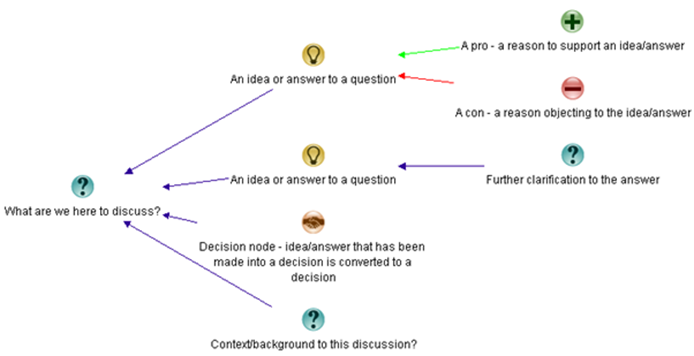
  • IBIS: The grammar that is used to create an issue map. When I talk about issues, ideas, pros and cons, I am describing the elements of IBIS grammar. You can read about this elsewhere on my blog, my mentor, Jeff Conklin or the amazing work by Kailash Awati.
  • Issue mapping: The craft of creating an map based on IBIS notation. Some examples are in this article.
  • Dialogue Mapping: The facilitation process where a facilitator works with a group to create an issue map and translate discussion into Issue Maps.

Why dialogue mapping?

If you have ever uttered the cliché “They don’t know what they want”, then you have your answer. Many problems are rather difficult to define and pin down because, even to define them, requires you to think about possible solutions to the problem. Based on our experience, values (and DNA), we will form our own interpretations of the problem space and then spend considerable time “fumbling around” when working with the rest of the group to clearly articulate our understanding to others, only to find that our understanding is not universal. Disagreements, therefore, are inevitable and are amplified by the sheer number of stakeholders, the fluidity of the problem space and the constraints around the problem, such as a time deadline. This has a way of making life unpleasant and stressful; a situation nobody particularly enjoys.

People deal with this in different ways. For many, the natural reflex to this situation is avoidance – to try and return to the “business-as-usual” or status quo that existed before. True believers may don the boxing gloves and spar for a few rounds with other true believers. Some may become the ninja, invisible and striking silently. Either way, this sort of chaos that represents organisational pain is fairly familiar to most.

Now, there are many methods that you can use to remedy this situation. But for me, there are some key ingredients required for the really effective methods.

  1. The method should not take you too far away from the problem space. So, for example, you are trying to grapple with a difficult organisational problem. You decide to adopt a methodology. Now you are focussing on learning the methodology, obsessing if you are doing it ‘right’ and then still trying to gain a shared understanding of the problem space.
  2. The method should be simple enough that people do not have to be trained just to participate.
  3. The method needs to be inclusive, and all voices (not just the metaphorical boxers) need to be heard
  4. The method should be easy to adapt and grow as understanding of the problem changes over time.
  5. Most importantly of all, the method needs to allow a group to start from what they know now. Half the battle with organisational chaos is the continual “going in circles” pain from feeling that all of the questions need to be answered now and if not, we are doing something wrong.

One of my clients recently summed it up well when he said to me “In dealing with complexity we persist in creating complex methods and wonder why its still complex.” – I found that very profound, but it might have been the beer I was drinking at the time.

Anyway, I digress. Below is an IBIS based issue map discussing Frodo’s dilemma. Note that I didn’t need to tell you how to read the map. it is inherently readable due to the symbolism in the nodes. This is the sort of output to expect from a dialogue mapping session in Middle Earth.

image

So, how would such a map be produced from a meeting or workshop?

Ideally the room would be set up as per the illustration below. This image below is from the Cognexus site, the home of Dialogue Mapping. Note how one person is sitting at a laptop, with a projected map behind them, facing the rest of the group. The rest of the group is interacting with the mapper and map, discussing arguments, asking for additions or modifications and building out a chain of logic around the problem space.

image

The facilitator is the key here. This person knows the IBIS grammar and is taking the group deliberations and translating it to the issue map in real-time. Using software and a projector, as opposed to flip charts, restructuring or refactoring the map live and on the fly is quick and painless. By using the IBIS grammar, the map is inherently readable and very clear, compared to a normal meeting where there is no tool to provide the sort of “holding environment” to allow people to keep collective focus and explore the different perspectives on the problem space.

This notion of the holding environment also is critically important. If you are lucky enough to work in a job you love, with a team you love, for a visionary CEO who you admire and respect, then that CEO has created the ultimate holding environment and you should consider yourself very lucky (and your CEO is worth all that money they earn). For the other 99.9% of us, we have to make do with what we have. The point here is that any tool or method you use needs to augment the understanding process, not complicate it. If it is over-complicated it will not improve understanding and the group will fall back to business-as-usual and participants will likely wind up resenting the method.

Consider dialogue mapping as a holding environment versus traditional meeting decorum. Inevitably, a group will start out with one question, and fairly quickly realise there are underlying or deeper questions that also need to be answered. In a regular meeting governed by a strict agenda and roles (as is recommended by many books and facilitators), problem exploration will be stifled. All too often, changes in understanding of the problem is seen as an unwanted tangent that derails the agenda of the meeting. In other words, the system works against the problem exploration space and that sort of meeting decorum is a poor option for this sort of exploration. Why did we invent such systems to keep meetings on track? Because meetings alone are a crappy container for problem exploration! However with the IBIS grammar and the shared space of the dialogue map, underlying questions can be captured and explored with an organised, evolving point of reference.

The shared space also has a positive effect on the decorum of exploring prickly issues. The group’s attention is now fixed on an evolving map on the wall. A skilled dialogue mapper can utilise IBIS grammar to take a lot of the heat out of argumentation and the process becomes more about building a chain of logic, than cheap point scoring. Typical meeting tactics like pulling rank or personal attacks thinly veiled as “questions” are easily dealt with by the dialogue mapper and never make it to the map in the form intended. The desire to pull back to business is usual is mitigated by the neutrality of the IBIS language and the improved quality of deliberation.

Perhaps the most important benefit of all, is the capture of rationale, or organisational memory. For me, this is precisely where my SharePoint world intersects with this craft because IBIS maps have for me been one of the best artefacts I have seen for the capture of implicit or tacit knowledge. These maps ultimately are an extremely rich exploration of a given problem and demonstrate very effectively, the circumstances and understanding of a problem at that point in time. With issue maps, gone are the days of looking at a process, policy or report years later and wondering “what the hell were they thinking?”.

image

So finally for part 1, let’s sum up by examining dialogue mapping in relation to my earlier criteria for the really effective methods of collaborating on difficult problems.

The method should not take you too far away from the problem space. So, for example, you are trying to grapple with a difficult organisational problem, so you decide to adopt a methodology. Now you are focussing on learning the methodology, obsessing if you are doing it ‘right’ and then still trying to gain a shared understanding of the problem space.

With Dialogue Mapping, only the mapper needs any training. All other participants do not need any previous IBIS or Issue Mapping experience. Participants do not need to wonder if they are doing it right, because just by articulating their opinion on issues, ideas and arguments, they are doing it right.

The method should be simple enough that people do not have to be trained just to participate.

Cut and paste my last answer. Aside from the mapper, all other participants do not need any previous IBIS or Issue Mapping experience. 

The method needs to be inclusive, and all voices (not just the metaphorical boxers) need to be heard

Two things that positively kill meetings is death by repetition and grenade lobbing. Death by repetition is when we tend to find a way to suggest our solution, no matter what question is asked. This behaviour has the opposite effect than intended on other participants. But once an idea is captured, it idea is visible along with all of the other ideas. If the repetition continues, all the dialogue mapper needs to do is ask the person if they have anything more to add to the map for that idea. This is surprisingly effective as the disruptive behaviour becomes very obvious to the serial repeater.

Grenade lobbing happens when someone challenges the whole context of the conversation in some way. When this is a dialogue mapped meeting or workshop, the map comes into its own. The dialogue mapper will capture the challenge as an issue and restructure the map to accommodate this issue. The previous disruptive power of the grenade lob is significantly mitigated and the map now has richer argumentation.

The method should be easy to adapt and grow as understanding of the problem changes over time.

IBIS is founded on the principle that problems and solutions are intertwined closely and that exploration of one will change the other in a cyclical fashion. As discussed, refactoring maps over time is critical to managing a problem that is a moving target. But also being able to save the state of understanding at a given point in time, and then being able to examine the evolution of that understanding and rationale (tacit knowledge) over time is capturing a snapshot of organisational memory. Even better, put that snapshot into SharePoint, classify it with metadata and now your collaborative portal includes findable, organised tacit knowledge!

Most importantly of all, the method needs to allow a group to start from what they know now.

The exploration of what we know now actually can offer a lot of clarity and insights when integrated into a coherent map. Instead of a long, laborious meeting where various people have lost the thread of the conversation, we have a point of reference on the wall. Furthermore, in breaking down the arguments into simple to follow IBIS structure, participants are better equipped to make the sort of connections between chains of logic to better understand the frame of reference of the other participants. The map is an output of this collective effort, which is visible and available for others to explore. Rather than starting out by trying to peel the onion of problems understanding in ever widening scope, we simply start. We put up a question on the map and attempt to answer it.

Conclusion

Hopefully, I have managed to convey a little of what the dialogue mapping experience looks like. In part 2, I will expand upon this topic and discuss my baptism of fire experience with dialogue mapping, the factors that have helped me improve my skills in it, as well as working with the master in action – Jeff Conklin

Thanks for reading

Paul Culmsee

www.sevensigma.com.au

No Tags


Jun 15 2009

SharePoint Governance – Debategraph style

Quick note: This is another of the sort of posts where I cannot help but feel that some readers will wonder what I have been smoking. It is not essential, but reading the “one best practice” series will provide a lot of background to this post.

imageOn the grand scale of world problems, your average messed up SharePoint project would not be considered particularly “wicked”. If you compare a haywire SharePoint project to the truly *global* wicked problems, such as global warming, the Israeli/Palestinian conflict and Tom Cruise, then it kind of makes you realise just how good we SharePoint architects, developers and engineers have it. I mean, hey, if a bunch of nerds can’t make little ol’ SharePoint a success, what hope do we have for the big issues like making Tom Cruise less of a tool?

I know some people who have left SharePoint architecture work because of all the “people crap”. If you think “people crap” is bad in IT, imagine trying to mediate between the myriad of stakeholders involved in, say, cuts to carbon dioxide emissions. That is a world of hurt that is so huge that it pains my brain just to imagine it.

Last year when I was learning the dark Jedi arts of dialogue mapping I got to know David Price, one of my fellow students who operated in that world of hurt. David is a very smart man indeed, with a Ph.D in organisational learning and environmental policy. His career has included public policy consultancy, TV documentary production, academic research and mediation.

It was during that training course that David introduced me to a joint venture that he started with another scarily smart man named Peter Baldwin. Peter is an Australian who had a 15 year career in national politics, including six years as a federal minister in the Australian government. Unlike many Australian pollies, his background was engineering. After leaving politics, with a keen interest in how the web could “raise the quality of debate about public policy issues,” he cranked out visual studio and got down to some coding.

The “baby” from this collaboration between David and Peter is a unique tool called Debategraph and it is a very interesting tool indeed.

image

DebateGraph was conceived as a tool to improve the quality of public debate on contentious or complex issues. Public debate, in general, is usually pretty awful. David and Peter explain why this is the case pretty comprehensively below.

Public debates tend to be complex; with multiple data sources and perspectives and conflicting demands and values. In complex debates, the volume of information and arguments can seem like an overwhelming obstacle to someone, trying to develop a comprehensive understanding of the essential arguments advanced by all sides.

Public debate is all too often characterized by repetitive contributions, digressions, argumentative fallacies, rhetorical flourishes, manipulative framing, obfuscation and personal attacks that result in a high noise-to-signal ratio and confusion rather than clarity.

Conventional media reporting of public policy debates often struggles with the challenge of conveying nuanced, reasoned positions in a compressed linear form, when simple heated oppositions deliver a more dramatic and rewarding effect.

This, in turn, makes it harder for established public figures to think tentatively and creatively in public about new policy approaches and to acknowledge strengths and common ground in opponents’ positions.

We are talking about wicked problems here a lot of the time since public policy debates by definition respond to problems or questions where the general public are stakeholders. This means that there are a lot of varied stakeholders with even more varied world views and frames of reference. By creating a tool to improve the quality of a public policy discussion, DebateGraph is a tool that helps to deal with wicked problems themselves. What is interesting about DebateGraph is that like the IBIS based issue mapping that I practice, it is a visual, map based approach, yet it was developed independently from Conklin, Compendium or anything else in the space.

image

DebateGraph is a free online service. It allows the global community to collaboratively build maps of complex debates that accurately present all sides of the debate from a neutral standpoint, free of repetitive clutter and ‘noise’. Like a wiki, all aspects of the debate maps, both their content and structure, are continuously open to revision, refinement, comment, and evaluation by anyone who wants to join the community of thought. Each map is a cumulative work in progress.

Readers and editors of the maps can explore the top-level structure of debates and delve into specific strands or sub-structures of a debate. What interested me was the fact that the debate maps can be embedded into other websites; with changes made to the map on one site updating immediately across every site on which it appears.

DebateGraph also has RSS and email alerting like SharePoint, as well as a unique rating system where users can specify how much they relate to, or believe in a particular argument. The map then self reconfigures based on what arguments are considered the strongest. In effect, the map becomes a multi-dimensional poll or decision making tool.

“Although consensus can emerge from such a process, not least because it promotes the discovery of previously unidentified options, our hope is as much that the people who continue to disagree will do so on the basis of an enriched understanding of the reasons for their disagreement and having had the chance to test each other’s reasoning to the fullest.”

How DebateGraph works

Using DebateGraph is pretty easy, given that you can embed it into other web sites as I have done here in this post. From the hundreds of maps that I can choose, I’ve decided to embed the map of the global financial crisis for you to explore. Click on the bubbles below and move them around. You will find that like bubble-wrap, you will spend your first few minutes immersing yourself in moving nodes around and navigating here and there. Go ahead and have a play – I’m patient – I’ll wait for you :-)

Right! I’m guessing around seven minutes have passed. Now that you’ve had a play, click on the first arrow, below the map and above the bottom toolbar. This will take you back to the top level financial crisis map. Let’s take a closer look at what is going on here.

Attached to this “Global Financial Crisis” map is several root questions covering the cause, consequences, triggers and response to this problem. If you hover your mouse over any of the nodes, you will find a more detailed view of the question. Hover your mouse over the arrows between nodes, and you will find that the questions “arise from” the central “global financial crisis” node.

Also, note the thickness of the arrows between nodes. The width represents the importance placed on this node by the community of users that have developed this map.

The node colours are important too. Click on the “Long term causes of the financial crisis?” node above, and it will break out to a sub-map. Here the nodes are blue, rather than orange as shown below. The difference in colour is because these nodes are possible responses to the question “Long term causes of the financial crisis?” Once again, the width of the arrows indicate the community’s view of the validity of the responses. Now let’s look at a response that would potentially be divisive. One of the potential answers to the long term causes of the current crisis is “Natural financial dynamics of the baby boom generation.” So, it’s all the baby boomers fault, is it? ;-)

image

Clicking on the “Natural financial dynamics of the baby boom generation” and we see a map with a few different coloured nodes. This is because there are some supporting and opposing arguments to this idea. The green nodes support the idea and the red nodes oppose the idea. This is the essence of the pro and con type arguments used when you create IBIS maps.

image

There are also some other nodes where the direction of the arrow is the opposite to the ones we have examined so far. These are links to other maps, and if you highlight the outward arrows, you can see that our current map relates to nodes in completely separate maps.

This highlights a really important point about DebateGraph. It links related issues into a “web” of argumentation allowing readers to fully explore the myriad of interlocking issues that make up complex problems without “drowning” in information overload.

Contributing to debates

If you feel strongly on a particular subject then you are free to contribute to the debate. All DebateGraph maps have a toolbar that allows you to perform more advanced activities.

image

From left to right, the icons perform the following tasks

  • Open the DebateGraph home page
  • Show detailed text and comments for the currently selected item
  • Add comments to the selected item
  • Open this map in mapper (map edit) view
  • Edit this map in mapper (map edit) view
  • Search all DebateGraph maps for a given term
  • Share this map view or embed it in your own site
  • View the map in full screen mode
  • Key and explanatory notes for maps

SharePoint Governance?

Andrew Woodward suggested that I should create a DebateGraph map for us all to collectively explore how we could save Tom Cruise from complete agonising lameness. I chose not to do this for three reasons.

  1. Tom Cruise cannot be saved
  2. Tom Cruise’s lawyers would sue my ass
  3. There are more important topics to explore

Let’s instead talk about a pet topic of mine: SharePoint governance.

Governance in SharePoint is pretty misunderstood. There are many definitions of governance and they are all equally right, when judged through the lens of the person defining it. I have my own interpretation of governance (which is, of course, the definitive and completely correct one! – hehe). Maybe we should debate the issue?

Joel talks about a SharePoint governance plan needing to be a ‘living’ document and in fact he states this explicitly in the sample governance plan that he did for Microsoft. I agree wholeheartedly on this notion. The reality is that documents like MSWord documents are not overly conducive to this ideal. The paradox is that the bigger and more comprehensive the governance plan is initially, the harder it can be to maintain and manage over time, and therefore, the greater the likelihood that it can go out of date or fall into disrepair over time.

As a result, it occurred to me some time back that a DebateGraph map is the sort of “living” document that a governance plan really aspires to be. So, I roped in a couple of friends, most notably Andrew Jolly and Ruven Gotz, and together we experimented with DebateGraph to explore our own questions and ideas on the topic of SharePoint governance. The result is the map below which you can explore.

Seven Sigma web part for DebateGraph

It then occurred to me that others could benefit from this experimental exploration of the topic of SharePoint governance. This gave me the idea that having a “SharePoint governance web part” that could be added to any enterprise SharePoint portal would be a really great way to augment internal governance efforts. Additionally, one of my clients is responsible for conservation and sustainability at a local level in the community. They loved the DebateGraph debates around environmental, social and economic sustainability and this web part idea would work equally well for them.

Accordingly, my company, Seven Sigma, has just released a free webpart for SharePoint that allows you to embed DebateGraph debate maps into your SharePoint sites and tune their display to fit into enterprise SharePoint portals. The default debate is the SharePoint Governance debate shown above, but you can view any of the many Debategraph maps via the web part properties.

I have recorded a couple of webcasts, covering the installation and usage of the web part which can be viewed below. Otherwise, click here to download this free web part from the Seven Sigma web site.

dginstall  dgusage

Conclusion

This new web part and the SharePoint governance debate, are essentially an experiment in trying to tackle collaboration a novel way. Like any wiki, to make it truly “living”, the maps need contributions from people who have something to offer on the topic. I fully accept that this initiative is not going to be everybody’s cup of tea, but I hope that it might get people to think about the sort of possibilities presented by this sort of wiki based display. The fact that all of the issues, ideas and argumentation can so easily be made available to a wide audience via a simple web part I think is unique.

Thus, if you would like to contribute to this SharePoint governance debate sign up to Debategraph and we will add you to the governance debate.

I think that DebateGraph, and applications like it, may well represent the next step in the evolution of collaborative applications. While Twitter and Facebook have found interesting ways to bring people together, those applications aren’t exactly going to provide you with the sort of ‘container’ required to tackle really wicked problems. I foresee a lot of development in this sub-genre of collaborative applications in the future.

In other words, watch this space!

Thanks for reading

Paul Culmsee

www.sevensigma.com.au

No Tags


Apr 21 2009

Perth SharePoint Users Group wrap

Today I presented a session at the Perth SharePoint Users Group. I was a little unsure whether my non-technically focussed content would be of interest to the geeks but the turnout was terrific and the feedback has been brilliant. (The 3 copies I gave away of Dux’s excellent “SharePoint for Project Management” book may have sweetened the deal – hehe )

My sincere thanks to new user group president Sezai Komur for giving me the opportunity to present this material as it was the first time it has seen the light of day in Perth.

If you want to check out the slide deck from the session, you will find it below. Expanded information that builds on this content can be found at the Seven Sigma site, as well as here at CleverWorkarounds.

Thanks for reading

Paul Culmsee

www.sevensigma.com.au

No Tags


Apr 01 2009

Issue Mapping Webinar Series in April 09

Hi all

There are a few people in my life who have had a big influence on me as a person, consultant and trainer. Jeff Conklin from CogNexus Institute is one of them. If I was to rank Conklin, I’d say he comes in somewhere between Jackie Chan and Freddie Mercury – illustrious company indeed. :-)

Jeff armed me with the right set of skills and way of thinking that allowed me to defeat the likes of “SharePoint vs Skype guy”, a highly skilled foe that I previously wrote about in the “One Best Practice” series of posts. As it happens, Jeff is running another of his Issue Mapping webinar based training series starting April 8 2009. Anyone who is involved in highly complex projects (whether technically or socially challenging), including managers, project leaders, consultants and facilitators should consider attending.

SharePoint people? You are dealing with technical and social challenges almost by definition. Issue Mapping is the most effective craft I have come across to:

  • be able to lead a group to a robust decision that endures and that inspires consistent actions and outcomes despite the cross-currents of hidden and competing agendas
  • get traction in the "swamp" of a project that is cursed with both technical and social complexity
  • have real dialogue without getting bogged down in politics, personalities or an overload of information
  • help a group get its bearings in the fog of confusion, contradictory objectives and changing constraints
  • be able to focus a group’s energy in a way that boosts collective intelligence: the capacity to work with ambiguity and equivocal knowledge
  • be able to capture and organize a large volume of unstructured information to create a coherent foundation for thinking and learning in an organization

Consider my example below: I have summed up the entire global financial crisis in a single issue map – neat eh!

image

Like my above example, you will learn how to create great issue maps – maps that are clear, coherent, and expose the deep structure of an issue. (okay so I am being just a *tad* tongue in cheek with my example)

In all seriousness, it is a great course and well worth attending. If you enjoyed the “one best practice” series or my “wicked problems” sessions, this is your opportunity to learn from the master.

Thanks for reading

Paul Culmsee

www.sevensigma.com.au

No Tags


Mar 20 2009

The one best practice to rule them all – Part 6

BoromirRing

Hi again and welcome to the sixth and final post in this series aimed at enlightening readers to the often overlooked importance of shared understanding of a problem. For those of you who have come across this article for the first time, I suggest very strongly that you stop and read through its predecessors. There is a lot that was covered to get to here.

To recap, we have spent the last two posts delving into the deep structure of problems by using an issue based mapping method. This post will continue in that same vein, but I am going to move a little faster this time and cover more argumentation with a little less explanation. I’ll also finish off with some other interesting aspects to IBIS and dialogue mapping that we haven’t covered so far.

The first 4 posts were all about one of the key root causes of the organisational chaos that causes projects to go haywire, whether it is a SharePoint installation or trying to get the coffee machine fixed. I believe very strongly that if a group of participants can attain and maintain a sufficient level of shared understanding, then often what seemed like a polarising problem with intractable stakeholder positions, can start to make real progress toward resolution. The collective intelligence of a group is a powerful tool to be leveraged, but all too often it can be brought undone by social complexity and the inherent inefficiency of meetings. SharePoint is prone to social complexity because of its technical complexity, malleability and the fact that it is sold by Microsoft and they use that damn six pillar pie chart :-) .

By the way IT people – your projects are rarely actually “wicked problems” in the true sense of the term. Until you have been involved in dialogue mapping a planning or social policy type problem with countless sub-issues and stakeholders, then you do not know just how good you have it! :-)   In saying that, I recognise that many, if not all, IT projects have a lot of wicked elements to them.

Previously on CleverWorkarounds…

In my last post, we had developed an IBIS based issue map that I think is a reasonable reflection of a blog article written by Joel Oleson, incorporating some feedback by readers who disagreed with many of his points. What is great about Joel’s style of writing is that he likes to use headline grabbing titles for his articles. As a result of this, he stimulates rigorous debate and I could probably spend the rest of my days on CleverWorkarounds simply IBIS mapping his posts and all of the responses.

But, we haven’t finished issue mapping this site definitions thing, so let’s finish it off by mapping the rest of the responses. Below is a scaled down view of the map that we had by the end of part 5 (click to enlarge).

image_thumb9

Now, let’s go through some more responses and work them into the issue map. First up was this incredible quote showing much wisdom and maturity. Who uttered such pearls of wisdom? Oh, wait, that was me  :-) !

Joel and I spoke about this earlier in the day actually before this was posted – I hate them also but accept their need in WCM scenarios.
My biased view of the world stems from a site that I visited where branding had been put above all else and so it was an undocumented site definition with custom controls, dodgy web.config hacks all running in full trust to make it all work. 2 days later and I had it migrated. But it was all so *unnecessary* and I think that’s Joel’s point. They get used when they shouldn’t.

The client in this case had never been shown columns, views, versioning and this was a document centric intranet for cryin’ out loud! Instead they get a pretty site with a 50gig content DB because of a hacked site definition with custom nav controls to look pretty, application.master hacks to make it consistent and no thought process into information architecture. They simply took their existing ugly filesystem and whacked it in!

Hmm, when you read my response, all I did was support Joel’s original assertion that site definitions are modified unnecessarily, so in essence I did not really add that much to the conversation and in fact the example that I used was a client who had way more issues than the custom site definition alone. So as it happens, my post really didn’t add anything *new* to the discussion.

Next we have this anonymous response:

In situations where lots of sites need to be created from one pattern and you want old sites to get new changes, site definitions are a must. As mentioned above, you can’t staple features to a template.

I think you’ve swung the pendulum too far with your comment. Yes, big, bulky, all encompassing site definitions aren’t very maintainable. So don’t use them this way! As AC and others have blogged about, create a blank site definition for stapling purposes, and package everything in features. You still need that first site definition though! STP’s are for end users, IMO, not for solution developers.

The quote above makes the important point that “if a lot of sites need to be created from one pattern” and “if you want old sites to get new changes”, then site definitions are pretty much required. I created an pro called “Single click deployment and upgrade” and then fleshed it out with the those ideas. The comment about pendulum is unimportant. Below is the new map

image

Next up Adam Toth makes an excellent, yet subjective counterpoint to the “difficult to upgrade” argument.

Since this is version 1.0 of Features, Solutions, Stapling, Content Types, Workflow, etc., I really believe that any upgrade to the next version is going to be a headache anyway. No matter what you did in sharepoint v1, it broke going to v2. v2 to v3 was also incredibly painful because the product changed so dramatically. We have no visibility into v4, and have no way to figure out what approach will make upgrades least painful. We can assume that things are starting to solidify, but there are no guarantees.

The above response from Adam questions the previous claim that site definitions “are difficult to upgrade and support” by arguing that upgrading will be difficult no matter what. I do not delete the original “difficult to upgrade and support” con, but incorporate Adam’s points as a new question “Really?” against the con, and then support that question with the idea that “Upgrading will be difficult anyway”. Adam supplied 3 arguments supporting his claim (many SharePoint components are V1, the previous versions were all painful upgrades and that we have no visibility into how the next SharePoint will work). Now the map looks like this.

image

Next is David Mann

Custom Site Definitions are a tool. Like any tool, they have benefits and drawbacks. Used properly, they provide much value. Used improperly, they cause pain.
Even the body of the article contradicts the sensationalist-headline by saying that there are some things you can’t do without a custom site def. The article of AC’s that this links to, and it’s comments, talk about a solution that is a totally blank CUSTOM SITE DEFINITION, that is then built up properly with Features/Solutions. They also mention publishing scenarios that the recommended approach is a custom site def.

So, the best approach is to do your homework. If a custom site def REALLY is the best approach, then feel free to use them. Just make it a conscious decision, knowing the trade-offs, not your default reaction because it’s easier.

At this point, it is time to add a new question to this map, as like other respondents, David is referencing Andrew Connell’s post on this subject. David mentions a specific application of site definitions (use a blank one and add to it with stapled features), which is in itself not a pro or con of site definitions, but a way of using them that mitigates many of the disadvantages of them.

Since we are IBIS, and we now have this new idea “Use a blank site definition with features/solutions”, and we need to infer the question behind the idea. My initial guess is “What is the best practice for using Site Definitions” and I have added it to the map as shown below. We could easily use Andrew Connell’s post on this subject to further flesh out the best practice for Site Definitions on this map, but for the sake of article size I have chosen to continue with the original responses to Joel’s post.

image

Chunk it up

At this point, the map is getting large and we need to make it more manageable. Fortunately, this is very easy using tools like Compendium. I simply create a new sub-map and copy the nodes to the sub map. In effect I start to build a hierarchy of the logic behind the argumentation. Below shows the top level argument map at this point, now chunked into sections. Each sub map “Discussion on the use of site definitions” and “Discussion on the use of site templates” is now in its own sub-map that is accessed by clicking on the parent map.

image

The final response that I will cover off for now is from SharePoint Yoda, Eric Shupps who writes a really excellent factual based response to the post.

There are many scenarios in which they are required:
1. Automated Provisioning – Self-contained solutions that have all necessary functionality baked in (think hosting and SAS models).
2. Repeatability – They migrate better from dev to staging to production better than any other method.
3. Maintainability – New Features can be added or removed as required and the solution upgraded. Try doing that with an STP file.
4. One Click Deployment – The user simply selects the proper definition on the site creation page, to which you can add descriptive text and sample images (what do you think all those other options are? They’re OOTB site defs, that’s what).
5. Control – Nothing beats a site def for restricting what features site owners can and cannot use. Very important in many enterprise environments.
6. Ease of use – There are lots of workarounds for the power and flexibility that site defs provide but all require a great deal more code than a simple site def with stapled features.
Sorry to burst your bubble but you’re wrong on this one. Next time, ask a developer with experience doing Site Definitions the proper way before you go off on an opinionated rant. I’d be happy to help!

Some of Eric’s arguments are already in the map, but not all of them. Furthermore, he further expands on some of the arguments that already are there. First up, I changed my original pro of “Single click deployment and upgrade” to “automated provisioning” because I think this captures that argument more succinctly. Even though Eric then lists “1 click deployment” as a separate criteria, I think they belong together and it’s my map! ;-) .

Eric also highlighted “hosted” and ”software as a service” scenarios where automated provisioning is particularly important. Since I already have a nice string of argumentation, asking for criteria of when to use site definitions, I have added these as supporting arguments to this existing set of nodes.

“Repeatability” and “Control” are excellent points, and I have captured Eric’s arguments in this area. To make the idea clearer, I captured “Control” as “Tight administrative controls” as this is less ambiguous in its meaning than “control” alone.

Then Eric hits the one argument that no-one seems to agree on. “Ease of use”. Clearly Eric’s idea of ease of use is different to Joel’s. When you look at Eric’s supporting arguments for ease of use, it appears that he is really reiterating the “automated provisioning” pro for site definitions and supported the “more manual customisations needed” con for site templates.

The adjusted map for the site definitions idea has now morphed into this.

image


Emergent Themes

I am going to stop this IBIS map now because otherwise, I could spend another 5 posts just working through all of the contributions made by various people. But more importantly I want to highlight a few really important points that might get lost in all of the screen-shots.

One of the things that I notice when performing Dialogue Mapping with a group is that the action of utilising a shared display like IBIS allows people to make connections much more quickly and really starts to make clear some of the underlying themes behind the discussion. It is much quicker and more efficient for participants to achieve the necessary breakthroughs when argumentation is visually represented and lots of seemingly abstract concepts can be logically related to each other. It seems to be that as human beings, our brains are particularly well-wired to visual based representation.

I want you to picture yourself in a meeting scenario where we are discussing a problem. It doesn’t have to be a face to face meeting either (although this is usually the case). It can be a group collaborating on a problem using blogs, wikis, discussion forums or any other medium. Without the issue map, there will be a number of problems that will combine to derail the meeting.

First up, there is likely to be a lot of points that have been made. If we were following the meeting in a traditional, linear fashion the argumentation would look something like this:

image

What you are looking at above is in effect, a visual version of traditional meeting minutes. (You know those documents that get sent around that you never read?). This also is not too dissimilar to the structure of a blog post (and the subsequent comments). Contrast this to the issue map that uses an issue based structure that makes the logic and flow of the conversation visible. Which is more meaningful? Which is easier to “read”?

For a start, people do not have to decipher any convoluted dialogue – we do not spend half the meeting disagreeing and then realising that we are actually talking about the same thing. The objectifying of the dialogue reduces those situations where the defences are high because people have inferred some bias that can easily be misconstrued. Different points of view are made much clearer and we do not continually revisit the same old topics over and over again. As the argumentation is further fleshed out, participants are much less likely to get lost or lose track of the conversation. Even if they do, we have a beautiful ‘corporate memory’ system here that is starting to form. Just because one person wants to return to a previous point and ask a question or add an argument to it, doesn’t mean that the next person has to take up this point at his or her turn. They can jump to wherever in the map their current train of thought takes them.

Death by repetition is also mitigated nicely. Death by repetition is those times in a meeting where there is a “true believer” who believes very strongly in a course of action to the point that they will find a way to work their answer into every question asked. Don’t feel too guilty when reading that – we all have done this.  Of course, it annoys the crap out of everybody else present, but the true believer will doggedly persist because they feel that their answer has not been considered enough or given the recognition that it deserves. But once captured on the issue map, the idea is visible and has equal footing to all of the other ideas. If the true believer persists, then the mapper simply asks the true believer if they have anything more to add to what is there already. Usually this only happens once :-) .

There are other phenomena that are guaranteed to derail a meeting, usually leaving all participants emerging from the meeting annoyed that they never got to the actual agenda. Conklin calls this “grenade lobbing” and this is where a participant, usually with the defence drawbridge raised, will challenge the whole frame of the meeting. “That is not the real issue here”, they will explain, “it is this”. (Remember wicked problem rule number 8, every problem is a symptom of another problem). Every time you have emerged from a meeting, feeling deflated and wondering what happened to the agenda, chances are a few grenades were lobbed and the entire purpose for coming together was caught up on a tangent.

But issue mapping makes dealing with this easier too. Usually when a grenade is lobbed, where the frame of the meeting is challenged, it means that the root question of the map is not correct. Fortunately with an issue map, the answer is quite easy. You simply shift the map to the right and work with the grenade lobber to infer the deeper question. Once captured, the group can continue to work with the implications of this new question or continue to work with the rest of the map. The previous disruptive power of the grenade lob is significantly mitigated.

Final Note – Tech geeks vs Developers

I previously said that performing Dialogue Mapping and IBIS allows people to make logical connections much more quickly and really start to clear some of the underlying themes behind the discussion. This “Joel vs developers on site definitions” example that I have been working with was actually not a great IBIS example. The reason is that if we had started the entire conversation using IBIS, then a lot of the subsequent argumentation would have been very different. If say, Joel had used IBIS to structure his arguments to begin with, apart from making my job a lot easier, the map would have underpinned a very different blog post in structure and clarity of argument.

But despite the somewhat artificial nature of my example, from the mapping that we have performed so far it is clear to me that the two distinct viewpoints have emerged. This argument cuts to the heart of the IT Pro vs Developer world. Certainly a strong indication of this was the disagreement behind what is actually “easier”. It seemed that Joel’s easier is very different to the developer view of “easier”. Of course, we haven’t even counted the other stakeholders either and I bet the end-users’ definition of “easier” would be completely different from the two themes that emerged.

I personally come from an IT pro background and IT pro’s have become paranoid types because they are always the ones who have to deal with the after-effects of bad customisations (See the “mother hen reflex” post for how that has come to be). But through mapping this issue out, I was able to make some definite connections with the developer centric replies too. I didn’t necessarily agree with all of the points made, but I now have a much better understanding of their point of view.

At the end of the day, understanding those points of view is going to give you that shared commitment required to see a problem through to an effective a solution.

Well that is it for this series. I hope that you found it of some use and welcome any feedback. Since I am a trained, practicing and designated Dialogue Mapper, expect to see a lot more IBIS on CleverWorkarounds and Seven Sigma over the coming months.


Thanks for reading

Paul Culmsee

www.sevensigma.com.au

No Tags


Next Page »

Today is: Friday 12 March 2010 |