Back to Cleverworkarounds mainpage
 

High school students showing us SharePoint consultants how it’s done

Hi all

Once in a while, you can come across a case study that not only showcases innovative and brilliant solutions, but tells a much deeper story that both inspires and teaches. I am writing this post to tell you such a story – a story about genuine collaboration and what it can enable when the right conditions exist to foster it.

To explain this story, I first need to talk about the work of an academic named Richard Hackman. Here is a guy who spent most of his working life examining the factors that make teams work really well. Over the years he studied hundreds of high performing teams, trying to distil the magical ingredients that would lead to success for other teams. He would come up with theories, then create models that looked great on a whiteboard, but when applied to real teams in the real world, reality never fitted the models.

From causes to conditions…

After years of doing this, Hackman started to wonder whether he was leaning the ladder against the wrong wall. In other words, he wondered if trying to determine the causes of team efficacy by looking at successful teams retrospectively was the wrong approach. In the end, he changed his focus and asked himself a different question. What are the enabling conditions that need to exist that give rise to great teams?

He came up with six conditions arguing that irrespective of what else you did or what methodology you used, usually led to better results. I will give you a super brief summary below:

  1. A real team: Interdependence among members, clear boundaries distinguishing members from non-members and moderate stability of membership over time
  2. A compelling purpose: A purpose that is clear, challenging, and consequential. It energizes team members  and fully engages their talents
  3. Right people: People who had task expertise, self organised and skill in working collaboratively with others
  4. Clear norms of conduct: Team understands clearly what behaviours are, and are not, acceptable
  5. A supportive organisational context: The team has the resources it needs and the reward system provides recognition and positive consequences for excellent team performance
  6. Appropriate coaching: The right sort of coaching for the team was provided at the right time

Now my interest in Hackman and his conditions stemmed from reviewing the published “models” for SharePoint governance. Whether it is the 7 “pillars”, the 5 “steps”, or the 6 “focus areas”, all are developed in a retrospective way – by looking at a mythically perfect SharePoint solution and then breaking it down into all the things that need to be done to enable it. You see, for a long time now, I have deliberately not started with one of the models up front and Hackman offered me a reason why. Instead I first strive to create the conditions that Hackman lists above and develop governance as it is needed, rather than follow a fixed model.

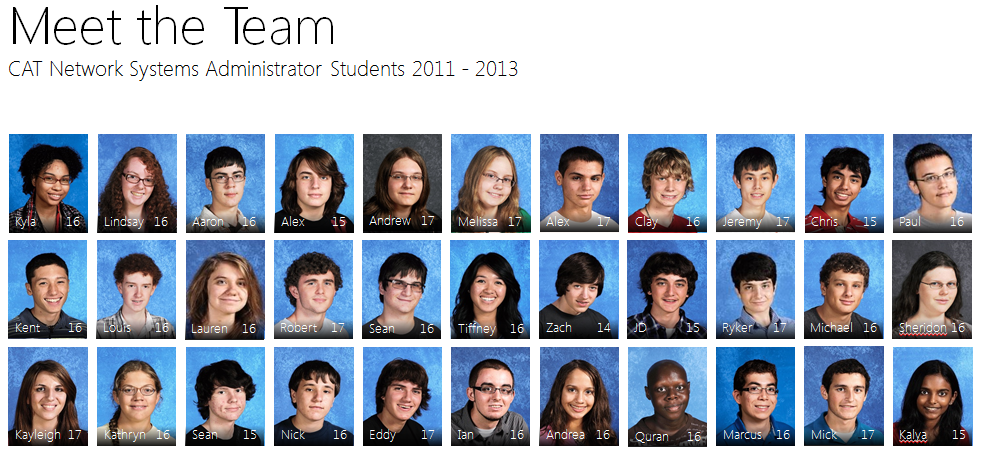
Meet Louis Zulli Jr and his students

Earlier this year, I met Louis Zulli Jnr – a teacher out of Florida who is part of a program called the Centre of Advanced Technologies. We were co-keynoting at a conference and he came on after I had droned on about common SharePoint governance mistakes. Louis then gave a talk that blew me away, and at the same time proved Hackman completely right. The majority of Lou’s presentation showcased a whole bunch of SharePoint powered solutions that his students had written. The solutions themselves were very impressive, as this was not just regular old SharePoint customisation in terms of a pretty looking site with a few clever web parts. Instead, we were treated to examples like:

  • IOS, Android and Windows Phone  apps that leveraged SharePoint to display teacher’s assignments, school events and class times;
  • Silverlight based application providing a virtual tour of the campus;
  • Integration of SharePoint with Moodle;
  • An Academic Planner web application allowing students to plan their classes, submit a schedule, have them reviewed, track of the credits of the classes selected and whether a student’s selections meet graduation requirements;
  • An innovative campus Hall Pass system that leveraged jQuery, HTML5, CSS3, XML, JSON, REST, List Data Web Services and features integration with IOS, Windows 8 and swipe card hardware.

All of this and more was developed by 16 to 18 year olds and all at a level of quality that I know most SharePoint consultancies would be jealous of. To any of Lou’s students who read this – and I have consulted and delivered SharePoint since 2006, as well as speaking to people around the world on SharePoint – the work quality that I saw is world-class and you all have lucrative careers ahead of you in the SharePoint space and beyond.
image

So the demos themselves were impressive enough, but that is actually not what impressed me the most. In fact, what had me hooked was not on the slide deck. It was the anecdotes that Lou told about the dedication of his students to the task and how they went about getting things done. He spoke of students working during their various school breaks to get projects completed and how they leveraged each other’s various skills and other strengths. Lou’s final slide summed his talk up brilliantly, and really spoke to Hackman’s six conditions. The slide made the following points:

  • Students want to make a difference! Give them the right project and they do incredible things.
  • Make the project meaningful. Let it serve a purpose for the campus community.
  • Learn to listen. If your students have a better way, do it. If they have an idea, let them explore it.
  • Invest in success early. Make sure you have the infrastructure to guarantee uptime and have a development farm.
  • Every situation is different but there is no harm in failure. “I have not failed. I’ve found 10,000 ways that won’t work” – Thomas A. Edison

If you look at the above 5 points and think about Hackman’s conditions of compelling direction, supportive context, real team and coaching in particular, you can see that Lou ensured those conditions were present. The results of course spoke for themselves.

About halfway through Lou’s talk, I decided that whether he liked it or not, he was coming out to Australia to tell this story. So we sat down together and talked for a long while and I asked him all sorts of questions about his students, the projects, how he coached his students and how his own teaching style developed. I ended up showing him Hackman’s six conditions for great teams performance and he said “that’s what we do”.

The real lesson…

So as I write this, Lou is on his long journey home after similarly blowing away the attendees of the Australian SharePoint conference with his story about what he and his students have done. His talk was the hit of the conference and I hope that the staff and students of Lakewood High School read this post because it’s important for them to know that their story and examples were the topic of much conversation amongst attendees and highly inspiring. I also hope that people in the SharePoint community read this because CAT shows precisely why SharePoint can be such an amazing enabler within organisations when the right conditions are in place for it. Governance models are great and all, but without these enabling conditions in place, cannot deliver great outcomes on their own.

This leads me onto one final cautionary point – directed at Lou’s students, but applicable to all readers who aspire to improve collaboration in their organisations and their projects.

There are plenty of clever people in this world – in fact most IT people from my experience are intellectually very clever (IQ), but some have all the emotional maturity (EQ) of a baseball bat. IQ is what you are born with, but EQ is caught and lived. What makes great SharePoint practitioners (and in fact great leaders) is EQ, not just IQ and the CAT program shows what happens when clever people are given discretionary freedom with supportive conditions in place. My advice is to never forget that it is the conditions in which a team or organisation finds itself that a strong predictor of outcome. Take the same clever people and change the conditions (for example, from a supportive educational institution to an organisation with a blame culture and silo based fiefdoms) and you will get very different outcomes indeed.

What students may not realise is that what the CAT program is really teaching them is the experience of living those enabling conditions and therefore teaching them EQ. These students will eventually move into organisations that do not necessarily have the same enabling conditions as what exists for them now. So look past the cool API’s, the development tools, technical whitepapers, the certifications, endless debates as to whether X vs Y is the best practice, and understand the conditions like Hackman did. Strive to (re)create those conditions in all your future work and you will go further than a SharePoint laden CV ever will.

This of course, took me around 18 years of working in IT before I figured it out and have been making amends ever since. So whatever you do, wise up earlier than I did!


Thanks for reading

Paul Culmsee
www.cleverworkarounds.com

www.hereticsguidebooks.com

HGBP_Cover-236x300


Introduction to Dialogue Mapping class in Melbourne June 13-14

Hi all

We have all felt the pain of a meeting or workshop where no-one is engaged, the conversation is being dominated by the loudest or everyone is mired in a tangle of complexity and there is no sense of progress. Not only is it incredibly frustrating for participants, but it is really inefficient in terms of time and effort, reduced collaboration and can lead to really poor project outcomes.

The big idea behind the technique of Dialogue Mapping is to address this problem. Dialogue Mapping is an approach where a project manager or business analyst acts as a facilitator while visually mapping the conversation of a group onto a projected display. This approach reduces repetition by acknowledging contributions, unpacks implicit assumptions and leads to much better alignment and understanding among a group.

For SharePoint projects, this is a must and I have been using the technique for years now. Other SharePoint luminaries like Michal Pisarek, Ruven Gotz and Andrew Woodward also use the approach, and Ruven even dedicated a chapter to Dialogue Mapping in his brilliant Information Architecture book.

In Melbourne, I am going to be running a 2 day Introduction to Dialogue Mapping class to teach this technique. There are only 10 places available and this is one of the few public classes I will be running this year. So if you are attending the Australian SharePoint conference, or live near Melbourne and deal with collaborative problem solving, stakeholder engagement or business analysis, this is a great opportunity to come and learn this excellent problem solving technique.

Hope to see you there!

Paul


An Organisational Psychologist is keynoting a SharePoint conference? What the…

Collaborate

Yup you heard right. I am particularly excited for the Melbourne SharePoint conference in June because I get to unleash “Dr Neil” onto the SharePoint world. Neil (who’s full name is Neil Preston) is an Organisational Psychologist who I have been working with for several years now in all sorts of novel and innovative projects. He’s not a SharePoint guy at  all – but that doesn’t matter for reasons that will soon become clear…

I spent January 2013 on holiday in New Zealand and caught up with Debbie Ireland in her home town of Tauranga. We talked about the state of SharePoint conferences around the world and mused about what we could do to raise the bar, particularly with the Melbourne SharePoint conference in June 2013. Both of us felt that over the last few years, the key SharePoint message of “It’s all about business outcomes” was now:

  1. well understood by the SharePoint community; and
  2. getting a little stale

So the challenge for Debbie and I – and for that matter, all of us in the SharePoint community – is how to go beyond the paradigm of “It’s not about SharePoint, it’s about the business”, and ask ourselves the new questions that might lead to new SharePoint powered innovations.

The theme that emerged from our conversation was collaboration. After all, one of the most common justifications for making an investment in SharePoint is improved collaboration within organisations. Of course, collaboration, like SharePoint itself, means different things to different people and is conflated in many different ways. So we thought that it is about time that we unpacked this phenomena of collaboration that everyone seeks but can’t define. This led to a conversation about what a SharePoint conference would look like if it had the theme of collaboration at its core. Who would ideal to speak at it and what should the topics be?

As Debbie and I started to think more about this theme, I realised that there was one person who absolutely had to speak at this event. Dr Neil Preston. Neil is a world expert on collaboration, and his many insights that have had a huge influence on me personally and shaped my approach to SharePoint delivery. If you like what you read on this blog, or in my book, then chances are that those ideas came from conversations with Neil.

Debbie then suggested that we get Neil to keynote the conference to which he graciously accepted. So I am absolutely stoked that attendees of the Melbourne SharePoint conference will have the opportunity to learn from Neil. I can guarantee you that no SharePoint conference in the world has ever had a keynote speaker with his particular set of skills. Thus, I urge anyone with more than a passing interest in developing a more collaborative culture in their organisations should come to the conference to learn from him.

Then, in one of those serendipitous moments, a few weeks later I was in the US and met an amazing schoolteacher named Louis Zulli Jnr who presented a case study on how he enabled 16-19 year old students to develop SharePoint solutions that would be the envy of many consultancies. As I listened to him speak, I realised that he was the living embodiment of the collaborative maturity stuff that Neil Preston preaches and I asked Debbie about bringing him to Melbourne to speak as well.

So there you have it. On June 11, you get to hear from one of the most brilliant people I have ever met who’s understanding of collaboration and collaborative maturity is second to none. You also get to hear an inspiring case study of what how the incredible potential of enthusiastic and engaged students can enable SharePoint to do amazing things.

That is not all either – we have Craig Brown (of betterprojects.net and LAST conference fame) introducing Innovation Games and we also have John Denegate from collaborative governance specialists Twyfords, speaking on the curse of the expert.

So don’t miss this event – I think it will be amazing. In the next blog post I will write about the 2 day post-conference workshops


Thanks for reading

Paul Culmsee
SPC MEL 2013 Im speaking        SPC MEL 2013 connect with us


Powerful questions part 2: The key focus area question

Hiya

I just recorded the second video on the topic of powerful questions. These powerful questions are the result of the years I’ve spent dialogue mapping many different groups of people on many different problems. As time has gone on, I’ve learnt a lot about collaborative problem solving, and concluded that some questions tend to lead to breakthrough more than others.

In the previous video, I introduced you to the platitude buster question. This time around, I have recorded a video on one of the best questions you can ask in any form of strategy development meeting – the key focus area question. For all you SharePoint types, I always use this question during SharePoint governance planning and when drawing up a project charter, but it is equally effective when working with an executive team who are working out their short and long term strategies.

Like the previous post, I suggest you watch this video in full screen. Enjoy!

How to eke out key focus areas from a discussion

Thanks for reading

Paul Culmsee
HGBP_Cover-236x300


Confession of a (post) SharePoint architect… “Thou shalt NOT”

Hi all

*sigh*

This post comes to you during my reality check of returning to work after the bliss of 1 month of vacation in New Zealand. After walking on a glacier, racing around in jetboats and relaxing in volcanic hot springs, the thought of writing SharePoint blog posts isn’t exactly filling me with excitement right now. But nevertheless I am soldiering on, because as Ruven Gotz frequently tells his conference attendees – I do it because I love you all.

Now this is article ten (blimey!) in a series of posts about my insights of being a cross between a SharePoint architect and facilitator/sensemaker. In case this is your first time reading this series, I highly recommend that you go back to the beginning as we have covered a lot of ground to get to here. Inspired by the late, great Russell Ackoff, I used his notion of f-laws – sometimes inconvenient truths about what I think is critical for successful SharePoint delivery. At this point in proceedings, we have covered 6 f-laws across 9 articles.

The next f-law we are going to cover is a bit of a mouthful. Are you ready?

F-Law 7: The degree of governance strictness is inversely proportional to the understanding of the chaos its supposed to prevent

So to explain this f-law, here is a question I often ask clients and conference attendees alike…

What is the opposite of governance?

The answer that most people give to this question is “Chaos”. So what I am implying? Essentially that the stricter you are in terms of managing what you deem to be chaos, the less you actually understand the root causes of chaos in the first place.

Ouch! Really?

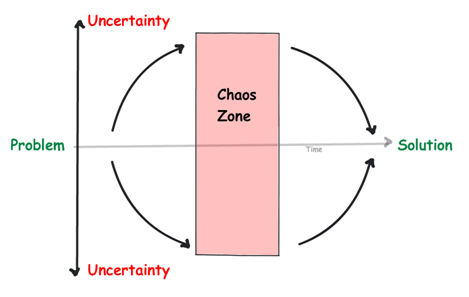
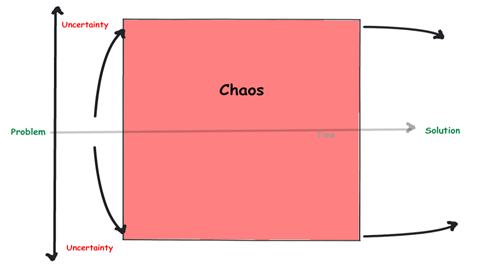
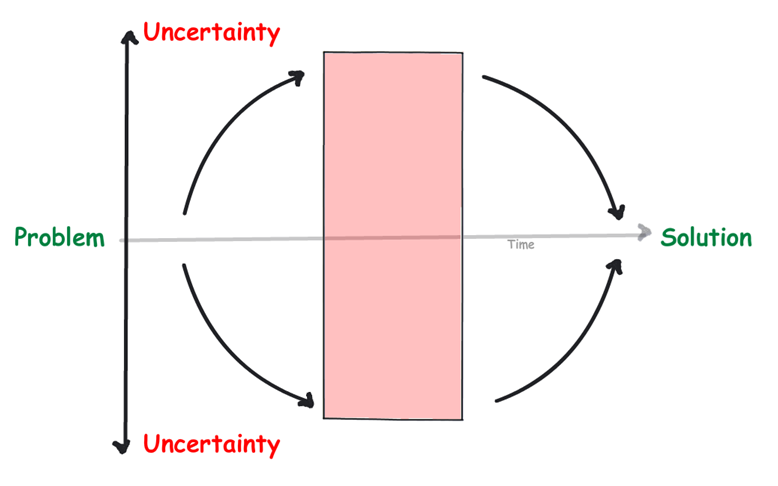
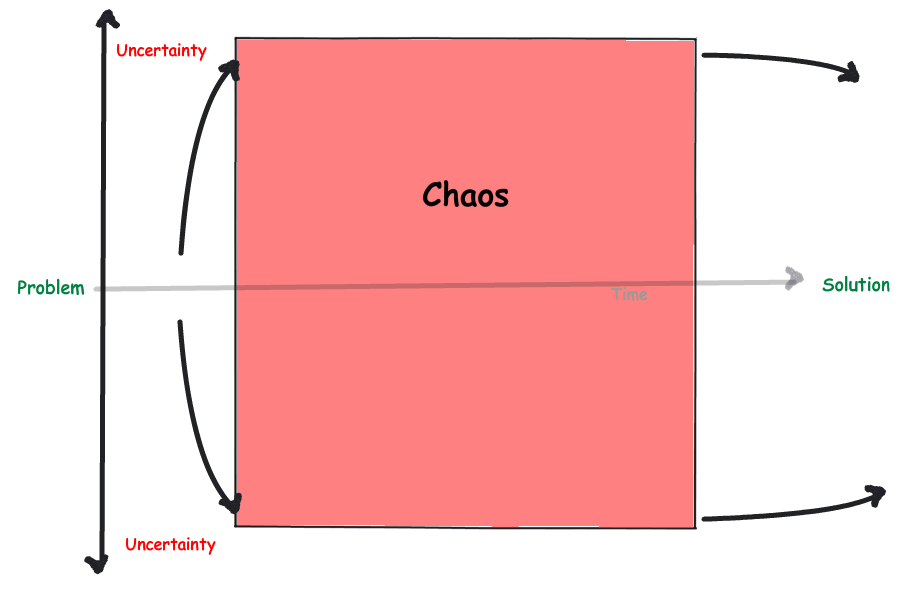
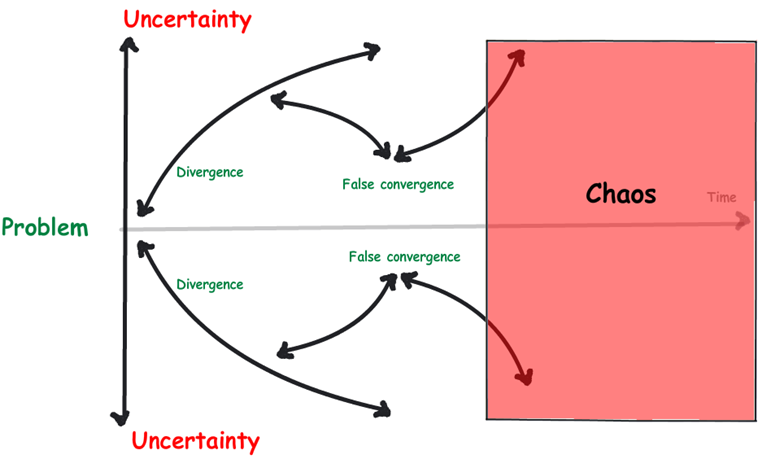
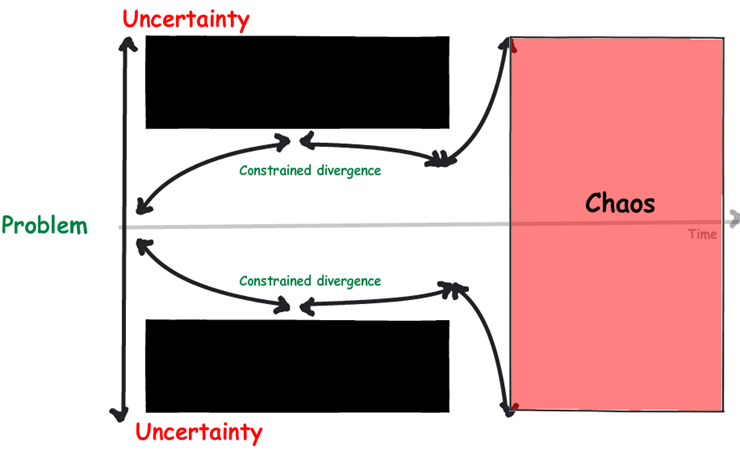
To explain, let’s revisit f-law 5, since this is not the first time the theme of chaos has come up in this series. If you recall f-law 5 stated that confidence is the feeling you have until you understand the problem. In that article, I drew the two diagrams below, both of them representing the divergence and convergence process that comes with most projects. The pink box labelled chaos illustrated that before a group can converge to a lasting solution, they have to cross the ‘peak’ of divergence. This is normally a period of some stress and uncertainty – even on quite straightforward projects. But commonly in SharePoint things can get quite chaotic with lots of divergence and very little convergence as shown by the rightmost diagram where there appears to be little convergence.

image  image

“Thou shalt not…”

There are clearly forces at play here… forces that push against convergence and manifest in things like scope creep, unreconciled stakeholder viewpoints and the stress of seeing the best laid plans messed with. The size and shape of the pink ‘chaos’ box reflects the strength of those underlying forces.

To manage this, many (if not most) SharePoint practitioners take a “thou shalt not” approach to SharePoint delivery in an attempt to head things off before they even happen. After the dissection in f-law 6 of how IT people channel Neo and focus on dial tone issues, it is understandable why this approach is taken. Common examples of this sort of thinking are “Thou shalt not use SharePoint Designer” or “Thou shalt use metadata and not folders” or “Thou shalt use the standard site template no matter what.”

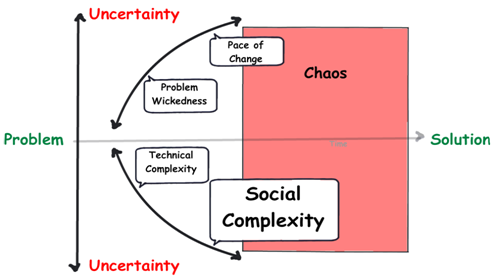
These sort of commandments may be completely appropriate, but these is one really important thing to make sure you consider. If having no governance indeed results in chaos, then it stands to reason that we need to understand the underlying divergent forces behind chaos to mitigate chaos and better govern it. In other words, we need look inside pink box labelled chaos and see what the forces are that push against convergence. So lets modify the diagrams above and take a look inside the pink box.

image

For me, there are four forces that govern the amount of chaos in SharePoint projects, namely:

  1. Pace of Change
  2. Problem Wickedness
  3. Technical Complexity
  4. Social Complexity

Let’s examine each one in turn…

Pace of change

image

Remember the saying “The only certainty in life are death and taxes”? Outside of that, the future is always unpredictable. In between SharePoint 2003 and SharePoint 2007, the wave of web 2.0 and social networking broke, forever changing how we collaborate and work with information online. In between SharePoint 2010 and SharePoint 2013, the wave of cloud computing broke, which is slowly but surely changing the way organisations view their IT assets (both systems and people). The implications of this are huge and Microsoft have to align their product to tap into these opportunities. Net result? We all have a heap of new learning to do.

If you read the last post, you might recall that pace of change was a recurring theme when people answered the question about what is hard with SharePoint. But let’s look beyond SharePoint for a second… change happens in many forms and at many scales. At a project level, it may mean a key team member leaves the organisation suddenly. At an organisational level, there might be a merger or departmental restructure. At a global level, events like the Global Financial Crisis forced organisations to change strategic focus very quickly indeed.

The point is that change breeds innovation yet it is relentless and brings about fatigue. Continual learning and relearning is required and even the best laid plans will inevitably be subject to changing circumstances. The key is not to fight change but accept that it will happen and work with it. In terms of SharePoint, this is best addressed by an iterative delivery model that has a high degree of key stakeholder involvement, recognises the learning nature of SharePoint and fosters meaningful collaboration.

Problem “Wickedness”

image

Some problems are notoriously hard to solve because they evoke a lot of diverse, often conflicting viewpoints and it can be difficult even agreeing on what the core problem actually is. F-law 1 examined how we sometimes fixate on the means of governance when the end goal of SharePoint is uncertain. Over-reliance on definitions is the result. F-law 2 looked at how users understanding of a problem changes over time and f-Law 4 looked at the folly in chasing platitudes. The underlying cause for all of these f-laws is often the very nature of the problem you are trying to solve.

You might have heard me talk about wicked problems or read about it in my blog or my book. In short, some problems are exceptionally tough to solve. Just trying to explain the problem can be hard, and analysis-paralysis is common because it seems that each time the problem is examined, a new facet appears which seemingly changes the whole concept of the problem. This phenomenon was named as a wicked problems by Horst Rittel in 1970. One of the most extreme examples right now of a wicked problem in the USA would be the gun control debate since depending on your values and ideology, you would describe the underlying problem in different ways and therefore, the potential solutions offered are equally varied and contentious.

While there are actually many different management gurus who have also come up with alternate names for this sort of complexity (“mess”, “adaptive problem”, “soft systems”), the term wicked problem has become widely used to describe these types of problems. I suspect this is because Rittel listed a bunch of symptoms that suggest when your problem has elements of wickedness. Here are some of the commonly cited ones:

  1. There is no definitive formulation of a wicked problem (defining wicked problems is itself a wicked problem).
  2. The problem is not understood until after the formulation of a solution.
  3. There is no immediate and no ultimate test of a solution to a wicked problem.
  4. Every solution to a wicked problem is a “one-shot operation”; because there is no opportunity to learn by trial and error, every attempt counts significantly.
  5. Wicked problems do not have an enumerable (or an exhaustively describable) set of potential solutions, nor is there a well-described set of permissible operations that may be incorporated into the plan.
  6. Every wicked problem is essentially unique.
  7. Every wicked problem can be considered to be a symptom of another problem.
  8. The existence of a discrepancy representing a wicked problem can be explained in numerous ways. The choice of explanation determines the nature of the problem’s resolution.
  9. Stakeholders have radically different world views and different frames for understanding the problem.
  10. The constraints that the problem is subject to and the resources needed to solve it change over time.
  11. The problem is never solved definitively

Can you tick off some of those symptoms with SharePoint? I’ll bet you can… I’ll also bet that for other IT projects (say MS Exchange deployments) these symptoms are far less pronounced.

Guess what the implication is of wicked problems. They tend to resist the command-and-control approach of delivery and require meaningful collaboration to get them done. That is kind of funny when you think about it since SharePoint is touted as a collaboration tool yet falls victim to wicked elements. That suggests that there was not enough collaboration to deliver the collaboration platform!

Technical Complexity

image

Technical complexity involves difficulties in fact finding, technical information and the systematic identification and analysis of options and their likely consequences. It is an understatement to say that SharePoint is full of technical complexity. In fact, it is one of the most complex products that Microsoft has ever produced (and that’s before you get to dependencies like SQL Server, IIS, FIM, Federated authentication and the myriad of other things you need to know)

A typical characteristic of technical complexity is information overload in fact finding. There is far too much information to make sense of and as a result, no one person has the cognitive capacity to understand it all. Thus, stakeholders have to rely on each other and, on occasions, rely on outside experts to collaboratively work towards a solution. Technical complexity requires a lot of cognitive load to manage and it is easy to get caught up in the minute detail and lose the all important bigger picture.

Problems also arise when different technical experts come to opposite conclusions. This gives rise to the last and most insidious divergent force underlying SharePoint chaos and the governance that goes with it – social complexity.

Social Complexity

image

The first three symptoms tend to create a perfect storm of complexity, since we have a situation where there is a lot of uncertainty. Many people hate this because unknown unknowns creates fear if sufficient trust does not exist between all key parties. Developing trust is made all the harder because we are all a product of our experiences, with different values, cultural beliefs, personality styles and biases so reconciling different world views on various issues can be difficult. Then you have the issue that many organisations have a blame culture and people position themselves to avoid it. This my friends is social complexity and I know that all of you live this sort of stuff everyday.

Yet under the right circumstances, groups can be remarkably intelligent and are often smarter than the smartest people in group. Groups do not need to be dominated by exceptionally intelligent people in order to be smart – in fact diversity of group makeup is a much more important factor than individual IQ. Without this diversity, groups are less likely to arrive at a good answer to a given problem because they are likely to fall into groupthink. Groupthink is when highly cohesive groups make unsound decisions due to group pressures, ignoring possible alternatives. Every management team that only wants to hear the good news is likely to have fallen foul of groupthink. The same applies to dismissing all SharePoint governance except for the dial tone stuff.

However, there is an inherent paradox here:

  • The more parties involved in a collaboration, the more socially complex;
  • The more different these parties are, the more diverse, the more socially complex; and
  • This creates tension, resentment and lack of communication and a strong desire to go back to business as usual

This paradox between diversity and harmony is the toughest aspect of the four forces to tackle.

Key takeaways…

Way back in the very first post I stated that a key job of a SharePoint architect is to architect the conditions by which SharePoint is delivered. By this I mean that the architect has to grease the gears of collaboration between stakeholders and provide an environment that has the safety and structure for people to raise their issues, speak their truths and not get penalised for improving their understanding of the problem.

To enable this to happen, we need to tackle all four of the forces behind chaos that we have covered here. In short, if you focus governance efforts only on one of the forces you will simply inflame the others. Accordingly, the final diagram illustrates the key takeaway from f-Law 7. Since the four forces behind chaos push out and create divergence, our governance efforts needs to push back. But the important thing to note is the direction of my arrows. It is not necessarily appropriate to provide a direct counterforce via the “thou shalt not” type of all-or-nothing approach. Governance always has to steer towards the solution. The end always drives the means and not the other way around! Arbitrarily imposing such restrictions is often done without due consideration of the end in mind and therefore gets in the way of the steering process. This is why my arrows point inwards, but always push toward the solution on the right.


image

In this context, it can be seen why envisioning, stakeholder and goal alignment is so critical. Without it, its too easy for governance to become a self fulfilling prophecy. So when you look at your own projects, draw my divergence/convergence diagram and estimate how big the pink box is. If you sense that there is divergence, then look at where your gaps are and make sure you create the conditions that help mitigate all of the forces and not just one one of them.

Thanks for reading

Paul Culmsee
www.hereticsguidebooks.com


Confessions of a (post) SharePoint Architect: A pink box called chaos…

Hi all and welcome back to my ever growing series which attempts to codify a lot of learning over a long period of time into something that I hope is readable, rigorous and is useful to anyone tasked with successful SharePoint project delivery. This is the 7th post in a what is turning out to be a large series. It is large for a good reason: SharePoint is complex and the problems it attempts to solve (collaboration) are complex as well. If this is your first article, I super-strongly suggest you take it from the beginning as these articles build on each-other.

My motivation for getting this stuff out there is to tap into the shift I now sense in how organisations approach the SharePoint platform. Through a combination of organisations living through SharePoint project failure, practitioners experiencing SharePoint fatigue syndrome, as well as the strength and congruence of the messages of many wise people in the SharePoint community, organisations now realise that SharePoint is a “different” kind of project.  This realisation represents the first stage of any form of learning where people have moved from unconscious incompetence to conscious incompetence.  These terms sound rather confronting but are common in training-speak…

  • Unconscious incompetence refers to people who do not realise they lack certain skills and therefore don’t realise they need training to address the gap. That explains pretty much every IT centric SharePoint deployment based on the “built it and they will come” delivery model (and we all know how much fun those projects are).
  • Conscious incompetence means that people now see the gap between their knowledge and know they need help. Much of my company’s work is in this area – as is our close friends at Dynamic Owl and 21apps. Aside from our own clients, all of us are often sought out by other Microsoft partners who have learnt the hard way that the classic model of sales guy, project manager, business analyst and developer doesn’t always crack the SharePoint nut.

So newfound realisation among clients and consultants is there and that’s all well and good. Now the issue is to get past the cover story and take it to the next level. We have to go beyond the oft-used hippie clichés like “It’s all about the business, man” and make the art of SharePoint delivery real, pragmatic, rigorous and tangible. This series aims to be my attempt to do just that, complimenting leaders like Andrew Woodward, Ruven Gotz, Michal Pisarek and Sue Hanley. To that end, as I continue writing the series I hope that you:

  • laugh at the various truths behind the various SharePoint governance f-laws;
  • smile knowingly at the folly of some of the elaborate project and governance rituals you have to do now;
  • have your own biases challenged as you either cringe in embarrassment or think “he has gone too far with *that* comment”; and
  • have enough solid ammo to get through to influence other key stakeholders in your organisation

Allrighty then! Let’s get down to business. Our f-law for today’s article comes from Woody Allen. I have never actually watched one of his movies, but I have to give him credit for this pearl of wisdom…

F-Law 5: Confidence is the feeling you have until you understand the problem

Most projects start with a honeymoon phase. A newly formed team gets to deliver some new technology that is high profile and bolster their CV’s while “taking the business to the next level” (platitude black belts take note!) Morale is high and the team feel the sort of excitement one feels when going on a first date. Like a bad first date however, it doesn’t take long for the slow but relentless imposition of reality to take hold. Accordingly, as understanding of the problem grows, uncertainty grows commensurately. This in turn tests the initial project assumptions which an optimistic budget was likely pinned to. Most people can’t handle this sort of uncertainty because it confers risk of blame – something we all seek to avoid if we can. Thus on a complex project where the problem has elements of wickedness, blame avoidance results in things becoming quite dysfunctional and often project teams lose confidence that they can solve the problem.

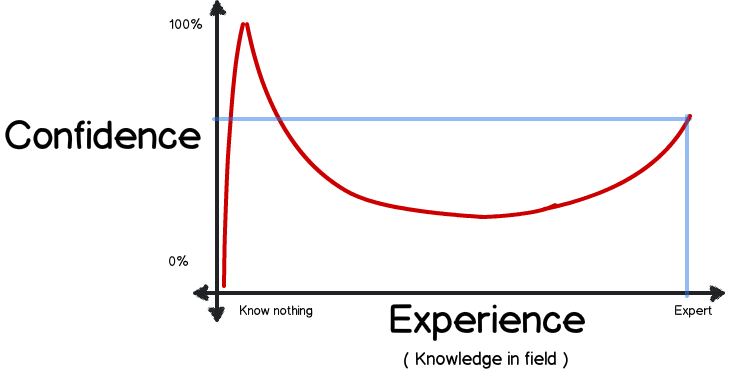
There is an underlying phenomenon at work here that seems to be part of the human condition. Check out these two diagrams below as both of them show the same pattern. The left image is by Gartner and is their famous hype cycle that they pin technology fads to. The other won a Nobel prize for the originators and refers to a phenomenon called the Dunning-Kruger effect.

Gartner_Hype_Cycle_svg    Snapshot

The diagrams should be self explanatory as both are a representation of increasing ones understanding of a problem over time. Both diagrams powerfully illustrate that as understanding grows, one never regains the same level of confidence that one had at the start! Take a look at the red line which reflects level of understanding of a problem. In both cases, the red line never reaches the same peak as it did at the very start when confidence was high and understanding was low. In other words, as your understanding grows and you become more informed about a problem, you will never be as certain as you would like to be.

Now in my mind, anyone who tries to argue against truth of the above patterns have fallen victim to the pattern. Furthermore, if you are dealing with someone who fits that level of optimistic naivety like a command-and-control project manager or CIO, just tell them that this has Nobel prize winning backing. For those CIO types who get all of their gospel from Gartner, use the hype cycle instead. After all, what would those Nobel dudes know eh? 🙂

So here is a tip. Next time you are kicking off a SharePoint project and need to assess risk, try this: First up, explain platitudes as described in the last two posts. Then draw one of the above diagrams on a whiteboard and ask your stakeholders to place an X on the above diagrams where they see the project team, themselves and where they see others! I guarantee much fun and frivolity will ensue…

Divergence and Convergence

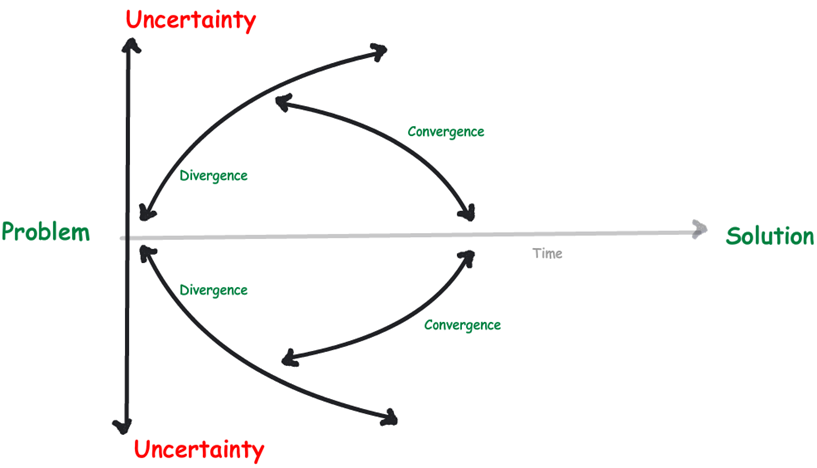
Now if you work for an organisation where the idea of ranking ones naivety is a bit confronting, let me offer you something gentler. This alternate way of looking uncertainty over time is similarly powerful to the images above. I first saw this diagram used by Jeff Conklin, who got it from a book by Sam Kaner called the Facilitator’s Guide to Participatory Decision-Making. My diagram below was modified from Kaner for my own purposes.

image

Like the Gartner and Dunning-Kruger diagrams above, the X axis represents time, with a problem at one end and the solution on the other. The Y-axis represents the level of uncertainty and it illustrates that project teams typically go through a cycle of divergent thinking, followed by a period of convergent thinking as the team becomes more aligned and the problem is better understood. What is interesting to note is that the point where divergence ends and convergence starts is never clear. No-one ever stops and pronounces “Okay guys, I think we have sufficiently diverged. Let’s converge now.”

To converge, one has to cross over the ‘hump’ of divergence. Imagine climbing a mountain and there are thick clouds that obscure the peak. For all you know, the peak might be a couple hundred feet further, but equally so, you might only be halfway up. For this reason I draw a box in the middle rather than connect the arrows. it is important to note that when I draw the box in the middle, I make a point of asking people to tell me the sort of words they would use to convey what they are feeling during this time. Without fail, I always get negative responses like “confusion,” “irritability,” “stress” and “uncertainty.”

Now consider this: Some projects tend to diverge sharply and convergence seems almost impossible. No attempts to reign things in by asserting control seem to work. In fact, they usually make things worse. Accordingly, SharePoint projects commonly look like the figure below. They are highly divergent with little convergence as a result of the varied implicit assumptions that stakeholders have about SharePoint that have not been aired and reconciled. The power of those pesky platitudes, eh?

image

When I show this version of the diagram to people, I always ask a simple question:

  • If you do not have governance for SharePoint, what do you have?

The answer I get is always “Chaos,” which I write in the box as you can see above. My next question to the group is this:

  • “So by definition, to understand SharePoint governance, we all have to metaphorically open this box we have labelled “Chaos” to understand the forces that create the divergence?

So far, nobody has disagreed with that logic. So I then I hit people with the punch line…

  • “So how can you tell me that your governance approach is addressing the forces of divergence if you don’t know what’s in the box?“

That is usually the great silence moment… Despite the logic of my argument, most organisations never open the damn box and then approach SharePoint project delivery in a manner that is very likely to exacerbate the problem, rather than address it.

False convergence…

Check out the figure below. It is a variation of the divergence/convergence figure and represents a common approach to rein in SharePoint going haywire. If you look closely, you can see that an attempt has been made to force convergence. This manifests in different ways, but is most often the scenario when a sponsor or key stakeholder starts to make key decisions on behalf of others. In the short term, this approach tends to feel good because there is a sense of momentum and something is “being done” to get things under control. Project managers stop palpitating for a time because their Gantt charts start to see some progress…

image

After explaining this diagram, I then ask my audience. “So has this dealt with divergence?”. To this day, not a single person I have ever asked has said yes. In fact, everyone implicitly seems to realise that this is a false convergence and the underlying divergent forces have not truly been addressed at all. There is usually a short term feeling that things are getting back on track, but it doesn’t last long because it is actually little better than an illusion and things starts to get fishy – both on the project and in my diagram as shown below…

image

So eventually we will be smacked by the chaos baseball bat whether we like it or not. Despite this, many organisations will persist with the forced convergence approach many times (with a different set of consultants each time) and of course continue to get crappy results. Eventually though, the attrition of this approach will exceed the commitment of stakeholders and something gives. It is at this point where some organisations react by doing another dumbass thing…

Overly constraining divergence…

Once there is a realisation that an elite coterie (like the IT department or a single champion in the business) cannot solve the information management problems for the entire organisation via false convergence approaches, the next approach seems to artificially constrain the divergence via controlling the terms of reference – aka lock the crap out of the scope. This is seductively tempting since scope creep is the quintessential symptom of stakeholders who are still in divergent thinking.

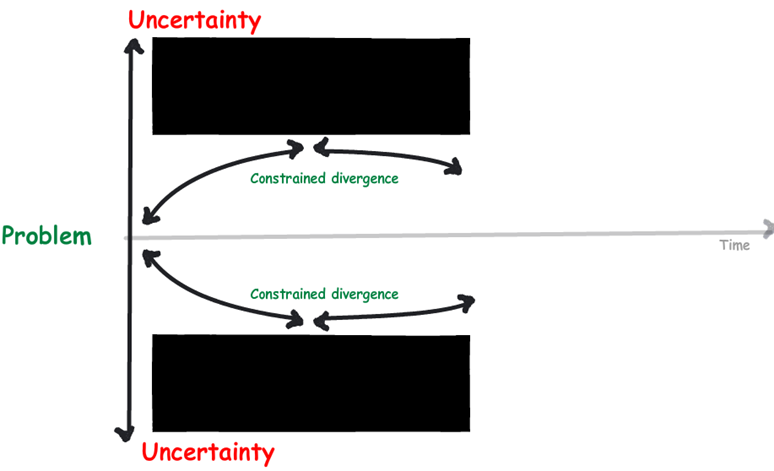
While I have no problem with determining an appropriate scope, as we all operate within time, people and budgetary limits. But it has to be done for the right reasons and constraining divergence is not a good reason. Why? Because it means that stakeholders have very little shared understanding at the point scope is decided. This is a problem because ideally, divergent thinking should be reconciled to be able to decide on scope. From a diagrammatic point of view, this is like putting clamps around the level of allowable uncertainty. The classic example of this approach is when an organisation opts for the installation and deployment of SharePoint itself as phase 1 of the project. Ever done that before? Smile

image

Like the previous example, I ask my audience whether this approach deals with divergence. Also like the first example, the answer is a universal no. The underlying divergent forces have not truly been addressed at all and things are still fishy – although on the diagram below it is a difference species of fish! 🙂 In fact what you are doing here is penalising people for their learning – something I warned against doing in part three.

image

Key takeaways

I hope that you find these diagrams useful when discussing SharePoint delivery with your own stakeholders. By explaining SharePoint delivery in terms of divergence, convergence and a pink box labelled “chaos” we are able to provide a frame to show why artificially constraining divergence often has the opposite effect of what is intended. It is also worth pointing out that both of the above approaches are not particularly collaborative either – which tends to go against what one is trying to do with SharePoint in the first place.

Many SharePoint projects proceed on the assumption that the problem is well understood – that divergence has peaked and we are heading down the slope of convergence. If this is indeed the case, then the SharePoint project should go reasonably well since all of the tools for managing and delivering projects are convergence tools and do a good job in assisting this process. When this is not the case however, those same approaches have a bad habit of getting in the way by precluding the sort of learning and exploration needed for stakeholders to align around a problem. Returning to my mountain climbing metaphor I used earlier, these tools are like gravity assist to help you get down the mountain, but they weight a lot when you are trudging up a steep mountain and when clouds are obscuring the peak.

My takeaway for f-law 5 is not to jump straight to convergence. It might give you an initial sense of certainty and momentum, but only for a short time. I have said it many times and I will say it again. While there is a lack of shared understanding among participants of a problem, you will never get the shared commitment you need to see a solution through. Shared commitment is critical because without it, projects lose their energy and momentum to be seen to conclusion. Persistent divergence is a sign of a lack of shared understanding so the trick of course, is to harness divergence and turn it into something positive. Create the conditions that allows for some uncertainty, reduce the blame culture and tolerate mistakes. Invest in tools and methods that allow collective sensemaking and give people safety and structure to raise and reconcile their concerns.

Achieving shared understanding of the problem is for me the essence of SharePoint governance. In the doctors vs. midwives post in this series I explained how the goal of an architect is to create the right conditions for SharePoint success. The conditions to manage and harness divergence is a critical skill.

If you can achieve this end you should be bloody proud of yourself – as you have done 80% of the work of SharePoint delivery already.

Thanks for reading

Paul Culmsee

www.hereticsguidebooks.com


Confessions of a (post) SharePoint architect: Black belt platitude kung-fu

Hello kung-fu students and thanks for dropping by to complete your platitude training. If you have been dutifully following the prior 5 articles so far in this series, you will have now earned your yellow belt in platitude kung-fu and should be able to spot a platitude a mile away. Of course, yellow belt is entry level – like what a Padwan is to a Jedi. In this post, you can earn your black-belt by delving further into the mystic arts of the (post) SharePoint architect and develop simple but effective methods to neutralise the hidden danger of platitudes on SharePoint projects.

If this is your first time reading this series, then stop now! Go back and (ideally) read the other articles that have led to here. Now in reality I know full well that you will not actually do that so read the previous post before proceeding. Of course, I know you will not do that either, so therefore I need to fill you in a little. This series of articles outline much of what I have learnt about successful SharePoint delivery, strongly influenced from my career in sensemaking. I have been using Russell Ackoff’s concept of f-laws – truth bombs about the way people behave in organisations – to outline all of the common mistakes and issues that plague organisations trying to deliver great SharePoint outcomes.

So far in this series we have explored four f-laws, namely:

In the last post, we took a look at the danger of conflating a superlative (like biggest, best, improved and efficient) with a buzzword like (search, portal, collaboration, social). The minute you combine these and dupe yourself into thinking that you now have a goal, you will find that your project starts to become become complex, which in turn results in over-engineered solutions solving everything and anything, and finally your project will eventually collapse under its own weight after consuming far too many financial (and emotional) resources.

This is because the goal you are chasing looks seductively simple, but ultimately is an illusion. All of your stakeholders might use the same words, but have very different interpretations of what the goal actually looks like to them. The diagram that shows the problem with this is below. On the left is the mirage and to the right is the reality behind the mirage. Essentially your fuzzy goal actually is a proxy for a whole heap of unaligned and often unarticulated goals from all of your stakeholders.

Snapshot   Snapshot

Now in theory, you have read the last post and now have a newly calibrated platitude radar. You will sit at a table and hear platitudes come in thick and fast because you will be using Ackoff’s approach of inverting a goal and seeing if a) the opposite makes any logical sense and b) could be measured in any meaningful way. As an example, here are three real-world strategic objectives that I have seen adorning some wordy strategic plans. All three set off my platitude radar big time…

“Collaboration will be encouraged”

“A best-practice collaboration platform”

“It’s a SharePoint project” Smile

I look at the first statement and think “so… would you discourage collaboration? Of course not.” Ackoff would take a statement like that and say “Stop telling me what you need to do to survive, and tell me what you need to do to thrive”.

What do you mean by?

So if I asked you how to unpack a platitude into reality, what might you do?

For many, it might seem logical to ask people what they really mean by the platitude. It might seem equally logical to come up with a universal definition to bring people to a common understanding of the platitude. Unfortunately, both are about as productive as a well-meaning Business Analyst asking users “So, what are your requirements?”

With the “what do you mean by [insert platitude here]” question, the person likely won’t be able to articulate what they mean particularly well. That is precisely why they are unconsciously using the platitude in the first place! Remember that a platitude is a mental shortcut that we often make because it saves us the cognitive effort of making sense of something. This might sound strange that we would do this, but in the rush to get things done in organisations, it is unsurprising. How often do you feel a sense of guilt when you are reflecting on something because it doesn’t feel like progress? Put a whole bunch of people feeling that way into a meeting room and of course people will latch into a platitude.

By the way, the “mental shortcut” that makes a platitude feel good seems to be a part of being human and sometimes it can work for us. When it works, it is called a heuristic, When it doesn’t its called a cognitive bias. Consult chapter 2 in my book for more information on this.

Okay, so asking what someone means by their platitude has obvious issues. Thus, it might seem logical that we should develop a universal definition for everyone to fall in behind. If we can all go with that then we would have less diversity in viewpoints. Unfortunately this has its issues too – only they are a little more subtle. As we discovered in part 2 of this series appropriately entitled “don’t define governance”, definitions tend to have a limited shelf life. Additionally, like best-practice standards, there are always lots of them to choose from and they actually have an affect of blinding people to what really matters.

So is there a better way?

It’s all in the question and its framing…

If there is one thing I have learnt above all else, is that project teams often do not ask the right question of themselves. Yet asking the right question is one of the most critical aspects to helping organisations solve their problems. The right question has the ability to cast the problem in a completely different light and change the cognitive process that people are using when answering it. In other words, the old saying is true: ask a silly question, get a silly answer.

Let me give you a real life example: Chris Tomich is a co-owner of Seven Sigma and was working with some stakeholders to understand the rationale for how content had been structured in a knowledge management portal. Chris is a dialogue mapper like me – and he’s extremely good at it. One thing Dialogue Mapping teaches you is to recognise different question types and listen for hidden questions. The breakthrough question in this case when he got some face time with a key stakeholder and asked:

  • What was your intent when you designed this structure for your content?

The answer he got?

  • “Well, we only did it that way because search was so useless”
  • “So if I am hearing you, you are saying that if search was up to scratch you would not have done it that way”
  • “Definitely not”

Neat huh? By asking a question that took the stakeholder back to the original outcome sought for taking a certain course of action, we learnt that poor search was such a constraint they compensated by altering page template design. Up until that point, the organisation itself did not realise how much of an impact a crappy search experience had made. So guess where Chris focused most of his time?

In a similar fashion, my platitude defeater question is this:

So if we had [insert platitude here], how would things be different to now?

Can you see the difference in framing compared to “what do you mean by [insert platitude here]?”. Like Chris with his “What was your intent”, we are getting people to shift from the platitude, to the difference it would make if we achieved the platitude. No definitions required in this case, and the answer you will get almost by definition has to be measurable. This is because asking what difference something would make involves a transition of some kind and people will likely answer with “increased this”  or “decreased that”.

Now be warned – a hard core middle manager might serve you up another platitude as an answer to the above question. To handle this, just ask the question again and use the new platitude instead. For example:

  • Me: Okay so if you had improved collaboration, how would things be different to now?
  • Them: We would have increased adoption
  • Me: And what difference would that make to things?

I call this the KPI question because if you keep on prodding, you will find themes start to emerge and you will get a strong sense of potential Key Performance Indicators. This doesn’t mean they are the right ones, but now people are thinking about the difference that SharePoint will make, as opposed to arguing over a definition. Trust me – its a much more productive conversation.

Now to validate that these emerging KPI’s are good ones, I ask another question, similarly framed to elicit the sort of response I am looking for…

What aspects should we consider with this initiative to [insert platitude here]?

This question is deliberately framed as neutral is possible. I am not asking for issues, opportunities or risks, but just aspects. By using the term aspects I open the question up to a wider variety of inputs. Like the KPI question above, it does not take long for themes to emerge from the resulting conversation. I call this the key focus area question, because as these themes coalesce, you will be able to ensure your emerging KPI’s link to them. You can also find gaps where there is a focus area with no KPI to cover it. As an added bonus, you often get some emergent guiding principles out of a question like this too.

The thing to note is that rather than follow up with “what are the risks?” and “what should our guiding principles be?”, I try and get participants to synthesize those from the answers I capture. I can do this because I use visual tools to collect and display collective group wisdom. In other words, rather than ask those questions directly, I get people to sort the answers into risks, opportunities and principles. This synthesis is a great way to develop a shared understanding among participants of the problem space they are tackling.

If we were unconstrained, how would we solve this problem?

This is the purpose question and is designed to find the true purpose of a project or solution to a problem. I don’t always need to use this one for SharePoint, but I certainly use it a lot in non IT projects. This question asks people to put aside all of the aspects captured by the previous question and give the ideal solution assuming that there were no constraints to worry about. The reason this question is very handy is that in exploring these “pie in the sky” solutions, people can have new insights about the present course of action. This permits consideration of aspects that would not otherwise be considered and sometimes this is just the tonic required. As an example, I vividly recall doing some strategic planning work with the environmental division of a mining company where we asked this exact question. In answering the question, the participants had a major ‘aha’ moment which in turn, altered the strategy they were undertaking significantly.

Note: If you want some homework, then check Ackoff’s notion of idealised design and the Breakthrough Thinking principle called the purpose principle. Both espouse this sort of framed question.

Sharpening the saw…

Via  the use of the above questions, you will have a  better sense of purpose, emergent focus areas and potential measures. That platitude that was causing so much wheel spinning should be starting to get more meaty and real for your stakeholders. For some scenarios, this is enough to start developing a governance structure for a solution and formulating your tactical approaches to making it happen. But often there is a need to sharpen the saw a bit and prioritise the good stuff from the chaff. Here are the sort of questions that allow you to do that:

No matter what happens, what else do we need to be aware of?

This question is called the criterial question and I learnt it when I was learning the art of Dialogue Mapping. When Dialogue Mapping you are taught to listen for the “no matter what…” preamble because it surfaces assumptions and unarticulated criteria that can be critical to the conversation and will apply to whatever the governance approach taken. Thus I will often ask this question in sessions, towards the end and it is amazing what else falls out of the conversation.

What are the things that keep you up at night?

I picked this up from reading Sue Hanley’s excellent whitepaper a while back and listening to hear speak at Share2012 in Melbourne reminded me why it is so useful. This question is very cleverly framed and is so much better than asking “What are your issues?”. It pushes the emotive buttons of stakeholders more and gets to the aspects that really matter to them at an gut level rather than purely at a rational level. (I plan to test out dialogue mapping a workshop with this as the core question sometime and will report on how it goes)

What is the intent behind [some blocker]?

This is the constraint buster question and is also one of my personal favourites. If say, someone is using a standard or process to block you with no explanation except that “we cannot do that because it violates the standards”, ask them what is the intent of the standard. When you think about it, this is like the platitude buster question above. It requires the person to tell you the difference the standard makes, rather than focus on the standard itself. As I demonstrated with my colleague Chris earlier, the intent question is also particularly useful for understanding previous context  by asking users to outline the gap between previous expectation and reality.

Conclusion…

To there you go – a black belt has been awarded. Now you should be armed with the necessary kung-fu skills required to deflect, disarm and defeat a platitude.

Of course, knowing the right questions to ask and the framing of them is one thing. Capturing the answers in an efficient way is another. For years now, I have advocated the use of visual tools like mind mapping, dialogue mapping and causal mapping tools as they all allow you to visually represent a complex problem. So as we move through this series, I will introduce some of the tools I use to augment the questions above.

Thanks for reading


Paul Culmsee



Confessions of a (post) SharePoint architect: Yellow belt platitude kung-fu

Hi all. It’s been a while I know, but it is time to continue along my journey of confessions of a post SharePoint architect. As I write this, the SharePoint community is in Vegas, soaking up the love of the biggest SharePoint conference yet. For the other twelve SharePoint professionals who are not there, I know your pain.

If this is your first  foray into this series of articles, consider it the closest I will ever get to a SharePoint governance book. Since all new knowledge is gained through the lens of existing knowledge, it is important to note that my world view has been shaped by the increasing amount of non IT work I do in various complex problem solving areas. Essentially this work has had a major effect on the lens that I view SharePoint projects and the approaches I use to steer them. When developing a class on the topic of SharePoint Governance and Information Architecture, I found a fun yet effective way to put coherence around things via Russell Ackoff’s concept of f-laws. These are simple home truths about the way people behave in organisations than explain much more than the complex ones proposed by theorists of various persuasions.

So far in this series we have explored three f-laws, namely:

The next f-law is straight from Ackoff himself and is a universal truth in any project, but absolutely chronic in SharePoint projects as well as many SharePoint slide decks:

F-Law 4: Most  SharePoint governance objectives are platitudes. They say nothing but hide behind words

Most people in the IT industry (with the obvious exclusion of sales guys, Office365 MVP’s and Google employees) tend to inwardly cringe or outrightly roll their eyes when the word “cloud” is uttered during conversation. This is because people instinctively know that what follows is either:

  • Gushing hyperbole squarely aimed at getting you to part with some cash
  • Gushing hyperbole squarely aimed at convincing you that they know what they are talking about
  • Gushing hyperbole in the form of FUD laden counter-arguments from server hugging sysadmins who reject “cloud” outright because they fear irrelevance

These reactions in such conversations result from the term “Cloud” being used in a platitudinal sense. In case you were not aware, a platitude is referred to as “a trite, meaningless, biased, or prosaic statement, often presented as if it were significant and original”. Platitudes are everywhere and usually unavoidable since many people use them unconsciously – especially politicians, senior executives and the aforementioned sales guys. Want proof? Just look on the wall behind the reception area of your office – chances are there is a mission statement there somewhere that would read something like:

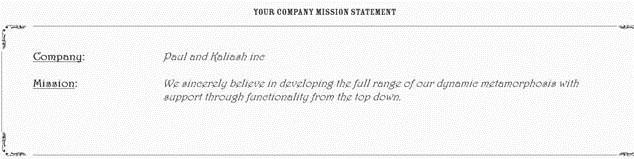
“We are dedicated to ensuring a long-term commitment to stakeholder value from performance and improved returns at all levels.”

Does a mission like that sound familiar? What if I told you the line above was generated from a website that generates mission statements like a poker machine. Just pull the lever and within a few seconds, a random assortment of small quotes are mashed together to create a cool sounding sentence. If you enter your company name into it, you can even print a certificate.  I generated this  one for the Heretic’s Guide book. Neat, huh?

clip_image002

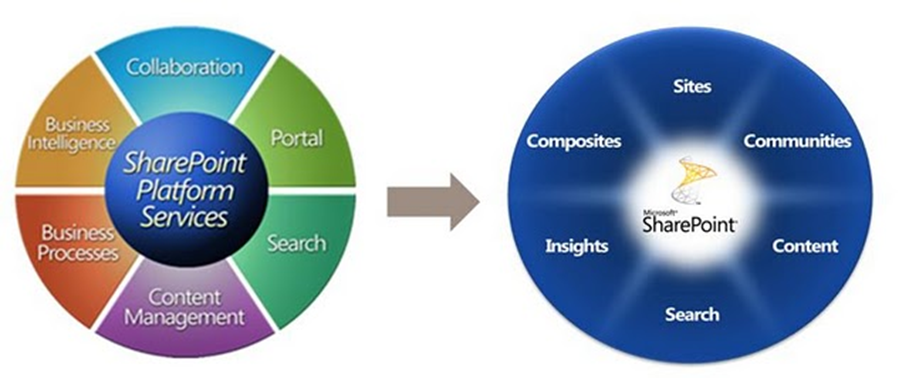
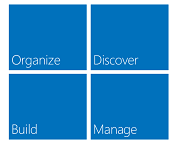
The problem, of course, with a platitude is that while it sounds significant, it doesn’t actually tell you much at all. So this f-law states that most SharePoint governance objectives are platitudes. One of the core reasons for this is a side effect of Microsoft’s marketing approach. Consider Microsoft’s SharePoint marketing material as it has evolved. Take a look at how many words survived the transition from Microsoft’s SharePoint pie of 2007, the Frisbee of 2010 and now the square of 2013. Do you see a pattern? What is the average shelf life of a word in each of these diagrams?

image image

Now, let me start out by stating that I have no problems with any of these diagrams. Microsoft is perfectly entitled to develop the message it wants to convey in whatever means it sees fit. The biggest travesty is when people frame the above words as deliverables. They take a superlative word like “improved”, “best practice” or “effective” and then add one of the above words to it. This combination inevitably forms the basis for the justification of putting SharePoint in.

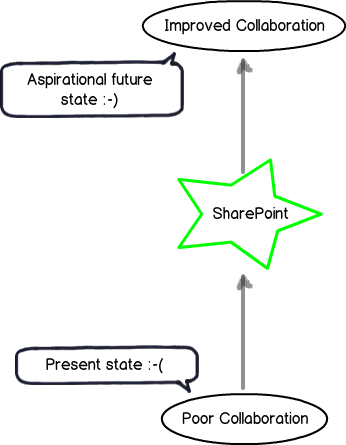
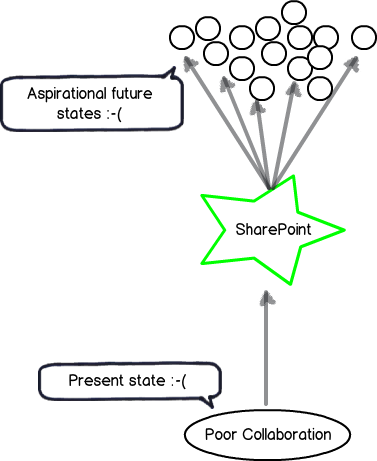
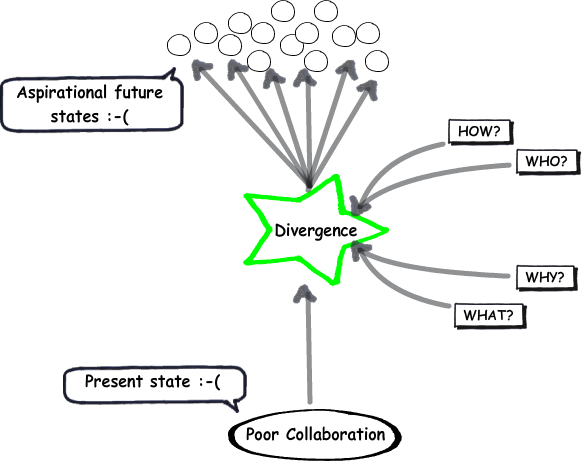
The classic example that still pervades SharePoint projects to this day is the perennial mirage of “Improved Collaboration.” If we return to the “here” and “there” diagrams of the previous posts, it looks like this… note the aspiration goal has a happy smiley on it!

Snapshot

Platitude detection 101

So the first thing you have to do as a SharePoint architect or practitioner is to develop a finely tuned platitude radar. The thing to be aware of is that platitudes come in many forms – some which are obvious and some much more subtle. Thus we will start your platitude radar calibration via a quick and easy method that Ackoff came up with. Years ago, Russel Ackoff critically examined mission statements and said that a mission statement that merely restates the obvious does not say anything that is truly aspirational. To quote from Ackoff:

They often formulate necessities as objectives: For example, ‘to achieve sufficient profit’. This is like a person saying his mission is to breathe sufficiently.

Ackoff’s test to judge the quality of a mission statement was to inverse the statement and see it still made logical sense. If you could not reasonably disagree with this negative version, then the original statement was a platitude. As an example, consider this mission statement from a well-known global organisation:

… our mission and values are to help people and businesses throughout the world realize their full potential.

So, our inverse here is that we are working to hinder people and businesses to realise their full potential. Who in the hell would ever do that? Well – given this is Microsoft’s mission statement, suddenly Windows Vista is finally starting to make sense to me. Smile

Now, go and take any word from the 3 diagrams above and put a superlative like “biggest”, “best”, “optimum” or “improved” in front. If I use my example – “Improved Collaboration” – Ackoff’s inversion approach results in “Worse Collaboration” and is therefore a platitude. I mean – aside from the odd command and control boss, would anybody seriously want to make collaboration less effective?

So, to put it simply – stop stating the bloody obvious! If your SharePoint goal doesn’t satisfy Ackoff’s simple platitude test, you have a problem.

The seeds of doom are sown at the start…

Now that I have wired up your platitude detector via Ackoff’s inversion test, you will start to notice how utterly pervasive they are in SharePoint projects and beyond. As Kailash and I state in the Heretics Guide book:

A platitude is a mental shortcut we take, a deceptively quick way to cut through uncertainty. We clump our unclear, unarticulated aspirations in a bunch of platitudes. It is easy to do and it gives us a sense of achievement. But it is a mirage because the objective is not clear and we cannot define sensible measurements of success if the goal is fuzzy. It never fails to amaze us that many organisational endeavours are given the go-ahead on the basis of platitudinous goals. Mind-boggling, isn’t it?

What is really amazing and sad at the same time is how badly the platitude problem is misattributed. One of my students at a recent SPGovIA class said that with SharePoint projects “the seeds of doom are sown at the very beginning”. He’s right too…project teams will commit significant time and money into a project that is chasing a platitude, and when things inevitably go haywire, will blame the process, methodology, people… everything but the mirage at the root of it all.

The seduction of a platitude is strong. Many have been entranced by some nice sounding desirable future state incorporating some superlative like “Improved quality” or “Best practice collaboration”. But the key point is this: The platitude becomes a sort of proxy for the end in mind rather than the real end. We have no shared understanding of what where we want to get to. Empty words preclude a shared understanding because they mean nothing at all.

The image below illustrates the effect of a platitude being confused with the actual desired state. We do not have an aspirational future state at all. Instead, we have many possible, fuzzily-defined future states.

Snapshot

If you look really closely, the future state is a sad smiley. This is because the visible symptoms of a project with a divergent understanding among participants are well documented. Scope creep and vague requirements mean that the project will start to unravel, yet the platitude-driven journey towards the mirage will continue. The project will lurch from crisis to crisis, with scope blowing out, tensions and frustrations rising. This is accompanied by classic blame-shift or hind-covering moves that people make when they realise that their ship’s taking water.

How to defeat a platitude…

I am going to conclude this post at this point because it is starting to get too long. But I will leave you with a teaser about the next post…

One of the most important things about dealing with a platitude is knowing what *not* to do. I know that what I am about to say may sound counter intuitive to many readers, but trust me when I tell you that there are two things you should avoid doing.

  1. Never, never, never ask someone what they mean when they use a platitude
  2. Never try and come up with a definition for a platitude

In the next post, I will elaborate on these two contentions and provide you with a much better way to get past the seductive danger of platitudes, so you can find out what really matters to your stakeholders.

Until then, thanks for reading…


Paul Culmsee

www.sevensigma.com.au

Falling Books Stack


Confessions of a (post) SharePoint Architect: The self-fulfilling governance prophecy

Hi and welcome to another SharePoint (post) architect confessional post. In case you are here via the good grace of whatever Google’s search relevance algorithm feels like doing today, I need to give you a little context to this post and the larger series of which it is a part. These days, I spend a lot of time working on projects beyond the cloistered confines of SharePoint; in fact, beyond the confines of IT altogether. Apart from being a cathartic release from SharePoint work, I’ve had the privilege to work with various groups on solving some very complex problems in a collaborative fashion. As a result of these case studies, I’ve become a bit of a student of various collaborative problem solving approaches and recently released a business book on the subject called “The Heretics Guide to Best Practices” co-written with mild-mannered mega-genius Kailash Awati. Despite (or because of) the book having no absolutely SharePoint content whatsoever, it managed to win an Axiom Business Book award and I feel it’s indirectly a good SharePoint governance book in its own right.

Now, for the rest of you who have been following my epic rant thus far, you will now be familiar with the notion of Ackoff’s f-laws: “truths about organisations that we might wish to deny or ignore – simple and more reliable guides to everyday behaviour than the complex truths proposed by scientists, economists, sociologists, politicians and philosophers.” Via the f-law metaphor, you now also understand why midwives are more valuable than doctors, the word “governance” should not be defined if you actually want people to understand it and that people should not be penalised for their learning.

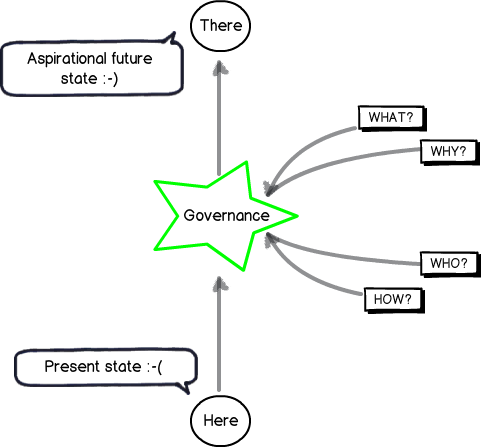
The next f-law that we will explore provides an explanation to why organisations so consistently and persistently apply the wrong approaches to SharePoint-type projects. IT departments have genetic predisposition to falling into this trap, as do other service delivery departments such as Finance and HR when they put in ERP systems. To explain my assertion, we are going to revisit the governance diagram that I used in the first f-law. You can see it below:

I used the above diagram to to explain f-law 1 which was “The more comprehensive the definition of governance is, the less it will be understood by all”. The above diagram serves to point out that governance is not the end in mind, but the means by which you achieve a desirable future state. Without any context to an end in mind, we have to accommodate many vague potential ends. To deal with this uncertainty, we inevitably look to definitions to provide clarity about what governance means. Unfortunately, this form of “definitionisation” tends to confuse more than clarify because it sneakily starts to drive the end, rather than be the means. This inevitably results in over-engineered, over-complicated and likely inappropriate governance approaches that do more harm than good.

It should be noted that “governance” is by no means the only word that falls into this trap. Words like quality, effective, “best practice” and even “SharePoint” should all be put in the green star above too because all of these words have no inherent meaning until they are applied to a given situation or context. This point is echoed by people like Andrew (“SharePoint by itself knows nothing”) Woodward, Dux (“SharePoint doesn’t suck – you suck.”) Sy and Ruven (“Can I use this diagram in my Information Architecture book?”) Gotz.

To that end, our next  f-law expands on this notion of means vs. ends and provides you with a practical way to assess the clarity of a SharePoint goal or outcome.

F-Law 3: The probability of SharePoint success is inversely proportional to the time taken to come up with a measurable KPI

Hmm… f-law 3 is a mouthful isn’t it. For a start I used the acronym of “KPI”, which in case you are not aware, stands for Key Performance Indicator – something that we can measure to visibly demonstrate that we have not sucked and actually achieved what we have set out to do. In essence, this f-law states that the longer it takes to determine a reasonable and measurable indicator that SharePoint has been a success, the less likely your SharePoint project is to succeed.

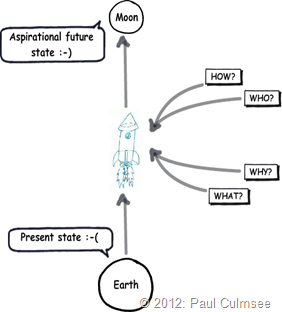
To demonstrate this, I am going to give you one of my patent pending techniques that is highly useful in client engagements to get people to think a little differently about their approach. Let’s reuse my “from here to there” diagram above to perform a basic experiment. Check out the project below and tell me … what project is this?

image

Hopefully, it did not take you long to work out that this project is the Apollo moon missions. Now, for the experimental bit. Grab a stopwatch, start the clock and answer this question:

“How do you know you have succeeded with this project?”

Once you have your answer, stop the clock and note the time. I’m willing to bet that you gave one or two answers:

  • You successfully landed a person on the moon
  • You got the person back to Earth again

I am also willing to bet that you worked out that answer within 2 to 15 seconds of pondering my diagram. Am I right?

Now, consider for a moment the sheer scale of of this project in terms of size, risk, innovation and level of expertise required to land a person on the moon and bring them back safely. Imagine the sheer number of projects within multiple programs of work that had to be aligned. Imagine the tens of thousands of people who directly and indirectly worked on this epic project. It is mind boggling when you think about it and it is little wonder that putting a man on the moon is regarded one of mankind’s greatest technical achievements.

And then we have SharePoint…

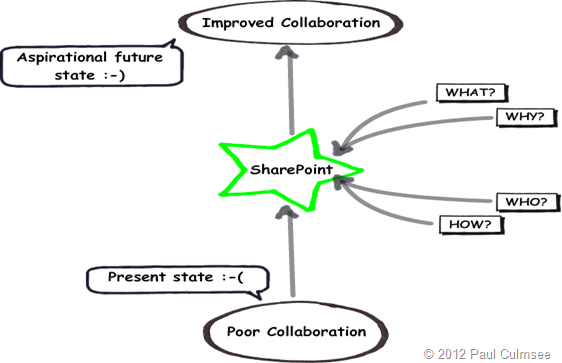
Now let’s contrast the moon project with another one likely to be very familiar with readers. So once again, tell me what project this is…

image

This one takes some people a bit longer to answer, but when I ask this in workshops and conferences I sometimes get people jokingly saying “my SharePoint project!” or “a nightmare.” So once again I want you to answer the following question:

“How do you know you have succeeded with this project?”

I bet this one has you a little more stumped and is much harder to answer than the moon example above. What is funny with this one is that, when you consider that in terms of scope and size, using SharePoint to improve collaboration is a mere pimple on the butt of sending a rocket to the moon. Yet, despite the moon example being much larger in scope, cost, degree of innovation and engineering, the success criteria is clear and unambiguous to all. People can identify what success looks like very quickly. No-one will point to Venus and say “I think that’s the moon.”  You either got there or you didn’t.

Yet, when I show a SharePoint project that is framed like the above example, people have a much (much) harder time describing what success would look like. In fact, I have asked this question many times around the world and most of the answers I am offered do not hold up to any serious form of scrutiny. Consider these common suggestions of SharePoint success and my response to them:

  • “People are using it.” My response: “Yeah, but people use email and the file system now, so why are you putting SharePoint in?”
  • “People are happy.” My response: “I bet if I replaced the crappy coffee with a top of the range espresso machine I could make people really happy and it’s a fraction of the cost of SharePoint.”

Sorry folks, but this isn’t good enough… in fact it’s a recipe for a situation where, in the name of “governance,” you deliver a bloated, over-engineered failure.

When problems are complicated…

My two project examples above highlight a particular characteristic of problems that is at the root of the difference between the moon and SharePoint example. Consider the following common IT projects:

  • Replacing your old email system with Microsoft Exchange
  • Consolidating Active Directory
  • Replacing your old phone system with Voice over IP system
  • Upgrading your storage area network  to new infrastructure

All of these are like the moon example. None of them are easy – in fact you need specialist expertise to get them successfully implemented. But when you put each of these in the green star of my “here to there” picture, criteria for success is fairly clear and unambiguous. For example, if email comes in and goes out of everyone’s inboxes, Exchange is a usually success. If you can pick up the phone, get a dial tone and make a call, then the VOIP upgrade has been a success.

These are all examples of complicated problems. With complicated problems, the criteria for success is clear and unambiguous and there is a strong relationship between cause and effect. You can be highly confident that doing X will lead to Y. In these sorts of problems, experts can come together and analyse the problem by breaking the problem down neatly into its parts to develop a high-confidence solution. Furthermore, there are likely to be many best practices that have emerged from years of collective wisdom of implementing solutions because of that relationship between cause and effect.

Wouldn’t it be nice if reality was always like this. Project Managers and tech people would actually get on with each other! But of course, reality paints a different picture…

When complicated approaches fail…

In a 2002 discussion paper about reform of the Canadian health system, authors Sholom Glouberman and Brenda Zimmerman make a statement that is completely applicable to how most organisations approach SharePoint:

In simple problems like cooking by following a recipe, the recipe is essential. It is often tested to assure easy replication without the need for any particular expertise. Recipes produce standardized products and the best recipes give good results every time. Complicated problems, like sending a rocket to the moon, are different. Formulae or recipes are critical and necessary to resolve them but are often not sufficient. High levels of expertise in a variety of fields are necessary for success. Sending one rocket increases assurance that the next mission will be a success. In some critical ways, rockets are similar to each other and because of this there can be a relatively high degree of certainty of outcome. Raising a child, on the other hand, is a complex problem. Here, formulae have a much more limited application. Raising one child provides experience but no assurance of success with the next. Although expertise can contribute to the process in valuable ways, it provides neither necessary nor sufficient conditions to assure success. []

In this paper we argue that health care systems are complex, and that repairing them is a complex problem. Most attempts to intervene [] treat them as if they were merely complicated. [] We argue that many of these dilemmas can be dissolved if the system is viewed as complex.

The key point in the above quote is that the tools and approaches that work well with complicated problems actually cause a lot of trouble in complex problems, where certainty of an outcome is much less clear. My point is that while the notion of using SharePoint to get from “poor collaboration” to “improved collaboration” might seem logical on the surface, it is hard to come up with any sensible criteria for success. Therefore you are setting yourself up for a fail because you have made SharePoint take on the characteristics of complex problems. Without unpacking these implicit assumptions about “Improved Collaboration,” our aspirational future state will look like the diagram below. The reality is we have many aspirational future states, all hidden beneath the seductive veneer of “improved collaboration” that in reality tells us nothing.

image

What blows me away is that to this day most project governance material published consistently fail to realise this core issue while trying to treat the very symptoms caused by this issue!  They provide you with the tools, means and methods to chase goals which are little better than an illusion, with no means to measure progress and therefore guide the very decisions that are made in name of governance.

Without unpacking and aligning all of these different future states above, how can any SharePoint architect be sure that they are providing the right SharePoint-based enabler? If you cannot tell me the difference made by implementing a project, how can anyone else know the difference? Even if you can, how do you know that everybody else sees it the same way as you?

Is it little wonder then, that after more than a decade of trying, SharePoint projects (complex problems) continue to go haywire? While approaches to governance force a complicated lens on a complex problem and assume the goal as stated is understood by all, governance itself will be one of the root causes of poor outcomes. Why? Because governance will require people to focus in all the areas except the one that matters. When this gap in focus manifests visibly (for example SharePoint site sprawl), governance is seen as the means to address the gap. Thus governance becomes a self-fulfilling prophecy “We will get it right this time” is the mantra, all the while, we still chase those rainbows of “improved collaboration.”

Conclusion and coming next

I do not recall where I first heard the distinction between “Complicated” and “Complex” problems because I came across it some time after I discovered the term “wicked problem.” I suspect that it was the Cynefin model that first pushed my cognitive buttons on the idea, although I distinctly recall Russell Ackoff also making the distinction between complex and complicated. Irrespective of the source, I find this a hugely valuable frame of reference to examine problems and understand why SharePoint projects are routinely tackled in an inappropriate manner. With it, I have been able to give IT departments in particular, a frame of reference to understand why they have trouble with particular kinds of projects like SharePoint.

Many people in organisations do not discern the difference between a complicated and complex problem and use the tools of the “complicated problem toolkit” to address complex problems when they are inappropriate at best and will kill your project at worst. I will expand on why this happens in the next and subsequent posts. But my key takeaway is that addressing the issue of multiple interpretations of the future is not only the key SharePoint governance challenge, it is the key challenge for any complex project.

The sorts of tools and approaches that are part of the “complex problem” utility belt are numerous and are really starting to gain traction which is great. There is plenty to read on this topic elsewhere on this blog as well as people like Andrew Woodward and Ruven Gotz. The great irony is that if you do manage align people to a shared sense of what the end in mind will look like, things that might have been seen as complex will now become complicated and the traditional tools and approaches will have efficacy because outcomes are clear and the path to get there makes more sense.

In the next post and f-law, I am going to outline another chronic issue that further explains why we get suckered into chasing false goals…


Thanks for reading

Paul Culmsee
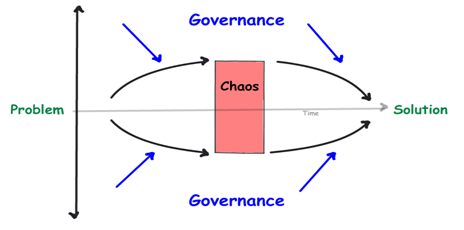
www.sevensigma.com.au

HGBP_Cover-236x300


Save the date in October: SharePoint Governance and Dialogue Mapping in the UK

Hi all

Just to let you know that in October, I will be in the UK to run a SharePoint Governance and Information Architecture class with Andrew Woodward. Additionally, I am very pleased to offer a Dialogue Mapping introductory course for the first time in the UK as well. Work has been extremely busy this year and this is my only UK/Europe trip in the next 9-12 months. In short, this is likely to be a once-off opportunity as I travel less and less these days.

Introductory Dialogue Mapping October 17-18, 2012

  • Venue: The Custard Factory, Birmingham, UK
  • Cost: £995

Eventbrite - UK: Solving Complex Problems with Issue Mapping

The introductory Dialogue mapping class will arm you with a life skill that can be used in many different situations and has changed my career. If you have been following my “confessions of a (post) SharePoint Architect” series, a lot of the content is based on my experiences of Dialogue Mapping many different projects in many different industries. Dialogue Mapping is a novel, powerful and inclusive method to elicit requirements, capture knowledge and develop shared understanding in complex projects, such as SharePoint or broader strategic planning. It was pioneered by CogNexus Institue in California, and is used by NASA, the World Bank and United Nations.

My book, “The Heretics Guide to Best Practices” is based on my Dialogue Mapping work and if you liked the book, then I know you will love the course!

What does a map look like? Check out my map of the AA1000 Stakeholder Engagement Standard or my synthesis on problems with intranet search below…

image  image

I should stress that this is not a SharePoint course. If you are an organisational development practitioner, facilitator, reformed project manager, all-round agitator or are simply interested in helping groups make sense of complex situations, then you would find this class to be highly valuable in your personal arsenal of tools and techniques. When performed live during a facilitated session, it is a highly efficient and engaging experience for participants.

Please note that seats are limited in this class and it cannot be more than  10.

  • Date: October 17-18, 2012
  • Venue: The Custard Factory, Birmingham, UK
  • Cost: £995

Eventbrite - UK: Solving Complex Problems with Issue Mapping


Aligning SharePoint Governance & Information Architecture to Business Goals October 15-16 2012

  • Venue: The Custard Factory, Birmingham, UK
  • Cost: £995
  • Limited seats available: 12

Eventbrite - #SPGov+IA Aligning SharePoint Governance & Information Architecture to Business Goals with Paul Culmsee

Previous Master Class Feedback:

  • "This course has been the most insightful two days of my SharePoint career"
  • "…Was the best targetted and jargon free course I’ve ever been on"
  • "Re-doing my draft SharePoint Governance. Moving away from blah, blah technical stuff"
  • "Easily one of the best courses I’ve been to and has left me wanting more!"
  • "Had a great couple of days at #SPIAUK loving IBIS"
  • "The content covered was about the things technically focussed peeps miss.."

Most people understand that deploying SharePoint is much more than getting it installed. Despite this, current SharePoint governance documentation abounds in service delivery aspects. However, just because your system is rock solid, stable, well documented and governed through good process, there is absolutely no guarantee of success. Similarly, if Information Architecture for SharePoint was as easy as putting together lists, libraries and metadata the right way, then why doesn’t Microsoft publish the obvious best practices?

In fact, the secret to a successful SharePoint project is an area that the governance documentation barely touches.

This master class pinpoints the critical success factors for SharePoint governance and Information Architecture and rectifies this blind spot. Based upon content provided by Paul Culmsee (Seven Sigma) which takes an ironic and subversive take on how SharePoint governance really works within organisations, while presenting a model and the tools necessary to get it right.

Drawing on inspiration from many diverse sources, disciplines and case studies, Paul Culmsee has distilled in this Master Class the “what” and “how” of governance down to a simple and accessible, yet rigorous and comprehensive set of tools and methods, that organisations large and small can utilise to achieve the level of commitment required to see SharePoint become successful.

Seven Sigma, together with 21apps, are bringing the the acclaimed SharePoint Governance and Information Architecture Master class back to the UK, October 2012.

  • Date: October 15-16, 2012
  • Venue: The Custard Factory, Birmingham, UK
  • Cost: £995
  • Limited seats available: 12

Eventbrite - #SPGov+IA Aligning SharePoint Governance & Information Architecture to Business Goals with Paul Culmsee


Thanks for reading

Paul Culmsee
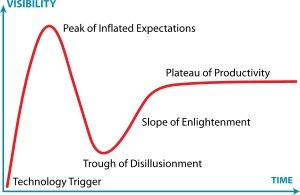


« Previous PageNext Page »

Today is: Wednesday 3 June 2026 -