Back to Cleverworkarounds mainpage
 

Trials or tribulation? Inside SharePoint 2013 workflows–Part 2

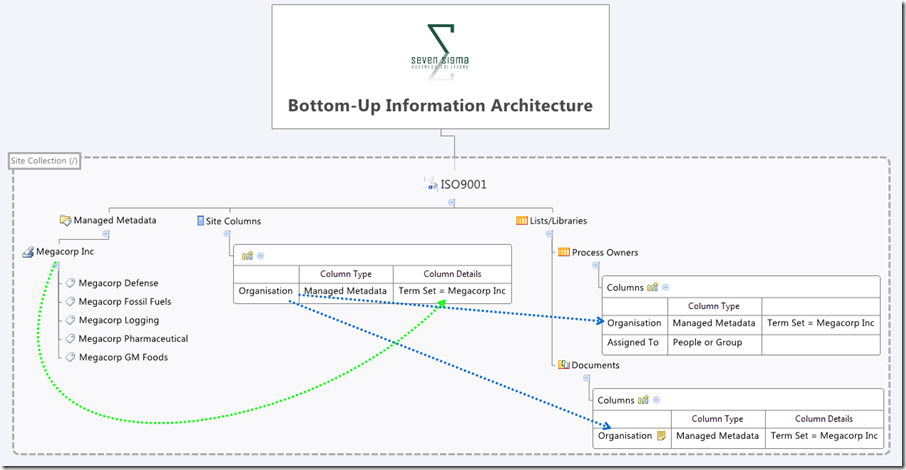
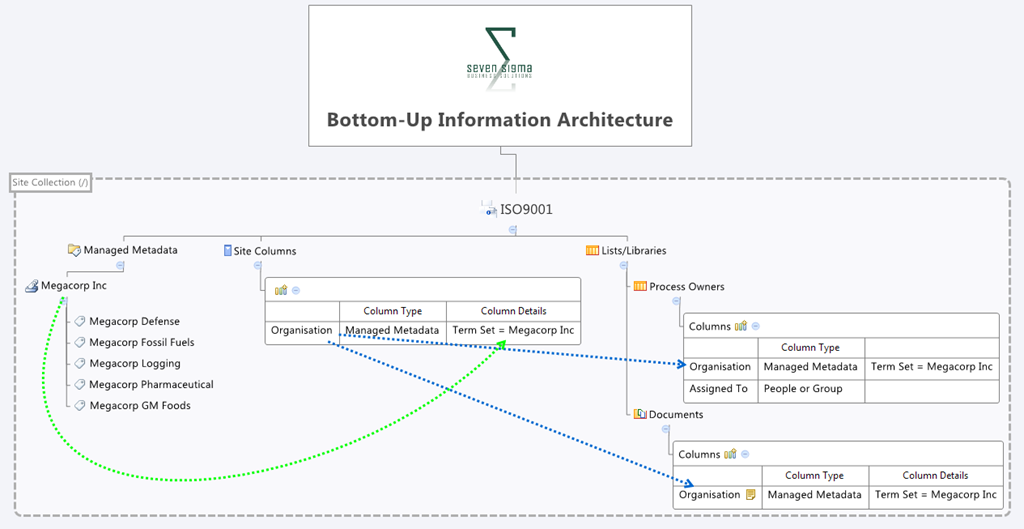
Hi and welcome to part 2 of a series that aims to showcase the good and the bad of SharePoint 2013 workflows, using a simple use-case. In part 1 I introduced you to the mythical multinational called Megacorp and its document control requirements. Also in part 1, we created a site with the necessary lists and libraries from which we can build the workflow. To recap, we used the Document Center site template, and then modified the built-in document library (Documents) to store the organisation that each document belongs to. We created a custom list called Process Owners that stored who is accountable for controlled documents in each organisation. Below is an XMind map to show you the Information Architecture of the Megacorp document control site.
image_thumb1

Our workflow is going to:

  • Look at a document and determine the organisation that a document belongs to
  • Look in the process owners list for that organisation and then determine the process owner for the organisation by grabbing the information in the “Assigned To” field
  • Create an approval task for the process owner to approve the release of a controlled document.

Now this all sounds straightforward enough in theory, but this is SharePoint we are talking about. Let’s see how reality stacks up against theory. I will give lots of screenshots for readers who have never tried using SharePoint Designer Workflow before…

Creating the workflow

Step 1:

Right, so the workflow will fire when a document is modified, so we will start by adding a list workflow and link it to the Documents library. So using SharePoint Designer 2013, we open the Megacorp site and in the ribbon, we click the List Workflow button. This will cause a dropdown menu to appear below the icon, showing the lists and libraries on the Megacorp site. From this list, we choose the Documents library.
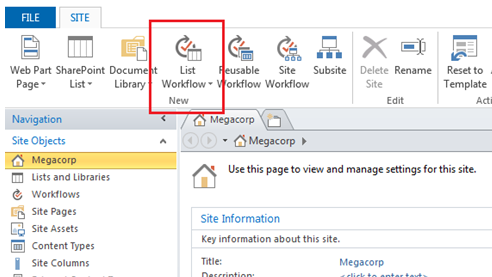
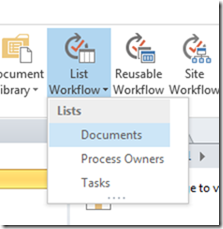
image    image_thumb23

Step 2:

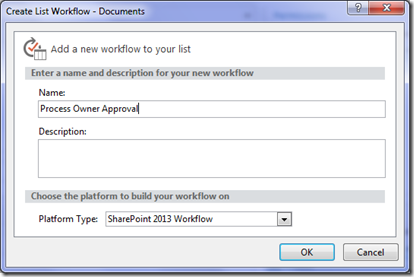
We are presented with the workflow creation screen. Call the workflow “Process Owner Approval” and click OK.
image_thumb9

Note: If, at this point, you get an error, it means that Workflow manager has not been provisioned properly. Remember that in SharePoint 2013, workflow is a separate product and needs to be installed. This is a change from previous versions of SharePoint where workflow was always there, as it was part of SharePoint.

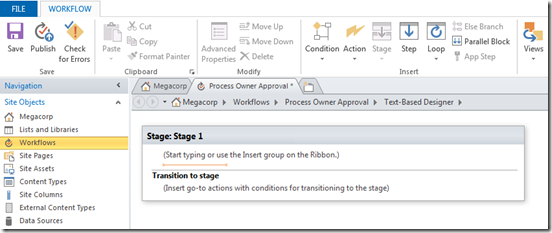
Assuming SharePoint is configured right, SharePoint Designer will have a think for a while and eventually display the following workflow creation screen, ready for us to do cool things!
image_thumb12

The next step is to add a workflow action. The most logical workflow action for us to try is one of the task actions. We will attempt to assign a task to the process owner for a document.

Step 3:

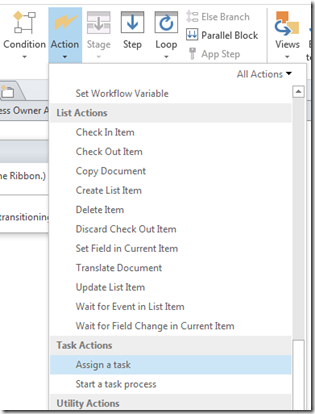
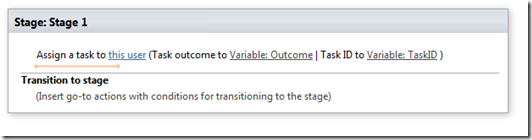
From the workflow ribbon, click the Action icon and choose “Assign a task”. The action will be added to the workflow, ready for you to fill in. For those of you reading this who have never done this before, the process is reminiscent of configuring email rules in outlook in that the action is added and you then fill in the blanks..
image_thumb15   image_thumb18

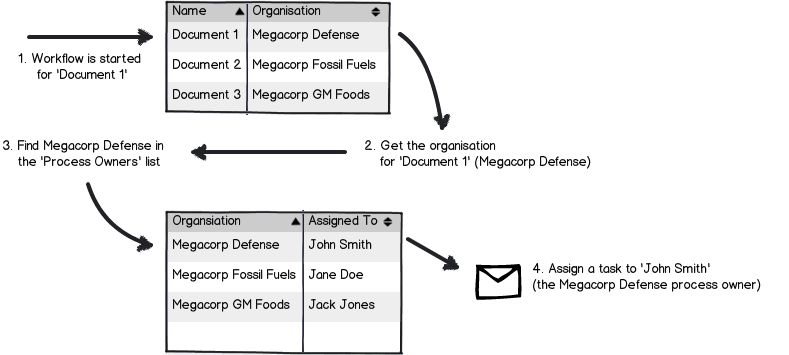
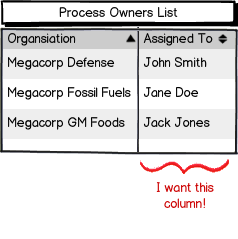
Now let’s configure the finer details of the Assign action above. A task needs to be assigned to a user, and we need to set up the logic for the workflow to work out who that user is. If you recall, the Documents library has a column called Organisation that specifies which Megacorp entity owns each document. A separate list called Process Owners then stores whoever is assigned as the process owner for each organisation (using the Assigned To column). So when the workflow runs on a particular document, we have to take Organisation specified for that document and use it to search the Process Owners list for the matching Organisation. Once we find it, we grab the value of the Assigned to user and create a task for them.

Here is a dodgy diagram that explains the logic I just described.
Snapshot

So let’s give it a go…

Step 4:

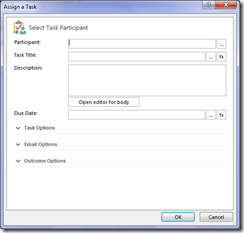
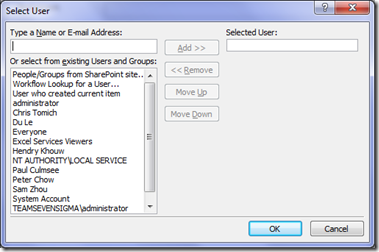
Go back to your newly minted “assign task” that you just added. Click the “this user” hyperlink on the newly created task. The task properties screen will appear as shown below. In the Participant textbox, click the ellipses button to bring up the Select User dialog box.
image_thumb19  image_thumb24

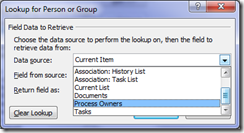
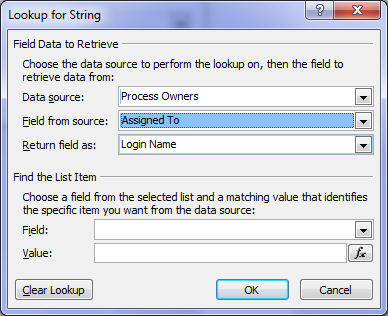
In the Select User dialog box, choose Workflow Lookup for a User and click the Add >> button. This will bring up the ambiguously named Lookup for string dialog box that allows us to choose where to look for our process owner. In the Data source drop down, we choose Process Owners from the list.

Next we have to tell the workflow which column holds the details of the person to perform the task. In the Field from source drop down, choose the Assigned to column as we talked about above.
image_thumb27image

At this point, the workflow knows which list and column holds the information it needs as per the image below:
Snapshot,

But currently we do not know the specific user we need. Is it John Smith, Jane Doe or Jack Jones? Fear not though – this is what the Find the list item section of the Lookup for string dialog box is for. This is where we will tell the workflow to find only the person who matches the value of the Organisation column assigned to the document.

Step 5:

First up, we tell the workflow which field in Process Owners will be used to compare. This is the Organisation column, so in the Field: drop down, choose Organisation. Next we have to match that organisation column with the one in the Documents library. Click the Fx button next to column textbox called Value. A new dialogue box will appear called Lookup for Extended Field. Leave the Data source dropdown as Current item and in the Field from source dropdown, choose the Organisation column.
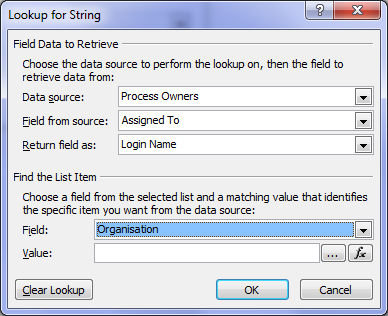
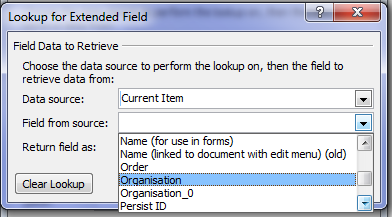
image   image

Note 1: in a workflow, “Current item” refers to the item that the workflow has been invoked from. If you recall at the start of this post, we created a list workflow and associated with the Documents library. Current item refers therefore to any document in the Documents library that has had a workflow invoked. All of the metadata associated with the current document is available to the workflow to use.

Note 2: Keen eyed readers may be wondering what the deal is with the column labelled Organsiation_0. Don’t worry – I’ll get to that later.

Now that you have selected the organisation column from the Documents library, we have filled in all of the logic we need to grab the right Assigned to user. Clicking ok, the workflow designer will warn you that if you have been silly enough to add multiple process owners for a given organisation, that it will use the first one it finds.
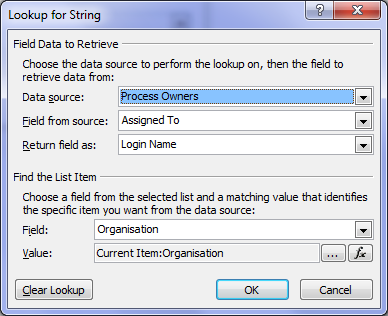
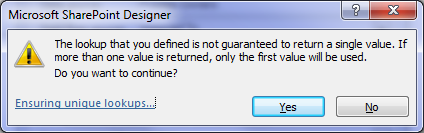
image  image

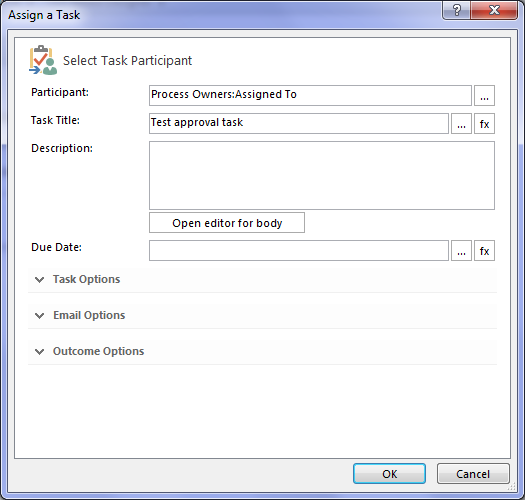
Finally, we are back at the task designer screen. A lot of screenshots just to wire up the logic for finding the right process owner eh? We haven’t even configured the behaviour of the task itself yet!
image

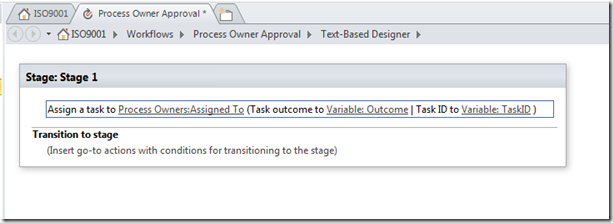
In fact, for now we are not going to wire up the rest of the task. I would like to know if the logic we have just wired up will work. If I can confirm that, I will come back and finish off creating the task with the behaviours I want.  So instead, let’s click Ok to go back to the workflow designer. Now we can see our Assign a task action, ready to go.
image_thumb39

Now before we can test and publish the workflow, we need to tell it to end. Now this is a little counter intuitive to someone who is used to SharePoint 2010 workflows, but it makes sense once you understand the concept of a workflow stage.

SharePoint Workflow 2013 Stages – an interlude…

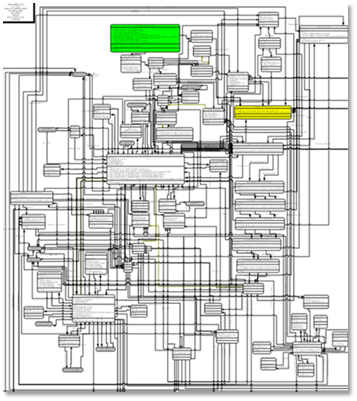
If you have ever sat around and tried to map out a business process, you have probably experienced the fun (not) of discovering that even a relatively simple business process has a lot of variations to it – some quite ad-hoc or dynamic. Trying to account for all of these variations in workflow design can make for some very complex and scary diagrams with even scarier implementations. As an example, take a look at the diagram below – this is a real process and apparently it is only page 12 of a 136!
image

Now in SharePoint 2010, implementing these sorts of workflows was pretty brutal, but in 2013 it has been rethought. A stage is a construct that allows you to group a number of workflow actions together, as well as defining conditions that govern how those actions happen. Each stage in a workflow can transition to any other workflow stage based on conditions. This means that a workflow can effectively loop around different stages and greatly simplify implementing business logic compared to SharePoint 2010.

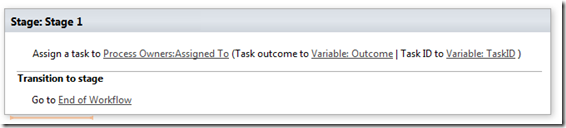
The means by which this is done is via the the new Transition to Stage workflow action. The way this works is at the end of each workflow stage, there is a transition to stage section as shown below:

image

Step 6:

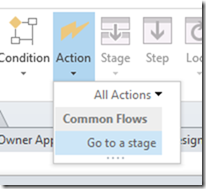
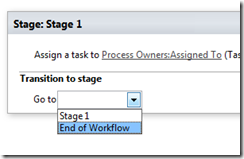
When you click into the Transition to stage section of the workflow, there is only one workflow action available: the Go To A Stage action. Adding this to the workflow will present a dropdown that will allow you to transfer the workflow to any the you have defined, or to end the workflow. Right now we will end the workflow, but we will be revisiting this stage idea later in the series.
image_thumb40  image_thumb41  image_thumb43

All right! We are done. The final step is to save and publish the workflow.

Step 7:

In the ribbon, look for the Publish icon and click it. Assuming everything goes according to plan, you will be back at the workflow overview screen in SharePoint Designer.
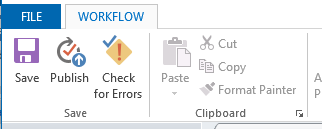
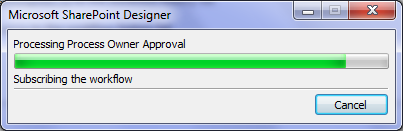
image  image

Congratulations – you have published your workflow. “Well that was easy,” I hear you say… But we haven’t tested it yet! In the next post we will test our masterpiece and see what happens. You might already have an inkling that the result may not be what you expect… but let’s save that for the next post.

Thanks for reading

Paul Culmsee
HGBP_Cover-236x300.jpg

www.hereticsguidebooks.com


Trials or tribulation? Inside SharePoint 2013 workflows–Part 1

Hi all

Workflows are big business in SharePoint land, despite the capability of SharePoint Designer Workflows being a fairly weak link in the overall SharePoint value proposition. If this wasn’t the case, then products like Nintex or K2 would not be so popular and workflow vendors wouldn’t have the biggest booths at the average SharePoint conference.

One of the serious strategic advantages of going with the SharePoint stack is the amazing 3rd party ecosystem that flourishes around the base product. No other platform in the space has the level of 3rd party support that SharePoint enjoys. But while its nice to be able to have great options for serious SharePoint workflow development, with each successive version of SharePoint that comes out, there is always that hope that one can use the base functionality without having to jump straight away to the 3rd party tools.  After all, it is quite common for organisations, having just gone to the time and expense of adopting SharePoint, to be dismayed that they have to part with yet more cash for 3rd party tools to address large functional gaps that were not apparent in the contrived product demos.

Another important trend being hidden by cloud hubris is the rise of the citizen developer. The CIO’s fountain of knowledge known as Gartner, stated that by 2014 25% of new business applications will be delivered by Citizen Developers.  They defined citizen developers as “a user operating outside of the scope of enterprise IT and its governance who creates new business applications for consumption by others either from scratch or by composition.” Elaborating, Gartner stated that

“Future citizen-developed applications will leverage IT investments below the surface, allowing IT to focus on deeper architectural concerns, while end users focus on wiring together services into business processes and workflows. Furthermore, citizen development introduces the opportunity for end users to address projects that IT has never had time to get to — a vast expanse of departmental and situational projects that have lain beneath the surface.”

So with SharePoint 2013, Microsoft has indeed changed things up a notch in the workflow world. Is it enough to enable and empower citizen developers?

That is what this series aims to find out… First up, lets take a quick look at the forces we are going to be meddling with…

What’s new with SharePoint 2013 and workflow…

Workflow in SharePoint 2013 is significantly different from SharePoint 2010. It fact, it is essentially a completely separate product called Workflow Manager. Technically, Workflow Manager is not part of SharePoint at all – there is no “workflow” service application or “service on a server” to be found. Instead, it is a separate process that works by communicating with SharePoint over the HTTP protocol in various ways.

This means that we have the option of deploying Workflow Manager onto its own server, or set of servers (although for you smaller sites, it happily installs onto your SharePoint servers and coexists with the rest of SharePoint too). This loosely coupled model has scalability benefits as workflow load can now be separated from the rest of SharePoint. It also means badly behaved workflows are less likely to affect SharePoint sites because they run in a separate process or separate servers. 3rd party applications (think about solutions built using the SharePoint 2013 apps model here) can also interact and communicate with workflow manager separately to SharePoint. It also helps Microsoft to realise their strategy of “encouraging” everyone to their vision of a cloud-based happy place.

Now new does not always equate to good – and Microsoft have a bit of a dubious history with V1 products and technology. So in this series, I’d like to show you an example of what the SharePoint 2013 new workflow regime can do. The example that I am going to use for this set of articles is useful for this purpose for several reasons:

  • 1. It is a common use-case that many organisations would find familiar – particularly those with compliance regimes
  • 2. It demonstrates a fairly typical SharePoint consulting “oh crap” moment, where you realise your masterpiece of a solution is completely undone by an untested assumption or a SharePoint caveat that you forgot about.
  • 3. It demonstrates a path to redemption that is an excellent utilisation of the new capabilities of SharePoint 2013 and Workflow Manager
  • 4. It gives you a great sense as to whether workflows are a real developer, information worker or citizen developer tool. In other words, after reading this, you should have a good idea what you are getting yourself into!

I have a lot to cover, so this series will be multi-part. This first post will outline the scenario that we are dealing with.

The scenario: Document Control at Megacorp

Many organisations operate in industries where they are required to manage documentation in a systematic way. Documents that are subject to any sort of quality or compliance regime are often referred to as “Controlled Documents”. Typically, a controlled document will have an assigned responsible party who is accountable for the management (i.e. approving the issuing of updates) of that document.

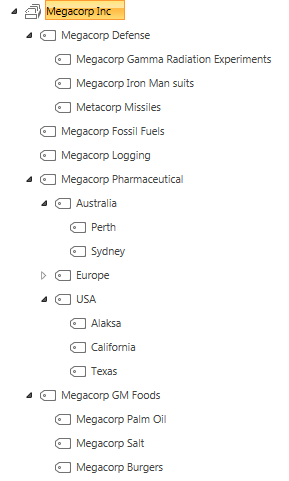
To illustrate, consider the document control requirements of Megacorp Inc – a mythical multinational conglomerate with a vide variety of businesses in many different industries and locations. Megacorp is your typical diversified multinational, making everything from Iron Man suits to hamburgers. A managed metadata term set illustrating the Megacorp conglomerate structure can be seen below. If you look closely, Megacorp Inc, actually consists of several companies and each is structured differently. For example: Megacorp Pharmaceutical divides itself based on country and state jurisdiction, whereas Megacorp GM foods divides itself up on the particular food it is generically modifying.

image

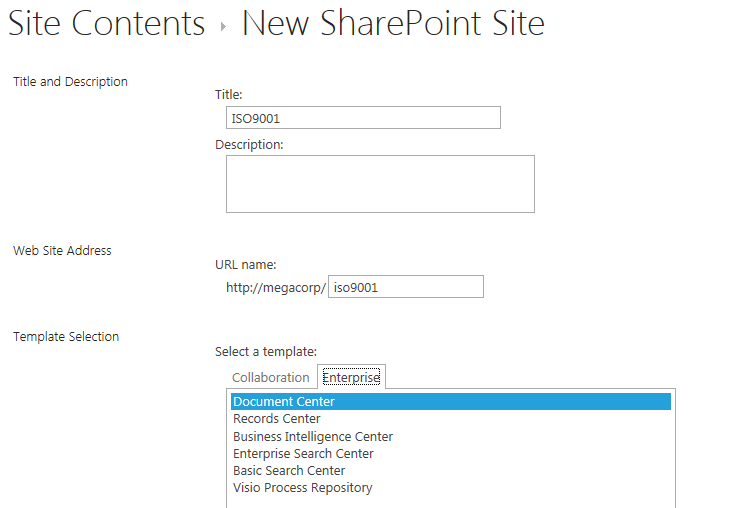
So let’s say that Megacorp is maintaining ISO9001 certification for assurance purposes and therefore has to control their documents as I have stated above. Let’s create a SharePoint site called ISO9001 to handle this requirement. We perform the following steps:

  1. Build a term set (called Megacorp Inc)that stores all of the Megacorp businesses (you can see that in the image above)
  2. Create a site based on the built-in Document Center template
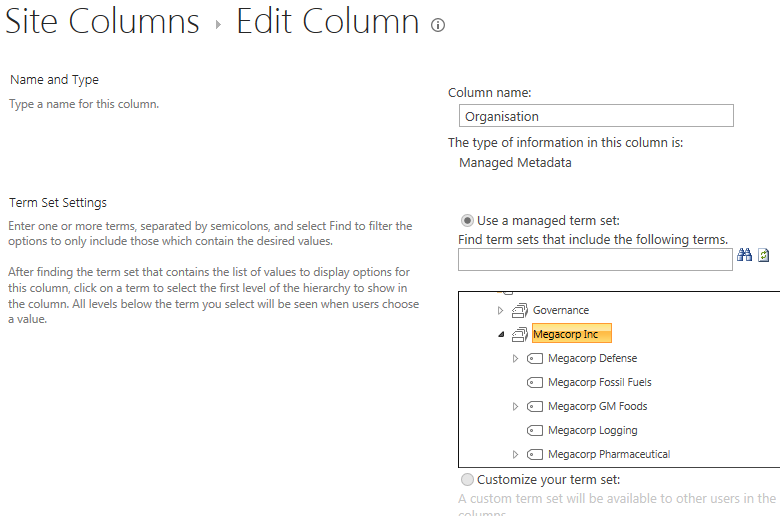
  3. Create a managed metadata site column called Organisation and associate it to the Megacorp term set
  4. Add the organisation column to the document library (called Documents) in the Document Center site
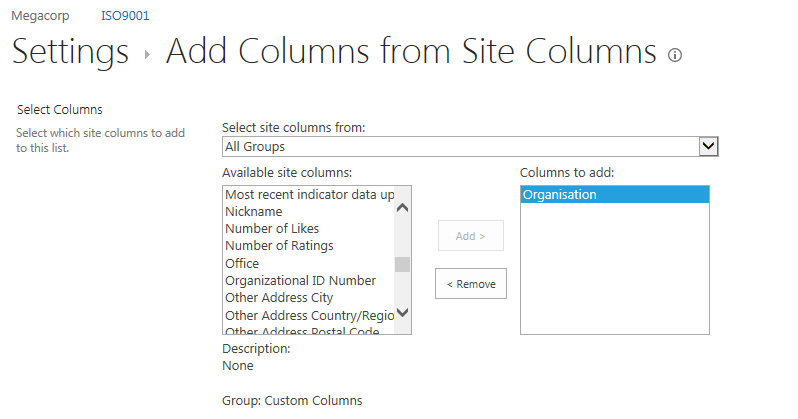
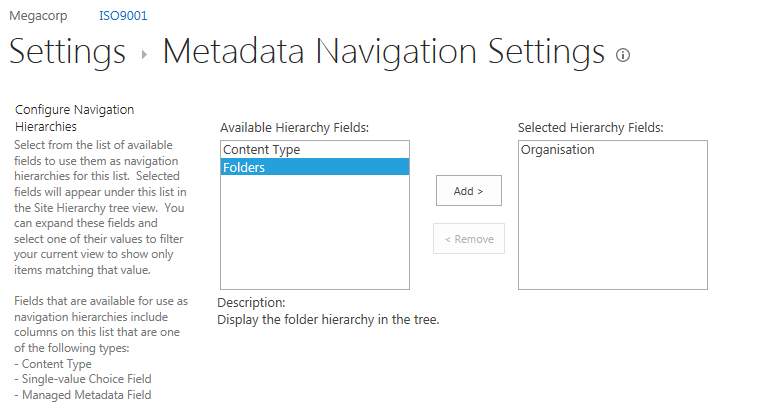
  5. Enable Metadata Navigation on the Documents library and add the Organisation column as a hierarchy field

For those of you who are new to SharePoint, below are screenshots from those steps to help you with the above steps… I am not going through this stuff in detail, so hopefully this suffices…

image  image

imageimage

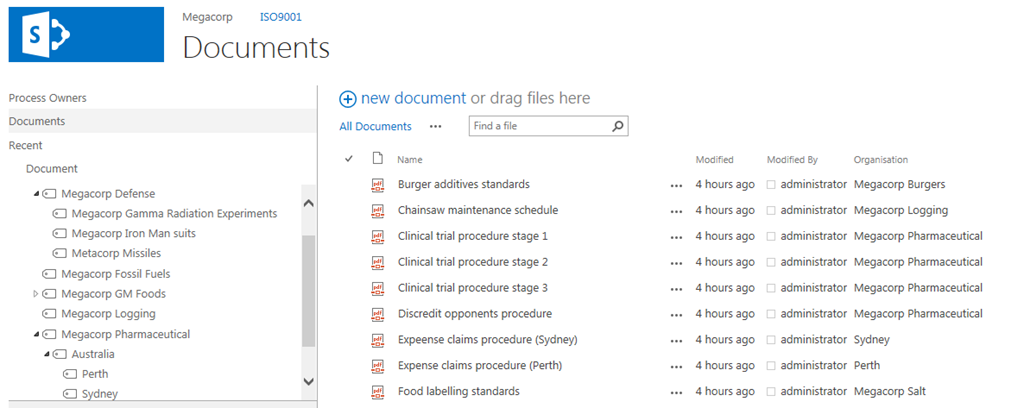
Now that the above plumbing is done, a few documents have been added to the Documents library and tagged to their organisation. With Metadata Navigation enabled, we now have the easy means to browse and filter documents to the specific organisation who owns them as shown below…

image

So let’s now think through a workflow scenario. Each organisation that makes up Megacorp has a process owner and when a document is ready for publishing, the process owner needs to approve it. Now we could do this by adding a “Person or Group” column to the document library and call it “process owner.” But Megacorp has some additional considerations that need to be pondered…

  • 1. They have thousands of documents in the library
  • 2. The process owner is a role, not an individual person. For audit purposes, Megacorp wants to have a record of when a person was in a particular process owner role.

The reason this complicates things is twofold. If we use a person’s user account in Active directory for tagging the process owner, we can easily track when a process owner changes because it will show up in the version history of the documents. But the downside is that we would have to update each document individually when that process owner changes to someone else. Not to mention that we may not want this change to be a version change in the document itself.

Now I know what your thinking – “Just use an Active Directory Group instead of an account”. Yes, it is a good and logical suggestion, since a SharePoint or Active Directory group allows us to easily manage changes in personnel between roles by changing group members. But the downside is that we have no easy way to see the history of who was in the process owner role at a given time because SharePoint would see and store the group, not the members of that group.

So let’s try an alternative approach. We will make a custom list called “Process Owners” and add two columns to it. We will add the Organisation site column that we created and used earlier, and we will add the “Assigned To” column that is built-into SharePoint and used in task lists. This will give us a list of process owners for a given Megacorp company or division. Even better – if we turn on version history on the Process Owners list, we now have a record of who was in the process owner role at any given time because it will show up in the changes in the “Assigned to” field over time.

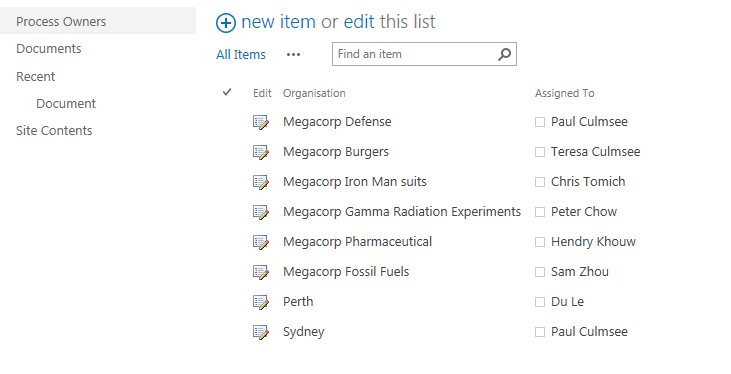
The image below illustrates the Process Owners list.

image

So to summarise, we have a document library where all documents are tagged to the organisation that they belong to. We have a list of the process owners for each organisation. To better visualise this, I have drawn an xmind map to show you the Information Architecture of the Megacorp document control site

image

Now we turn our attention to the document approval workflow. It should be able to:

  • Look at a document and determine the Organisation that a document belongs to
  • Look in the process owners list for that organisation and then determine the process owner for the organisation by grabbing the information in the “Assigned To” field
  • Create an Approval task for the Process owner to approve the release of a controlled document.

Now this all sounds straightforward enough in theory but as we will see as this series progresses, when it comes to SharePoint, theory and reality are two very different things. So in part 2, we will build out the workflow..

Thanks for reading

Paul Culmsee
h2bp2013_thumb.jpg

www.heretisguidebooks.com


What does project management mean to me – a Project Manager’s sermon

The "message"

What does project management mean to me?

Well if you want me to give you the ‘glass half empty’ perspective, it’s easy. What project management means to me is a confused discipline where practitioners routinely do really dumb shit in its name.

Sermon over – go forth and spread the word…

Okay so that was fairly blunt, so I had better elaborate and perhaps take a more positively framed ‘glass half full’ approach to this sermon. To do that, I need to tell you about the legacy that Cleo magazine has left on society.

When I was younger, I used to skim through magazines like Cosmopolitan and Cleo while waiting in line at the checkout. Now you might think that I must really be in touch with my feminine side in admitting this, but no: the reality is that raw testosterone was the motivator. You see, Cleo would have headline articles like “10 great sex tips (in 50 words or less)” Or “The 10 things he doesn’t want in bed.” Titles like that dangled the possibility in front of me of finally understanding women, with the added bonus of developing Olympic class skills in the bedroom. Of course, each and every time the actual article never lived up to the catchy title. I rarely learnt anything new and in fact the “10 things” were usually pretty banal, self-evident and left me none the wiser.

So as our collective attention spans diminish via constant exposure to “5 steps to success with [insert buzzword here]” articles (articles designed more for search engine placement than actually informing an audience), the curse of Cleo-like catchy titles telling you stuff of little value is now so commonplace that it is hard to suss out the stuff that really makes a difference in outcomes.

So where does one go to find out the answers in project management? Should aspiring Project Managers master the dark arts of their craft by learning everything there is to learn from one or more of the bibles that contain the word “BoK” in them? On the surface it would seem so, given all of the past collective wisdom that is claimed to be codified therein – as well as shiny certification proving that one has passed the multi-choice exam on its contents.

But wait…which BoK is best? After all, we have multiple to choose from, with each making their own claims to the truth. Some BoKs even reject the key tenets of other BoKs, arguing that theirs offers a better answer. Of course, this leads to an endless stream of debate by their respective proponents as to which is really best and who is really the wisest. Not to mention that over time, new and updated BoKs emerge like phoenixes from the ashes of older BoKs. (Sometimes they are so cool that they don’t even claim to be a BoK at all).

It’s little wonder that Project Management is a confused discipline. No matter where you turn, someone is bound to tell you that you are doing it wrong.

While I am on the subject of doing it wrong, let’s poke a stick in one of the well-known project management hornets-nests: the “Waterfall vs. Scrum” argument. We all know that any self-respecting Scrum guy will not miss an opportunity to tell you about the evils of Waterfall – and for the most part they are right too, as Waterfall has a dubious history of which most people are not aware.

But that is not the reason I chose this particular topic, even though it is much loved by PMs who spend endless hours filling up the forums of various LinkedIn groups with discussion. I chose it simply because it’s fun to mess with Scrum guys – particularly the zealots. So if you have a “scrumdamentalist” in your midst, try this question on them:

Would Waterfall work if one could create an environment where all parties—as soon as they become aware of something that might affect a project materially—communicate it to all other parties involved in the project in a full, sincere and open way?

I have posed this question to many Scrum people. Most will think about it for some time, before answering a grudging “possibly” or “I don’t see why not.” Try it yourself… it’s fun pulling the rug out from under their firmly held convictions.

The best answer I have ever got to this question was from Chris Chapman – an Agile coach from Toronto. He gave me what I think is the perfect answer when he astutely observed that in the environment I described, Waterfall would actually not exist in the first place!

Therein lies the heart of my sermon. I contend that the endless debates over the efficacy of methods, tools and even BoKs are answering the wrong question! Don’t worry though, Project Management is not the first, nor the last discipline to lean their ladder against the wrong wall in this regard. To explain, let me introduce you to the work (and genius) of J Richard Hackman.

From the late sixties, Hackman spent his career researching and teaching about team performance, leadership effectiveness, and the design of self-managing teams and organizations. He died in 2013 and one of his last papers he published was called “From causes to conditions in group research.” In this swansong paper, Hackman explained how he spent years examining the factors that made teams work really well. He studied hundreds of teams (not just project teams mind you, but sporting teams, orchestras and flight crews), with the aim to distil the causes of success. Each time Hackman thought he had the causes figured out he would create a model, plug his model into a stats program, and work with real teams to see if the application of his model led to better performance.

On the surface, this approach seems like a logical thing to do. After all, if we can work out the magic levers that cause team success, then organisations would surely work better because they can start to pull those same levers. This is precisely the value proposition offered by the aforementioned BoKs as well.

When Hackman applied the models he lovingly researched and developed, he found they did not make a significant difference in outcomes. Being an academic, he did what most academics do: he spent years trying to refine his models and then re-tested them against real life teamwork situations. But this didn’t work either; his models got no closer to predicting or influencing outcomes in a reliable fashion. Reality it seemed, never fitted the models he developed.

At this point, Hackman began to question whether he was looking at the problem through the right lens. He wondered if trying to determine the causes of team efficacy by looking at successful teams retrospectively and then codifying these into causal models was the best approach. So he changed his focus and asked himself a very different question – a question that every project management practitioner (and project team member) should be asking themselves:

What are the enabling conditions that need to exist that give rise to great outcomes?

Now if, at this point, you think that this is the same question as “What are the causes of successful projects” you would be mistaken. Think about the BoKs and consider this: if you have ever argued with someone about whether a tool, methodology or some process is great or completely sucks, eventually someone will say something like “Well it can work for the right organisation.”

The implicit point here is that depending on the conditions, something that works for one organisation may completely suck for another (thereby invalidating the notion of a “best” practice). The genius of Hackman is that he challenges us to stop arguing about whether one methodology or model is better than the other and focus on what the enabling conditions are instead. Think about it – if project managers and developers did this, we would be able to avoid low value arguments like earned value management versus burndown charts.

In the case of Hackman, he re-examined all of his work on teams and boiled it down to six essential conditions, arguing that irrespective of what else you did or what methodology you used, having these conditions tended to lead to better results. Hackman did not rank any one condition over any other, instead arguing that all were needed for teams to have a greater chance of being high performing. The conditions are:

  1. A real team: Interdependence among members, clear boundaries distinguishing members from non-members and moderate stability of membership over time
  2. A compelling purpose: A purpose that is clear, challenging, and consequential. It energizes team members and fully engages their talents
  3. Right people: People who had task expertise, self-organised and skill in working collaboratively with others
  4. Clear norms of conduct: Team understands clearly what behaviours are, and are not, acceptable
  5. A supportive organisational context: The team has the resources it needs and the reward system provides recognition and positive consequences for excellent team performance
  6. Appropriate coaching: The right sort of coaching for the team was provided at the right time

There is more to that list than what I am covering here, and it is important to note that I’m not saying that Hackman’s conditions are *the* conditions. But I would contend that they are a pretty good start. Look at Hackman’s conditions for teams above and think about your projects and how you manage them. Did you have these conditions in place when you started? If you had them, would it have led to better outcomes?

I believe that it is a huge mistake to attribute success or failure of projects to methods, processes and models used to manage them rather than the conditions in which those processes operate. As long as this attribution error persists, people will continue to get suckered into B-grade verbal-slugfests about whether method X is better than method Y.

What exacerbates this “causes over conditions” problem is that enabling conditions rarely get codified in procedures, governance models, bodies of knowledge or certifications. As a result, the very factors that leads to success (the conditions) are entirely absent from the models that we use. My contention is that most organisations, when delivering projects, do not have the right enabling conditions in place to begin with. If your organisation has a blame culture, then chances are that any process, no matter how noble its design or intent, has the potential to become a blame apportionment mechanism or a responsibility avoidance mechanism.

So Hackman, despite looking at a different discipline of teamwork and leadership, gives us an important clue about what ails project management and how to we might improve it. Focus on enabling conditions rather than attributing causes!

Let’s get back to Chris Chapman’s answer to my Waterfall question. His assertion that Waterfall would not exist in the conditions I described holds a less obvious lesson. That is, the way project management tools or methods are used will affect conditions as well. So if you have ever said to yourself “I can’t believe that I am being forced to follow this wrong-headed process” chances are you have been on the receiving end of negative conditions created by application of a process. (So in this sense the agile dudes have it right.)

So what does project management mean to me? In short, focusing on creating the enabling conditions for great performance, and then getting out of the way!


Thanks for reading

Paul  Culmsee
 

Epilogue:

In this sermon I cannot hope to cover all of the things I would like to cover but never fear, Kailash Awati and I already piled some of our thoughts into 420 pages of goodness known as the book “The Heretics Guide to Best Practices” – so if you like what you read here, you will really like what is in there.

Acknowledgements:

As usual I have to thank Kailash for reviewing this post and making it suck much less than it did 🙂

Further reading:

  1. My series on rethinking SharePoint maturity: Don’t let the title put you off – the material here further explores the conditions for great project performance: http://www.cleverworkarounds.com/2013/08/19/rethinking-sharepoint-maturity-part-1-conditions-over-causes/
  2. Jon Whitty’s brilliant work on memeplexes and reconceptualising project management: http://espace.library.uq.edu.au/eserv/UQ:8801/sjw_ijpm_05.pdf
  3. Pretty much anything on Kailash Awati’s blog, but in particular his sermon in this flashblog: http://eight2late.wordpress.com/2013/09/25/what-project-management-means-to-me-a-metalogue/
  4. Stephen Duffield’s work on project knowledge management and risk: http://www.invictaprojects.com.au/pmlessonslearnedblog/?p=850

p.s: This post is published as part of a first ever project management related global blogging initiative to publish a post on a common theme at exactly the same time. Over seventy bloggers from Australia, Canada, Colombia, Denmark, France, Italy, Mexico, Poland, Portugal, Singapore, South Africa, Spain, UK and the USA have committed to make a blogging contribution and the fruit of their labor is now (literally NOW) available all over the web. The complete list of all participating blogs is found here so please go and check them out!


Rethinking SharePoint Maturity Part 5: From Conditions to Actionable Lessons Learnt

Hi all

Welcome to part five of my quest to improve people’s awareness and understanding of what SharePoint maturity is really all about. For those new to this series of articles, we have traversed a bit of territory to get here, and during the journey there has been not a single SharePoint site column, content type or site collection in sight. In fact, I have not touched any of the topics that many would traditionally view as a sign of SharePoint maturity. Instead, I have been taking readers on a fun-filled journey examining three nerdy, yet highly interesting areas of research in team development, collaboration and organisational learning. Along the way we defaced the Mona Lisa, looked at SharePoint through holes in slices of Swiss Cheese and channelled the number of the beast.

After all that, we ended part 4, by arriving at this odd looking diagram below…

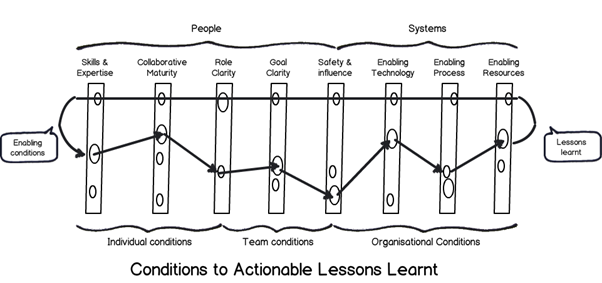
What you are looking at is something called the CALL model, which stands for “Conditions to Actionable Lessons Learnt”. I originally developed the model with Dialogue Mapping and knowledge management in mind – essentially to help my clients do a better job of integrating double loop learning into their projects. However, it soon became apparent that it was valuable in various SharePoint contexts too.

Single vs. double loop learning

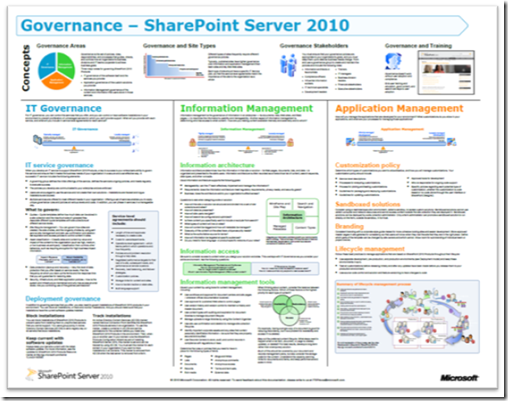
In the previous paragraph I made a reference to “double loop learning” without explaining what it was, so let’s quickly make amends because it is interesting stuff. The idea of single and double loop learning has been around for close to 40 years – it was in 1974 when Chris Argyris came up with the idea. To explain, let’s bring back our trusty SharePoint 2010 governance poster that I trash-talked in the first and fourth articles…

If you have not seen this poster before, it represents what Microsoft believe to be the focus areas for SharePoint 2010 governance. Many people – consultants in particular – will take the information in this poster for granted and create SharePoint governance plans that try to cover off the various areas it suggests to be covered. Everyone will feel good because they have ticked all the boxes of this authoritative fountain of SharePoint wisdom.

Then, if SharePoint then fails to live up to expectations, many will look at the poster and wonder which areas they did not adequately cover. They will study the poster, search Google or Wikipedia for better definitions of the terms listed and then make another reattempt, trying to do an even better job of implementing the wisdom contained therein.

This my friends, is a shining example of single loop learning. Single loop learning, as described in this article “seems to be present when goals, values, frameworks and, to a significant extent, strategies are taken for granted. The emphasis is on techniques and making techniques more efficient.” In single loop learning, the fundamental premise of a course of action remains unchanged. All of the energy of learning is directed to making sure “we get it right this time.” In short, in a single loop learning scenario, repeated attempts are made at solving the same issue, but no-one questions the underlying premise of the strategy.

Now in case you haven’t noticed, I spent the first three posts of this series “questioning the underlying premise” of the above SharePoint governance poster. So in effect I’ve been introducing you to the notion of double loop learning already. Double-loop learning involves taking a deeper look at what is going on. In double-loop learning, having attempted to achieve a goal on different occasions, the goal itself may be modified, re-framed or rejected in the light of the experience gained in trying to achieve it. Think about it – double loop learning actually happened in organisations people would never say things like “well that’s always how we have done it here.”

I see a lot of single loop learning in SharePoint land, and I want to help people break out of their existing framing of the issue – compassionately, of course Smile

Enter the CALL Model

So getting back to my CALL model, I propose it as a multi-purpose tool that can be used for various SharePoint related stuff. It is based on the Swiss cheese risk management model; a metaphor which suggests most strategies have gaps that create risk. These gaps are analogous to holes in slices of Swiss cheese. In terms of the SharePoint governance poster, think of each of the areas it suggests to be covered as slices of cheese. This key to this model is that it assumes that no single defence layer is sufficient to mitigate risk. It also implies that if risk mitigation strategies are set up with all the holes lined up, there is a systematic flaw, since it would allow a problem to progress all the way through to adversely affect the organisation. Accordingly, the Swiss cheese model encourages a more balanced view of how risk is managed.

You can think of the CALL model as a SharePoint optimised Swiss cheese model. CALL extends the Swiss cheese model by incorporating cutting edge research in enabling team performance (Hackman), collaboration (Wilder) and knowledge management (Duffield). It outlines 8 actionable areas (Swiss cheese slices) that operate at the individual, team and organisation levels. These focus areas can be thought of as enabling conditions that mitigate risk, as well as focus areas for identification and application of lessons learnt. In other words, my contention is that for SharePoint maturity, you should strive to create these 8 conditions and then consider them when evaluating project performance.

image

The image above is another drawing of the model minus the pretty colours I used earlier. In this version, I am showing the path of a SharePoint project flows through these 8 areas. Note how the arrow from left to right deviates because we are seeking to use them to mitigate risk via defence in depth. But when it comes to applying learnings from a project (arrow now moves from right to left to close the loop), the flow is designed to be smooth and unencumbered to ensure that the opportunity for double loop learning takes place.

Here is a description of each of the 8 focus areas:

Skills and expertise

This focus area is concerned with ensuring individuals are selected with the right skills and task expertise to perform their role in delivery and operation of services. In SharePoint this is critical because of the technical depth and breadth of the product. Want to deploy SharePoint 2013 request routing in dedicated mode? Go see Spence so he can tell you not to. Want to learn how the new WOPI protocol works with Office Web Apps? Sign a cheque for Wictor to help you.

Skills is closely associated with high IQ. In other words, specialist skills require smart, dedicated people. Therefore this also incorporates ensuring staff have appropriate qualifications and certifications, that education, training and ongoing development practices are properly targeted, and that individuals are willing to learn new skills and be proactive in keeping themselves up-skilled. (In other words, all of the hallmarks of those brilliantly talented people who completed the now defunct Microsoft Certified Masters program).

Collaborative Maturity

Ever heard of the term “dumb smart guy”? Usually it is someone who is intellectually smart, but has all the emotional maturity (EQ) of a potato. Collaborative maturity is all about ensuring that individuals have skills in working collaboratively with others. It signifies a willingness to listen, empathy, mutual respect, understanding and trust. Collaboratively mature people have a tolerance for ambiguity and have the ability to engage in genuine dialogue to reach compromise. Collaboratively mature people also see collaboration in their self-interest and foster develop deep ties with colleagues in order to work interdependently.

Being in the IT industry, I’m not sure if this person actually exists, but hey – this description gives us all something to aspire to!

Role clarity

Role clarity is concerned that the role of each team member is understood by everyone within the team and it is clear how much authority is vested within each role. This in turn provides task clarity, fosters interdependency among a team and reduces process loss. (Process loss is difficulty in knowing who is doing what and how it is done). Where roles are clear and understood, team members are appropriately appointed to tasks according to their capacity (see “skills and expertise” above) and character (see “collaborative maturity” above).

Goal clarity

Goal clarity relates to purpose, direction and goal alignment between members of a team is essential for good team performance. A compelling purpose energizes team members, orients them toward their collective objective, fully engages their talents and motivates them to resolve conflicts. A compelling purpose should be underpinned by concrete, attainable goals and objectives, both short and long term. Knowing where you are heading focuses the team’s energy in directive meaningful activity. This also helps build team efficacy, which is the belief within teams of their ability to solve problems and deliver great solutions. On the other hand, lack of goal clarify is one of the classic symptoms of wicked problems.

Participation safety and decision influence

Ever been on a project that’s taking on water, but nobody seems to be willing to listen? Ever had any critically important topics not discussed because they are simply taboo and unmentionable? It is not fun – and little breakthrough thinking or innovation can exist without participation safety and decision influence. When a team has a high level of participation safety, members feel safe to share ideas, raise unpopular views or opinions, or speak their truth to one another. This reduces groupthink and social loafing, encourages breakthrough and can lead a collaborative team and a collaborative organisational culture. There are countless case studies of major disasters (such as the Deepwater Horizon Oil Spill), where a culture of “only tell me the good news” prevented critical information from being raised that could have averted the issue. In fact ‘communication’ (or lack of it) is probably the most commonly cited project failure factor.

Having said all that, while participation safety is critical, the ideas that team members put forward need to influence the direction and outcome of the team. A manager who says “my door is always open”, but then ignores feedback creates dissonance among team members because what is espoused is not practiced. The simple facts of the matter is that a key element for peak performance is to provide an environment safe enough for team members to speak their truths, to be rewarded for doing so and for truth telling to actually influence direction.

Enabling Technology

Technology underpins all aspects of organisational systems and projects and provides the means to generate leaps in performance and capabilities of users, as more broadly, team and organisational productivity. Technology at its best facilitates the delivery of timely, relevant information for decision making, co-ordination and collaboration. Thus it is critical that technology does not get in the way of delivering value. How often have you worked on a project when you have been forced to use technologies that stifle productivity, create frustration and reduce collaboration between team members? How often has that technology been SharePoint?

Enabling Process

How often have you said to yourself “I can’t believe I have to follow this braindead process.” Process is the glue that provides the rules of behaviour in delivering on goals and like technology, underpins all aspects of organisational systems and projects and is a key part of performance and productivity. It is critical that process, like technology, is always driven by purpose and that it does not get in the way of delivering value. Inappropriate process can make a huge difference in how team members interact with stakeholders and each-other.

Enabling Resources

Enabling resources is concerned with the financial, material and human input necessary to develop and sustain delivery of services. Put simply, even the best teams with the most compelling direction can falter if they are under-resourced. It is critical that sufficient funds, staff, materials and time are provided to get the job done.

Applications for the CALL model

The CALL model can be used in many ways, given its heritage of Hackman, Wilder and Duffield. Examples include:

  • A model for performing SharePoint governance health check/assessment
  • A model for assessing the makeup of a SharePoint team
  • A model for assessing the complexity of a proposed SharePoint solution
  • A model for assessing departmental readiness for SharePoint
  • A model for developing SharePoint Business Continuity planning

It is worthwhile noting that Hackman developed a team performance instrument called a Team Diagnostic Survey based around his 6 enabling conditions. Since the CALL model is so closely aligned to Hackman, it should also be able to be used in a similar fashion. The same goes for the Wilder research on collaboration, that developed an instrument called the Collaboration Factors Inventory.

So given the source material, the CALL model also has applicability in the areas of:

  • An set of enabling conditions to establish to develop high performing teams
  • An set of enabling conditions to successful collaborative delivery of projects
  • A focus area for the identification of risks (and opportunities) on organisational initiatives
  • A framework for the systematic capture of project lessons learnt
  • A framework for assessing change and other organisational initiatives
  • A governance maturity model
  • A knowledge management and organisational learning maturity model

Conclusion

The CALL model reflects a synthesis of three highly rigorous research efforts. All three seemed to gel really well when they were put into the melting pot and I was pleased with the result. In the next post, I will show you how I have used the CALL model when developing a SharePoint Business Continuity Strategy for a client. I’ll also talk about how I have used it in lessons learnt workshops.

Thanks for reading


Paul Culmsee
www.hereticsguidebooks.com

HGBP_Cover-236x300


Rethinking SharePoint Maturity Part 4: The number of the beast…

Hi all

This is part four of a series I am writing on my ideas about how the SharePoint community can revitalise how SharePoint maturity is understood and communicated. If this is your first time reading this series, then I urge you to go back and read the first three posts in the series because I covered a bit of ground to get to here. For those of you who will not do that, here is a super quick recap.

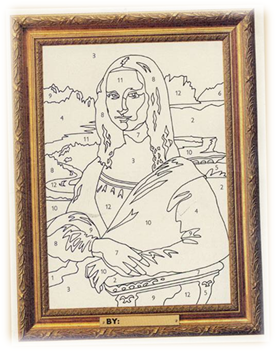
As part of doing some book research, I came across three distinct bodies of work that I think can help Microsoft and their customers better understand, foster and cultivate SharePoint maturity. To set the scene, I started this series by taking a few cheap potshots at the SharePoint 2010 governance poster that many people use as a guide to ensure they are doing SharePoint “right”. I highlighted some of the less obvious risks with it, by comparing it to a paint by numbers representation of the Mona Lisa. While people seem to understand implicitly that colouring in a Mona Lisa template will not make it a Mona Lisa (far from it), there same cannot be said for our SharePoint paint by numbers poster. The result is a skewed version how SharePoint ‘maturity’ is perceived, because this poster ignores some critical factors.

image_thumb2image_thumb5

To shine a spotlight on areas not covered by the above poster, I introduced you to the work of JR Hackman, who’s pioneering work in the area of leadership and team development contains important lessons for SharePoint teams. Hackman urges people to stop trying to look life through simplistic cause and effect lens of “If you do Z, you will get Y” and instead focus on the conditions that enable or disable success. Hackman, in his examination of leadership and the performance of teams, listed six conditions that he felt led to better results if they were in place (none of which make much of an appearance on the above poster):

  1. A real team: Interdependence among members, clear boundaries distinguishing members from non-members and moderate stability of membership over time
  2. A compelling purpose: A purpose that is clear, challenging, and consequential. It energizes team members  and fully engages their talents
  3. Right people: People who had task expertise, self organised and skill in working collaboratively with others
  4. Clear norms of conduct: Team understands clearly what behaviours are, and are not, acceptable
  5. A supportive organisational context: The team has the resources it needs and the reward system provides recognition and positive consequences for excellent team performance
  6. Appropriate coaching: The right sort of coaching for the team was provided at the right time

I sometimes challenge agile development evangelists by saying “If Scrum was ‘the answer’ then there would be no need for Scrum coaches.” When you speak to good agile coaches, what they strive to do is create the sort of enabling conditions conducive to getting the best out of Agile – exactly what Hackman is urging us to do. Hackman’s insight is super important because It is incredibly common for people to say things like “now this will work for the right organisation…” or “this will work provided the right culture is there to support it,” but they do not elaborate further on what “right” actually is. Hackman challenges us to actually focus on the enabling conditions that underpinning a process, not the other way around.

To see if Hackman’s 6 conditions were applicable outside of his interest area of team development, I then examined the work done by the Wilder Research Group. This group published a book “Collaboration: What Makes It Work” which distilled the wisdom from 281 research studies on successful collaboration. Importantly for me, they looked at very different research than Hackman did, yet also broke it down to six quite similar focus areas:

  1. Membership characteristics: Skills, attributes and opinions of individuals as a collaborative group, as well as culture and capacity of orgs that form collaborative groups
  2. Purpose: The reasons for the collaborative effort, the result or vision being sought
  3. Process and structure: Management, decision making and operational systems of a collaborative context
  4. Communication: The channels used by partners to exchange information, keep each-other informed and convey opinions to influence
  5. Environment: Geo-location and social context where a collaborative group exists. While they can influence, they cannot control
  6. Resources: The financial and human input necessary to develop and sustain a collaborative group

Finally, I examined the work of Stephen Duffield, who took the Swiss Cheese model for risk management (which is popular in safety circles) and adapted it for organisational learning for projects. This is brilliant because the Swiss cheese model assumes that any one mitigation strategy has holes in it (hence the Swiss cheese metaphor). If you consider the SharePoint governance poster above as listing particular slices of cheese, then if you still have not met with the success you were hoping for, some important slices of cheese must be missing. So what are they?

To develop his project learning model (called SYLLK), Duffield distilled the wisdom over 500 papers on the topics of project lessons learned, knowledge management and risk management. Like above two research efforts, he also distilled it down to six key areas. Duffield’s slices of cheese were:

  1. Learning: Whether individuals on the team were skilled, had the right skills for their role and whether they were kept up-skilled
  2. Culture: What participants do, what role they fulfil, how an atmosphere of trust is developed in which people are encouraged, even rewarded for truth telling– but in which they are also clear about where the line must be drawn between acceptable and unacceptable behaviour”
  3. Social: How people relate to each-other, their interdependence and how they operate as a team
  4. Technology: Ensuring that technology and data supports outcomes and does not get in the way
  5. Process: Ensuring the appropriate protocols drive people’s behaviour and inform what they do (gate, checklists, etc.)
  6. Infrastructure: Environment (in terms of structure and facilities) that enable project outcomes

Why does all this stuff matter?

Now I am hoping this is not the case, but I would not be surprised that some readers have gotten to this point and are thinking “What the hell does all this have to do with SharePoint maturity?” (particularly if you have not read the 3 articles that preceded this one). So let’s address this one now…

Since 2009 I have taught a SharePoint Governance and Information Architecture class to BAs, PMs, CIOs, consultants, as well as developers and IT Pros. I’ve taught the class around the world and in every class I start by asking students to articulate what they feel is the hardest thing about SharePoint delivery. Take a look at the answers for yourself…

A Brisbane 2012 class said:

  • Explaining what SharePoint is
  • User uptake (“People do not like new things”)
  • Managing proliferation of SharePoint sites
  • Too much IT ownership (“Sick of IT people telling me that SP is the solution”)
  • Users don’t know what they want
  • Difficulties around SP ownership because of a lack of accountability

Not too many technical answers here it seems – in fact I am seeing connections to Hackman, Wilder and Duffield already. Looking at the seven points, they indicate we are missing some key enabling conditions like a compelling purpose, role clarity as well as the collaborative skills and attributes needed in the SharePoint team to address them (“User uptake” and “Difficulties around SP ownership because of a lack of accountability”). Perhaps we are also missing product skills (“proliferation of SharePoint sites”) and have an issue with process and structure, given the complaint of “too much IT ownership”.

Not convinced? For what it’s worth, Melbourne 2010 answered with:

  • Every project is “new” (“Traditional ASP.NET web site development is ‘same old same old’)
  • The solution is never the same as the initial design and the end client may not realise this. The implication is gaps between expectation and delivery
  • Stakeholders don’t know what they want (“First time around what they sign off on is not what they want “)
  • Projects launched as “IT projects” with no clear deliverable and no success indicators
  • Lack of visibility as to what other organisations are doing
  • Determining limits and boundaries (“Doing anything ‘practically’ in SharePoint is hard”).
  • Managing expectations around SharePoint.
    • Clients with no experience think it can do everything
    • Difficulties getting information from and translating into design, so it can be implemented
  • Legacy of bad implementations makes it hard to win the business owner
  • Lack of governance
    • Viral spread of unmanaged sites
    • No proper requirements of “why”
    • No-one managing it

… and if you want to move further afield, Singapore 2012 said:

  • Trying to deal with the sheer number of features
  • “A totally different kind of concept”
    • A little knowledge can be dangerous
    • If you start with the wrong footing, you end up messing it up
  • Trying to deal with “I need SharePoint”
  • SharePoint for an external web site was difficult to use. Unfriendly structure for a public facing website
  • Trying to get users to use it (Steep learning curve for users)
  • The need for “deep discussion” to ensure SharePoint is put in for the right reasons. Without this, the result is messy, disorganised portals
  • The gap between the business and IT results in a sub optimal deployment
  • Demonstrating value to the business (SharePoint installed, but its potential is not being realized)
  • Stakeholders not appreciating the implication of product versus platform
  • You are working across the entire business (The disconnect between management/coalface)
  • “Everything hurts with SharePoint”
  • Facilitating the discussion at the business level is hard when your background is IT

Once again, if you start to distil the underlying themes behind the above answers, you can start to see how Hackman’s conditions are not met and how we are missing some of Duffield’s slices of cheese. So at this point if you are not convinced of the relevance of Hackman, Wilder and Duffield’s research by now, then I can confidently tell you two things…

  • 1) I am not the SharePoint consultant that you need!
  • 2) I am eventually going to become the SharePoint consultant you need! (You will see the light eventually Smile)

The number of the beast…

Hopefully by now I have given you an appreciation of Hackman, Wilder and Duffield’s work and its relevance to SharePoint maturity. All of them have made highly rigorous research efforts, each asking different questions and utilising different research. Those of you who are more superstitiously minded might feel that I am meddling with the forces of darkness here, given that each of the three distilled 6 themes – 666 Surprised smile

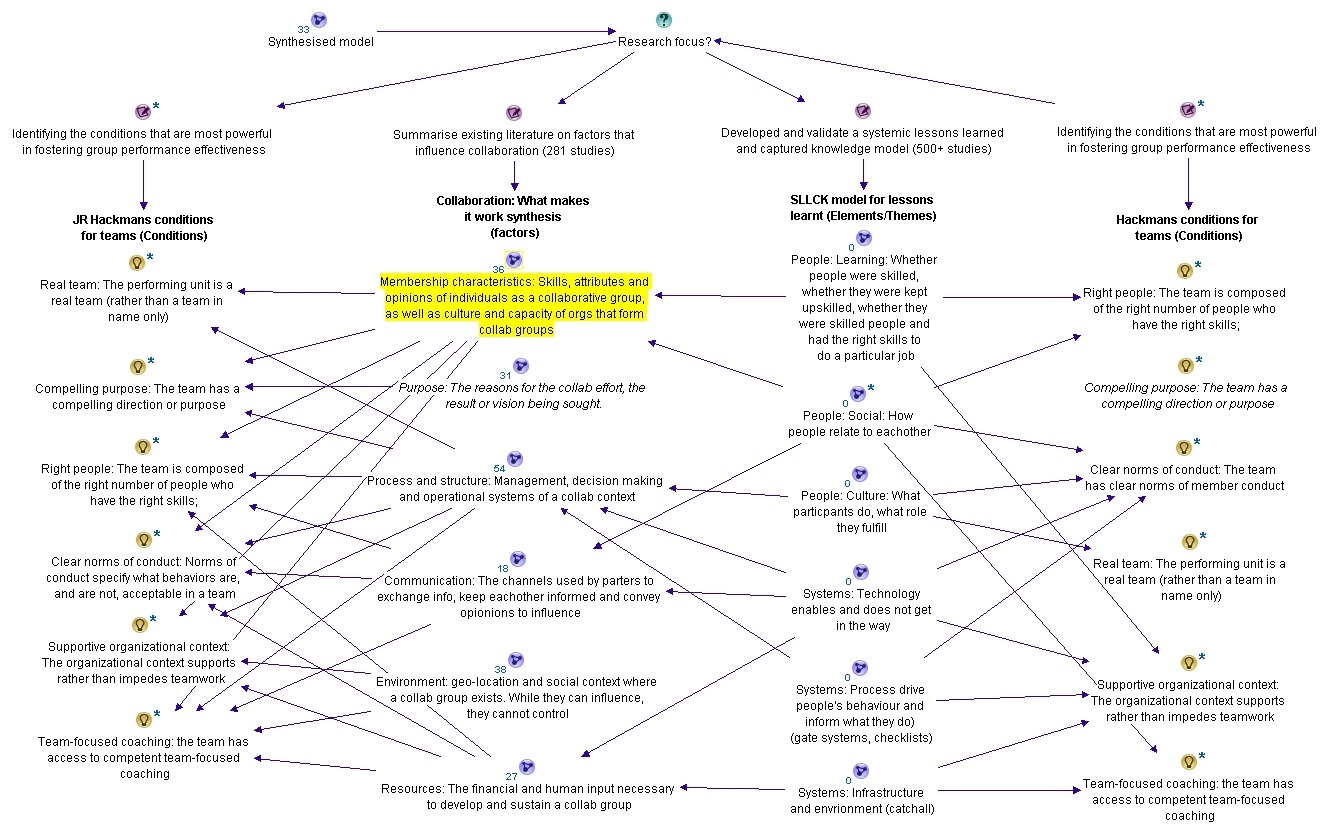
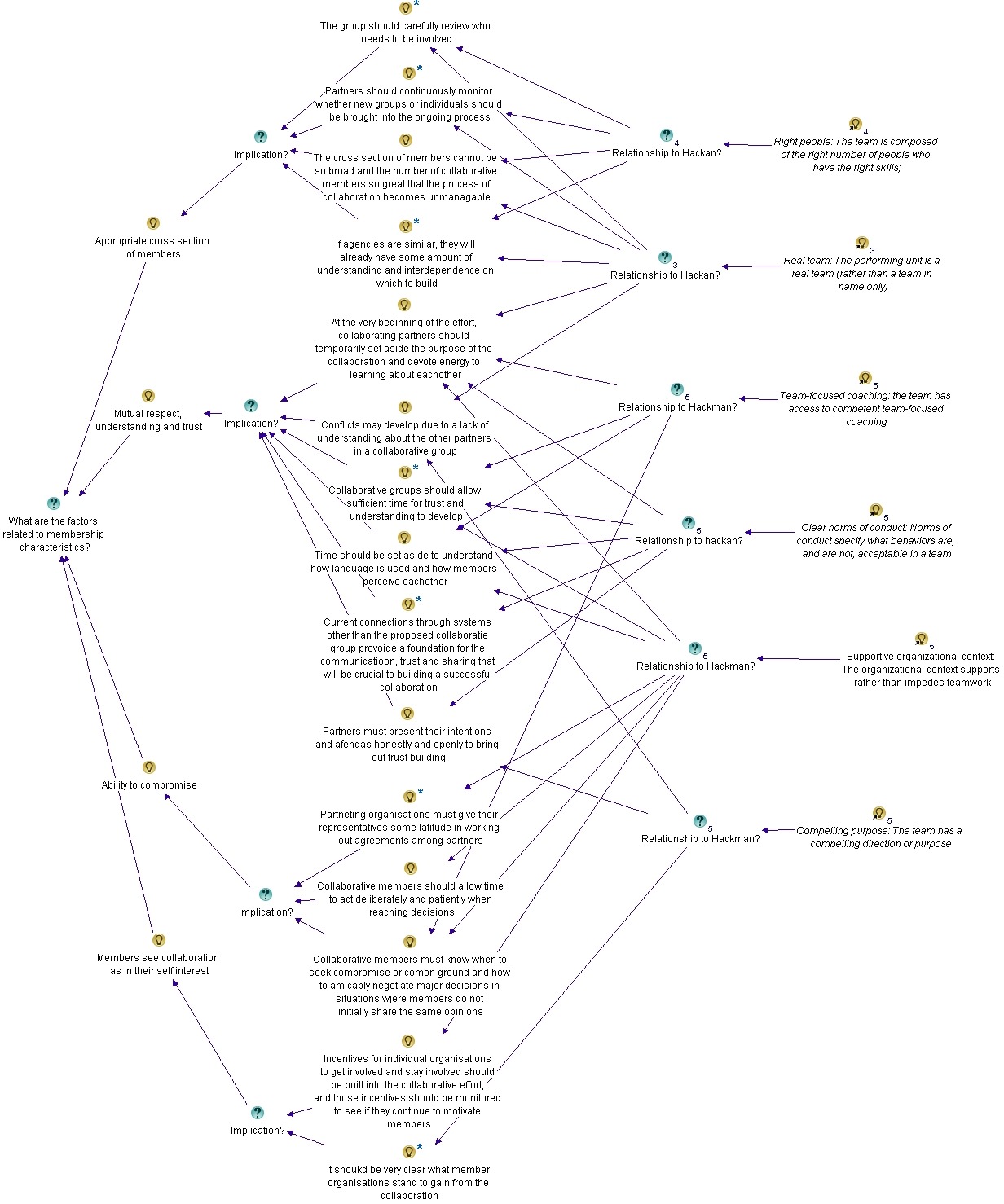
While there is no fire and brimstone nearby as I write this text, my next job was to indeed meddle with dark forces in the sense that I had to perform my own analysis of their work to draw out the commonalities and gaps. I figured that this would go a long way to laying the groundwork for gaps I see in SharePoint maturity. I won’t bore you with too much of the detail on this effort, except to say that I used Dialogue Mapping techniques to perform the synthesis. Below are a couple of screenshots illustrating the maps I built which give you a feel for what was done (click to enlarge)…


In a nutshell, I mapped out each authors six constructs and then mapped their behind the scenes detail. As expected, while some terminology differed somewhat , by in large there was a lot of commonality. I linked all the commonalities together in my maps and slowly, a new picture began to emerge…

Meddling with forces…

When you think about it, my synthesis of this research is not all that different from what SharePoint people do all the time when developing an information architecture to store organisational data in a meaningful and intuitive way. Just like when you have to determine an appropriate navigation structure for your SharePoint sites, with this work I had to first think about the basis for how I wanted to structure things.

First up, I found Duffield’s use of Swiss cheese model for risk inspiring and absolutely applicable for SharePoint maturity. The metaphor of holes in each slice of SharePoint governance “cheese” is vivid and confronting. The commonality in the answers I got to the above “What is the hardest thing about SharePoint?” question speaks to the fact that there are universally common missing slices of SharePoint governance cheese. I also felt strongly that there was huge potential for a clearer relationship between Hackman’s enabling conditions and Duffield’s lessons learnt. My logic was pretty basic here: Surely organisational lessons learnt (if actually learnt), should be enabling conditions next time around? It seemed to me that Hackman “conditions” and Duffield “lessons” are looking at the same thing, just from different points in time. So my intention was to develop my own Swiss cheese model using constructs (navigation labels if you will) that could be lessons learned focus areas as well as enabling conditions. That way one could truly gauge if lessons really had been learnt, because by definition they would be the enabling conditions to strive for next time around.

The other thing I was looking to do was to make things more actionable. Saying things like “have the right people”, “the right membership characteristics” or “the right culture” are not easily actionable because what exactly is “right” anyway? To that end, I think all of the authors suffered from creating constructs that were fine for their purposes, but were a bit wishy-washy when trying to be more directive and action-focused.

One particular anomaly I noticed when comparing the research was the lack of “purpose” as a construct in Duffield’s work. Hackman and Wilder both list “purpose” as one of their six factors, but Duffield’s SYLLK model makes no mention of purpose at all. I felt this needed to be addressed because lack of purpose is one of the classic symptoms of a wicked problem – a topic I have been writing about for years now. So for me, clarity of purpose is a very big slice of Swiss cheese!

I also felt that Hackman was a bit weak on some of the process/system areas. Duffield lists “process”, “technology” and “infrastructure” as key focus areas for lessons learnt on projects and the closest Hackman comes to that is “Supportive organizational context”. This is understandable when you remember that Hackman was talking only about teamwork in general. Nevertheless for our SharePoint context, I thought that Duffield was closer to the mark. Wilder turned out to be a bit in between – as they list “Process and structure” and “Resources” as two of their six areas.

There were other various things that influenced my synthesis as well, but none of them matter for this discussion. I guess you want to see the results no?

The CALL model

The result of this work is a model I have called the CALL model (Conditions to Actionable Lessons Learnt). Since this post is getting long, I will defer a detailed description of the model for the next article. But to whet your appetite, below is an image that shows what I ended up with. It adopts Duffield’s SYLLK model as its base, but highlights 8 enabling conditions (or learning areas), split across individual, team and organisation lines. Additionally, distinction is also made between the soft (people) factors and the harder (system) factors. The arrows are there to help convey the “defence in depth” idea of the Swiss cheese model.

If you go back to the start of this article and examine Hackman, Wilder and Duffield’s work, you will see all of them represented here, except I used more action focused labels. My contention is that these eight areas are what you should be considering when judging your organisation’s SharePoint maturity. The importance of considering these as enabling conditions, to be put in place right at the start cannot be underestimated. Going back to Hackman, here is what he said about the importance of enabling conditions for team performance (emphasis mine):

Let me go out on a limb and make rough estimates of the size of these effects. I propose that 60 per cent of the difference in how well a group eventually does is determined by the quality of the condition-setting prework the leader does. Thirty per cent is determined by how the initial launch of the group goes. And only 10 per cent is determined by what the leader does after the group is already underway with its work. This view stands in stark contrast to popular images of group leadership—the conductor waving a baton throughout a musical performance or an athletic coach shouting instructions from the sidelines during a game

I note that Hackman’s view doesn’t just stand in stark contrast to “popular images of group leadership” – it also stands in stark contrast to Microsoft’s SharePoint governance poster too!

Conclusion

Now I am sure that some of you are still trying to decipher the model above, or feel the urge to tell me that something is missing or that the labels for each of my slices of SharePoint maturity cheese don’t do it for you. In the next post I will spend more time going over the model and what each slice really means. Given the heritage of the source material that inspired it, I feel that it can be used in various SharePoint and non-SharePoint scenarios. So I will also spend some time talking about that.

Finally, I don’t know if any of you have noticed, but I didn’t actually develop this model just for SharePoint! In fact I have already used this model in various non-SharePoint ways too. We will also take a look at this…

thanks for reading


Paul Culmsee
www.hereticsguidebooks.com

HGBP_Cover-236x300


Rethinking SharePoint Maturity Part 3: Who moved my cheese?

Hi all

Welcome to part 3 in this series about rethinking what SharePoint “maturity” looks like. In the first post, I introduced the work of JR Hackman and his notion of trying to create enabling conditions, rather than attribute cause and effect. Hackman, in his examination of leadership and the performance of teams, listed six conditions that he felt led to better results if they were in place. Those conditions were:

  1. A real team: Interdependence among members, clear boundaries distinguishing members from non-members and moderate stability of membership over time
  2. A compelling purpose: A purpose that is clear, challenging, and consequential. It energizes team members  and fully engages their talents
  3. Right people: People who had task expertise, self organised and skill in working collaboratively with others
  4. Clear norms of conduct: Team understands clearly what behaviours are, and are not, acceptable
  5. A supportive organisational context: The team has the resources it needs and the reward system provides recognition and positive consequences for excellent team performance
  6. Appropriate coaching: The right sort of coaching for the team was provided at the right time

I then got interested in how applicable these conditions were to SharePoint projects. The first question I asked myself was “I wonder if Hackman’s conditions apply to collaboration itself, as opposed to teams.” To find out, I utilised some really interesting work done by the Wilder Research Group, that produced a book called “Collaboration: What Makes It Work.” This book distilled the wisdom from 281 research studies on collaborative case studies and their success or failure. They distilled things down to six focus areas (they ended up with the same number as Hackman). Their six were:

  1. Membership characteristics: (Skills, attributes and opinions of individuals as a collaborative group, as well as culture and capacity of orgs that form collaborative groups)
  2. Purpose: (The reasons for the collaborative effort, the result or vision being sought)
  3. Process and structure: (Management, decision making and operational systems of a collaborative context)
  4. Communication: (The channels used by partners to exchange information, keep each-other informed and convey opinions to influence)
  5. Environment: (Geo-location and social context where a collaborative group exists. While they can influence, they cannot control)
  6. Resources: (The financial and human input necessary to develop and sustain a collaborative group)

If you want the fuller detail of Hackman and Wilder, check the first and second posts respectively. But it should be clear from even a cursory look at the above lists, that there is a lot of overlap and common themes between these two research efforts and we can learn from them in our SharePoint work. I strongly believe that this sort of material constitutes a critical gap in a lot of the material out there on what it takes to have a successful SharePoint deployment and offers some excellent ideas in further developing ideas around SharePoint maturity. I started to develop a fairly comprehensive Dialogue Map of both of these research efforts so I could synthesise them to create my own set of “conditions” in the way Hackman describes. While I was doing this, I met a fellow via LinkedIn who opened my mind to further possibilities. Everybody, meet Stephen Duffield

Duffield’s SYLLK model for lessons learnt

I met Steve because we both shared a common interest in organisational knowledge management. In, fact Steve is working on his PhD in this area, focussing on addressing the pitiful record of organisations utilising lesson learnt practices on projects and then embedding them into organisational  culture and practices. If you have ever filled out a lessons learnt form, knowing full-well that it will disappear into a filing cabinet never to be seen again, Steve shares your frustration. For his PhD, he is tackling two research questions:

  1. What are the significant factors that negatively influence the capture, dissemination and application of lessons learned from completed projects within project-based organisations?
  2. Can a systemic knowledge model positively influence the capture, dissemination and application of project management lessons learned between project teams within the organisation?

Now if you think it was impressive that Wilder researched 281 studies on collaboration, Steve topped them by miles. His PhD literature review covered over 500+ papers on the topics of project lessons learned, knowledge management, risk management and the like. 500! Man, that’s crazy – all I can say to that is I am sure as hell glad he did it and I didn’t have to!

So what was the result of Duffield’s work? In a nutshell, he has developed a model called “Systemic Lessons Learned Knowledge” (SYLLK), which was influenced by the Swiss Cheese model for risk management, originally proposed by Dante Orlandella and James T. Reason.

Why SYLLK is important for SharePoint

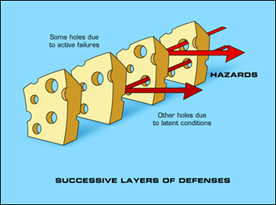
imageBefore I explain Duffield’s SYLLK model, it is important I briefly explain the Swiss Cheese model for risk management that inspired him. The Swiss Cheese Model (see the image to the left) for risk management is commonly used in aviation and healthcare safety. It is based on the notion that systems have potential for failure in many areas and these are analogous to a stack of slices of Swiss cheese, where the holes in each slice are opportunities for a process to fail. Each of the slices are “defensive layers” and while an error may allow a problem to pass through a hole in one layer, in the next layer the holes are in different places, allowing the problem to be caught before its impact becomes severe.

The key to the Swiss Cheese Model is that it assumes that no single defence layer is sufficient to mitigate risk. It also implies that if risk mitigation strategies exist, yet all of the holes are lined up, this is an inherently flawed system. Why? because it would allow a problem to progress through all controls and adversely affect the organisation. Therefore, its use encourages a more balanced view of how risks are identified and managed.

So think about that for a second… SharePoint projects to this day remain difficult to get right. If you are on your third attempt at SharePoint, then by definition you’ve had previous failed SharePoint projects. The inference when applying the Swiss cheese model is that your delivery approach is inherently flawed and you have not sufficiently learnt from it. In other words, you were – and maybe still are – missing some important slices of cheese from your arsenal. From a SharePoint maturity perspective, we need to know what those missing slices are if we wish to raise the bar.

So the challenge I have for you is this: If you have had a failed or semi-failed SharePoint project or two under your belt, did you or others on your team ever say to yourself “We’ll get it right this time” and then find that the results never met expectations? If you did, then Duffield’s (and my) contention is you might have failed to truly understand the factors that caused the failure.

Back to Duffield…

This is where Duffield’s work gets super interesting. He realised that the original Swiss cheese “slices” that resolved around safety were inappropriate for a typical organisation managing their projects. Like the Wilder work on collaboration, Steve reviewed tons of literature and synthesised from it, what he thinks are the key slices of cheese that are required to enable not only mitigation of project risks, but also focus people on the critical areas that need to be examined to capture the full gamut of lessons learnt on projects.

So how many slices of cheese do you think Steve came up with? If you read the previous two posts then you can already guess at the answer. Six!

There really seems to be something special about the number 6! We have Hackman coming up with 6 conditions for high performing teams, Wilder’s 6 factors that make a difference in successful collaboration and Duffield’s 6 areas that are critical to organisational learning from projects! For the record, here are Duffield’s six areas (the first three are labelled as people factors and the second three are system factors):

  1. Learning: Whether individuals on the team are skilled, have the right skills for their role and whether they are kept up-skilled
  2. Culture: What participants do, what role they fulfil, how an atmosphere of trust is developed in which people are encouraged, even rewarded for truth telling– but in which they are also clear about where the line must be drawn between acceptable and unacceptable behaviour”
  3. Social: How people relate to each-other, their interdependence and how they operate as a team
  4. Technology: Ensuring that technology and data supports outcomes and does not get in the way
  5. Process: Ensuring the appropriate protocols drive people’s behaviour and inform what they do (gate, checklists, etc.)
  6. Infrastructure: Environment (in terms of structure and facilities) that enable project outcomes

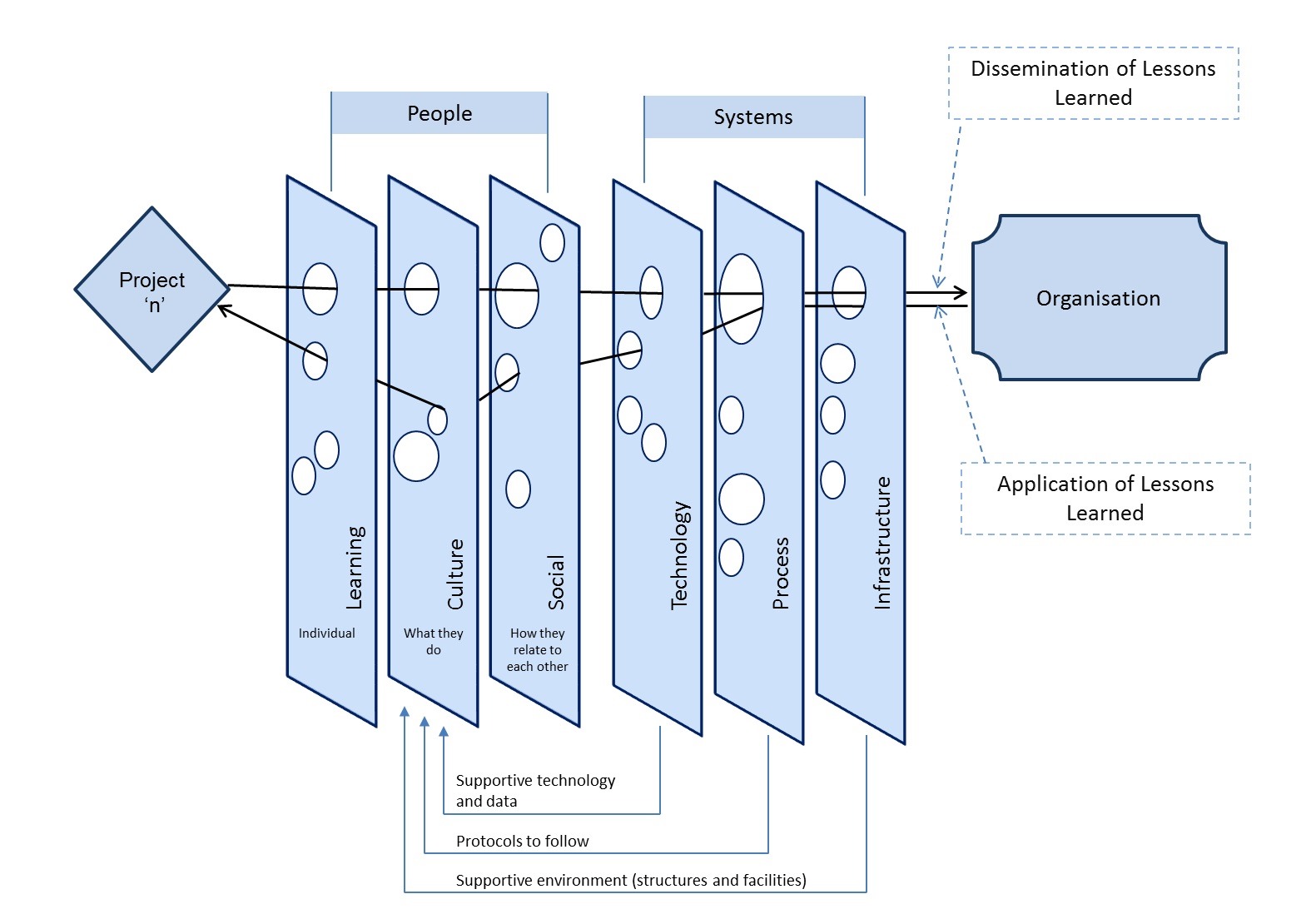
Duffield has a diagram that illustrates the SYLLK model, showing how his six identified organisational elements of learning, culture, social, technology, process and infrastructure align as Swiss cheese slices. I have pasted it (with permission), below (click to enlarge).

Duffield states that the SYLLK model represents “the various organisational systems that collectively form the overall behaviour of the organisation. The various modes of social and cultural learning, along with the organisational processes, infrastructure and technology that support them.” Notice in the above diagram how the holes in each slice are not lined up when the project arrow moves right to left. This makes sense because the whole point of the model is the idea of “defence in depth.” But then the holes are aligned when moving from left to right. This is because each slice of cheese need to be aligned to enable the feedback loop – the effective dissemination and application of the identified lessons.

Conclusion

The notion of the Swiss cheese model for mitigating risk makes a heck of a lot of sense for SharePoint projects, given that

  • a) there is a myriad of technical and non technical factors that have to be aligned for sustained SharePoint success, and
  • b) SharePoint success remains persistently illusive for many organisations.

What Duffield has done with the SYLLK model is to take the Swiss Cheese model out of the cloistered confines of safety management and into organisational learning through projects. This is huge in my opinion, and creates a platform for lots of innovative approaches around the capture and use of organisational learning, all the while framing it around the key project management task of identifying and mitigating risk. From a SharePoint maturity perspective, it gives us a very powerful approach to see various aspects of SharePoint project delivery in a whole new light, giving focus to aspects that are often not given due consideration.

Like the Wilder model, I love the fact that Duffield has done such a systematic and rigorous review of literature and I also love the fact that his area of research is quite distinct from Hackman (conditions that enable team efficacy) and the Wilder team (factors influencing successful collaboration). When you think about it, each of the three research efforts focuses on distinct areas of the life-cycle of a project. Hackman looks at the enabling conditions required before you commence a project and what needs to be maintained. Wilder appears to focus more on what is happening during a project, by examining what successful collaboration looks like. Duffield then looks at the result of a project in terms of the lessons learnt and how this can shape future projects (which brings us back to Hackman’s enabling conditions).

While all that is interesting and valuable, the honest truth is that I liked the fact that all three of these efforts all ended up with six “things”. It seemed preordained for me to “munge” them together to see what they collectively tell us about SharePoint maturity.

… and that’s precisely what I did. In the next post we will examine the results.


Thanks for reading


Paul Culmsee

www.hereticsguidebooks.com


Rethinking SharePoint Maturity Part 2: What Makes Collaboration Work

Hi all

Welcome to part 2 about my research efforts that has led me to thinking a little differently in how we understand and measure SharePoint and organisational “maturity”. In the first post, I gave a glimpse into the work of JR Hackman, who had presented some really interesting ideas about what leads to outstanding team performance. In case you have not read the first post (damn you!), Hackman presented the notion that trying in vain to come up with the causes of team efficacy was a rather dumb idea and instead, looking at the conditions that enable great teams was a much more productive approach.

This notion of conditions over causes is really important to understand, because we all routinely get suckered into conversations about whether one process, approach or model is objectively “better” than another. This sort of discussion frustrates me and I usually find it all rather pointless because it all but ignores the underlying conditions that enabled or disabled things. As a result, we misattribute success or failure of SharePoint to how we used methods, processes and models, rather than focus on what really matters – the conditions under which those methods, processes and models operated.

Now Hackman was not looking at SharePoint projects when he came to this realisation. He was looking at leadership and the performance of teams in general. He synthesised his years of research work down to six conditions that he felt led to better results if they were in place. Those conditions are:

  1. A real team: Interdependence among members, clear boundaries distinguishing members from non-members and moderate stability of membership over time
  2. A compelling purpose: A purpose that is clear, challenging, and consequential. It energizes team members  and fully engages their talents
  3. Right people: People who had task expertise, self organised and skill in working collaboratively with others
  4. Clear norms of conduct: Team understands clearly what behaviours are, and are not, acceptable
  5. A supportive organisational context: The team has the resources it needs and the reward system provides recognition and positive consequences for excellent team performance
  6. Appropriate coaching: The right sort of coaching for the team was provided at the right time

So I very much bought into Hackman’s conditions over causes argument, but wasn’t sure whether his six conditions were directly applicable to SharePoint projects. To find out, I got lucky, coming across some really great work on the subject of collaboration by the Wilder Research Group.

Collaboration: What Makes it Work

Earlier this year, I  bought a crapload of books on the topic of collaboration. One of them had the rather long title of “Collaboration: What Makes It Work, 2nd Edition: A Review Of Research Literature On Factors Influencing Successful Collaboration” written by Paul W. Mattessich, Marta Murray-Close, Barbara R. Morrisey and published by the Wilder Research Group.

This book is quite short – just over 100 pages, but it packs a heavy punch nevertheless. The core question asked in this book was “What makes the difference between your collaboration’s failure or success?” and it sought to answer the question by providing an in-depth review of lots (and lots and lots) of academic research on collaboration. In all, the authors examined more than 281 research studies on collaborative initiatives (and their success or failure) and synthesised them. I love these sort of meta-analysis studies, because I am lazy and its terrific when someone else has done the rigorous hard work!

Why Wilder matters for SharePoint

The intent of the report is to help readers expand their thinking about ways to help projects succeed, gain background information before beginning a collaboration, compare their situation with others, determine collaboration strategy including necessary ingredients, uncover and resolve trouble spots. It also provides a tool called the “The Collaboration Factors Inventory which allows you to self-assess how your collaboration is doing against the success factors they came up with. Examples are also provided of how organizations have used the inventory as well as a case study illustrating how one collaboration assessed itself and how it  used the results to take action to improve its success.

Thus, it should be fairly obvious why this particular work should be of interest to SharePoint practitioners. After all, improving collaboration in organisations and teams is one of the core value propositions that underpins SharePoint and has done so for years now. Under the guise of “governance”, we do lots of work and produce processes (and usually lots of documentation) in the hope that we have put in the necessary plumbing for collaboration to take root and blossom. So when someone has taken the time to distil the learnings from 281 research efforts into collaborative success, there is bound to be valuable takeaways to be had for us SharePoint peeps – especially if our organisations have bought heavily into “social” features of the product.

Now while that all sounds good, there is another less obvious, but cooler reason to be interested in this book – especially given my examination of Hackman in part 1. The Wilder team found a total of 20 factors that were identified as “ingredients” for successful collaboration and guess how many categories they distilled them down to?

Six! – precisely the same number of conditions that Hackman distilled for great team performance. So, wouldn’t it be interesting to see how much overlap there is between what Hackman says are the six conditions for great teams versus Wilder’s six “differences” between collaboration failure and success?

I thought so too…

Back to the Wilder team…

So what are the factors that make a difference in successful collaboration identified by Wilder? Below are their twenty ingredients, divided into the aforementioned six categories…

  • 1. Membership characteristics: (Skills, attributes and opinions of individuals as a collaborative group, as well as culture and capacity of orgs that form collaborative groups)
    • – Mutual respect, understanding and trust: Members of the collaborative group share an understanding and respect for each other and their respective organizations: how they operate, their cultural norms and values, limitations, and expectations.
    • – Appropriate cross section of members: To the extent that they are needed, the collaborative group includes representatives from each segment of the community who will be affected by its activities.
    • – Members see collaboration as in their self interest: Collaborating partners believe that they will benefit from their involvement in the collaboration and that the advantages of membership will offset costs such as loss of autonomy and turf.
    • – Ability to compromise: Collaborating partners are able to compromise, since the many decisions within a collaborative effort cannot possibly fit the preferences of every member perfectly.
  • 2. Purpose: (The reasons for the collaborative effort, the result or vision being sought)
    • – Concrete, attainable goals and objectives: Goals and objectives of the collaborative group are clear to all partners, and can realistically be attained.
    • – Shared vision: Collaborating partners have the same vision, with clearly agreed-upon mission, objectives, and strategy. The shared vision may exist at the outset of collaboration, or the partners may develop a vision as they work together.
    • – Unique purpose: The mission and goals or approach of the collaborative group differ, at least in part, from the mission and goals or approach of the member organizations.
  • 3. Process and structure: (Management, decision making and operational systems of a collaborative context)
    • – Members that share a stake in both process and outcome: Members of a collaborative group feel “ownership” of both the way the group works and the results or product of its work.
    • – Multiple layers of participation: Every level (upper management, middle management, operations) within each partner organisation has at least some representation and ongoing involvement in the collaborative initiative
    • – Flexibility: The collaborative group remains open to varied ways of organising itself and accomplishing its work
    • – Development of clear roles and policy guidelines: The collaborating partners clearly understand their roles, rights, and responsibilities, and they understand how to carry out those responsibilities.
    • – Adaptability: The collaborative group has the ability to sustain itself in the midst of major changes, even if it needs to change some major goals, members, etc., in order to deal with changing conditions.
    • – Appropriate pace of development: The structure, resources, and activities of the collaborative group change over time to meet the needs of the group without overwhelming its capacity, at each point throughout the initiative.
  • 4. Communication: (The channels used by partners to exchange information, keep each-other informed and convey opinions to influence)
    • – Open and frequent communication: Collaborative group members interact often, update one another, discuss issues openly, and convey all necessary information to one another and to people outside the group.
    • – Established informal relationships and communication links: In addition to formal channels of communication, members establish personal connections — producing a better, more informed, and cohesive group working on a common project.
  • 5. Environment: (Geo-location and social context where a collaborative group exists. While they can influence, they cannot control)
    • – History of collaboration or cooperation in the community: A history of collaboration or cooperation exists in the community and offers the potential collaborative partners an understanding of the roles and expectations required in collaboration and enables them to trust the process
    • – Collaborative group seen as a legitimate leader in the community: The collaborative group (and by implication, the agencies in the group) is perceived within the community as reliable and competent—at least related to the goals and activities it intends to accomplish.
    • – Favourable political and social climate: Political leaders, opinion-makers, persons who control resources, and the general public support (or at least do not oppose) the mission of the collaborative group
  • 6. Resources: (The financial and human input necessary to develop and sustain a collaborative group)
    • – Sufficient funds, staff, materials and time: The collaborative group has an adequate, consistent financial base, along with the staff and materials needed to support its operations. It allows sufficient time to achieve its goals and includes time to nurture the collaboration.
    • – Skilled leadership: The individual who provides leadership for the collaborative group has organizing and interpersonal skills, and carries out the role with fairness. Because of these characteristics (and others), the leader is granted respect or “legitimacy” by the collaborative partners.

Now that you have seen Wilders six factors that influence successful collaboration, think about where you focus on your SharePoint projects in the name or guide of “governance”. How many of these factors did you consider when you started on your quest to use SharePoint for improved collaboration? Which of these really scream out at you as something worth pursuing? Go back in time and with hindsight, imagine if you had considered these and acted on it… Would it had led to better outcomes?

Conclusion

I have previously stated that collaboration is a classic SharePoint platitude, and chasing goals like “improved collaboration” are a sure fire way to create elaborate SharePoint solutions that miss the mark. Thus, this work by Wilder is a crucial resource in helping organisations determine what collaboration means to them. Furthermore, anyone interested in assessing SharePoint “readiness” (whatever your interpretation of readiness), would be well served to think about how they can incorporate the Wilder work into their readiness or maturity models. After all, how many other meta analyses of 281 studies on the topic have been done, eh?

Consider also that the Wilder team asked themselves a different question than Hackman. While Hackman framed his question around “What are the enabling conditions?” the Wilder team asked “What makes the difference?” This more broader question posed by the Wilder team explains a lot about their results. Some of their collaboration success factors can be seen as potential enabling conditions as Hackman described, whereas others are a more retrospective look on what successful collaboration looks like during and after collaboration has taken place. Consider also Hackman and the Wilder team used very different areas of research to come up with their answers. Wilder examined 281 case studies on successful collaboration, whereas Hackman used decades of research in teamwork and leadership. While research on collaboration might seem related to teamwork and leadership, in the world of academic research, you are talking about completely different bodies of knowledge.

Nevertheless, if you compare Hackman’s six conditions to Wilder’s six collaboration factors, there are more overlaps than there are differences. This I find exciting because it tells me that these independent research efforts are coalescing around the same themes. But I am going to defer a detailed examination of them both in context till a future post, because as I started to synthesise Hackman and Wilder together, I came across a third area of research that also led to some important insights – perhaps the most important ones of all… the work of PhD candidate Stephen Duffield in the area of risk and organisational learning on projects.

That my friends, is the topic of the next post…


Thanks for reading

Paul Culmsee
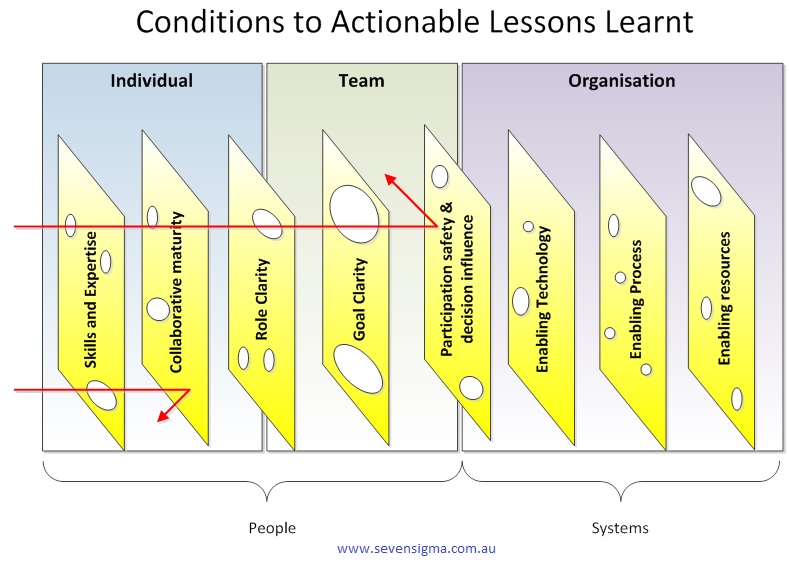
www.hereticsguidebooks.com


Rethinking SharePoint Maturity Part 1: Conditions Over Causes

Hi all

I have been hitting the books lately, doing various bits of research, all related to plans for a new book.  While most of that research would not be of too much interest to readers, some of it turned out to be quite profound and has significant implications for anybody interested in SharePoint governance/maturity/readiness, as well as risk management, organisational learning, knowledge management and team development. So if you are spending your days delving deep into the bowels of the SharePoint 2013 apps model, oAuth and Azure Service Busses, then maybe this article is not for you. However if you manage or are responsible for people or projects that delve deep into the bowels of the SharePoint in areas like the apps model, oAuth and Azure Service Busses, then I strongly suggest you read on. Continue reading “Rethinking SharePoint Maturity Part 1: Conditions Over Causes”


Powerful questions part 3: The “I told you so” question

Hi all

I just recorded the third video on the topic of powerful questions. The purpose of this series of videos is to help facilitators, project managers, business analysts and SharePoint peeps ask better questions of their stakeholders. The first video introduced the platitude buster question and the second video unveiled the key focus area question. Both are hugely important – especially for SharePoint projects and any SharePoint governance efforts because failure to answer these two will positively kill your project. This 3rd powerful question is related to risk perception and how you can frame questions to get a much better sense of what the real risks are in projects or problems. In this video, I made the contention that asking “What are the risks” is not a great way to identify and subsequently manage risks. The inference for SharePoint people here is that if you think you have done your job by creating a risks and issues list (ala Project Server) and asking for people to fill it in, I am here to tell you that there is much more to the story…

Don’t believe me? Then watch the video. 

Like the previous post, I suggest you watch this video in full screen. Enjoy!

How to find out what the real risks are…


High school students showing us SharePoint consultants how it’s done

Hi all

Once in a while, you can come across a case study that not only showcases innovative and brilliant solutions, but tells a much deeper story that both inspires and teaches. I am writing this post to tell you such a story – a story about genuine collaboration and what it can enable when the right conditions exist to foster it.

To explain this story, I first need to talk about the work of an academic named Richard Hackman. Here is a guy who spent most of his working life examining the factors that make teams work really well. Over the years he studied hundreds of high performing teams, trying to distil the magical ingredients that would lead to success for other teams. He would come up with theories, then create models that looked great on a whiteboard, but when applied to real teams in the real world, reality never fitted the models.

From causes to conditions…

After years of doing this, Hackman started to wonder whether he was leaning the ladder against the wrong wall. In other words, he wondered if trying to determine the causes of team efficacy by looking at successful teams retrospectively was the wrong approach. In the end, he changed his focus and asked himself a different question. What are the enabling conditions that need to exist that give rise to great teams?

He came up with six conditions arguing that irrespective of what else you did or what methodology you used, usually led to better results. I will give you a super brief summary below:

  1. A real team: Interdependence among members, clear boundaries distinguishing members from non-members and moderate stability of membership over time
  2. A compelling purpose: A purpose that is clear, challenging, and consequential. It energizes team members  and fully engages their talents
  3. Right people: People who had task expertise, self organised and skill in working collaboratively with others
  4. Clear norms of conduct: Team understands clearly what behaviours are, and are not, acceptable
  5. A supportive organisational context: The team has the resources it needs and the reward system provides recognition and positive consequences for excellent team performance
  6. Appropriate coaching: The right sort of coaching for the team was provided at the right time

Now my interest in Hackman and his conditions stemmed from reviewing the published “models” for SharePoint governance. Whether it is the 7 “pillars”, the 5 “steps”, or the 6 “focus areas”, all are developed in a retrospective way – by looking at a mythically perfect SharePoint solution and then breaking it down into all the things that need to be done to enable it. You see, for a long time now, I have deliberately not started with one of the models up front and Hackman offered me a reason why. Instead I first strive to create the conditions that Hackman lists above and develop governance as it is needed, rather than follow a fixed model.

Meet Louis Zulli Jr and his students

Earlier this year, I met Louis Zulli Jnr – a teacher out of Florida who is part of a program called the Centre of Advanced Technologies. We were co-keynoting at a conference and he came on after I had droned on about common SharePoint governance mistakes. Louis then gave a talk that blew me away, and at the same time proved Hackman completely right. The majority of Lou’s presentation showcased a whole bunch of SharePoint powered solutions that his students had written. The solutions themselves were very impressive, as this was not just regular old SharePoint customisation in terms of a pretty looking site with a few clever web parts. Instead, we were treated to examples like:

  • IOS, Android and Windows Phone  apps that leveraged SharePoint to display teacher’s assignments, school events and class times;
  • Silverlight based application providing a virtual tour of the campus;
  • Integration of SharePoint with Moodle;
  • An Academic Planner web application allowing students to plan their classes, submit a schedule, have them reviewed, track of the credits of the classes selected and whether a student’s selections meet graduation requirements;
  • An innovative campus Hall Pass system that leveraged jQuery, HTML5, CSS3, XML, JSON, REST, List Data Web Services and features integration with IOS, Windows 8 and swipe card hardware.

All of this and more was developed by 16 to 18 year olds and all at a level of quality that I know most SharePoint consultancies would be jealous of. To any of Lou’s students who read this – and I have consulted and delivered SharePoint since 2006, as well as speaking to people around the world on SharePoint – the work quality that I saw is world-class and you all have lucrative careers ahead of you in the SharePoint space and beyond.

image

So the demos themselves were impressive enough, but that is actually not what impressed me the most. In fact, what had me hooked was not on the slide deck. It was the anecdotes that Lou told about the dedication of his students to the task and how they went about getting things done. He spoke of students working during their various school breaks to get projects completed and how they leveraged each other’s various skills and other strengths. Lou’s final slide summed his talk up brilliantly, and really spoke to Hackman’s six conditions. The slide made the following points:

  • Students want to make a difference! Give them the right project and they do incredible things.
  • Make the project meaningful. Let it serve a purpose for the campus community.
  • Learn to listen. If your students have a better way, do it. If they have an idea, let them explore it.
  • Invest in success early. Make sure you have the infrastructure to guarantee uptime and have a development farm.
  • Every situation is different but there is no harm in failure. “I have not failed. I’ve found 10,000 ways that won’t work” – Thomas A. Edison

If you look at the above 5 points and think about Hackman’s conditions of compelling direction, supportive context, real team and coaching in particular, you can see that Lou ensured those conditions were present. The results of course spoke for themselves.

About halfway through Lou’s talk, I decided that whether he liked it or not, he was coming out to Australia to tell this story. So we sat down together and talked for a long while and I asked him all sorts of questions about his students, the projects, how he coached his students and how his own teaching style developed. I ended up showing him Hackman’s six conditions for great teams performance and he said “that’s what we do”.

The real lesson…

So as I write this, Lou is on his long journey home after similarly blowing away the attendees of the Australian SharePoint conference with his story about what he and his students have done. His talk was the hit of the conference and I hope that the staff and students of Lakewood High School read this post because it’s important for them to know that their story and examples were the topic of much conversation amongst attendees and highly inspiring. I also hope that people in the SharePoint community read this because CAT shows precisely why SharePoint can be such an amazing enabler within organisations when the right conditions are in place for it. Governance models are great and all, but without these enabling conditions in place, cannot deliver great outcomes on their own.

This leads me onto one final cautionary point – directed at Lou’s students, but applicable to all readers who aspire to improve collaboration in their organisations and their projects.

There are plenty of clever people in this world – in fact most IT people from my experience are intellectually very clever (IQ), but some have all the emotional maturity (EQ) of a baseball bat. IQ is what you are born with, but EQ is caught and lived. What makes great SharePoint practitioners (and in fact great leaders) is EQ, not just IQ and the CAT program shows what happens when clever people are given discretionary freedom with supportive conditions in place. My advice is to never forget that it is the conditions in which a team or organisation finds itself that a strong predictor of outcome. Take the same clever people and change the conditions (for example, from a supportive educational institution to an organisation with a blame culture and silo based fiefdoms) and you will get very different outcomes indeed.

What students may not realise is that what the CAT program is really teaching them is the experience of living those enabling conditions and therefore teaching them EQ. These students will eventually move into organisations that do not necessarily have the same enabling conditions as what exists for them now. So look past the cool API’s, the development tools, technical whitepapers, the certifications, endless debates as to whether X vs Y is the best practice, and understand the conditions like Hackman did. Strive to (re)create those conditions in all your future work and you will go further than a SharePoint laden CV ever will.

This of course, took me around 18 years of working in IT before I figured it out and have been making amends ever since. So whatever you do, wise up earlier than I did!


Thanks for reading

Paul Culmsee
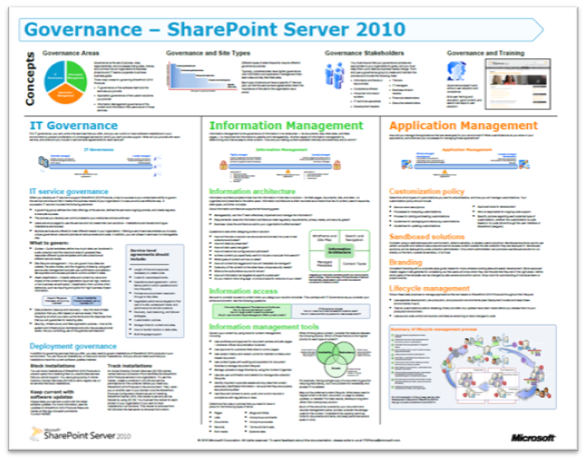
www.cleverworkarounds.com

www.hereticsguidebooks.com

HGBP_Cover-236x300


« Previous PageNext Page »

Today is: Wednesday 3 June 2026 -