Back to Cleverworkarounds mainpage
 

Save the date in October: SharePoint Governance and Dialogue Mapping in the UK

Hi all

Just to let you know that in October, I will be in the UK to run a SharePoint Governance and Information Architecture class with Andrew Woodward. Additionally, I am very pleased to offer a Dialogue Mapping introductory course for the first time in the UK as well. Work has been extremely busy this year and this is my only UK/Europe trip in the next 9-12 months. In short, this is likely to be a once-off opportunity as I travel less and less these days.

Introductory Dialogue Mapping October 17-18, 2012

  • Venue: The Custard Factory, Birmingham, UK
  • Cost: £995

Eventbrite - UK: Solving Complex Problems with Issue Mapping

The introductory Dialogue mapping class will arm you with a life skill that can be used in many different situations and has changed my career. If you have been following my “confessions of a (post) SharePoint Architect” series, a lot of the content is based on my experiences of Dialogue Mapping many different projects in many different industries. Dialogue Mapping is a novel, powerful and inclusive method to elicit requirements, capture knowledge and develop shared understanding in complex projects, such as SharePoint or broader strategic planning. It was pioneered by CogNexus Institue in California, and is used by NASA, the World Bank and United Nations.

My book, “The Heretics Guide to Best Practices” is based on my Dialogue Mapping work and if you liked the book, then I know you will love the course!

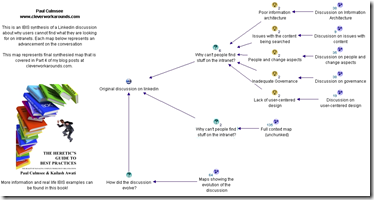
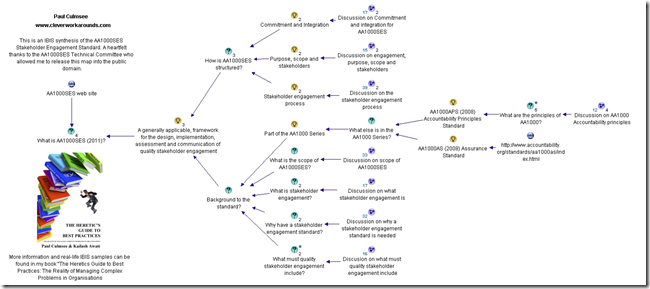
What does a map look like? Check out my map of the AA1000 Stakeholder Engagement Standard or my synthesis on problems with intranet search below…

image  image

I should stress that this is not a SharePoint course. If you are an organisational development practitioner, facilitator, reformed project manager, all-round agitator or are simply interested in helping groups make sense of complex situations, then you would find this class to be highly valuable in your personal arsenal of tools and techniques. When performed live during a facilitated session, it is a highly efficient and engaging experience for participants.

Please note that seats are limited in this class and it cannot be more than  10.

  • Date: October 17-18, 2012
  • Venue: The Custard Factory, Birmingham, UK
  • Cost: £995

Eventbrite - UK: Solving Complex Problems with Issue Mapping


Aligning SharePoint Governance & Information Architecture to Business Goals October 15-16 2012

  • Venue: The Custard Factory, Birmingham, UK
  • Cost: £995
  • Limited seats available: 12

Eventbrite - #SPGov+IA Aligning SharePoint Governance & Information Architecture to Business Goals with Paul Culmsee

Previous Master Class Feedback:

  • "This course has been the most insightful two days of my SharePoint career"
  • "…Was the best targetted and jargon free course I’ve ever been on"
  • "Re-doing my draft SharePoint Governance. Moving away from blah, blah technical stuff"
  • "Easily one of the best courses I’ve been to and has left me wanting more!"
  • "Had a great couple of days at #SPIAUK loving IBIS"
  • "The content covered was about the things technically focussed peeps miss.."

Most people understand that deploying SharePoint is much more than getting it installed. Despite this, current SharePoint governance documentation abounds in service delivery aspects. However, just because your system is rock solid, stable, well documented and governed through good process, there is absolutely no guarantee of success. Similarly, if Information Architecture for SharePoint was as easy as putting together lists, libraries and metadata the right way, then why doesn’t Microsoft publish the obvious best practices?

In fact, the secret to a successful SharePoint project is an area that the governance documentation barely touches.

This master class pinpoints the critical success factors for SharePoint governance and Information Architecture and rectifies this blind spot. Based upon content provided by Paul Culmsee (Seven Sigma) which takes an ironic and subversive take on how SharePoint governance really works within organisations, while presenting a model and the tools necessary to get it right.

Drawing on inspiration from many diverse sources, disciplines and case studies, Paul Culmsee has distilled in this Master Class the “what” and “how” of governance down to a simple and accessible, yet rigorous and comprehensive set of tools and methods, that organisations large and small can utilise to achieve the level of commitment required to see SharePoint become successful.

Seven Sigma, together with 21apps, are bringing the the acclaimed SharePoint Governance and Information Architecture Master class back to the UK, October 2012.

  • Date: October 15-16, 2012
  • Venue: The Custard Factory, Birmingham, UK
  • Cost: £995
  • Limited seats available: 12

Eventbrite - #SPGov+IA Aligning SharePoint Governance & Information Architecture to Business Goals with Paul Culmsee


Thanks for reading

Paul Culmsee


Confessions of a (post) SharePoint architect: Do not penalise people for learning

Hi all and welcome to another small piece of my SharePoint architect manifesto. In the previous post I introduced you to the notion of f-laws, which were first coined in a book co-authored by Russell Ackoff. In the process of developing a SharePoint governance and information architecture class, I was inspired to use the idea of an f-law because they appealed to my contrarian sense of humour and also contained some interesting nuggets of wisdom. I ended up coming up with a heap of f-Laws for SharePoint, and plan to write an article to cover each one.

In the last post, we learnt that f-Law 1 was all about the contention that the more you try and define what governance is, the less anyone will actually understand it. If you never read the first SharePoint Governance f-law then I suggest you do so, because these articles do tend to build on the foundation set from the previous. On that note, the focus of todays f-law extends on one that Ackoff himself came up with. All I am doing it putting a SharePoint bent on it…

F-Law 2: There is no point in asking users, who don’t know what they want, to say what they want.

This f-law comes with an additional corollary: There is even less point in thinking that you already know what they want! (IT departments – I am looking at you here!)

The definitive way to explain this f-law is to leverage the work of one of my mentors – Jeff Conklin. In 2007 I read a paper of his that literally changed my career. It was titled “Wicked problems and social complexity” and despite me reading many papers since, to this day it is one of the best introductions to complex problem solving you could ever read.

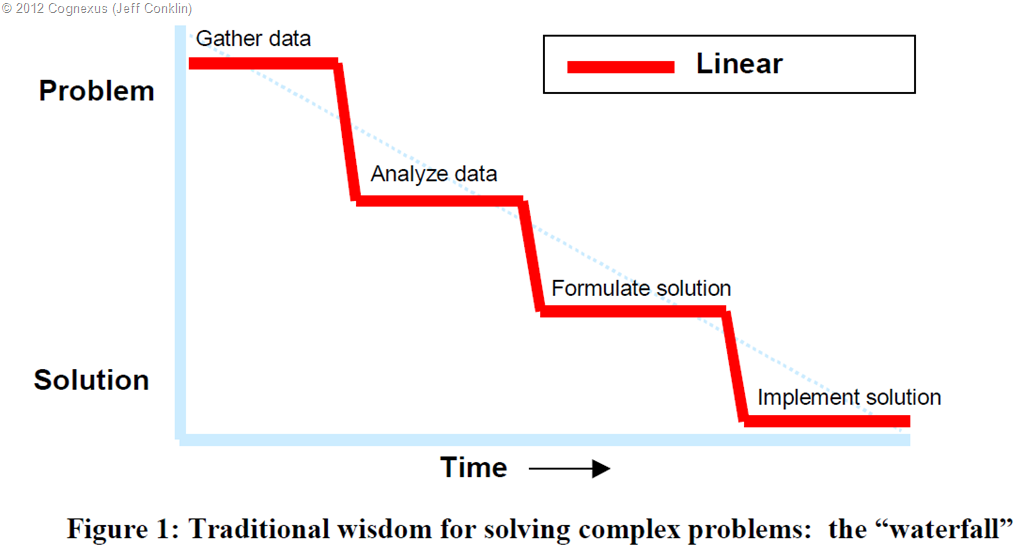
In this paper, Jeff talks about the fact that many prevailing methodologies suggest that the best way to work on a problem is to follow an orderly and linear “top-down” process, working from the problem to the solution. You begin by understanding the problem, including gathering and analysing “requirements” from customers or users. Once you have the problem specified and the requirements analysed, you are ready to formulate a solution and eventually implement that solution. This is illustrated by the red line in the figure below.

image

Now many project managers, cheque signers and just about every program management office I have ever worked with try to operate this way because it promises order, certainty and control. This is understandable when ones performance is being judged on getting stuff done to an agreed time and cost. It is also understandable if you are a manager and will get your ass kicked if you blow your budget. There is only one teeny issue. For some scenarios, it simply does not work.

In Conklin’s paper, he detailed a 1980’s case study at the Microelectronics and Computer Technology Corporation (MCC) that looked into how people solve problems. A number of designers participated in an experiment where they were give a one page problem statement – not too different to many SharePoint business cases I have seen. Participants in the experiment had to design an elevator control system for an office building. Despite participants being experienced and expert integrated-circuit designers, none had ever worked on elevator systems before. Each participant was asked to think out loud while they worked on the problem. The sessions were videotaped and analysed in detail.

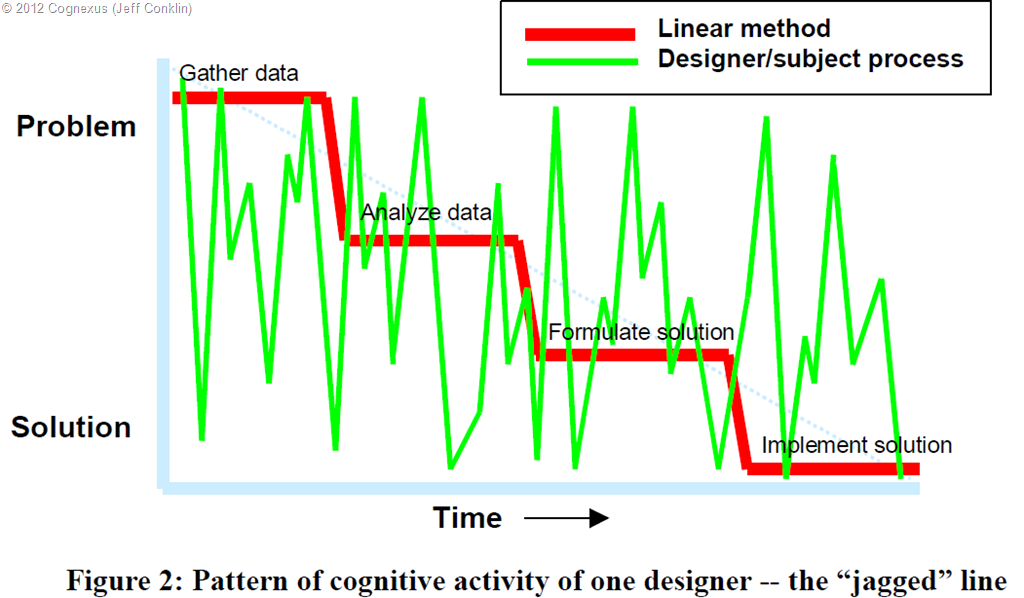
Below is what really happened. Check out the green line…

image

Clearly, the subjects in the elevator experiment did not follow a linear approach. They would start by trying to understand the problem, but they would immediately jump into formulating potential solutions. Then they would jump back up to refining their understanding of the problem. Rather than being orderly and staged like the red line, the line plotting the course of their thinking looked more like a seismograph for an earthquake. Now if you are looking at the green line and thinking “my god I better put a stop to that sort of shenanigans,” consider what Conklin had to say about it in his paper:

These designers are not being irrational. They are not poorly trained or inexperienced. Their thought process was something like: “Let’s see, idle elevators should return to the first floor, but then, you only need one elevator on the first floor, so the others could move to an even distribution among the floors. But the elevators need to be vacuumed regularly. I suppose we could add a switch that brought idle elevators down to the first floor. But then what happens in an emergency?” In other words, what is driving the flow of thought is some marvellous internal drive to make the most headway possible, regardless of where the headway happens, by making opportunity-driven leaps in the focus of attention. It is precisely because these expert designers are being creative and because they are learning rapidly that the trace of their thinking pattern is full of unpredictable leaps.

When I am speaking at conferences I like to mess with project managers in particular (who doesn’t eh?), because they are an easy target and already an insecure lot to begin with. I will ask the audience if anybody has an industry certification, such as a PMP or Prince II. Several hands usually go up. I then point to the phases of the above diagram and ask them if – when they were studying hard to obtain their certification – they actually followed the discrete phases that everybody else is supposed to follow. No single person has ever suggested that they did, instead all acknowledging that their process of learning looked more like the green line. I then point out that I’ve always found this perversely funny that people follow the green line to learn a process that tries to insist that everybody else must follow the red line. Ironic huh?

Knowing vs. learning problems

It should be stated at this point that you can use the red-line approach for certain types of problems so I am not outright dismissing it. In fact, within SharePoint projects there are indeed elements that can work quite well this way. The green line on the other hand, represents a phenomenon that Conklin called “Opportunity driven problem solving” and is the de-facto way we work on problems that are new or novel. For example, if you have ever experienced an “aha” moment, it was probably a leap of cognition that followed the jagged green line up or down, where you suddenly saw the problem in a different light. (Shhhh… don’t let your project manager know because you will have to fill in a form of some description!)

In these types of problems, we do not start by gathering and analysing data about the problem because the problem itself is moving target and varies depending on different stakeholders and their world views. Thus, there is no pure and concrete understanding of “the problem” because it is still forming as you think about solutions. In short, the jagged green line is a picture of learning. Quoting again from Conklin:

The more novel the problem, the more the problem solving process involves learning about the problem domain. In this sense the waterfall is a picture of already knowing – you already know about the problem and its domain, you know about the right process and tools to solve it, and you know what a solution will look like. As much as we might wish it were otherwise, most projects in the knowledge economy operate much more in the realm of learning than already knowing. You still have experts, but it’s no longer possible for them to guide the project down the linear waterfall process. In the current business environment, problem solving and learning are tightly intertwined, and the flow of this learning process is opportunity-driven

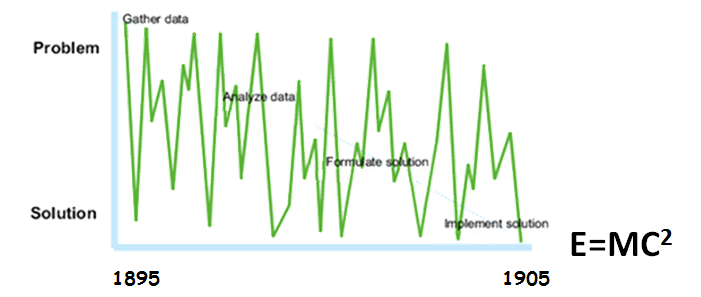
I believe that many innovations stem from the opportunity driven, creative leap of faith of the green line. On that note, I’d say that one of the greatest opportunity driven learners had to be Einstein. An article by Mort Orman suggests that Einstein was intrigued by “holes” in prevailing theories and enjoyed posing “mind riddles” to himself, just to see if present theories could satisfactorily explain them. Unlike many others who might have given up when they got stuck, Einstein was persistent and kept at it for 10 years before he came up that little formula everyone knows. After explaining this story at conferences, I sometimes ask people “Do you think Einstein used waterfall when he came up with relativity?” No one has said yes yet…

image

Implications…

The pattern of behaviour between the red and green lines represents the difference between a knowing problem and a learning problem. With a knowing problem, the problem is clear to all participants and even though it might require specialist expertise to solve, many of the variables are well understood. But for a problem that is novel or requires learning from participants Conklin’s case study illustrates that:

  1. People will examine potential solutions just to explain the problem.
  2. Each instance of examining the solution will impact the understanding of the problem.

Given that SharePoint is almost always starts out as a learning problem for the majority of participants, I do not see the point in trying to fight that green line. Instead, it is critical that you work with it rather than against it. The difficulty people have with this is that to do so conflicts with that promise of certainty, order and control that the red appears to offer. Why? Well among other things, you have to:

  1. Expect fluid requirements and scope changes
  2. Involve stakeholders from the start (they have to live with the result and their up-take is presumably a key KPI)
  3. Expect resistance and pullback from stakeholders (because people attribute more to what they perceive to lose compared to what they might gain)

Above all, you have to avoid penalising people for their learning. If you put barriers in front of people who are trying to improve their understanding of a multi-faceted problem they will eventually disengage from you. If you want to guarantee this sort of disengagement, go right on ahead and solve some problem before your stakeholders even realise there is a problem. Then when they do realise, smack them with the metaphorical baseball bat known as the scope variation form. One of two of those babies and those annoying stakeholders are guaranteed to go away. A pity your solution will go away with them but hey, it was in scope right?

Confessions…

I deal with this core issue of not penalising learning in a number of ways… some of which I have outlined in blog posts and many that I will cover in detail as we progress in this series and examine more f-laws. If you simply can’t wait for me and want “the answer” then I have news for you. If it were that easy there would be a “best practice” for it and someone would have created a certification by now!

So instead I will give you a couple of KPI’s to work to.

  • KPI 1: You get to a stage where your clients questions are “informed”. It is pretty easy to tell as a SharePoint professional where your stakeholders are at in their understanding of SharePoint. Over time there is a certain level of maturity in the questions asked of you and the way they are asked. This reflects both stakeholder learning as well as your ability to teach. If you get to this stage, you have increased your chances of SharePoint success significantly, which leads onto the next KPI…
  • KPI 2: You get to the stage where your clients are asking you well informed questions that you don’t know the answer to. Trust me that they will not mind that you don’t because their awareness of the product will no longer be naively simplistic anyways. You will also have developed a great collaborative partnership by then too. Also don’t forget my quote from Horst Rittel in the midwives post. There is a symmetry of ignorance with complex problems. The knowledge required to solve a complex problem never resides with a single person.

This leads me onto the final KPI:

  • KPI 3: Your clients should start telling you stuff about SharePoint that they have done that you have never done before or didn’t know you could do. In short, they will start teaching you stuff.

If you can create those conditions, be happy that they don’t need you that much anymore.


Thanks for reading


Paul Culmsee

www.hereticsguidebooks.com

www.sevensigma.com.au


Confessions of a (post) SharePoint Architect: Don’t define “governance”

Hi all and welcome to the second post of a series that I have been wanting to write for a while. In this series, I am going to cover some of the lesser considered areas of being a SharePoint architect and by association, key aspects to SharePoint governance. In the first confessional post I alluded to the fact that a good SharePoint architect also need to architect the right conditions for SharePoint success. As I work through this series of articles, I will elaborate further on what those conditions are and how to go about creating them.

To do this, I am drawing from my non IT work as a Dialogue Mapper and facilitator, and where applicable, will cover these case studies to see if they give us any insights for SharePoint. I also hope to dispel some common myths and misconceptions about SharePoint project delivery in organisations. Some of these might challenge some notions you hold dear. But for the most part, I hope that many of you reading this find this material to be instinctively compatible with what you have already come to believe. If you are in the latter group and feel as if you are an organisational agitator, this just might give you that rigour and ammo that you need when getting through to the powers that be. Better still, tell them to read this series and let them decide for themselves.

Backstory: Ackoff and f-Laws

image

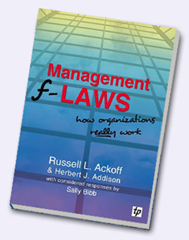
For what it’s worth, a fair chunk of this material comes from my book, as well as the first module of my SharePoint Governance and Information Architecture class that I run a few times a year in various places around the world. When I designed that class, I was inspired by Russell Ackoff, who co-wrote a funny and highly readable book called “Management f-LAWS: How organisations really work”. F-Laws were defined as:

“truths about organisations that we might wish to deny or ignore – simple and more reliable guides to everyday behaviour than the complex truths proposed by scientists, economists, sociologists, politicians and philosophers”

In case you hadn’t noticed, if you remove the hyphen, each f-law become a flaw. You could also consider them as #fail laws. Years ago, I laughed and at the same time, inwardly cringed when I read each f-Law that Ackoff and his co-authors had come up with. I came to realise that SharePoint problems are simply a microcosm of broader issues that plague organisations. If you read Ackoff’s book (and I highly recommend it), you will soon realise that the word “Management” could easily be substituted with “SharePoint” and it doesn’t take much to come up with a few of your own f-laws. This is exactly what I did and at last count, I have 17 of them. In this post, I will detail the very first one.

F-Law 1: The more comprehensive the definition of governance is, the less it will be understood by all

The first condition that I need to design as a SharePoint architect is to put to bed the many misconceptions about SharePoint governance. In this f-Law, I state that the more you try and define what SharePoint governance is, the less anybody will actually understand it. If you consider this counter-intuitive, then let me take it even further. For any project that has a change management aspect (SharePoint projects often are), definitonising not only doesn’t work, but it is actually quite dangerous to your projects health.

To explain why I have come to this conclusion, I’d like to tell you a little story from my non IT work. Several years ago, I was working in a sensemaking capacity with an organisation to help them come up with a strategic plan and performance framework for a new city. This was not a trivial undertaking. The aim was to create a framework with an aligned set of KPI’s to realise the vision for what the city needed to be in the year 2030. While the vision for the city had been previously agreed and understood, the path to realise that vision had not been.

Now if you have ever been involved in strategic plan development, and think that working out your corporate strategy is difficult, I have news for you. Aligning an organisation to a 3 year plan is one thing. Working with a diverse group to determine performance measures of a future city 25 years away is a different thing altogether. I never realised at the time we did this work, just how unique and (dare I say) “cutting edge” it was. Participants were highly varied in skills and areas of interest, and to say each had their own world-view was an… understatement to say the least.

I my book I describe this case study in detail but for the sake of post size, let’s just say that the opportunity to do this work arose from a failed first attempt to create the framework. The first time around an excel spreadsheet was projected onto the wall that looked like the example below. Attempts were made in vain to fill in the strategic outcomes, strategic objectives, key result areas, key performance indicators and measures. After a frustrating few hours of trying this approach, we gave up because participants spent all of their time arguing over the labels and got bogged down in a tangle of definitions and ambiguous terminology. Was it a KPI (Key Performance Indicator) or a KRA (Key Result Area)? Was it a Guiding Principle or a Strategic Objective? Was it a KRA or a Critical Success Factor?  Attempts to resolve this issue with definitions got nowhere because even the definitions could not be agreed upon.

image

In the end, we solved this issue via a rather novel use of Dialogue Mapping along with a problem structuring approach outlined in a book called Breakthrough Thinking. If you’d like to know more on how it was done, then take a look in chapter 12 of the Heretics Guide.

The criticality of context…

The core problem boiled down to context – or lack of it. What I learnt from this is that in situations without a shared context (and the wrong tools to deal with it), we fall back to using definitions to try and fill the gap. When faced with a blank spreadsheet and just some labels, participants attention was fixated on the definitions of the labels, rather than the empty cells where the focus needed to be. This resulted in a bunch of long winded discussions about what terms meant. This seriously stymied efforts aimed at making progress.

I have since performed many workshops, both SharePoint and non SharePoint ones and the pattern is clear. In fact I contend that if you proceed down the road of trying to build context via definitions for complex problems, one of three things will happen.

  1. The definition becomes more verbose. There are a couple of reasons for this:
    • – The definition is expanded to incorporate new aspects of the topic space. In an organisational setting, this creates confusion because the definitions of multiple disciplines can often seemingly contradict each other and thus, careful “wordsmithing” is required to navigate a path through it.
    • – New qualifications or exceptional situations have to be excluded. This leads to more new terms being used in the definition.
  2. As a result of #1, a broader, fundamental definition is developed. This broader definition encompasses more and so is prone to motherly sounding platitudes. Further, such definitions also run the risk of being interpreted in ways other than the one intended by those who worked so hard on the definition.
  3. As a result of #1 and #2, a new word is used or an existing word is used in a new context to try and convey the new meanings or concepts proposed. I have heard governance described as “stewardship”, “risk management” and (guilty as charged), “assurance”.

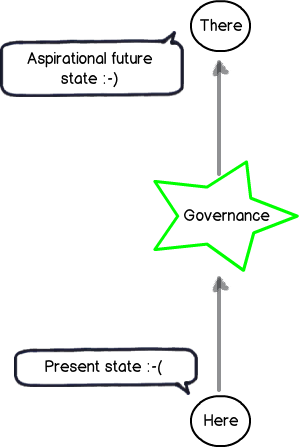
The effect of this can be far reaching in a bad way because definitionising has a habit of blinding people to what really matters. This leads to terrible project decisions being made up front that have serious consequences. To understand why, consider the image below:

Snapshot

This image represents how governance of a SharePoint project should be viewed. A SharePoint initiative takes time and effort which costs money. We presumably have recognised that the present state is lacking in some way and want to get to somewhere better – an aspirational future place (if you look closely in the left above image note the happy and sad smilies). Accordingly we accept the cost of deploying SharePoint because we believe it will make a positive difference by doing so. If this was not the case, you would be wasting your time and resources on a pointless initiative. Therefore, it is the difference made by the initiative that will tell you if you have succeeded or not. As a result, we have to have a shared context on what that aspirational future looks like!

Don’t confuse the means with the ends…

Governance is, therefore, the means by which you will achieve the end of getting to some better place. It is informed by the end in mind and this is why I drew it in the star in the middle of the above diagram. For example; If the end in mind was compliance, then I will govern SharePoint a heck of a lot differently than say, if the end in mind was improving collaborative decision making.

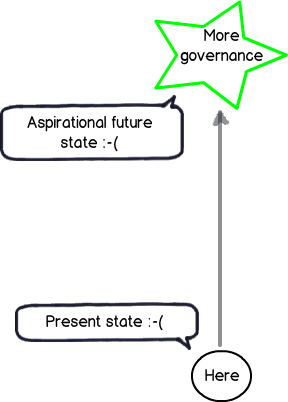
But consider the diagram below. In this context, it should be clear why working from a definition of governance is often problematic. It implies that:

  1. Governance is not being informed by the end in mind;
  2. Your team do not have a shared understanding of what the end in mind actually looks like.

When this happens, project teams rarely realize it and respond by substituting the end with the means. We overly focus on governance via definition without any clarity or context as to what the aspirational future state actually is. Like the example of the blank spreadsheet example I started with, reality starts to look more like the diagram below: (note the happy smilie is gone now)

Snapshot

Steering…

So how do we steer out of this definition pickle? Interestingly “steer” is a appropriate choice of word if we look at the origin of the word “Govern”. This is because “Govern” is a nautical term from Latin and actually means “to steer”. So if your SharePoint project has been more like the Titanic, and hit a giant iceberg along the way, then clearly you need to focus your governance efforts to looking at what is in front of you, rather than scrubbing the deck or keeping the engine room well oiled. The latter tasks are important of course, but you can do all that, still hit an iceberg and waste a lot of money.

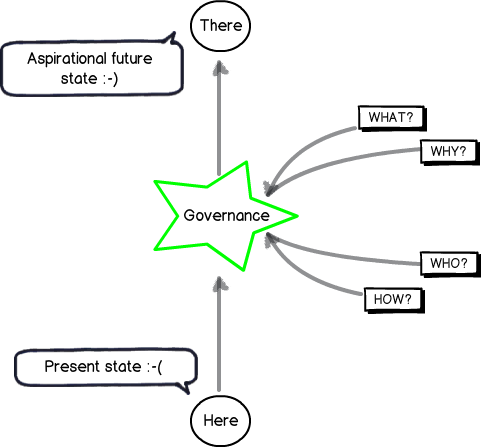
To steer, we all have to understand what the destination is, or at the very least, all agree on the direction. To help you with that journey, consider my final diagram. To steer SharePoint the right way for your organisation requires you to answer four key questions:

  1. What is the aspirational future state and what does it look like?
  2. Why is this the aspirational future state we want?
  3. Who will do what to get us to that state?
  4. How will we get to that state?

Snapshot

The fundamental problem with most SharePoint projects is that questions 1 and 2 are not answered sufficiently, if at all. The next few posts will explore why this is the case, but in the meantime, remember that we could do a SharePoint project that is to scope, time and cost, yet still have no user up-take if we are solving the wrong problem in the first place. Therefore remember that:

  1. Governance is a means to an end, and not the end in itself.
  2. We shouldn’t undertake a “SharePoint governance” project, or consider “SharePoint governance” as deliverable on a project plan. The act of developing a shared context of what the problems are and using that to always steer the governance decision making is paramount. Failure to do this and and your best plans will not save you.

Conclusions and coming next…

This is the second post on what will be a large series – possibly the largest series I have written so far. In the next post in this series, I will continue into our journey of SharePoint governance mistakes and along the way, start to identify what we can do to better answer the “What”, “Why”, “Who” and “How” questions. If you enjoy this series, then consider signing up to one of my classes if one is running in your neck of the woods.


Thanks for reading

Paul Culmsee

www.sevensigma.com.au

www.hereticsguidebooks.com


Confessions of a (post) SharePoint Architect: Midwives versus doctors

Bjørn Furuknap you have gone too far this time! There I said it.

On behalf of the SharePoint community, I feel that someone needs to speak up about your reprehensible behaviour, so I have taken it upon myself to right the wrongs that you so needlessly inflicted onto the community. You see, Bjørn has gone and written a non controversial post on the confused role of the SharePoint architect. I am extremely concerned about this abrupt change of behaviour and worry about the example he is setting for the young and impressionable members of the SharePoint community. If Bjørn keeps going down this rational road, then he will make the rest of us look irrational and tip the delicate balance of the SharePoint blogging ecosystem into unknown territory. In other words, we will lose the excuse of “Well, at least I’m not as nuts as Furuknap!”

That said, I have been meaning to write about insights from my life as a (post) SharePoint architect anyway. I have a few of my own lessons learnt and Bjorn has inspired me to finally get a few written down. So in this preamble post, and in a forthcoming series on common SharePoint governance mistakes, I will give you a dose of the opinionated world according to Paul, but I will back it up with some juicy references that you can check out for yourself if you are that way inclined.

Why (post) SharePoint Architect?

You might be wondering why I referred to myself as a “post” SharePoint architect. Unfortunately its hard to answer this question without sounding self-indulgent so I will keep it brief.

In 2007, I got my first non IT gig in a highly complex urban planning project. I had no contribution to make in terms of technical or discipline knowledge to this project at all. My job was to enable others to develop a shared understanding on a highly complex problem they all faced, to enable shared commitment to a course of action. Since that time, this non IT side of my work has continued to grow in terms of number of clients and the scale of the problems being tackled. Like any skill, I have gotten better with practice, which in turn has led to larger and more complex scenarios.

This year in particular, I’ve helped the executive teams of several large organisations re-find their purpose, realign their strategy and make some very difficult and courageous decisions in redesigning their organisations. Just to be clear, we are not talking SharePoint and we are not talking IT. I am talking about how these organisations adapt to changing conditions that, in some cases, affect their very existence. These organisations span the public and private sector across Australia.

From a SharePoint perspective, you could say I have moved from the server room to the meeting room and now to the boardroom. In spite of my self-indulgence warning earlier, you have to admit – this is damn cool!

Who’s misunderstood anyway?

So with that little preamble done, let me return to Bjørn’s post. He feels the SharePoint architect role is misunderstood and I agree with this, but in a different way. I feel the core issue is that SharePoint architects themselves are often the ones who misunderstand what they need to do and how they should go about it. This in turn manifests in the rest of the world not understanding what they ought to be doing.

To elaborate on this contention, let’s meet the four most common SharePoint architect stereotypes that I see in organisations:

The SharePoint architect who used to be a developer

This stereotype comes in two flavours. The alpha developer who had attained top dog status among peers via bluffed programming prowess, or the developer who always struggled and finds that this is a way to get out of hands on coding. Either way, this person still lives through the SharePoint object model. They will focus on ensuring that there are unit tests, solid source control and solutions packaging regime. Utilising the object oriented view means that metadata is king and folders are to be despised. They will not think twice about utilising content types in any situation because it is completely obvious that you would work this way. Their information architecture will be a work of art, and they are not shy in telling everyone so. To sum up, their SharePoint solutions will be logical, well coded to defined standards and completely useless to users.

The SharePoint architect who used to be an infrastructure guy

This stereotype tends to bewilder clients and colleagues alike with a seemingly endless set of options and considerations that need to be made up front. It is likely this architect will introduce SharePoint via the pie/frisbee diagrams, but discussions will focus on architecting for scalability, security and fault tolerance. This architect will likely mandate strict governance rules on those cowboy developers, untrustworthy site admins, and downright scary users to ensure that the environment remains pristine. Accordingly, SharePoint Designer will be outlawed – it’s so obvious that one shouldn’t even be asking why. Any burden imposed by these governance rules will be seen as a necessary evil and will be addressed by mandatory user training and besides, the next SharePoint version will definitely address the gaps. Their solutions will be scalable, architecturally sound and completely useless to users.

The SharePoint architect who thinks they are an enterprise architect

This stereotype – despite their obvious protests to the contrary – is the right brained equivalent of the infrastructure guy. This person absolutely gets off on making models because conceptual reality does not involve making any actual commitments. In fact as soon as there is any push to a commitment, they feel an irrepressible urge to resist and push everyone back into make-believe world. Over-utilising the line “Oh, I am business you see, not technical” as if it’s a sign of maturity, they will plan, plan and plan again, drawing many cool diagrams on whiteboards but never a task on a Gantt chart. The models they come up with are abstract, over-engineered and they always fall deeply in love with them. They won’t let anybody touch their models for fear of their abstract thing of beauty being messed with. The irony is that the basis for their models will actually be underpinned by some solid theoretical frameworks. Unfortunately, this person actually doesn’t understand them in any depth, but the terms used sound really cool. Their solutions will be … Wait, who am I kidding? They won’t have any solutions because they plan forever…

The SharePoint project manager who thinks they are an architect

This stereotype is arguably the most dangerous of the lot because they are driven by the need to “Get Things Done Now!” whether those “Things” make sense or not. Consequently, they jump into solution mode without a full understanding of the real problem the business is facing. Scope documents, plans, schedules and Gantt Charts abound, but the chances are that all these are geared towards solving the wrong problem. Talking to annoying stakeholders just gets in the way of the scope statement and besides, that’s what Business Analysts are put on this earth to do anyway. Their solutions will be built to time and cost, but completely useless to users.

“Let’s drill halfway…”

Bjørn also spoke of architects needing breadth of knowledge over depth of knowledge. This is completely true, but is not the full story. You see, there is a common bad habit that our stereotype architects often make; a bad habit that is in common with many other consultants who end up doing damage to organisations.

Irrespective of their breadth of knowledge or otherwise, these architects act like doctors prescribing remedies. They breeze into organisations, making sweeping statements that contain cool sounding maxims like “business value.” Then, using their clearly superior intellect based on years of experience and that cherished breadth of knowledge, they assess the organisational symptoms and prescribe the appropriate SharePoint medicine to address them.

I can hear it now… “Got an organisational headache? Just take this SharePoint content-type three times a day and see me if pain persists.”

I’m sure people can see the obvious problems with this approach (If you can’t then you are in the wrong business – seriously). One of the many issues is that organisational symptoms are often just visible manifestations of deeper underlying issues. The late, great Russell Ackoff once stated that you would not use brain surgery to cure a headache, despite the pain being felt in your head. Instead you would take a pill, even though there appears to be no direct relationship between the pill and the pain being experienced. Ackoff mused that organisations routinely use brain surgery for their headaches and tools like SharePoint are the blunt instrument of choice to do the drilling. Add to this, the technical complexity of SharePoint means that brain surgery has to happen in discrete phases.

“Okay guys we don’t have enough budget for this, so let’s drill halfway into the skull for phase 1.”

The SharePoint midwife…

SharePoint architects have to understand that the solutions they architect are actually not for them. “Gee Paul that’s profound,” I hear you say sarcastically. While this statement might sound obvious, why is it that many architects exhibit behaviours that contradict it?

If you want to know why this happens I suggest that you read part 1 of the Heretics book. But rather than rehash that here, let’s see what we can learn about problem solving from the insights of Horst Rittel and Ron Heifetz. In case you are wondering, no they are not SharePoint MVPs. Rittel coined the term “wicked problem” and is highly influential in various fields due to his early insights into complex problem solving. Heifetz is well known for his work on the theory and practice of adaptive leadership: how to mobilise people through what he termed adaptive change.

Note: If you have not heard of the term “wicked problem”, then go and read this old post of mine. It’s assumed knowledge here…

Rittel stated that when solving problems, nobody wants to be “planned at.” Additionally, the knowledge required to solve a complex (wicked) problem never resides with a single person. Instead, there is a symmetry of ignorance (I love that term). Rittel characterised symmetry of ignorance as situations “where both expertise and ignorance is distributed over all participants and no-one ‘knows better’ by virtue of degrees or status.” Accordingly, the process of problem solving must involve those who are directly affected by the problem. These are the key stakeholders “living” the problem, rather than experts who “know” the problem theoretically. The aforementioned experts should guide the process of dealing with a wicked problem but not impose solutions. In Rittel’s words, the planner is the “midwife of problems rather than the offerer of therapies.” It is the group that must come up with the answers.

Ron Heifetz echoed Rittel in his advice to leaders. One key strategy of adaptive leadership is to give the work back. Heifetz warned that when a leader undertakes to solve a problem, the leader becomes the problem in the eyes of many stakeholders. The implication is that the leader also becomes the convenient scapegoat if the solution goes awry as blame can be attributed to the leader. Instead by placing work where it belongs—with employees responsible for doing the work—Heifetz argued that issues will be internalized and owned by the parties best placed to deal with them. The best solutions, he maintained, are when the people with the problem become the people with the solution.

Confessions…

Given what Rittel and Heifetz have to say, it should be little wonder that I feel SharePoint architects should not be doctors prescribing remedies. SharePoint is often an adaptive change because you are asking people to change their behaviours. Those architects (and management consultants) who act like doctors tend to find out fairly quickly that the solutions they so lovingly come up with do not always get traction. Therefore, as Rittel suggests, a SharePoint architect needs to be more of a midwife than a doctor. It’s the client who is giving birth to this thing and you are there to create the conditions for them to make that journey as stress free as one can. Who is the one who has to adapt and live with the result anyway? Certainly not the consultant.

For some, this comes at a cost to architect ego because architects often have to let go of their creations. An architect cannot revel in the glory of their masterpiece if those affected by it do not buy into it. It will have a crappy legacy no matter what the intent. In letting go, one has to accept that stakeholders will also have an incomplete world view and will make mistakes. Therefore as an architect, how about architecting not just the SharePoint platform, but architecting the conditions by which SharePoint is delivered.

An obvious condition is one of real collaboration among stakeholders (which when you think about it, is kind of important when putting in collaborative systems!) Another condition that should be there is one that allows people to fail forward. Assume that mistakes will be made, take away the blame and architect SharePoint to be resilient in the face of change instead of making it brittle. Create the environment conducive to co-creation by painting part of the picture and allow participants to fill it in. After all, the learning that occurs via the journey is often just as important as the result achieved.

My confession is that I often say to my SharePoint clients that it is inherently more efficient for me to transfer my knowledge of SharePoint to them, than for them to transfer their deep knowledge of their organisation to me. To do the latter would be highly inefficient for both my clients and me, and my clients would not have the same opportunity to build their own SharePoint competencies and adaptive capacity. At the end of the day, they architect a lot of the solutions. Sure… I might offer suggestions here and there, and I might nudge them when I feel they need to be nudged, but more often than not, I lay some core foundations and they are the ones who do a lot of the legwork.

So to conclude, while I agree with everything Bjørn said in his post, I think the real key to being a good SharePoint architect is to architect the conditions by which SharePoint is delivered, just as much as SharePoint itself. While being a midwife may not be as glamorous as being a doctor, the solutions delivered will have more staying power.


Thanks for reading

Paul Culmsee


On the decay (or remarkable recurrence) of knowledge

“That’s only 10%…”

One of my mentors who is mentioned in the book I wrote with Kailash (Darryl) is a veteran project manager in the construction and engineering industry. He has been working as a project manager more than 30 years, is a fellow of the Institute of Engineers and marks exams at the local university for those studying a Masters Degree in Project Management. His depth of knowledge and experience is abundantly clear when you start working with him and I have learned more about collaborative project delivery from him than anyone else.

Recently I was talking with him and he said something really interesting. He was telling some stories from the early days of alliancing based project delivery in Australia (alliancing is a highly interesting collaborative project governance approach that we devote a chapter to in our book). He stated that alliancing at its core is the application of good project management practice. Now I know Darryl pretty well and knew what he meant by that, but commented to him that when you say the word “project management practice,” some would associate that statement with (among other things) a well-developed Gantt chart listing activities with names, tasks and times.

His reply was unsurprising: “at best that’s only 1/10th of what project management is really about.”

Clearly Darryl has a much deeper and holistic view of what project management is than many other practitioners I’ve worked with. Darryl argues that those who criticise project management are actually criticising a small subset of the discipline, based on their less than complete view of what the discipline entails. Thus by definition, the remedies they propose are misinformed or solve a problem that has already been solved.

Whether you agree with Darryl or not, there is a pattern here that occurs continually in organisation-land. Fanboys of a particular methodology, framework model or practice (me included) will waste no time dumping on whatever they have grown to dislike and swear that their “new approach” addresses the gaps. Those with a more holistic view like Darryl might argue that crusaders aren’t really inventing anything new and that if a gap exists, it’s a gap in the knowledge of those doing the criticising.

As Ambrose Bierce said, “There is nothing new under the sun but there are lots of things we don’t know.”

From project management to systems thinking…

Now with that in mind, here’s a little anecdote. A few weeks back I joined a Design Thinking group on LinkedIn. I had read about Design Thinking during its hype phase a couple of years ago and my immediate thought was “Isn’t this just systems thinking reinvented?” You see, I more or less identify myself as a bit of a pragmatic systems thinker, in that I like to broaden a discussion, but I also actually get shit done. So I was curious to understand how design thinkers see themselves as different from systems thinkers.

I followed several threads on the LinkedIn group as the question had been discussed a few times. Unfortunately, no-one could really put their finger on the difference. Eventually I found a recent paper by Pourdehnad, Wexler and Wilson which went into some detail on the two disciplines and offered some distinctions. I won’t bother you with the content, except to say it was a good read, and left me with the following choices about my understanding of systems and design thinking:

  • That my understanding of systems thinking is wrong and I am in fact a design thinker after all
  • That I am indeed a systems thinker and design thinking is just systems thinking with a pragmatic bent

Of course being a biased human, I naturally believe the latter point is more correct. clip_image002

From systems to #stoos

Like the Snowbird retreat that spawned the agile manifesto, the recent stoos movement has emerged from a group of individuals who came together to discuss problems they perceive in existing management structures and paradigms. Now this would have been an exhilarating and inspiring event to be at – a bunch of diverse people finding emergent new understandings of organisations and how they ought to be run. Much tacit learning would have occurred.

But a problem is that one has to have been there to truly experience it. Any published output from this gathering cannot convey the vibe and learning (the tacit punch) that one would get from experiencing the event in the flesh. This is the effect of codifying knowledge into the written form. Both myself and Kailash were fully cognisant of this when we read the material on the stoos website and knew that for us, some of it would cover old ground. Nevertheless, my instinctive first reaction to what I read was “I bet someone will complain that this is just design thinking reinvented.”

Guess what… a short time later that’s exactly what happened too. Someone tweeted that very assertion! Presumably this opinion was offered by a self-identified design thinker who felt that the stoos crowd was reinventing the wheel that design thinkers had so painstakingly put together. My immediate urge was to be a smartarse and send back a tweet telling this person that design thinking is just pragmatic systems thinking anyway so he was just as guilty as the #stoos crowd. I then realised I might be found guilty of the same thing and someone might inform me of some “deeper knowing” than systems thinking. Nevertheless I couldn’t resist and made a tweet to that effect.

The decay (or remarkable recurrence) of knowledge…

(At this point I discussed this topic with Kailash and have looped him into the conversation)

Both of us see a pattern of a narrow focus or plain misinterpretation of what has come before. As a result, it seems there is a tendency to reinvent the wheel and slap a new label on claiming it to be unique or profound. We wonder therefore, how much of the ideas of new groups or movements are truly new.

Any corpus of knowledge is a bunch of memes – “ideas, behaviours or styles that spread from person to person within a culture.” Indeed, entire disciplines such as project management can be viewed as a bunch of memes that have been codified into a body of knowledge. Some memes are “sticky,” in that they are more readily retained and communicated, while others get left behind. However, stickiness is no guarantee of rightness. Two examples of such memes that we covered in our book are the waterfall methodology and the PERT scheduling technique Though both have murky origins and are of questionable utility, they are considered to be stock standard in the PM world, at least in certain circles. While it would take us too far afield to recount the story here (and we would rather you read our book Smile ) the point is that some techniques are widely taught and used despite being deeply flawed. Clearly the waterfall meme had strong evolutionary characteristics of survival while the story of its rather nuanced beginnings have been lost until recently.

A person indoctrinated in a standard business school curriculum sees real-life situations through the lens of the models (or memes!) he or she is familiar with. To paraphrase a well-known saying – if one is familiar only with a hammer, every problem appears as a nail. Sometime (not often enough!) the wielder of the metaphorical hammer eventually realises that not all problems yield to hammering. In other words, the models they used to inform their actions were incomplete, or even incorrect. They then cast about for something new and thus begin a quest for a new understanding. In the present day world one doesn’t have to search too hard because there are several convenient corpuses of knowledge to choose from. Each supply ready-made models of reality that make more sense than the last and as an added bonus, one can even get a certification to prove that one has studied it.

However, as demonstrated above with the realisation that not all problems yield to hammering, reality can truly be grasped only through experience, not models. It is experience that highlights the difference between the real-world and the simplistic one that is captured in models. Reality consists of complex, messy situations and any attempt to capture reality through concepts and models will always be incomplete. In the light of this it is easy to see why old knowledge is continually rediscovered, albeit in a different form. Since models attempt to grasp the ungraspable, they will all contain many similarities but will also have some differences. The stoos movement, design thinking and systems thinking are rooted in the same reality, so their similarities should not be surprising.

Coming back to Darryl – his view of project management with 30 years experience includes a whole bunch of memes and models, that for whatever reason, tend to be less sticky than the ones we all know so well. Why certain memes are less successful than others in being replicated from person to person is interesting in its own right and has been discussed at length in our book. For now, we’ll just say that those who come up with new labels to reflect their new understandings are paradoxically wise and narrow minded at the same time. They are wise in that they are seeking better models to understand the reality they encounter, but at the same time likely trashing some worthwhile ones too. Reality is multifaceted and cannot be captured in any particular model, so the finders of a new truth should take care that they do not get carried away by their own hyperbole.

Thanks for reading

Paul Culmsee (with Kailash Awati)

www.hereticsguidebooks.com


« Previous Page

Today is: Wednesday 3 June 2026 -