Back to Cleverworkarounds mainpage
 

Warts and all SharePoint caveats in Melbourne and Auckland

image   image

Hi all

There are a couple of conferences happening this month that you should seriously consider attending. The New Zealand and Australian SharePoint Community Conferences. This year things have changed. There are over 50 Sessions designed to cater to a wide audience of the SharePoint landscape and the most varied range of international speakers I have seen so far. What is all the more pleasing this year is that aside from 20 sessions of technical content, the business side of SharePoint focus has been given greater coverage and there are over 20 customer case studies, which give great insight into how organisations large and small are making the most of their SharePoint deployments. This stuff is gold because it is what happens in the trenches of reality, rather than the nuanced, airbrushed one you tend to get when people are trying to sell you something.

My involvement will include some piano accompaniment while Christian Buckley hits the high notes Smile, and in terms of talks, I will be “keeping it real“ by presenting a talk called “Aligning Business Objectives with SharePoint“. I will also be running a 1 day class on one of the hardest aspects of SharePoint delivery: Business goal alignment. This is workshop is the “how” of goal alignment (plenty of people can tell you the “what”). If you are a BA, PM or recovering tech dude, do not miss this session. It draws a lot of inspiration from my facilitation and sensemaking work and has been very well received wherever I have run it.

The other session I am really looking forward to is a talk called SharePoint 2010 Caveats: Don’t get caught out! Now anybody in SharePoint for long enough has learnt the hard way to test all assumptions. This is because SharePoint is a complex beast with lots of moving parts. Unfortunately these moving parts don’t always integrate the way they one would assume. Usually the result of such an untested assumption is a lot of teeth gnashing and heavily adjusted project plans.

I mentioned airburshed reality before – this is something that occasionally frustrates me, especially when you see SharePoint demonstrations full of gushing praise, via a use case that glosses over inconvenient facts. Michal Pisarek of SharePointAnlystHQ fame, is a SharePoint practitioner who shares my view and a while back, we both decided to present a talk about some of the most common, dangerous and some downright strange caveats that SharePoint has to offer. The session outline is below.

"Yes but…" is a common answer given by experienced SharePoint consultants when asked if a particular solution design "will work". One of the key reasons for this is that SharePoint’s greatest strength is one of its weaknesses. The sheer number of components or features jam packed into the product, means that there are many complex interactions between them – often with small gotchas or large caveats that were not immediately apparent while the sales guy was dutifully taking you through the SharePoint pie diagram.

Unfortunately, some organizations trip up on such untested assumptions at times, and in turn it can render the logical edifice of their solution design invalid. This is costly in terms of lost time to change approaches, but increased complexity since sometimes workarounds are worse than the caveats. In this fun, lively and interactive session, Michal Pisarek will put his MVP (not really) on the line, and with a little help from Paul Culmsee, examine some of SharePoint’s common caveats. Make no mistake, understanding these caveats and the approaches for mitigating them will save you considerable time, money and heartache.

Don’t miss this informative and eye opening session

Now let me state up front that our aim is not to walk into a session and just spent all of the time bitching about all the ills of SharePoint. In fact the aim and intent of this session was from the point of view of “knowing this will save you money”. To that end, if there is a workaround for an issue, we will outline it for you.

Now just about every person who I have mentioned this talk to, have said something along the lines of “Oh I could give you some good ones”. So to that end, we want to hear any of the weird and wacky things that have stopped you in your tracks. If you have any rippers, then leave a comment below or submit them to Michal (michalpisarek@sharepointanlysthq.com)

We will also make this session casual and interactive. So expect some audience participation!

Thanks for reading


Paul Culmsee

www.sevensigma.com.au

www.hereticsguidebooks.com


An opportunity to learn about aligning SharePoint to business goals in Vancouver

Hi all

Just a quick note to mention that I’m off travelling again, this time swapping 39 degree Celsius summer weather of Perth for somewhere between –6 to 5 degrees of Canada. I’ll be spending a week in Canada running two classes – one public and one private. The first class is a public SharePoint Governance and Information Architecture class running in Vancouver. MVP Michal Pisarek of SharePointAnalystHQ fame will be there and it should be a terrific two days of learning how to think a little differently to govern SharePoint strategy and deployment. You will learn a bunch of new skills, techniques and perspectives. Best of all, the skills learnt are applicable for many other types of complex projects.

The class flyer is here: http://www.sevensigma.com.au/wp-content/uploads/downloads/2011/02/SPIA.pdf

The registration site is here: http://spiavancouver.eventbrite.com/

In terms of course coverage and content it is worth noting the research performed by the Eventful group (who run the Share conferences). According to them, the hot topic areas for SharePoint are governance, user adoption, change management, information architecture and user empowerment. These sort of topics are the sort where plenty of people tell you what the issues are, but are typically lighter on what to do about them. This class covers why this is, as well as dealing with all of these areas and presents detailed strategies, tools and methods to address them. Furthermore, aside from the 500+ page manual of meaty governance goodness, as a take home, we supply a CD for attendees with a sample performance framework, governance plan, SharePoint ROI calculator and sample mind maps of Information Architecture.

At last count there were 5 places left for the Vancouver class, so if you have been pondering if it is a worthwhile class, check out some of the feedback from the class web site. Also, if you know anybody who might be interested in attending, please pass the course flyer and registration site details to them. We always end up with people who tell us “Ah – if only I knew about the class!!”

Thanks for reading

Paul Culmsee

www.sevensigma.com.au

www.hereticsguidebooks.com


Why SharePoint training sometimes doesn’t deliver (and what to do about it)

image

I was surprised to see the recent SharePoint Fatigue Syndrome post got some traction in the interweb. As it happened, that particular post was kicking around in an unfinished state for months. The thing is, its not the only “home truth” type of post that I have sitting in my “drafts” folder. I also have one on the state of the SharePoint training market. Given that I have a training announcement to make, I thought that I would combine them.

A day in the life…

We recently worked on a SharePoint upgrade project, where the previous developers did an excellent job overall. That is…if you judge them on the SharePoint governance metrics of writing clean and maintainable code, packaging it up properly, not hacking away at system files and actually writing documentation.

Unfortunately, although they did an excellent job through that lens, the actual solution, when judged on whether users found that it made their life easier, it was an epic fail. Users hated it with passion and like many solution that users hate, the system was soon relegated to being a little-used legacy platform where the maintenance costs now outweighed the benefits. The organisation had invested a couple-hundred thousand dollars on this solution and saw very little value for that money. Accordingly, they took their business elsewhere…to us. After a workshop, the client had one of those inverse “aha” moments when they realised that if they had taken a little more time to understand SharePoint, the custom solution would have never been developed in the first place.

This sort of example, to me, highlights where SharePoint governance goes so wrong. The care and diligence the developers exercised was necessary, but clearly not sufficient. No matter what the quality of the code, the unit testing regime and its packaging, at the end of the day a blueberry pie was baked and the client wanted an apple pie. The problem was not in the ingredients or the baking. The problem was that by the time they delivered the pie, it was clear that the wrong recipe was used. In the above case, the developer had omitted a whole raft of critical considerations in creating the solution – none of which were covered in developer training.

Necessary but not sufficient…

image

When you think about it, the current approach to SharePoint training seems not to be about recipes, but all about ingredients. Trainees get shipped off to “boot camps” for an indoctrination of all of the ingredients in the cupboard (and SharePoint is a bloody big cupboard!). SharePoint features and components are examined in individual detail, usually with an accompanying exercise or lab to demonstrate competency in that particular component. Graduates then return with a huge list of ingredients, but still no skills in how to develop the right recipes.

What exacerbates this problem is that training is siloed across disciplines. As an example: An “IT Pro” bootcamp will go into meticulous detail about performance, scalability and design aspects. Any considerations around development, information architecture and user engagement are seen through the lens of the infrastructure nerd. (Ah – who am I kidding… user engagement in an IT pro bootcamp has never happened. Smile)

Now consider for a second, how we design SharePoint sites. These days, it is common for people to actively discourage designing SharePoint solutions based on organisational departmental boundaries. (By organisational departmental boundaries I mean Marketing, HR, IT etc.) Why is this design approach frowned upon? Proponents claim that it tends to perpetuate  the problem of information silos and doesn’t stand the test of time, given that organisations tend to restructure just when your information architecture masterpiece is ready for prime time. In fact, the research organisation Jackob Neilsen did a study and found that task based structures (characterised by “My…” and “I need to…”) endured better than organisational based structures. Quoting from them:

In our study, task-based structures often endured better than intranets organized departmentally. In our user testing of intranets, we’ve also found that task-based navigation tends to facilitate ease-of-learning. Thus, the benefits for IA durability are just one more argument in favor of adopting a task-based structure for your intranet.

So what I find ironically funny is the second sentence of the Jackob Neilsen quote: “Ease-of-learning.” I wonder what sort of learning they are talking about? Presumably something other than delivering a failed solution with some really nice programming governance behind it! Yet the way SharePoint training is designed and marketed actually compartmentalises SharePoint training into similar silos. The result? Students get a rose coloured view of the SharePoint world, based on their discipline. This is because, as Ackoff brilliantly put it,  “complexity is in the eye of the beholder – the other persons job always looks simple”.

By the way, what I am highlighting is not the fault of the trainers because at the end of the day, they respond to what they think the market wants. Sadly, what the market thinks it wants is often not what it needs.

I feel that the missing link – and most critical aspect of SharePoint training for practitioners – is not about how many ingredients you know, but how you go about creating those recipes. Yet SharePoint training overly focuses on what each ingredient does in isolation – whether a job discipline or a particular component. Whilst I fully accept that knowing the ingredients is a necessity, it is clearly not sufficient. This is an airbrushed version of reality, without due consideration of how ingredients combine in unique scenarios. Accordingly, this training does nothing to teach how to achieve shared understanding between practitioner and the eventual users who have to live with the legacy of what is delivered.

When you think about it, shared understanding is what makes or breaks SharePoint success because it is the pre-requisite to shared commitment to a solution. As demonstrated by the example of great code underpinning a crap solution, lack of shared understanding and commitment will always trump any other good work performed.

What to do about it…

SharePoint is a product that often requires adaptive change on the part of users. Learning the capabilities of the product is one thing – changing entrenched collaborative practice is another altogether. In case you haven’t noticed before, users tend not to be charmed by new, shiny features if they cannot see how it will make their jobs easier. (Nerdy knowledge workers like you and me easily get seduced by shiny things but our world view is seriously skewed compared to those who live on the coal face of organisations). Thus, the skills required to facilitate change and align various roles, require a different type of training course: one that integrates rather than compartmentalises. One that teaches how to synthesise the whole, rather than reductionise into the parts.

For such a course, no virtual machines are needed because there are no labs to demonstrate competence in some SharePoint component that will be out of date by SharePoint vNext. Instead, such a course needs to focus on the concepts, patterns and practices that are typically not seen in the IT practitioners toolkit (and for that matter, not seen in many complex mainstream IT/PM methodologies). The added bonus for such a course is that the skills and learning’s it provides are applicable beyond SharePoint and even beyond IT itself. While a typical SharePoint might give you mileage for the current version, a course like what I describe will give you tools that you can use anywhere, irrespective of the technology and project.

Does such a class exist? (Is that the longest post you have ever read to get to such a rhetorical question? Smile )

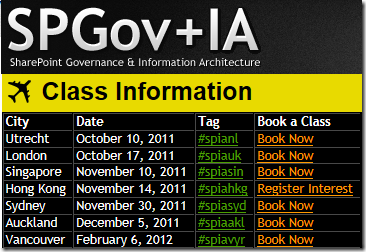
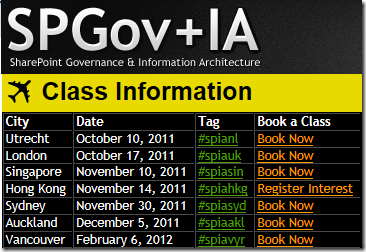
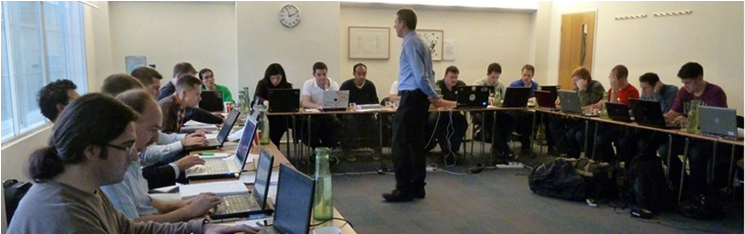
Of course it exists – I’ve been running it around the world for a couple of years now. It’s called the SharePoint Governance and Information Architecture Class (#SPGovIA) and it was a year in the making and comes with lots of goodies, such as a CD with a sample performance framework, governance plan, SharePoint ROI calculator (spreadsheet) and sample mind maps of Information Architecture. The class was originally designed for Microsoft New Zealand, on behalf of 3Grow for the Elite program that used to certify gold partners for serious SharePoint competence. Since then its been run in the UK, Netherlands, US, Australia and New Zealand. Next month I will run classes in Singapore and Hong Kong.

For my US readers, early next year I will be taking the course on the road, specifically Canada and the USA in Feb 2012. This course is not run often, because for me the US is a damn long way to travel and my time is tight these days! So I sincerely hope that if this sort of class sounds interesting to you, then you will consider being part of it. Michal Pisarek has already made an announcement for classes in Vancouver, and more details will be forthcoming for one or two US cities. I only have time for 2 classes in North America, so which city should it be?

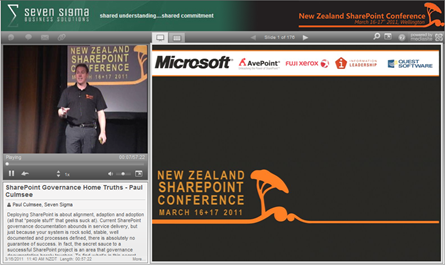
For more detail on the class, head on over to www.spgovia.com. While there, click the Media link and watch the first half hour of the class. I look forward to seeing you there.

image

Thanks for reading

Paul Culmsee

www.sevensigma.com.au


Seattle (and Bend) here we come!

Hi all

Just a quick post to let you all know that in around 11 hours I’m off on a long flight back to US shores – my first trip for quite some time. We will be in Seattle, Portland, Bend, San Francisco and Napa. I am really, really looking forward to this trip for a number of reasons.

  • Its my first ever SharePoint Governance and Information Architecture Class in the US and I intend to deliver a knockout class. The class has essentially sold out (at the time of writing one remaining place looks like its about to be filled). Erica Toelle has been absolutely brilliant, has placed a lot of faith in me and I do not intend to let her, or any of the attendees down.
  • I’m also speaking at the Seattle SharePoint User Group in early May 5th (with Ruven) and also speaking at the Bend SharePoint User Group on May 9th, both on some SharePoint Governance Home Truths. I don’t get to the US very often and that is not going to change anytime soon, so I suggest you don’t assume you can wait till next time, because that may be a while! If you know someone who needs a bit of an intervention or some governance “deprogramming”, then send them my way! Smile
  • A major, major milestone this year has been achieved. My Beyond Best Practices book is finally complete! I am super excited by this book too. I think we have really delved into areas that no other book has really done in terms of collaboration and dealing with complex, difficult to solve problems. We are sorting out publishers so hopefully there will be some face to face meetings when I am in San Francisco and I will be able to give you some relatively firm dates on when it might grace a bookshelf, iPad or Kindle. (I’ll cover some stuff from the book in the Seattle class).
  • I’ll have an opportunity to catch up with the likes of Erica Toelle, Ruven Gotz, Christian Buckley, Bill English, Jeff Conklin and a number of other people who I rarely get to see “in the flesh”. Maybe there is time to squeeze in another musical collaboration with Mr Buckley eh?
  • Best of all, my family is coming with me and we are taking a holiday while we are here – wohoo!

So if you are in Seattle between May 1-7, or the Bay Area between May 10-13, get in contact!

See you soon!

Paul


Seattle is go! SharePoint Governance and Information Architecture class

For one night only USA…

Ah, Erica Toelle – what a legend! Thanks to Erica and Fpweb, I’m thrilled to confirm that the Seattle SharePoint Governance and Information Architecture class is all systems go. Save the date as its very likely indeed to be the only SPIA class in the USA in 2011.  If it wasn’t enough that Erica will be joining me, but Ruven Gotz will be there too.

Thursday and Friday, May 05-06, 2011. (http://spiaseattle.eventbrite.com/)

The location is the Silvercloud Inn, 14632 SE Eastgate Way Bellevue, WA 98004

Map picture

In this multimedia extravaganza of a blog post, lets take a closer look at this class and what you can expect. Below is a snippet of a talk I did in New Zealand called “SharePoint Governance  Home Truths”. This clip shows a little diagnostic test that I do on my audience, to see whether they have experienced the visible signs of wicked problems. If you want to know why you should go to SPGov+IA, then take my 2 minute test yourself.

Do you need SPGov+IA? Take the two minute test to find out…

If the two minute test has taken your fancy, then you might want to see what is in store on the course itself. Below is the first half-hour of module 1 (in the form of a conference session), as well as the accompanying slide deck.

image 

View more presentations from paulculmsee

Course Information:

imageDownload Course Outline (PDF)

Download Class Flyer (PDF)

Most people understand that deploying SharePoint is much more than getting it installed.  Despite this, current SharePoint governance documentation abounds in service delivery aspects. However, just because your system is rock-solid, stable, well-documented and governed through good process, there is absolutely no guarantee of success.  Similarly, if Information Architecture for SharePoint was as easy as putting together lists, libraries and metadata the right way, then why doesn’t Microsoft publish the obvious best practices?

In fact, the secret to a successful SharePoint project is an area that the governance documentation barely touches.

This Master Class pinpoints the critical success factors for SharePoint Governance and Information Architecture and rectifies this blind spot.  Paul Culmsee’s style takes an ironic and subversive view on how SharePoint Governance really works within organizations while presenting a model and the tools necessary to get it right.

Drawing on inspiration from many diverse sources, disciplines and case studies, Paul Culmsee has distilled the "what" and "how" of governance down to a simple and accessible, yet rigorous and comprehensive set of tools and methods that organizations, large and small, can utilize to achieve the level of commitment required to see SharePoint become a successful part of your enterprise.

Some workshop sessions are hands on, we provide all of the tools and samples needed but please bring your own laptop.

Course Structure:

The course is split into 7 modules, run across two days.

Module 1: SharePoint Governance f-Laws 1-17:

Module 1 is all about setting context in the form of clearing some misconceptions about the often muddy topic of SharePoint governance. This module sheds some light onto these less visible SharePoint governance factors in the form of Governance f-Laws, which will also help to provide the context for the rest of this course

  • Why users don’t know what they want
  • The danger of platitudes
  • Why IT doesn’t get it
  • The adaptive challenge – how to govern SharePoint for the hidden organisation
  • The true forces of organisational chaos
  • Wicked problems and how to spot them
  • The myth of best practices and how to determine when a “practice” is really best

Module 2: The Shared Understanding Toolkit – part 1:

Module 2 pinpoints the SharePoint governance blind spot and introduces the Seven Sigma Shared Understanding Toolkit to counter it. The toolkit is a suite of tools, patterns and practices that can be used to improve SharePoint outcomes. This module builds upon the f-laws of module 1 and specifically examines the “what” and “why” questions of SharePoint Governance. Areas covered include how to identify particular types of problems, how to align the diverse goals of stakeholders, leverage problem structuring methods and constructing a solid business case.

Module 3: The Shared Understanding Toolkit – part 2:

Module 3 continues the Seven Sigma Shared Understanding Toolkit, and focuses on the foundation of “what” and “why” by examining the “who” and “how”. Areas covered include aligning stakeholder expectations, priorities and focus areas and building this alignment into a governance structure and written governance plan that actually make sense and that people will read. We round off by examining user engagement/stakeholder communication and training strategy.

Module 4: Information Architecture trends, lessons learned and key SharePoint challenges

Module 4 examines the hidden costs of poor information management practices, as well as some of the trends that are impacting on Information Architecture and the strategic direction of Microsoft as it develops the SharePoint road map. We will also examine the results from what other organisations have attempted and their lessons learned. We then distil those lessons learned into some the fundamental tenants of modern information architecture and finish off by examining the key SharePoint challenges from a technical, strategic and organisational viewpoint.

Module 5: Information organisation and facets of collaboration

Module 5 dives deeper into the core Information Architecture topics of information structure and organisation. We explore the various facets of enterprise collaboration and identify common Information Architecture mistakes and the strategies to avoid making them.

Module 6: Information Seeking, Search and metadata

Module 6 examines the factors that affect how users seek information and how they manifest in terms of patterns of use. Building upon the facets of collaboration of module 5, we examine several strategies to improving SharePoint search and navigation. We then turn our attention to taxonomy and metadata, and what SharePoint 2010 has to offer in terms of managed metadata

Module 7: Shared understanding and visual representation – documenting your Information Architecture

Module 7 returns to the theme of governance in the sense of communicating your information architecture through visual or written form. To achieve shared understanding among participants, we need to document our designs in various forms for various audiences.

Putting it all together: From vision to execution

Attendees will be taking home a manual ~480 pages, containing the Seven Sigma Shared Understanding Toolkit CD with a sample performance framework, governance plan, SharePoint ROI calculator (Spreadsheet), sample mind maps of Information Architecture. These tools are the result of years of continual development and refinement "out in the field" by Paul Culmsee and have only been recently released to the public through this Master Class.

More Information:

Refund Policy:

No refunds will be issued for attendee cancellations once payment is recieved.  Class cancellation by the organizer will result in a refund less transaction fees.

image

http://spiaseattle.eventbrite.com/


Praise for SharePoint Governance and IA Masterclass

I received this today and I had to post it. In New Zealand recently, Paul McTaggart of Gen-i stopped me and complimented the governance and information architecture course that some of his staff have attended. I am truly humbled by the feedback that he just sent through…

Practical, relevant and seriously funny: These attributes are seldom seen together in a training session.

However, Paul Culmsee has practical, real world experience having worked on complex (wicked) projects which provides him with the background and understanding of what works and why.

Discover the immutable f-laws of SharePoint projects. Cry and laugh when you identify the reality of you own organizational platitudes, but breathe a sigh of relief when you see that there is a way out and that SharePoint Governance and Information Architecture can be achieved with everyone sharing the same understanding of where you are now and where you are trying to get to.

Paul also supports you new found realization of what needs to be done by providing you with the guidance, tools and methods that you can take from the classroom and apply to your complex (wicked) problem projects to make them work.

Basically it is all about people (gaining shared understanding), process (knowing how to get from here to there) and then the technology (SharePoint).

My team now uses the concept of shared understanding and the tools that the Governance and Information Architecture Class has provided to get customers “on page” before we design and code in SharePoint land.

Paul McTaggart

ECM Business Manager

Gen-i a division of Telecom New Zealand

Thanks for reading

Paul Culmsee


Australian SharePoint Conference Community Challenge–How we did it.

Hiya

image

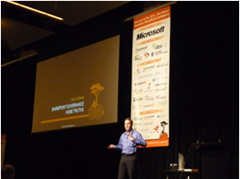
I recently participated in the Australian and New Zealand community SharePoint conferences and had a blast. First up, I was given the opportunity to keynote the Australian conference on day 2, where I spoke about SharePoint Governance home truths. It received very positive feedback and I was told by a lot of people that it really made them rethink their governance approach. In fact, in the New Zealand session, as I was going through some of the common mistakes people make, I could see people cringing as they knew they were guilty as charged. One attendee buried her head in her hands when I started talking about the “buffet of platitudes” (what is the “buffet of platitudes” you ask? Come to my class to find out! 🙂

The community challenge in Australia was a real highlight. This was a new addition to the conference where a group of conference attendees delivered a SharePoint solution for a not for profit organisation. WorkVentures was the organisation selected and the challenge progressed over three sessions, facilitated by SharePoint community leaders. Session one (Define and Design), was a business session which aimed to work through the high level requirements that WorkVentures had for an intranet, their aims for what they hope it would achieve and what they wanted included.  

This post was written on the assumption that you are familiar with some of Seven Sigma’s methods. If not, then we suggest you stop and read a couple of foundational posts first – especially if these maps do not mean much to you.

The Importance of Goal Alignment…

Nick Hadlee was supposed to chair this define and design session, but was unable to get to the Australian conference due to the earthquake events in Christchurch. As a result, I ended up inheriting this role, so I roped in Andrew Jolly to help me on this, because we have a lot in common and work in a similar way. User surveys had been conducted with WorkVentures staff and management, which gave some insights into potential focus areas for SharePoint. Even so, I had no way of knowing whether those potential focus areas made strategic sense. To resolve this issue, we examined WorkVentures 2009 Annual Report to understand their core purpose and strategic focus areas and various business units. After all, it is all well and good to develop some SharePoint functionality, but if you can’t see how that component helps achieve strategic objectives, how do you know it is the right thing to do?

The annual report proved to be a goldmine. It stated that WorkVentures had embarked on an enterprise improvement strategy prior to SharePoint and the community challenge being on the radar. This enterprise improvement plan, incorporating quality management, IT, HR and business strategy development, provided us the context to focus SharePoint as an enabler that fitted within the plan.

Andrew wasn’t due to fly into Sydney until the evening before the conference. So the day before the conference, Debbie Ireland and I visited WorkVentures on-site, meeting with the CEO, CFO and Marketing Director. The purpose of this visit was to ensure a shared understanding among us all of the alignment of the SharePoint community challenge outputs to the WorkVentures vision, purpose and strategic focus areas. From this conversation, which I mapped, some really interesting stories enabled them to pinpoint one of the key success factors for any SharePoint implementation at WorkVentures – “Bridging Silos”.

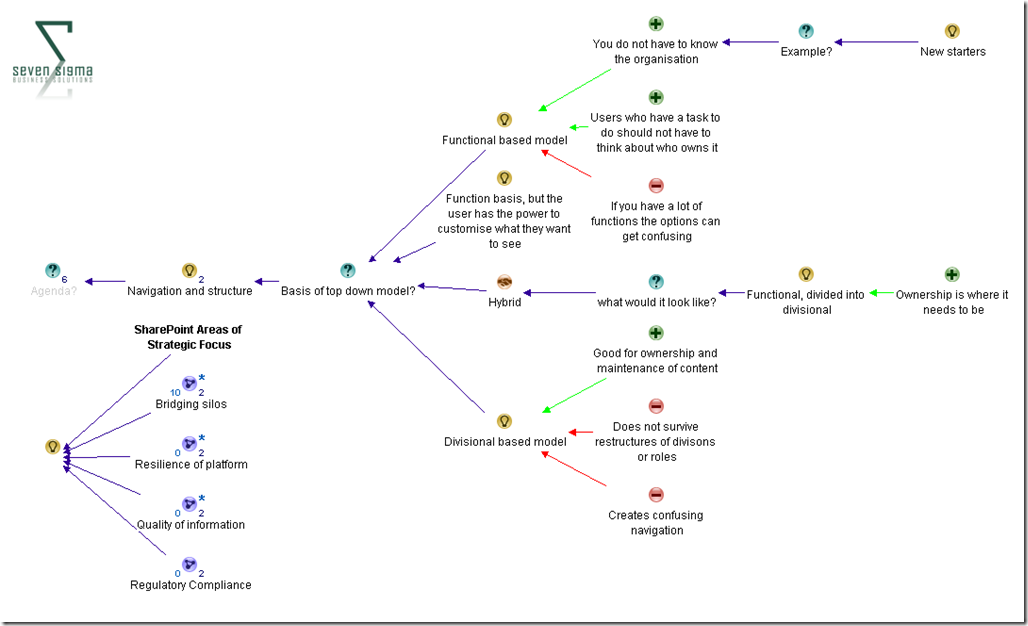
Ultimately, we identified four key areas of strategic focus for SharePoint that aligned to WorkVentures strategic goals. Below is a screenshot of the end-to-end alignment in map format . This map was used during the “define and design” conference session to help focus attendees on the purpose of SharePoint for this organisation, as well as noting the key areas that we would have to do well, to consider SharePoint a success.

FocusAreas

Stories that led to the goal

Lawrence Luk – the CFO of WorkVentures told Debbie and I several captivating stories that surfaced the bridging silos area of focus. One interesting facet of WorkVentures was that staff from the whole organisation came together once per year – at the Christmas party. This is because each WorkVentures “division” or “business unit” is in effect a separate mini-company, with different goals, customers, vertical markets and regulatory requirements. Thus the problem of silos isn’t a negative one in the sense where dysfunctional “culture” is blamed as such. More that it was the simple fact that each business unit didn’t have a lot in common with other business units. The silo effect was a by-product and it was not driven by negative behaviours.

A great example of this was one particular business unit, Connect IT. It solicits organisations to donate old PC’s, which provides opportunities for skills development for disadvantaged people by teaching them how to refurbish these PC’s. These refurbished PC’s are then sold at low cost. A KPI for this program is the number of organisations donating old PC’s to WorkVentures to sustain ConnectIT. Lawrence had the experience where WorkVentures financial auditors, who had been doing the books for two years prior, asked him why they hadn’t been approached to donate PC’s as they had some. Lawrence realised that he almost missed a great opportunity to help the ConnectIT division achieve one of their key KPI’s. Furthermore, the auditor should never have had to ask themselves. Instead all WorkVentures staff should have this core KPI instilled and internalised so that they could proactively seek out these opportunities to help the other business units.

Another couple of interesting contextual facets illustrated that there were other forms of silo that went beyond a purely divisional basis:

  • Most backoffice staff had never been to the Campbelltown office, where all of the “coal face” work took place with the community.
  • English was a second language to many staff.
  • Not all staff had their own PC’s.

These stories catalysed the conversation to many other examples of missed opportunities, where one business unit has the means to make a massive difference to the results of another. On reflection, it was realised that the nature of WorkVentures business units, being so independent of each-other, inevitably had a silo effect. There was a lack of awareness organisation-wide of the core KPI’s of each unit, hence bridging (not breaking) these silos became a key theme. If SharePoint was to have a long lasting, successful legacy, then it had to play a part in addressing this issue.

The define and design session live…

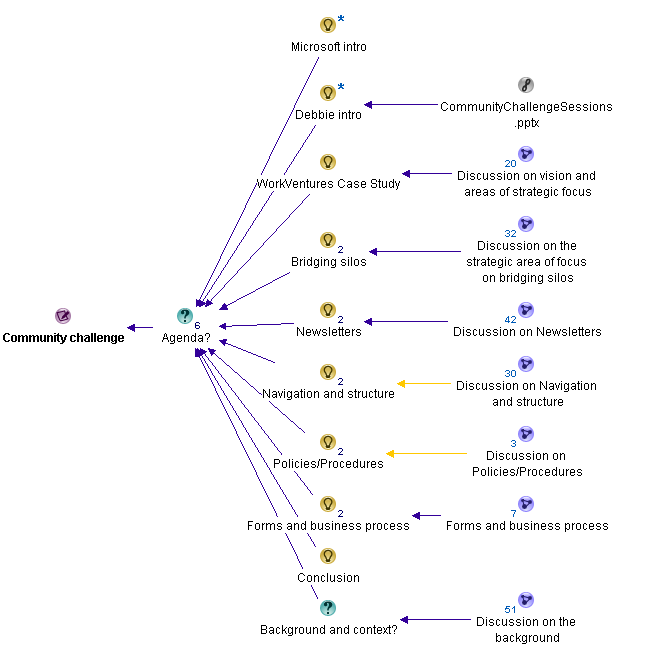
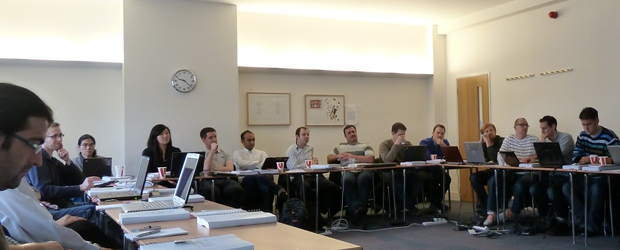
From there, with invaluable help from Andrew Jolly, we planned and then executed the requirements session with a conference audience of around one hundred people. We split the session up into several areas and the map below shows how we structured it.

After Microsoft did their intro, Debbie explained the context of the community challenge via a short PowerPoint presentation. I then took the chair and explained the vision and areas of focus map (the image above) and stressed to the audience that they were going to be participating in this session as well. I also stressed that no matter what solutions or ideas they came up with, they had to justify them against the four key focus areas, which I went through.

image

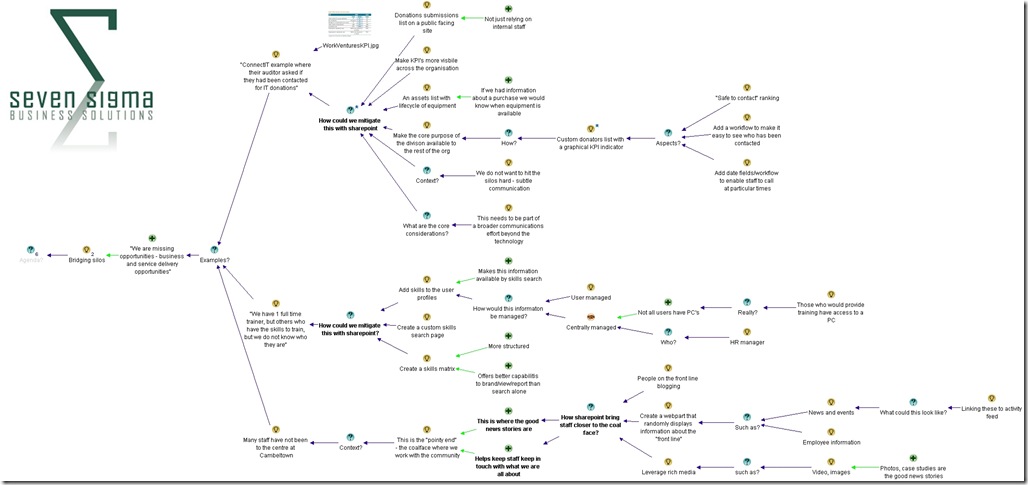
Then we got down to business where I dialogue mapped, with Andrew and I co-facilitating. We decided to focus people’s attention to the core goal of bridging silos as a topic area itself, and ask the audience how SharePoint could indeed bridge silos. We utilised three of the examples that Lawrence gave us  and then leveraged the wisdom of the (large) crowd to solicit ideas. Below is the dialogue map that shows the richness of this discussion (click to enlarge). You will see in this map that for each story told to us by Lawrence, we asked the question “How could we mitigate this with SharePoint?”. The purpose of asking the question this way helped the audience to focus on SharePoint as an enabler to a greater end – and not to be a tool looking for a problem to solve.


Silos

Given that we only had around 45 minutes to work with, Andrew and I could only spend around 15 minutes on the bridging silos area. But the map above shows that a lot of very valuable rationale from the audience was captured. The real benefit though was focusing the audience onto the broader goals and how SharePoint could enable them. This was critical to do, because now we had to switch focus from the lofty world of goal alignment to focusing on how SharePoint building blocks could be used to achieve specific ends.

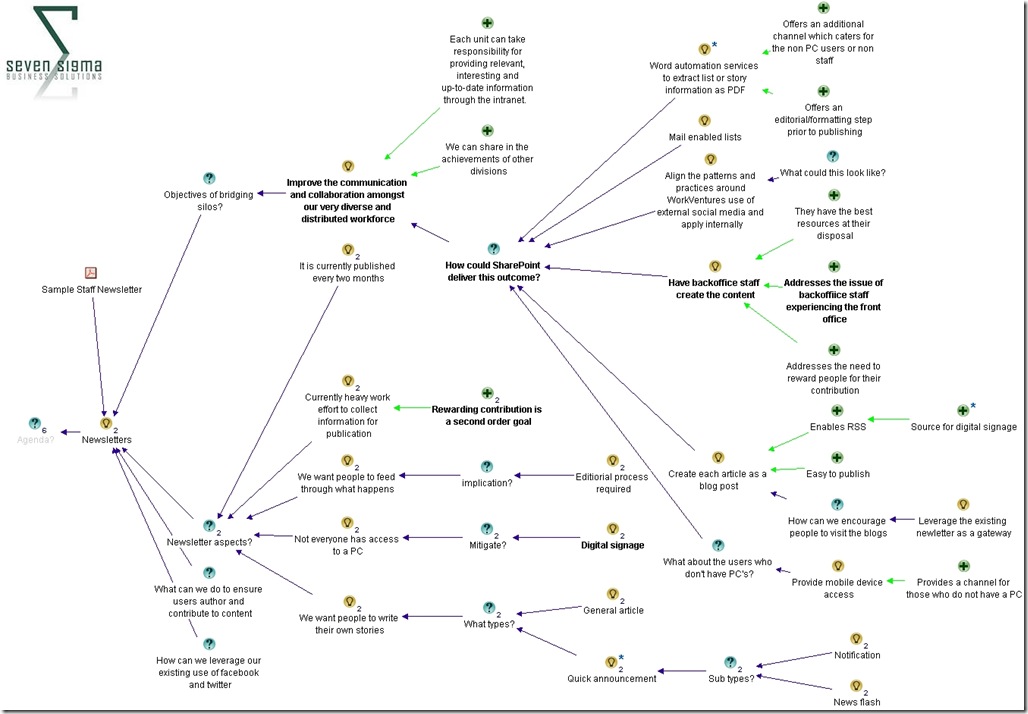
We examined how SharePoint could augment the existing newsletter based method for dissemination of information within WorkVentures. We showed the audience what sample WorkVentures newsletter looked like and reviewed some of the key contextual aspects to newsletters within WorkVentures in terms of their creation, management, reach and format.  We reminded the audience about the importance of bridging silos and then called for ideas from the audience as to how SharePoint could improve the dissemination of news. What was particularly great about this session was that audience members began to relate SharePoint ideas against the key focus areas and identify some of the governance aspects that would be required to make it work.

For example, if you look at the map below (click to enlarge), one of the ideas for the newsletter was a fairly technical one: leveraging “word automation services to extract list or story items and create a PDF”. On first glance one might think “wow that’s fairly heavy” (and not to mention quite nerdy), but the justification for this idea was that it would still account for those WorkVentures users who do not have a PC and therefore access to the portal. Another idea was “Have backoffice staff create the content” on the basis that in doing so, they would get a better feel for coal-face issues that they typically do not see normally. When you think about it, this idea is not SharePoint at all, but more of a strategy for how SharePoint should be adopted and accountabilities for doing so (i.e. a governance approach!)

The key point here is that In both of these examples, audience members were clearly relating their ideas back to the previously established goals, which in turn were aligned to the WorkVentures vision, purpose and key strategic focus areas. Not bad for a couple hours work eh? Smile

Newsletters

With the little time that we had left, we also looked at site navigation and structure, where the audience resolved that WorkVentures would be best served by a hybrid navigation model that was functionally driven primarily (i.e. task based navigation), but then divided into divisional areas. (As opposed to a purely organisational structure driven navigation model).

As you can see below, we made a point of always showing the four areas of focus for SharePoint overall, to ensure that decisions made were informed by them.

image

Conclusion

I have to say that given the timeframe and constraints, I think we did a great job of developing a shared vision for SharePoint, how it fitted into WorkVentures organisational and strategic context, and then focusing a diverse audience into looking at SharePoint building blocks through that lens. The dialogue maps were very rich, with some terrific ideas, and WorkVentures staff were thrilled to see the alignment of SharePoint to their strategic goals.

I use similar methods to this for non IT projects too, and I think that if we had a week to work on WorkVentures, we would have created something really special. Nevertheless, from my point of view, I think that the community challenge is an terrific idea, I enjoyed being a part of it, and I have to offer special thanks to Debbie and Andrew in particular for helping to make this into a really great mini-engagement. Hopefully we can do it all again next year.

Thanks for reading

Paul Culmsee

www.sevensigma.com.au


Exciting news for Governance and Information Architecture classes

Hi all

I just thought I would check-in with some updates on happenings and some upcoming travels. In less then 2 weeks now, I will be in London with Andrew Woodward and Ant Clay of 21apps for the second SharePoint Governance and Information Architecture Master Class. There are still places available on this class so if you have been thinking about attending, now is the time to act.

Also in Europe, a class is being run in Utrecht, Netherlands in May by Ant Clay.

I am proud to be chosen to be a keynote speaker at the Australian SharePoint conference in Sydney in March. I am still wondering if I should dialogue map 600 people! I will also be running a two-day class after this conference – the only one in Sydney for this year. The week after I am in NZ at the SharePoint conference there, also running a 2 day class and hopefully the first ever Issue Mapping class in New Zealand.

After a small break (begging forgiveness of clients who have to put up with my “international man of mystery” gallivanting), I’ll be heading to North American shores to run classes over there. Confirmed cities at this stage are Boston and Toronto, but DC and Chicago are in the works and I am hopeful to run one on the west coast, perhaps in San Francisco or Seattle.

If you are a SharePoint consultancy in these areas and would like to partner with us on this, please contact me on twitter @paulculmsee or email me via the address at the about page of this blog.

Below is the current itinerary for Governance and Information Architecture classes. Things are still being solidified, and will obviously change a little between now and then. Keep an eye on twitter @paulculmsee for more detail.

Date Location Class Hashtag Comments
Feb 21-22 London SharePoint Governance and Information Architecture #SPIAUK  
March 10-11 Sydney SharePoint Governance and Information Architecture #SPIAAU  
March 14-15 Wellington SharePoint Governance and Information Architecture #SPIANZ  
March 21-22 Wellington Issue Mapping Master Class #IBISNZ  
April 28-29 Washington DC SharePoint Governance and Information Architecture #SPIADC Tentative date: to be confirmed
May 2-3 Indianapolis SharePoint Governance and Information Architecture #SPIAIA Tentative date: to be confirmed
May 5-6 Boston SharePoint Governance and Information Architecture #SPIABN Tentative date: to be confirmed
May 9-10 Netherlands SharePoint Governance and Information Architecture #SPIANL Ant Clay of 21apps is running this class as I am in the USA
May 9-10 Chicago SharePoint Governance and Information Architecture ? Tentative date: to be confirmed
we will arrange some kind of hookup to the Netherlands class
May 12-13 Toronto SharePoint Governance and Information Architecture #SPIATO Announced
May 16-17 West coast USA SharePoint Governance and Information Architecture   Looking for a partner for this region
June London Issue Mapping Master Class   in the works…
July South Atrica SharePoint Governance and Information Architecture   in the works…

if you live in any of the regions that are either “tentative” or “in the works”, please contact me and register your interest so I can work with local partners on the ground in these locations.


Thanks for reading

Paul Culmsee


More SharePoint Governance, Information Architecture and *Sensemaking* Classes Planned

imageHi all

A big chunk of last year had me off under a metaphorical mushroom, putting together several days of courseware on the topic of SharePoint Governance and Information Architecture. My take on these topics are influenced from some odd places, and the course drew on a lot of the non IT work that I do, that involves collaboration on some very complex problems indeed.

In November and December of 2010, we took this “on the road”, so to speak, firstly in Dublin, then London and Sydney. The courses were sold out and feedback was terrific. Here are a few choice quotes (check out the hyperlinks for full reviews)


“Did it meet my expectations? Well I’d have to say that it far exceeded them. There had obviously been a large amount of effort in preparing the courseware and modules. They covered the important missing links currently absent from the Microsoft and traditional training courses” – Wes Hackett.

“I’ve just finished the second day of the SharePoint 2010 Governance and Information Architecture Master Class presented by Paul Culmsee with the support of Andrew Woodward . I can wholeheartedly say it was one of the best courses I’ve attended both in content and presentation style and they deserve a lot of credit for putting together a fantastic course. Paul in particular has put a huge amount of effort into the slidedeck, sample documents and enormous manual (almost 500 pages worth!) let alone all the great additional insight he could provide in person over both days” – Brendan Newell

“Finally …. after 12 years in the IT industry a course which covers some of the fundamental issues governing project success.   This course is a real eye opener and a must for any IT professional involved in project planning and delivery” -  Stephen McWilliams

“I just came back from the best technology training I have had in years: a world-first Microsoft SharePoint Elite Information Architecture course designed and delivered by Paul Culmsee. It has taught me a great deal across ALL facets of the day-to-day work that I do as a SharePoint architect” – Jess Kim

Based on this and similar feedback, we are going to do it again. Locations confirmed so far are London (#SPIAUK), Sydney (#SPIAAU) and Wellington (#SPIANZ) in February and March 2011 and in the pipeline is The Netherlands (#SPIANL) and at least a couple of US cities!

In addition to the unique content on these classes, I am honoured to announce that I am now authorised to teach the official Cognexus Issue Mapping courseware – the only non Cognexus Dialogue Mapping practitioner authorised to do so. As such, we will be running the inaugural Issue Mapping class in London in late February as well (wohoo!)

So, here are the details for each location:

  • (Register now) February 21, 2011, London   #SPIAUK SharePoint Governance and Information Architecture Master Class (Download Flyer)
  • (Register now) February 23, 2011, London #IBISUK Issue Mapping Master Class (Download Flyer)
  • (Register now) March 10, 2011, Sydney  #SPIAAU SharePoint Governance and Information Architecture Master Class (Download Flyer)
  • (Register now)March 14, 2011, Wellington #SPIANZ SharePoint Governance and Information Architecture Master Class (Download Flyer)
  • (Register soon) May 9, 2011, Utrecht, Netherlands (watch this space)
  • Wondering what to expect in these classes? Read on!

     SharePoint Governance and Information Architecture Master Class. 2 full days of real world, examples knowledge and techniques

    Most people understand that deploying SharePoint is much more than getting it installed. Despite this, current SharePoint governance documentation abounds in service delivery aspects. However, just because your system is rock solid, stable, well documented and governed through good process, there is absolutely no guarantee of success. Similarly, if Information Architecture for SharePoint was as easy as putting together lists, libraries and metadata the right way, then why doesn’t Microsoft publish the obvious best practices?

    In fact, the secret to a successful SharePoint project is an area that the governance documentation barely touches.

    This master class pinpoints the critical success factors for SharePoint governance and Information Architecture and rectifies this blind spot. Paul‘s style takes an ironic and subversive take on how SharePoint governance really works within organisations, while presenting a model and the tools necessary get it right.

    Drawing on inspiration from many diverse sources, disciplines and case studies, Paul has distilled the “what” and “how” of governance down a simple and accessible, yet rigorous and comprehensive set of tools and methods that organisations large and small can utilise to achieve the level of commitment required to see SharePoint become successful.

    Master class aims:

    • Present SharePoint governance and Information Architecture in a new light – focus on the “blind spots” where the current published material is inadequate
    • Cover lessons learned from Paul’s non IT work as a facilitator and sensemaker in complex large scale projects
    • Examine the latest trends in the information landscape for industry and government and review studies that inform governance and Information Architecture efforts
    • Present an alternative approach to business-as-usual SharePoint governance planning that focuses on real collaboration
    • Provide quality information that is rigorous yet accessible, entertaining and interesting

    Master class outcomes:

    • Understand the SharePoint governance lens beyond an IT service delivery focus
    • Develop your ‘wicked problem’ radar and apply appropriate governance practices, tools and techniques accordingly
    • Learn how to align SharePoint projects to broad organisational goals, avoid chasing platitudes and ensure that the problem being solved is the right problem
    • Learn how to account for cognitive bias and utilise tools and techniques that help stakeholders align to a common vision
    • Understand the relationship between governance and assurance, why both are needed and how they affect innovation and user engagement
    • Understand the underlying, often hidden forces of organisational chaos that underpins projects like SharePoint
    • Understand the key challenges and opportunities that SharePoint presents for Information Architecture
    • Learn how to document your information architecture
    • Practical knowledge: Add lots more tools to your governance and IA toolkit!

    Course Structure: The course is split into 7 modules, run across the two days.

    Module 1: SharePoint Governance f-Laws 1-17:

    Module 1 is all about setting context in the form of clearing some misconceptions about the often muddy topic of SharePoint governance. This module sheds some light onto these less visible SharePoint governance factors in the form of Governance f-Laws, which will also help to provide the context for the rest of this course

    • Why users don’t know what they want
    • The danger of platitudes
    • Why IT doesn’t get it
    • The adaptive challenge – how to govern SharePoint for the hidden organisation
    • The true forces of organisational chaos
    • Wicked problems and how to spot them
    • The myth of best practices and how to determine when a “practice” is really best

    Module 2: The Shared Understanding Toolkit – part 1:

    Module 2 pinpoints the SharePoint governance blind spot and introduces the Seven Sigma Shared Understanding Toolkit to counter it. The toolkit is a suite of tools, patterns and practices that can be used to improve SharePoint outcomes. This module builds upon the f-laws of module 1 and specifically examines the “what” and “why” questions of SharePoint Governance. Areas covered include how to identify particular types of problems, how to align the diverse goals of stakeholders, leverage problem structuring methods and constructing a solid business case.

    Module 3: The Shared Understanding Toolkit – part 2:

    Module 3 continues the Seven Sigma Shared Understanding Toolkit, and focuses on the foundation of “what” and “why” by examining the “who” and “how”. Areas covered include aligning stakeholder expectations, priorities and focus areas and building this alignment into a governance structure and written governance plan that actually make sense and that people will read. We round off by examining user engagement/stakeholder communication and training strategy.

    Module 4: Information Architecture trends, lessons learned and key SharePoint challenges

    Module 4 examines the hidden costs of poor information management practices, as well as some of the trends that are impacting on Information Architecture and the strategic direction of Microsoft as it develops the SharePoint road map. We will also examine the results from what other organisations have attempted and their lessons learned. We then distil those lessons learned into some the fundamental tenants of modern information architecture and finish off by examining the key SharePoint challenges from a technical, strategic and organisational viewpoint.

    Module 5: Information organisation and facets of collaboration

    Module 5 dives deeper into the core Information Architecture topics of information structure and organisation. We explore the various facets of enterprise collaboration and identify common Information Architecture mistakes and the strategies to avoid making them.

    Module 6: Information Seeking, Search and metadata.

    Module 6 examines the factors that affect how users seek information and how they manifest in terms of patterns of use. Building upon the facets of collaboration of module 5, we examine several strategies to improving SharePoint search and navigation. We then turn our attention to taxonomy and metadata, and what SharePoint 2010 has to offer in terms of managed metadata

    Module 7: Shared understanding and visual representation – documenting your Information Architecture

    Module 7 returns to the theme of governance in the sense of communicating your information architecture through visual or written form. To achieve shared understanding among participants, we need to document our designs in various forms for various audiences.

    Putting it all together: From vision to execution

    As a take home, we will also supply a USB stick for attendees with a sample performance framework, governance plan, SharePoint ROI calculator (Spreadsheet), sample mind maps of Information Architecture. These tools are the result of years of continual development and refinement “out in the field” and until now have never been released to the public.

    Note: The workshop sessions will be hands on, we provide all of the tools and samples needed but please bring your own laptop.

    Issue Mapping Master Class. Your path towards shared understanding and shared commitment

    “Some problems are so complex that you have to be highly intelligent and well informed just to be undecided about them.” Laurence J. Peter

    Presented by: Paul Culmsee

    Courseware by: Cognexus Institute and Seven Sigma

    “Not another $#%@*$ meeting!”

    All of us have felt the frustration of walking from yet another unproductive meeting, wondering where the agenda went. Yet, as problems become more complex, meetings are still the place where critical strategic decisions are made.

    ibis-map

    What is Issue Mapping?

    Issue-Based Information Systems (IBIS) is a sense-making framework used to support group discussions to assist all involved to come to a shared understanding. It visually maps participants’ points of views, problems voiced, the rationale and reasons leading up to decision(s). The maps can be easily read and understood by everyone, even by those not part of the discussion group.

    Why Issue Mapping?

    • Maps detailed rationale behind decision-making as well as the decision; maps the thinking process of the group
    • Concentrates on pros and cons to an idea, encourages and explores all views, taking the sting out of differences
    • Represents and clarifies diverse points of views, conflicting interpretations and goals, inconsistent information and other forms of complexity
    • Everyone gets a chance to speak, if they want. People are heard and contributions are acknowledged. Interruptions, repetition and dominance of the loudest decreases
    • Keeps participants on topic because they can visually see the progress of the discussion
    • Keeps everyone’s attention
    • Meeting progress/result can be seen
    • Map helps participants come up with ideas/arguments
    • Visual display of progress to review summary if need so the brain can absorb the bigger picture and appreciate the validity and value of a larger perspective
    • Avoids jumping to easy answers or superficial conclusions
    • Promotes deeper reasoning, rigor and even wisdom
    • Everyone can visually see everything discussed- leaves no room for misunderstandings
    • Documents can easily be attached to map to back up ideas
    • Participants can see effectiveness of mapping and genuine will try to make it more productive

    About Seven Sigma

    Issue Mapping is a life skill that can be applied to many different problem domains and scenarios. Participants will gain proficiency in a craft that can be applied long into the future, to help them and others bring clarity and convergence to the management of complex problems. At Seven Sigma, we practice Issue and Dialogue Mapping routinely and this has brought us many satisfied clients. The Mapping in itself is part of the ‘secret sauce’ that makes Seven Sigma’s reputation renowned.

    Seven Sigma Business Solutions is the only recognised designated partner of Cognexus Institute, founder of the art of Issue Mapping, in the world. We recognise that without reaching shared understanding, you will find yourself at yet another meeting, rehashing the same unresolved problems, listening to the same arguments month after month. Or, if a decision has been made, it has not been followed up to fruition due to lack of commitment/buy-in.

    We are proud to be part of your journey towards shared understanding and shared commitment.

    Master Class aims and outcomes:

    • Be able to create great maps – issue maps that are clear, coherent, and inviting
    • Immediately start using Issue Mapping effectively in your work and life; the class will focus on practical experience and map building
    • Command a rich range of options for publishing and sharing maps
    • Lead with maps: create direction, momentum, and energy with issue maps
    • Quickly and effectively do critical analysis in dynamic situations
    • Organize unstructured information and discover patterns and connections within it
    • Make critical thinking visible for inspection and analysis
    • Recognise early, the symptoms of wicked problems and the forces behind group divergence
    • Recognise the importance of capturing the rationale behind decisions, as well as the decisions themselves
    • Rethink the traditional approach to meetings and decision making
    • Start capturing the rationale leading up to the decisions by using IBIS and Compendium software

    It will also give you a deeper understanding of:

    • The fundamentals of IBIS and Compendium
    • The structural patterns that give clarity and power to issue maps
    • How decision rationale is represented in a map

    This master class will be hands on – please bring your own laptop with Compendium software (freeware) installed.

    Duration: 2 days, with homework after the first day

    Audience: For both IT and non-IT audience; those involved in highly complex projects including leaders, consultants, facilitators, organisational development professionals, change agents, managers and engineers.

    Prerequisite: An open mind geared for shared understanding and shared commitment


    Dialogue Mapping: The Ying to SharePoint Yang

    I don’t know about you, but as a SharePoint practitioner, I love the fact that I do not do SharePoint full-time anymore. I’d like to take some time to explain why this is the case, and how my non IT work helps me be a better SharePoint practitioner. To do so, I will talk about a recent non IT project I worked on. Who knows? This may give you some insights into how you view and approach collaborative work.

    Western Australia is BIG

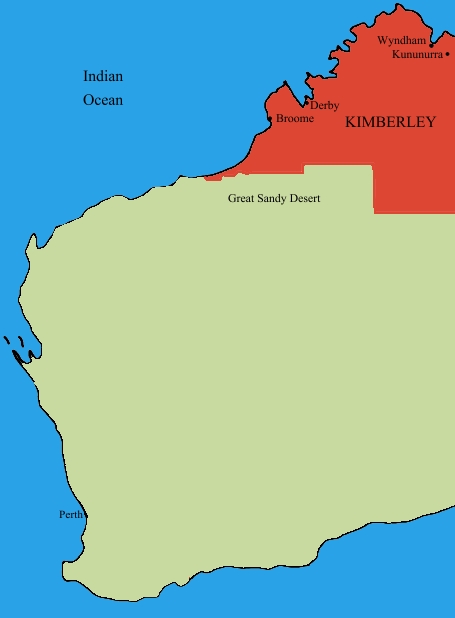
    File:Kimberley region of western australia.JPGIn case you don’t know already, I live in Perth, Western Australia. You can see Perth if you squint at the map on your left and look to the south west area.

    Western Australia is a bloody big land area and extremely isolated. One claim to fame about living in Perth is its distinction for being one of the most isolated cities in the world. In fact we has a population density is on par with Mongolia (this is dead-set true – I researched this fact). Of the 2.2 million people that live in the state, 1.8 million live in the Perth metropolitan area and the rest are scattered far and wide. In terms of distribution, there are no other major cities in Western Australia. The next most populated town outside of Perth is Mandurah with some 83,000 people. 

    In the north of Western Australia, these towns are often separated by anywhere from a couple hundred to more than a thousand kilometres. The weather is very hot, the landscape is breathtakingly beautiful and the isolation here is hard to comprehend without visiting. The wealth of Western Australia (“GFC? What GFC?”) comes from the north of this vast state, via huge mineral deposits that China seems happy to buy from us, which in turn keep me and my colleagues busy putting in SharePoint around the place.

    Now if you think Western Australia is big, get this: The Kimberley region of Western Australia (the top section marked in red) is almost as big as the entire country of Germany. For American readers, it alone is three fifths the size of Texas. For all that space, only around 45000-50000 people live there.

    These wide distances create all sorts of challenges. At a most basic level, think about the cost of basic services to such a remote location with such a small population density. Cost of living is high and services like health care are always stretched and people living here have to accept that they will never be able to enjoy the same level of service enjoyed by their city slicker cousins.

    Now that I have painted that picture in your mind, let me intersect that with one of Australia’s biggest wicked problems. The indigenous people’s of Australia have many social and health issues that have had a massive human cost to them. We are talking chronic alcoholism, physical and sexual abuse, depression, suicide and the whole range of mental illnesses. Families and communities tear themselves apart in a seemingly an endless negatively reinforcing cycle. Like many indigenous groups around the world, intervention approaches from earlier periods have had catastrophic long term consequences that were never considered at the time (a classic wicked problem characteristic). When you read the stories about the stolen generations, you cannot help but be deeply moved by the long term effects, the damage done and the sad legacy left behind.

    Continue reading “Dialogue Mapping: The Ying to SharePoint Yang”


    « Previous PageNext Page »

    Today is: Wednesday 3 June 2026 -