Back to Cleverworkarounds mainpage
 

The practice of Dialogue Mapping – Part 2

Hi there.

Welcome to part 2 of a series of articles on the craft of Dialogue Mapping – something that forms a significant chunk of my SharePoint and non SharePoint work. In the “One best practice” series of articles, I explained IBIS. In part 1 of this series, I introduced the facilitation part that goes along with IBIS. In this article, I’ll spend more time on how Dialogue Mapping works in real world scenarios.

In the previous article, I wrote about how important it was for tools and methods like this to be intuitive and inclusive, allowing you to start from any given point. I also wrote about how methods need to be adaptable and grow, accepting and accommodating for the fact that understanding of the problem changes over time. In any project or problem that is novel or new, there is, invariably, a large degree of unknowns and uncertainties among participants. Solutions are not always obvious and we should be careful not to presume that we are doing something wrong if we reinterpret the problem, as a result of learning more or seeing a suggested solution.

New IT projects, by definition, often fall into this bucket and SharePoint is a poster child for this type of project. But in saying that, some of the toughest problems on the planet are not technically complicated at all and SharePoint is actually not the most wicked problem that I have used this craft on. More on that in part 3…

So, the first example of the practice of Dialogue Mapping that I will tell you about is how effective it is in dealing with IT department physics and nerd law.

IT department physics and nerd law…

Before consulting on any IT project, it is important to understand the inner workings of the IT department. For SharePoint this is particularly important because of its amazing ability for exposing the inherent constraints of IT departmental physics in a negative way.

There are certain fundamental principles of how IT departments work that I have classified into several immutable laws. They are:

  1. The web team dislikes the corporate marketing team because marketing always wants the same garish lime-green colours they have for their printed brochures;
  2. The infrastructure team dislikes the web team because they see them as a bunch of cowboys who mess with forces they do not understand and do not have to deal with the consequences of it;
  3. The web team dislikes the infrastructure team because they are a bunch of control freaks who won’t even allow you to fart without filling in a change control form; and
  4. Nobody likes the misunderstood compliance/records management team at all. They unfortunately perpetuate this by droning on continually about whatever compliance standard/s the organisation has to adhere to.

There are some interesting sub-laws that go along with the four immutable laws. For example, you have only one shot to ask the right question to a good infrastructure guy. In other words, the way you word the question will tell them a lot about your technical chops and if you word the question badly, you will be forever banished into the same sin bin where they hold most project managers and sales people. Once sin-binned, it takes an enormous amount of effort to get out. Similarly, when approaching an application developer, always start the question from the presumption that the error you are encountering is *not* in their code, despite you being fairly certain that it is.

Ted Dzubia is a tech writer equivalent of Dr House. A terrific writer with brilliant insight woven between layers of blistering attitude and well placed vulgarity. He cites a classic example of what he calls “nerd law” and it cuts to the heart of the problem that projects like SharePoint face.

The only way to adjudicate Nerd Law is to write about a transgression on your blog and hope that it gets to the front page of Digg. Nerd Law is the result of the pathological introversion software engineers carry around with them, being too afraid of confrontation after that one time in high school when you stood up to a jock and ended up getting your ass kicked.

If you actually talk to people, network, and make agreements, you’ll find that most are reasonable…

Defying the laws of IT physics

One of my earliest uses of Dialogue Mapping was to deal with a classic case of IT department physics and nerd law. A completely new SharePoint project, with no in-house staff having significant expertise in the product, has decided to implement SharePoint for an intranet. To make it interesting, the project is instigated out of the web team. As the immutable laws explain the forces of IT nature, this means that several things happen by default:

  • The infrastructure team will automatically be against it because they don’t want to get saddled with, yet another, enterprise application to support and manage
  • The records management team, having already been scarred from trying to convince an uninterested workforce that the existing records software does not suck, now will assume that SharePoint is going to take over their area.
  • The software development team will assume that SharePoint is here to replace all of their lovingly coded, yet bloaty and insecure line-of-business systems.

At this point, each side starts googling and discovers that the means by which they will address the “obviously” out-of-bounds web team is via this thing called “Governance”. Governance is then mentioned in every second sentence, in a manner to improve their respective positions. This is the nightmare scenario where governance is used as a tool to perpetuate nerd law. This is to be avoided at all costs.

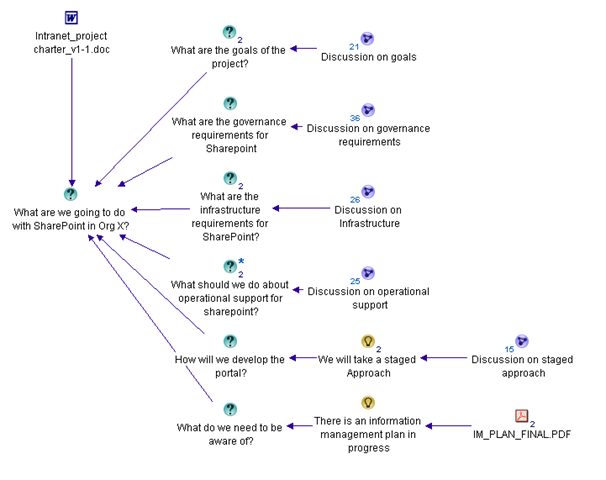
In this project, I introduced the dialogue map from the very first meeting with a simple root question “What are we going to do with SharePoint in Organsiation X”?

Now in this case, SharePoint is my core discipline, so unlike some of my subsequent engagements. I already had a bunch of questions that I wanted the client to start pondering. Being well aware of the destructive forces of the immutable laws of IT, I put down some immediate sub-questions.

  • What are the goals of the project?
  • What are the governance requirements of this project?
  • What are the infrastructure requirements for SharePoint?
  • What should we do about operational support for SharePoint?
  • How will we develop the project?
  • What else do we need to be aware of?

The web team had also developed a project charter which explained, in some detail, the background to this project and how we came to be where we were. I linked this into the issue map. Something that also came up fairly quickly was that the organisation had just completed a large strategic review project and an Information Management Plan had been drafted and approved. This was a key document that pretty much set the direction of the organisation for the next four years.

Below is the map showing these initial questions, along with the project charter and Information Management Plan. Note how I can attach documents into the IBIS map along with the argumentation.
image

Adaptive requirements gathering…

As you can imagine, we started working through these questions. Given that the SharePoint was completely new to the team, I was perfectly happy for the web team to jump around to different areas of the map and fill it in. Fairly quickly, the participants identified that a staged approach would be needed for implementation, and we initially would flick between goals and stages until that began to solidify that the details of the implementation matched the goals.

This map evolved over a period of time where we would spend time on-site with the team, performing training and advisory on SharePoint itself. As understanding of SharePoint’s capabilities grew from the use of a demonstration virtual machine, we refactored and re-examined the map as new knowledge, insights and/or understandings came to light. The team took to dialogue mapping like ducks to water, and the web team leader downloaded and installed compendium so that she always had the latest project rationale on her desktop.

This also had advantages to my colleagues who were also involved in the training and advisory phase. Since each of us were trained in IBIS and dialogue mapping, any one of us was able to conduct a session and the new map would be redistributed to all participants. Thus, even if I did not attend a meeting, I was able to very quickly orient myself around any new questions, issues or ideas.

Planting seeds of buy in…

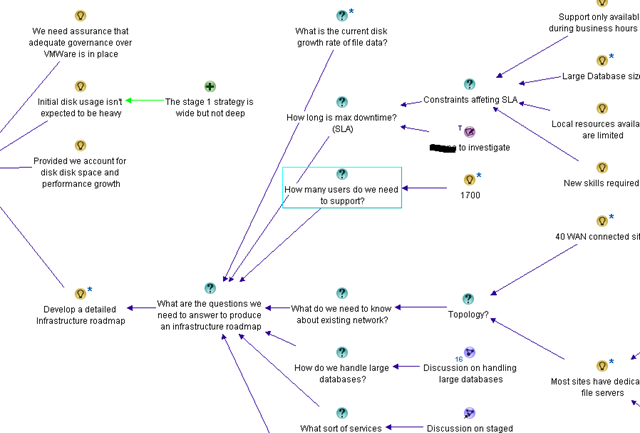
One area that many web teams are weaker on in their knowledge is in infrastructure. In this case, I had a dual role as dialogue mapper and SharePoint consultant because I know how infrastructure guys think. After all, I used to be one myself. Therefore, I wanted to ensure that a lot of infrastructure considerations were captured and made explicit in the map before we took it to the other teams. I ensured that farm topology options were captured, backup and recovery implications, virtualisation and the like were covered. Additionally, many questions were captured but not answered, such as network topology, active directory configuration, large database management, SLA and the like. A snippet of this is below.
image

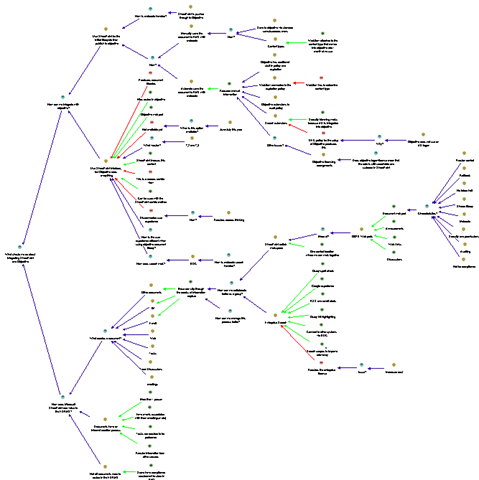
One thing that we were all aware of was to ensure that records management considerations were duly covered. By having a SharePoint environment to use and learn from, the team was able to quickly become much more informed about SharePoint’s view of the world, especially in relation to the orientation of metadata, sites and site collections. We confirmed that the goals of the project was an intranet and the sort of document management that would be required would be skewed very much towards team collaboration. The web team was aware that a records management system existed and also some members had some previous experience working with these systems. We ended up creating a very detailed map outlining the strategy for integration with records management, the options for integrating the current records system with SharePoint and most importantly, the golden rules around integration that ensured that the records management system was still the authoritative location for records. Later, Microsoft and the records management vendor visited the site and presented the latest information on the integration for the product and SharePoint, and the salient points were added to the map. Below is a snippet of the map discussing this topic (deliberately obscured for privacy, but you can get a good feel for the breadth of the discussion).
image

The acid test…

Fast forward another couple of weeks, and the team now has a pretty good understanding of SharePoint and a very well factored map. By this time, others in the department had been called in at various times and added their rationale to the map, answering some of the open questions. Next stop was the ultimate test. A meeting was called, where all of the opposing forces were going to be in the one room at the same time. A dozen people in all, key decision makers who didn’t always enjoy a cosy relationship, crammed into a hot, tiny room with a portable projector.

The web team manager introduced the project via the charter, and we all worked our way through the map. We discussed the goals of the project, how they related back to the strategic Information Management Plan, how we were structuring the phases to support those goals, what was in/out of phase 1 and why, and of course, the considerations that we had made in relation to the other IT Teams. After around 90 minutes, we were done and the group proceeded to give feedback.

The records management team was clearly relieved. In producing the map, we had demonstrated a good awareness of records management considerations and we made it clear and explicit in the map that SharePoint was *not* going to replace or devalue what they already had in place. They loved the fact that we had captured rationale that discussed the pros and cons of the various methods and techniques we could use for integration between their tool and SharePoint as they did not know about this. The infrastructure team was also happy for the same reason. We had captured many of the questions that they would have asked themselves of the web team. We had managed to pass our “one shot” test and were not sin-binned for being naive to the nuances of IT infrastructure.

Key success factors and conclusion

All in all, in that one two hour meeting, everybody was on-side and excited about the project. It was fed back to us that achieving such buy-in within one meeting across these different IT departments was previously unheard of in this organisation.

The key success factors boiled down to 3 major factors:

1. The participants in the Dialogue Mapping process were extremely enthusiastic with the process. We did not sell Dialogue Mapping at all with this engagement – we just used it from the very first workshop. By the end of that first workshop, the participants were very impressed with the richness of what had been captured and it became the standard way we conducted workshops and requirements meetings.

2. The visibility and clarity of the rationale meant that any major concerns of the other teams were mitigated by the fact that the questions they were interested in were either addressed or, at the very least, captured and visible on the map. For many parts of the map, the web team made no pretence to know all of the answers. However, by raising those questions in the map, it gave the other teams much more assurance that the web team were not running off and doing their own thing with a lack of consultation.

3. As a mapper, knowing a fair amount about SharePoint meant that fast-tracking of learning was taking place, both at the map level and at the product capability level. Providing the team with a demo virtual machine allowed members to learn about the product, and then applying that learning back to their understanding of the problem in the map space. This was a great way for them to iterate and converge on the solution much more quickly than fumbling around with the product alone. As a SharePoint practitioner, I was able to foresee problem areas and then utilise the rationale in the map to help steer the various participants into determining the optimum solution for their circumstances.

All in all, this was a great example of the power of Dialogue Mapping in speeding up the normally laborious process of stakeholder consultation and developing a shared sense of what was trying to be achieved. The one thing I would say about this method however, was that being a subject matter expert, as well as the dialogue mapper, meant that I was able to exercise a fair degree of control over the flow of the map. This is because I was both a participant as well as the mapper, both capturing as well as answering questions, raising concerns and flagging issues that may have been missed otherwise. For any aspiring dialogue mappers out there, this is actually a good way to start because you can concentrate on creating well formed IBIS, and not have to worry about whether you are articulating a participant’s dialogue correctly. Almost by definition in this case, you know exactly what the participant is talking about and getting the context onto the map in IBIS notation is not a huge mental challenge.

But there is more…

If I concluded this series now, I would be misleading you. The form of Dialogue Mapping that I undertook here was not what I would call pure Dialogue Mapping. In my explanation of the above process, I was a participant, strategist, mentor as well as mapper. My knowledge of the problem space was very detailed and I used Dialogue Mapping as a tool to help steer the group to a position that enabled them to improve their chances of a great outcome.

In part 3, I will detail more about the craft of pure Dialogue Mapping. In this case, you are not in the room because of any particular expertise and you often do not know any of the stakeholders either. Your critical success factor is to produce a great map and thus, make a positive difference for a group in tackling a really wicked problem. As you will soon see, that changes things quite a bit…

Until then, thanks for reading

Paul Culmsee

www.sevensigma.com.au


Speaking at BA World conference in Perth

BAW Logo w Globe

Hi all

Just a quick note to let you know that I will be speaking at the Perth leg of the BusinessAnalystWorld conference this week. My topic is called “IBIS: The one best practice for managing wicked problems" and I will be talking about the characteristics of wicked problems and how IBIS and Issue Mapping can help to manage them. I will also cover off some other sense-making tools in this talk like debategraph.

The BA World conference is the only one of its kind in Australia and will cover all sorts of interesting topics such as requirements elicitation, change management, business process modelling, Agile, stakeholder management and BABOK. The theme for the event is “Work Smarter. Plan Harder” and will allow BA leaders to ensure that projects are clearly defined and flawlessly executed, enabling them to make the right decisions at every level in the organisation and increase project success.

I am really looking forward to participating and it will be interesting to see what sort of feedback I get from a non SharePoint audience. As you may have gathered, this is not a SharePoint event and although I will still be talking about SharePoint as a collaborative platform to support working smarter, the main focus is on the power of IBIS and issue Mapping to help elicit real and tacit requirements and fast-track the path to shared understanding.

Thanks for reading

Paul Culmsee
www.sevensigma.com.au


The practice of Dialogue Mapping – Part 1

Hiya

For those who do not regularly read CleverworkArounds, I have a bit of a split career-personality where half my working life is spent as a SharePoint practitioner and the other half as a sort of facilitator, based around the craft of dialogue mapping. This series of articles will delve a little deeper into dialogue mapping and how I have used it.

I previously introduced the topic of IBIS and Issue Mapping to a SharePoint audience in the “One best practice” series of posts. That series of posts focussed on the issue mapping side of things because it dissected a debate that had already taken place (Joel’s ‘Just say “no” to site definitions’). While this is an effective demonstration of the way that IBIS can break down a seemingly complex argument into more easily digested chunks, I never really wrote about the craft of dialogue mapping, which is a much more difficult, mentally exhausting, yet ultimately fulfilling practice.

Now I have to tell you, as an IT consultant who has managed to not get *too* messed-up over the last 20 years, I don’t get too intimidated with IT these days. But first time dialogue mapping for a group of stakeholders on a non IT project, where I had no buy in to that project, and my sole purpose was to craft a good issue map to help them work through their complex issue, I was so nervous that I couldn’t sleep the night before.

So first up, let’s clear up the terms I using so that we are all on the same page.

  • IBIS: The grammar that is used to create an issue map. When I talk about issues, ideas, pros and cons, I am describing the elements of IBIS grammar. You can read about this elsewhere on my blog, my mentor, Jeff Conklin or the amazing work by Kailash Awati.
  • Issue mapping: The craft of creating an map based on IBIS notation. Some examples are in this article.
  • Dialogue Mapping: The facilitation process where a facilitator works with a group to create an issue map and translate discussion into Issue Maps.

Why dialogue mapping?

If you have ever uttered the cliché “They don’t know what they want”, then you have your answer. Many problems are rather difficult to define and pin down because, even to define them, requires you to think about possible solutions to the problem. Based on our experience, values (and DNA), we will form our own interpretations of the problem space and then spend considerable time “fumbling around” when working with the rest of the group to clearly articulate our understanding to others, only to find that our understanding is not universal. Disagreements, therefore, are inevitable and are amplified by the sheer number of stakeholders, the fluidity of the problem space and the constraints around the problem, such as a time deadline. This has a way of making life unpleasant and stressful; a situation nobody particularly enjoys.

People deal with this in different ways. For many, the natural reflex to this situation is avoidance – to try and return to the “business-as-usual” or status quo that existed before. True believers may don the boxing gloves and spar for a few rounds with other true believers. Some may become the ninja, invisible and striking silently. Either way, this sort of chaos that represents organisational pain is fairly familiar to most.

Now, there are many methods that you can use to remedy this situation. But for me, there are some key ingredients required for the really effective methods.

  1. The method should not take you too far away from the problem space. So, for example, you are trying to grapple with a difficult organisational problem. You decide to adopt a methodology. Now you are focussing on learning the methodology, obsessing if you are doing it ‘right’ and then still trying to gain a shared understanding of the problem space.
  2. The method should be simple enough that people do not have to be trained just to participate.
  3. The method needs to be inclusive, and all voices (not just the metaphorical boxers) need to be heard
  4. The method should be easy to adapt and grow as understanding of the problem changes over time.
  5. Most importantly of all, the method needs to allow a group to start from what they know now. Half the battle with organisational chaos is the continual “going in circles” pain from feeling that all of the questions need to be answered now and if not, we are doing something wrong.

One of my clients recently summed it up well when he said to me “In dealing with complexity we persist in creating complex methods and wonder why its still complex.” – I found that very profound, but it might have been the beer I was drinking at the time.

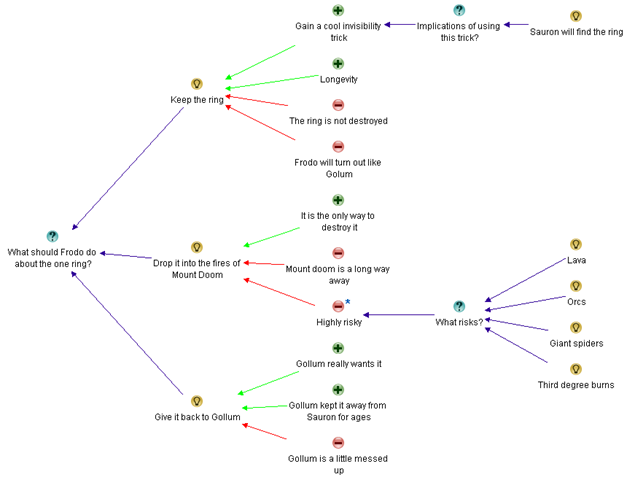
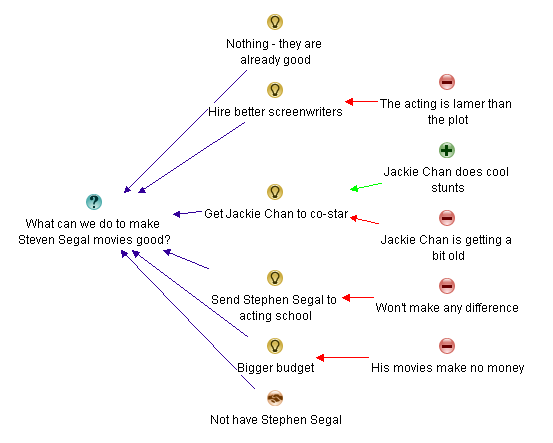
Anyway, I digress. Below is an IBIS based issue map discussing Frodo’s dilemma. Note that I didn’t need to tell you how to read the map. it is inherently readable due to the symbolism in the nodes. This is the sort of output to expect from a dialogue mapping session in Middle Earth.

image

So, how would such a map be produced from a meeting or workshop?

Ideally the room would be set up as per the illustration below. This image below is from the Cognexus site, the home of Dialogue Mapping. Note how one person is sitting at a laptop, with a projected map behind them, facing the rest of the group. The rest of the group is interacting with the mapper and map, discussing arguments, asking for additions or modifications and building out a chain of logic around the problem space.

image

The facilitator is the key here. This person knows the IBIS grammar and is taking the group deliberations and translating it to the issue map in real-time. Using software and a projector, as opposed to flip charts, restructuring or refactoring the map live and on the fly is quick and painless. By using the IBIS grammar, the map is inherently readable and very clear, compared to a normal meeting where there is no tool to provide the sort of “holding environment” to allow people to keep collective focus and explore the different perspectives on the problem space.

This notion of the holding environment also is critically important. If you are lucky enough to work in a job you love, with a team you love, for a visionary CEO who you admire and respect, then that CEO has created the ultimate holding environment and you should consider yourself very lucky (and your CEO is worth all that money they earn). For the other 99.9% of us, we have to make do with what we have. The point here is that any tool or method you use needs to augment the understanding process, not complicate it. If it is over-complicated it will not improve understanding and the group will fall back to business-as-usual and participants will likely wind up resenting the method.

Consider dialogue mapping as a holding environment versus traditional meeting decorum. Inevitably, a group will start out with one question, and fairly quickly realise there are underlying or deeper questions that also need to be answered. In a regular meeting governed by a strict agenda and roles (as is recommended by many books and facilitators), problem exploration will be stifled. All too often, changes in understanding of the problem is seen as an unwanted tangent that derails the agenda of the meeting. In other words, the system works against the problem exploration space and that sort of meeting decorum is a poor option for this sort of exploration. Why did we invent such systems to keep meetings on track? Because meetings alone are a crappy container for problem exploration! However with the IBIS grammar and the shared space of the dialogue map, underlying questions can be captured and explored with an organised, evolving point of reference.

The shared space also has a positive effect on the decorum of exploring prickly issues. The group’s attention is now fixed on an evolving map on the wall. A skilled dialogue mapper can utilise IBIS grammar to take a lot of the heat out of argumentation and the process becomes more about building a chain of logic, than cheap point scoring. Typical meeting tactics like pulling rank or personal attacks thinly veiled as “questions” are easily dealt with by the dialogue mapper and never make it to the map in the form intended. The desire to pull back to business is usual is mitigated by the neutrality of the IBIS language and the improved quality of deliberation.

Perhaps the most important benefit of all, is the capture of rationale, or organisational memory. For me, this is precisely where my SharePoint world intersects with this craft because IBIS maps have for me been one of the best artefacts I have seen for the capture of implicit or tacit knowledge. These maps ultimately are an extremely rich exploration of a given problem and demonstrate very effectively, the circumstances and understanding of a problem at that point in time. With issue maps, gone are the days of looking at a process, policy or report years later and wondering “what the hell were they thinking?”.

image

So finally for part 1, let’s sum up by examining dialogue mapping in relation to my earlier criteria for the really effective methods of collaborating on difficult problems.

The method should not take you too far away from the problem space. So, for example, you are trying to grapple with a difficult organisational problem, so you decide to adopt a methodology. Now you are focussing on learning the methodology, obsessing if you are doing it ‘right’ and then still trying to gain a shared understanding of the problem space.

With Dialogue Mapping, only the mapper needs any training. All other participants do not need any previous IBIS or Issue Mapping experience. Participants do not need to wonder if they are doing it right, because just by articulating their opinion on issues, ideas and arguments, they are doing it right.

The method should be simple enough that people do not have to be trained just to participate.

Cut and paste my last answer. Aside from the mapper, all other participants do not need any previous IBIS or Issue Mapping experience.

The method needs to be inclusive, and all voices (not just the metaphorical boxers) need to be heard

Two things that positively kill meetings is death by repetition and grenade lobbing. Death by repetition is when we tend to find a way to suggest our solution, no matter what question is asked. This behaviour has the opposite effect than intended on other participants. But once an idea is captured, it idea is visible along with all of the other ideas. If the repetition continues, all the dialogue mapper needs to do is ask the person if they have anything more to add to the map for that idea. This is surprisingly effective as the disruptive behaviour becomes very obvious to the serial repeater.

Grenade lobbing happens when someone challenges the whole context of the conversation in some way. When this is a dialogue mapped meeting or workshop, the map comes into its own. The dialogue mapper will capture the challenge as an issue and restructure the map to accommodate this issue. The previous disruptive power of the grenade lob is significantly mitigated and the map now has richer argumentation.

The method should be easy to adapt and grow as understanding of the problem changes over time.

IBIS is founded on the principle that problems and solutions are intertwined closely and that exploration of one will change the other in a cyclical fashion. As discussed, refactoring maps over time is critical to managing a problem that is a moving target. But also being able to save the state of understanding at a given point in time, and then being able to examine the evolution of that understanding and rationale (tacit knowledge) over time is capturing a snapshot of organisational memory. Even better, put that snapshot into SharePoint, classify it with metadata and now your collaborative portal includes findable, organised tacit knowledge!

Most importantly of all, the method needs to allow a group to start from what they know now.

The exploration of what we know now actually can offer a lot of clarity and insights when integrated into a coherent map. Instead of a long, laborious meeting where various people have lost the thread of the conversation, we have a point of reference on the wall. Furthermore, in breaking down the arguments into simple to follow IBIS structure, participants are better equipped to make the sort of connections between chains of logic to better understand the frame of reference of the other participants. The map is an output of this collective effort, which is visible and available for others to explore. Rather than starting out by trying to peel the onion of problems understanding in ever widening scope, we simply start. We put up a question on the map and attempt to answer it.

Conclusion

Hopefully, I have managed to convey a little of what the dialogue mapping experience looks like. In part 2, I will expand upon this topic and discuss my baptism of fire experience with dialogue mapping, the factors that have helped me improve my skills in it, as well as working with the master in action – Jeff Conklin

Thanks for reading

Paul Culmsee

www.sevensigma.com.au


Core Principles for User Engagement – a must read …er… explore!

I listened to Steve Smith talk about user engagement on the SharePoint Pod Show today and found myself nodding in strong agreement with many points that he made. So while in that mood of stakeholder engagement and how to achieve it, twitter made me aware of a really terrific Debategraph map on the topic of “Core Principles of Public Engagements” and think it is mandatory learning material for any SharePoint architect/collaboration consultant/business analyst/business improvement specialists/<insert title here>.

The map above, came from a collaborative effort called the “Public Engagement Principals Project”. This is a recent project (February 2009) and the aim was to “create clarity in our field about what we consider to be the fundamental components of quality public engagement”. The outcome of this project are seven recommendations that reflect the common beliefs and understandings of those working in the fields of public engagement, conflict resolution, and collaboration.

1. Careful Planning and Preparation
Through adequate and inclusive planning, ensure that the design, organization, and convening of the process serve both a clearly defined purpose and the needs of the participants.

2. Inclusion and Demographic Diversity
Equitably incorporate diverse people, voices, ideas, and information to lay the groundwork for quality outcomes and democratic legitimacy.

3. Collaboration and Shared Purpose
Support and encourage participants, government and community institutions, and others to work together to advance the common good.

4. Openness and Learning
Help all involved listen to each other, explore new ideas unconstrained by predetermined outcomes, learn and apply information in ways that generate new options, and rigorously evaluate public engagement activities for effectiveness.

5. Transparency and Trust
Be clear and open about the process, and provide a public record of the organizers, sponsors, outcomes, and range of views and ideas expressed.

6. Impact and Action
Ensure each participatory effort has real potential to make a difference, and that participants are aware of that potential.

7. Sustained Engagement and Participatory Culture
Promote a culture of participation with programs and institutions that support ongoing quality public engagement.

Despite the fact this map is all about public engagement, this material is absolutely the best advice you could ever get for dealing with user engagement in your SharePoint endeavours. If you have any interest whatsoever in the mystical arts of getting true understanding and buy-in among your organisational stakeholder group, then this map (and its underlying documents), is for you.

Also, be sure to use the Debategraph toolbar to explore the detailed information in the root node. There is a lot of supplementary information in this map that you can easily access by clicking on the “Show detailed text and comments” icon (highlighted below).

image 

If you are using the Seven Sigma Web Part for Debategraph, the Map ID is 16220 and you can incorporate this map into your broader governance site. I’ll be linking this map into my SharePoint governance map later as I think it complements, and expands upon the information contained there.

I think these seven principles make a terrific starting point for developing your own guiding principles around user-engagement as part of your governance efforts.

Finally, if you want more detailed information about how this map came to be, then consult the links below


Thanks for reading

Paul Culmsee


SharePoint Governance – Debategraph style

Quick note: This is another of the sort of posts where I cannot help but feel that some readers will wonder what I have been smoking. It is not essential, but reading the “one best practice” series will provide a lot of background to this post.

imageOn the grand scale of world problems, your average messed up SharePoint project would not be considered particularly “wicked”. If you compare a haywire SharePoint project to the truly *global* wicked problems, such as global warming, the Israeli/Palestinian conflict and Tom Cruise, then it kind of makes you realise just how good we SharePoint architects, developers and engineers have it. I mean, hey, if a bunch of nerds can’t make little ol’ SharePoint a success, what hope do we have for the big issues like making Tom Cruise less of a tool?

I know some people who have left SharePoint architecture work because of all the “people crap”. If you think “people crap” is bad in IT, imagine trying to mediate between the myriad of stakeholders involved in, say, cuts to carbon dioxide emissions. That is a world of hurt that is so huge that it pains my brain just to imagine it.

Last year when I was learning the dark Jedi arts of dialogue mapping I got to know David Price, one of my fellow students who operated in that world of hurt. David is a very smart man indeed, with a Ph.D in organisational learning and environmental policy. His career has included public policy consultancy, TV documentary production, academic research and mediation.

It was during that training course that David introduced me to a joint venture that he started with another scarily smart man named Peter Baldwin. Peter is an Australian who had a 15 year career in national politics, including six years as a federal minister in the Australian government. Unlike many Australian pollies, his background was engineering. After leaving politics, with a keen interest in how the web could “raise the quality of debate about public policy issues,” he cranked out visual studio and got down to some coding.

The “baby” from this collaboration between David and Peter is a unique tool called Debategraph and it is a very interesting tool indeed.

image

DebateGraph was conceived as a tool to improve the quality of public debate on contentious or complex issues. Public debate, in general, is usually pretty awful. David and Peter explain why this is the case pretty comprehensively below.

Public debates tend to be complex; with multiple data sources and perspectives and conflicting demands and values. In complex debates, the volume of information and arguments can seem like an overwhelming obstacle to someone, trying to develop a comprehensive understanding of the essential arguments advanced by all sides.

Public debate is all too often characterized by repetitive contributions, digressions, argumentative fallacies, rhetorical flourishes, manipulative framing, obfuscation and personal attacks that result in a high noise-to-signal ratio and confusion rather than clarity.

Conventional media reporting of public policy debates often struggles with the challenge of conveying nuanced, reasoned positions in a compressed linear form, when simple heated oppositions deliver a more dramatic and rewarding effect.

This, in turn, makes it harder for established public figures to think tentatively and creatively in public about new policy approaches and to acknowledge strengths and common ground in opponents’ positions.

We are talking about wicked problems here a lot of the time since public policy debates by definition respond to problems or questions where the general public are stakeholders. This means that there are a lot of varied stakeholders with even more varied world views and frames of reference. By creating a tool to improve the quality of a public policy discussion, DebateGraph is a tool that helps to deal with wicked problems themselves. What is interesting about DebateGraph is that like the IBIS based issue mapping that I practice, it is a visual, map based approach, yet it was developed independently from Conklin, Compendium or anything else in the space.

image

DebateGraph is a free online service. It allows the global community to collaboratively build maps of complex debates that accurately present all sides of the debate from a neutral standpoint, free of repetitive clutter and ‘noise’. Like a wiki, all aspects of the debate maps, both their content and structure, are continuously open to revision, refinement, comment, and evaluation by anyone who wants to join the community of thought. Each map is a cumulative work in progress.

Readers and editors of the maps can explore the top-level structure of debates and delve into specific strands or sub-structures of a debate. What interested me was the fact that the debate maps can be embedded into other websites; with changes made to the map on one site updating immediately across every site on which it appears.

DebateGraph also has RSS and email alerting like SharePoint, as well as a unique rating system where users can specify how much they relate to, or believe in a particular argument. The map then self reconfigures based on what arguments are considered the strongest. In effect, the map becomes a multi-dimensional poll or decision making tool.

“Although consensus can emerge from such a process, not least because it promotes the discovery of previously unidentified options, our hope is as much that the people who continue to disagree will do so on the basis of an enriched understanding of the reasons for their disagreement and having had the chance to test each other’s reasoning to the fullest.”

How DebateGraph works

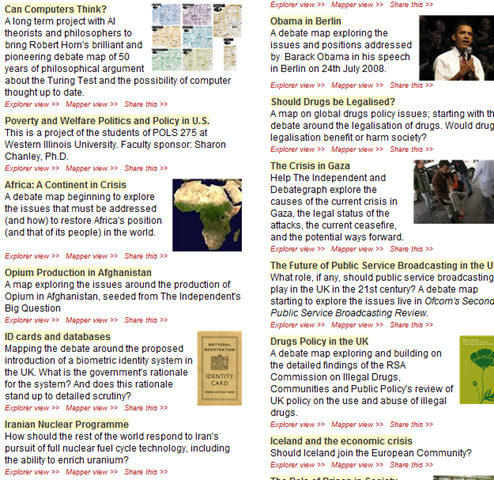
Using DebateGraph is pretty easy, given that you can embed it into other web sites as I have done here in this post. From the hundreds of maps that I can choose, I’ve decided to embed the map of the global financial crisis for you to explore. Click on the bubbles below and move them around. You will find that like bubble-wrap, you will spend your first few minutes immersing yourself in moving nodes around and navigating here and there. Go ahead and have a play – I’m patient – I’ll wait for you 🙂

Right! I’m guessing around seven minutes have passed. Now that you’ve had a play, click on the first arrow, below the map and above the bottom toolbar. This will take you back to the top level financial crisis map. Let’s take a closer look at what is going on here.

Attached to this “Global Financial Crisis” map is several root questions covering the cause, consequences, triggers and response to this problem. If you hover your mouse over any of the nodes, you will find a more detailed view of the question. Hover your mouse over the arrows between nodes, and you will find that the questions “arise from” the central “global financial crisis” node.

Also, note the thickness of the arrows between nodes. The width represents the importance placed on this node by the community of users that have developed this map.

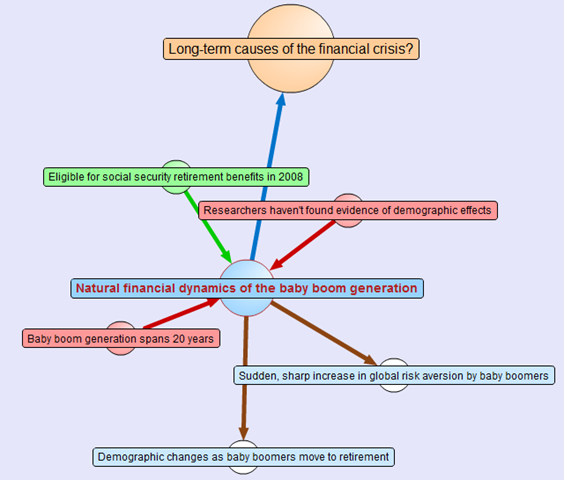
The node colours are important too. Click on the “Long term causes of the financial crisis?” node above, and it will break out to a sub-map. Here the nodes are blue, rather than orange as shown below. The difference in colour is because these nodes are possible responses to the question “Long term causes of the financial crisis?” Once again, the width of the arrows indicate the community’s view of the validity of the responses. Now let’s look at a response that would potentially be divisive. One of the potential answers to the long term causes of the current crisis is “Natural financial dynamics of the baby boom generation.” So, it’s all the baby boomers fault, is it? 😉

image

Clicking on the “Natural financial dynamics of the baby boom generation” and we see a map with a few different coloured nodes. This is because there are some supporting and opposing arguments to this idea. The green nodes support the idea and the red nodes oppose the idea. This is the essence of the pro and con type arguments used when you create IBIS maps.

image

There are also some other nodes where the direction of the arrow is the opposite to the ones we have examined so far. These are links to other maps, and if you highlight the outward arrows, you can see that our current map relates to nodes in completely separate maps.

This highlights a really important point about DebateGraph. It links related issues into a “web” of argumentation allowing readers to fully explore the myriad of interlocking issues that make up complex problems without “drowning” in information overload.

Contributing to debates

If you feel strongly on a particular subject then you are free to contribute to the debate. All DebateGraph maps have a toolbar that allows you to perform more advanced activities.

image

From left to right, the icons perform the following tasks

  • Open the DebateGraph home page
  • Show detailed text and comments for the currently selected item
  • Add comments to the selected item
  • Open this map in mapper (map edit) view
  • Edit this map in mapper (map edit) view
  • Search all DebateGraph maps for a given term
  • Share this map view or embed it in your own site
  • View the map in full screen mode
  • Key and explanatory notes for maps

SharePoint Governance?

Andrew Woodward suggested that I should create a DebateGraph map for us all to collectively explore how we could save Tom Cruise from complete agonising lameness. I chose not to do this for three reasons.

  1. Tom Cruise cannot be saved
  2. Tom Cruise’s lawyers would sue my ass
  3. There are more important topics to explore

Let’s instead talk about a pet topic of mine: SharePoint governance.

Governance in SharePoint is pretty misunderstood. There are many definitions of governance and they are all equally right, when judged through the lens of the person defining it. I have my own interpretation of governance (which is, of course, the definitive and completely correct one! – hehe). Maybe we should debate the issue?

Joel talks about a SharePoint governance plan needing to be a ‘living’ document and in fact he states this explicitly in the sample governance plan that he did for Microsoft. I agree wholeheartedly on this notion. The reality is that documents like MSWord documents are not overly conducive to this ideal. The paradox is that the bigger and more comprehensive the governance plan is initially, the harder it can be to maintain and manage over time, and therefore, the greater the likelihood that it can go out of date or fall into disrepair over time.

As a result, it occurred to me some time back that a DebateGraph map is the sort of “living” document that a governance plan really aspires to be. So, I roped in a couple of friends, most notably Andrew Jolly and Ruven Gotz, and together we experimented with DebateGraph to explore our own questions and ideas on the topic of SharePoint governance. The result is the map below which you can explore.

Seven Sigma web part for DebateGraph

It then occurred to me that others could benefit from this experimental exploration of the topic of SharePoint governance. This gave me the idea that having a “SharePoint governance web part” that could be added to any enterprise SharePoint portal would be a really great way to augment internal governance efforts. Additionally, one of my clients is responsible for conservation and sustainability at a local level in the community. They loved the DebateGraph debates around environmental, social and economic sustainability and this web part idea would work equally well for them.

Accordingly, my company, Seven Sigma, has just released a free webpart for SharePoint that allows you to embed DebateGraph debate maps into your SharePoint sites and tune their display to fit into enterprise SharePoint portals. The default debate is the SharePoint Governance debate shown above, but you can view any of the many Debategraph maps via the web part properties.

I have recorded a couple of webcasts, covering the installation and usage of the web part which can be viewed below. Otherwise, click here to download this free web part from the Seven Sigma web site.

dginstall  dgusage

Conclusion

This new web part and the SharePoint governance debate, are essentially an experiment in trying to tackle collaboration a novel way. Like any wiki, to make it truly “living”, the maps need contributions from people who have something to offer on the topic. I fully accept that this initiative is not going to be everybody’s cup of tea, but I hope that it might get people to think about the sort of possibilities presented by this sort of wiki based display. The fact that all of the issues, ideas and argumentation can so easily be made available to a wide audience via a simple web part I think is unique.

Thus, if you would like to contribute to this SharePoint governance debate sign up to Debategraph and we will add you to the governance debate.

I think that DebateGraph, and applications like it, may well represent the next step in the evolution of collaborative applications. While Twitter and Facebook have found interesting ways to bring people together, those applications aren’t exactly going to provide you with the sort of ‘container’ required to tackle really wicked problems. I foresee a lot of development in this sub-genre of collaborative applications in the future.

In other words, watch this space!

Thanks for reading

Paul Culmsee
www.sevensigma.com.au


Listen to me blab on about crap ;-)

Hi

I have been very busy on a number of fronts – which is why the blog hasn’t had much attention lately. I’ll be back soon enough though – once I get a few big jobs done.

For those of you that are not aware, there is a podcast interview that I did with Brett Lonsdale at Sharepoint Pod Show where he allowed me to blab on and on and on and on 🙂 Poor Brett – he didn’t know what he was getting himself into at all!

So if you think my posts are boring and wordy, wait till you hear me talk! 🙂

Paul


Perth SharePoint Users Group wrap

Today I presented a session at the Perth SharePoint Users Group. I was a little unsure whether my non-technically focussed content would be of interest to the geeks but the turnout was terrific and the feedback has been brilliant. (The 3 copies I gave away of Dux’s excellent “SharePoint for Project Management” book may have sweetened the deal – hehe )

My sincere thanks to new user group president Sezai Komur for giving me the opportunity to present this material as it was the first time it has seen the light of day in Perth.

If you want to check out the slide deck from the session, you will find it below. Expanded information that builds on this content can be found at the Seven Sigma site, as well as here at CleverWorkarounds.

Thanks for reading

Paul Culmsee

www.sevensigma.com.au


Issue Mapping Webinar Series in April 09

Hi all

There are a few people in my life who have had a big influence on me as a person, consultant and trainer. Jeff Conklin from CogNexus Institute is one of them. If I was to rank Conklin, I’d say he comes in somewhere between Jackie Chan and Freddie Mercury – illustrious company indeed. 🙂

Jeff armed me with the right set of skills and way of thinking that allowed me to defeat the likes of “SharePoint vs Skype guy”, a highly skilled foe that I previously wrote about in the “One Best Practice” series of posts. As it happens, Jeff is running another of his Issue Mapping webinar based training series starting April 8 2009. Anyone who is involved in highly complex projects (whether technically or socially challenging), including managers, project leaders, consultants and facilitators should consider attending.

SharePoint people? You are dealing with technical and social challenges almost by definition. Issue Mapping is the most effective craft I have come across to:

  • be able to lead a group to a robust decision that endures and that inspires consistent actions and outcomes despite the cross-currents of hidden and competing agendas
  • get traction in the "swamp" of a project that is cursed with both technical and social complexity
  • have real dialogue without getting bogged down in politics, personalities or an overload of information
  • help a group get its bearings in the fog of confusion, contradictory objectives and changing constraints
  • be able to focus a group’s energy in a way that boosts collective intelligence: the capacity to work with ambiguity and equivocal knowledge
  • be able to capture and organize a large volume of unstructured information to create a coherent foundation for thinking and learning in an organization

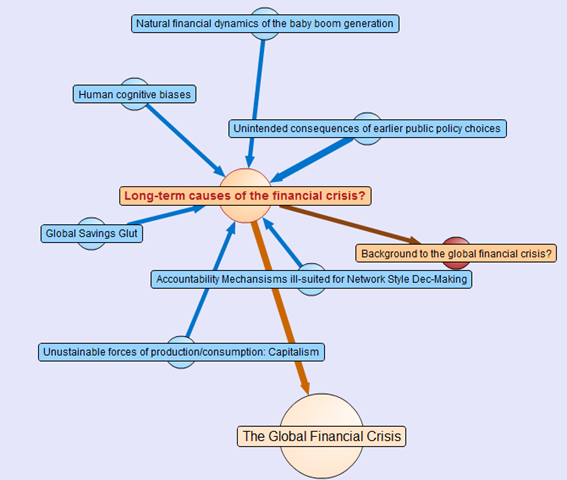
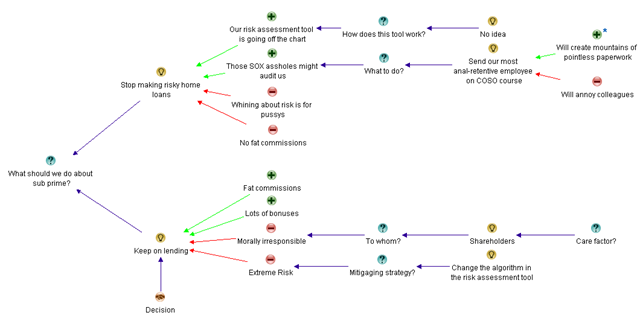
Consider my example below: I have summed up the entire global financial crisis in a single issue map – neat eh!

image

Like my above example, you will learn how to create great issue maps – maps that are clear, coherent, and expose the deep structure of an issue. (okay so I am being just a *tad* tongue in cheek with my example)

In all seriousness, it is a great course and well worth attending. If you enjoyed the “one best practice” series or my “wicked problems” sessions, this is your opportunity to learn from the master.

Thanks for reading

Paul Culmsee

www.sevensigma.com.au


« Previous Page

Today is: Saturday 14 March 2026 -