Back to Cleverworkarounds mainpage
 

Powerful questions part 2: The key focus area question

Hiya

I just recorded the second video on the topic of powerful questions. These powerful questions are the result of the years I’ve spent dialogue mapping many different groups of people on many different problems. As time has gone on, I’ve learnt a lot about collaborative problem solving, and concluded that some questions tend to lead to breakthrough more than others.

In the previous video, I introduced you to the platitude buster question. This time around, I have recorded a video on one of the best questions you can ask in any form of strategy development meeting – the key focus area question. For all you SharePoint types, I always use this question during SharePoint governance planning and when drawing up a project charter, but it is equally effective when working with an executive team who are working out their short and long term strategies.

Like the previous post, I suggest you watch this video in full screen. Enjoy!

How to eke out key focus areas from a discussion

Thanks for reading

Paul Culmsee

HGBP_Cover-236x300


Powerful questions part 1: The platitude buster question

Hi all

I’ve been a little busy lately so haven’t had sufficient time to write many articles. This will likely continue for a while as I’m also planning the next heretical book with Kailash.

But the other day on a whim, I decided to record a short video on the topic of powerful questions. As I do more and more facilitation, strategic planning and team development work, I am constantly learning about the patterns of group conversation. This has helped me develop insights into the sort of questions that have the potential to cut through complexity to achieve breakthroughs in complex situations. I call these questions “powerful” for that reason.

It should be noted that a powerful question is not necessarily the question itself, but sometimes the the way a question is asked. To that end, in this first video, I take you through the best way I know to cut through organisational platitudes. Platitudes are phrases that often sound impressive and authoritative, ultimately hide the fact that there is not a lot of substance underneath them. While its easy to cite a blatant example like “best practice organisational excellence,” most of the time platitudes are used unconsciously and in much more subtle and dangerous ways. In fact often people ask questions or conduct workshops in such a way that actually encourage platitude answers.

So how do I bust or disarm a platitude? Watch this video to find out! Smile

How to disarm a platitude with one question…

Now I plan to do a few of these videos, with each building on the last with a new powerful question. Also, I will utilise Compendium and Dialogue Mapping techniques, so you also get a better idea of the sort of non SharePoint work that myself and my colleagues get to perform. So please let me know what you think of the clip. (oh – before I forget, I strongly suggest you watch the video in full screen)

Thanks for reading

Paul Culmsee

www.hereticsguidebooks.com

HGBP_Cover-236x300


New videos: Demonstrating the value of Dialogue Mapping

Hi

In December I recorded a podcast with Nick Martin over at workshopbank.com. This was a fun interview for two reasons. Nick is a really smart guy and great to talk to, and it was Friday afternoon, close to Christmas and I was drinking a beer Smile

In any event, these two videos present an overview of what Dialogue Mapping is all about, some of the case studies where I have used it, and a demonstration of its utility. You will learn:

  • What Dialogue Mapping is and what it can do for you and your stakeholders
  • Learn when to use Dialogue Mapping and when not to
  • Learn how there is no setup or training that the participants have to go through when they’re in a Dialogue Mapping session
  • Learn how all participants feel like they’re being heard when being Dialogue Mapped
  • Hear an great case study when I used Dialogue Mapping for the first time…
  • Hear how as a mapper, you don’t need to be an expert in the subject being discussed
  • Glean a few insights about the Heretics guide to best practices book

To view the interview and demonstration, head on over to workshopbank.com

image

thanks for reading

Paul Culmsee

www.hereticsguidebooks.com


Learn about Dialogue Mapping in Auckland Jan 31st

Hi all

This message comes to you from New Zealand where I have been for the last three weeks with the family. While here, I am doing a talk on Dialogue Mapping for Tepu (a partnership between Unitec & Rosebank Business Association). If you are in Auckland or close by, then register to attend this free event and learn more about the techniques that inspired the award winning Heretics Guide to Best Practices book. I will provide a background to Dialogue Mapping and emergent design practice, cover some case studies and provide a live demo.

If you are in any sort of role that has to deal with complex problems (strategy, planning and policy development, sustainability, stakeholder engagement, etc), then the session should be well worthwhile.

When: Thursday, Jan. 31st
Where: Building 172, Room 2018, Unitec Mt. Albert campus

Door opens at 8:30 for coffee & tea
Presentation and workshop 9:00 a.m. – 10:00 a.m.
Coffee and networking, closes at 10.30a.m

Although this is not a SharePoint specific event, I urge any SharePointers in Auckland to come and be part of the discussion. The registration site with further detail can be found here:

www.catalystco.eventbrite.com


Thanks for reading


Paul Culmsee

www.hereticsguidebooks.com


Confessions of a (post) SharePoint architect: Black belt platitude kung-fu

Hello kung-fu students and thanks for dropping by to complete your platitude training. If you have been dutifully following the prior 5 articles so far in this series, you will have now earned your yellow belt in platitude kung-fu and should be able to spot a platitude a mile away. Of course, yellow belt is entry level – like what a Padwan is to a Jedi. In this post, you can earn your black-belt by delving further into the mystic arts of the (post) SharePoint architect and develop simple but effective methods to neutralise the hidden danger of platitudes on SharePoint projects.

If this is your first time reading this series, then stop now! Go back and (ideally) read the other articles that have led to here. Now in reality I know full well that you will not actually do that so read the previous post before proceeding. Of course, I know you will not do that either, so therefore I need to fill you in a little. This series of articles outline much of what I have learnt about successful SharePoint delivery, strongly influenced from my career in sensemaking. I have been using Russell Ackoff’s concept of f-laws – truth bombs about the way people behave in organisations – to outline all of the common mistakes and issues that plague organisations trying to deliver great SharePoint outcomes.

So far in this series we have explored four f-laws, namely:

In the last post, we took a look at the danger of conflating a superlative (like biggest, best, improved and efficient) with a buzzword like (search, portal, collaboration, social). The minute you combine these and dupe yourself into thinking that you now have a goal, you will find that your project starts to become become complex, which in turn results in over-engineered solutions solving everything and anything, and finally your project will eventually collapse under its own weight after consuming far too many financial (and emotional) resources.

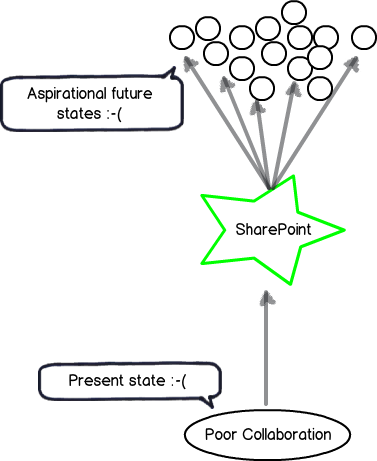
This is because the goal you are chasing looks seductively simple, but ultimately is an illusion. All of your stakeholders might use the same words, but have very different interpretations of what the goal actually looks like to them. The diagram that shows the problem with this is below. On the left is the mirage and to the right is the reality behind the mirage. Essentially your fuzzy goal actually is a proxy for a whole heap of unaligned and often unarticulated goals from all of your stakeholders.

Snapshot   Snapshot

Now in theory, you have read the last post and now have a newly calibrated platitude radar. You will sit at a table and hear platitudes come in thick and fast because you will be using Ackoff’s approach of inverting a goal and seeing if a) the opposite makes any logical sense and b) could be measured in any meaningful way. As an example, here are three real-world strategic objectives that I have seen adorning some wordy strategic plans. All three set off my platitude radar big time…

“Collaboration will be encouraged”

“A best-practice collaboration platform”

“It’s a SharePoint project” Smile

I look at the first statement and think “so… would you discourage collaboration? Of course not.” Ackoff would take a statement like that and say “Stop telling me what you need to do to survive, and tell me what you need to do to thrive”.

What do you mean by?

So if I asked you how to unpack a platitude into reality, what might you do?

For many, it might seem logical to ask people what they really mean by the platitude. It might seem equally logical to come up with a universal definition to bring people to a common understanding of the platitude. Unfortunately, both are about as productive as a well-meaning Business Analyst asking users “So, what are your requirements?”

With the “what do you mean by [insert platitude here]” question, the person likely won’t be able to articulate what they mean particularly well. That is precisely why they are unconsciously using the platitude in the first place! Remember that a platitude is a mental shortcut that we often make because it saves us the cognitive effort of making sense of something. This might sound strange that we would do this, but in the rush to get things done in organisations, it is unsurprising. How often do you feel a sense of guilt when you are reflecting on something because it doesn’t feel like progress? Put a whole bunch of people feeling that way into a meeting room and of course people will latch into a platitude.

By the way, the “mental shortcut” that makes a platitude feel good seems to be a part of being human and sometimes it can work for us. When it works, it is called a heuristic, When it doesn’t its called a cognitive bias. Consult chapter 2 in my book for more information on this.

Okay, so asking what someone means by their platitude has obvious issues. Thus, it might seem logical that we should develop a universal definition for everyone to fall in behind. If we can all go with that then we would have less diversity in viewpoints. Unfortunately this has its issues too – only they are a little more subtle. As we discovered in part 2 of this series appropriately entitled “don’t define governance”, definitions tend to have a limited shelf life. Additionally, like best-practice standards, there are always lots of them to choose from and they actually have an affect of blinding people to what really matters.

So is there a better way?

It’s all in the question and its framing…

If there is one thing I have learnt above all else, is that project teams often do not ask the right question of themselves. Yet asking the right question is one of the most critical aspects to helping organisations solve their problems. The right question has the ability to cast the problem in a completely different light and change the cognitive process that people are using when answering it. In other words, the old saying is true: ask a silly question, get a silly answer.

Let me give you a real life example: Chris Tomich is a co-owner of Seven Sigma and was working with some stakeholders to understand the rationale for how content had been structured in a knowledge management portal. Chris is a dialogue mapper like me – and he’s extremely good at it. One thing Dialogue Mapping teaches you is to recognise different question types and listen for hidden questions. The breakthrough question in this case when he got some face time with a key stakeholder and asked:

  • What was your intent when you designed this structure for your content?

The answer he got?

  • “Well, we only did it that way because search was so useless”
  • “So if I am hearing you, you are saying that if search was up to scratch you would not have done it that way”
  • “Definitely not”

Neat huh? By asking a question that took the stakeholder back to the original outcome sought for taking a certain course of action, we learnt that poor search was such a constraint they compensated by altering page template design. Up until that point, the organisation itself did not realise how much of an impact a crappy search experience had made. So guess where Chris focused most of his time?

In a similar fashion, my platitude defeater question is this:

So if we had [insert platitude here], how would things be different to now?

Can you see the difference in framing compared to “what do you mean by [insert platitude here]?”. Like Chris with his “What was your intent”, we are getting people to shift from the platitude, to the difference it would make if we achieved the platitude. No definitions required in this case, and the answer you will get almost by definition has to be measurable. This is because asking what difference something would make involves a transition of some kind and people will likely answer with “increased this”  or “decreased that”.

Now be warned – a hard core middle manager might serve you up another platitude as an answer to the above question. To handle this, just ask the question again and use the new platitude instead. For example:

  • Me: Okay so if you had improved collaboration, how would things be different to now?
  • Them: We would have increased adoption
  • Me: And what difference would that make to things?

I call this the KPI question because if you keep on prodding, you will find themes start to emerge and you will get a strong sense of potential Key Performance Indicators. This doesn’t mean they are the right ones, but now people are thinking about the difference that SharePoint will make, as opposed to arguing over a definition. Trust me – its a much more productive conversation.

Now to validate that these emerging KPI’s are good ones, I ask another question, similarly framed to elicit the sort of response I am looking for…

What aspects should we consider with this initiative to [insert platitude here]?

This question is deliberately framed as neutral is possible. I am not asking for issues, opportunities or risks, but just aspects. By using the term aspects I open the question up to a wider variety of inputs. Like the KPI question above, it does not take long for themes to emerge from the resulting conversation. I call this the key focus area question, because as these themes coalesce, you will be able to ensure your emerging KPI’s link to them. You can also find gaps where there is a focus area with no KPI to cover it. As an added bonus, you often get some emergent guiding principles out of a question like this too.

The thing to note is that rather than follow up with “what are the risks?” and “what should our guiding principles be?”, I try and get participants to synthesize those from the answers I capture. I can do this because I use visual tools to collect and display collective group wisdom. In other words, rather than ask those questions directly, I get people to sort the answers into risks, opportunities and principles. This synthesis is a great way to develop a shared understanding among participants of the problem space they are tackling.

If we were unconstrained, how would we solve this problem?

This is the purpose question and is designed to find the true purpose of a project or solution to a problem. I don’t always need to use this one for SharePoint, but I certainly use it a lot in non IT projects. This question asks people to put aside all of the aspects captured by the previous question and give the ideal solution assuming that there were no constraints to worry about. The reason this question is very handy is that in exploring these “pie in the sky” solutions, people can have new insights about the present course of action. This permits consideration of aspects that would not otherwise be considered and sometimes this is just the tonic required. As an example, I vividly recall doing some strategic planning work with the environmental division of a mining company where we asked this exact question. In answering the question, the participants had a major ‘aha’ moment which in turn, altered the strategy they were undertaking significantly.

Note: If you want some homework, then check Ackoff’s notion of idealised design and the Breakthrough Thinking principle called the purpose principle. Both espouse this sort of framed question.

Sharpening the saw…

Via  the use of the above questions, you will have a  better sense of purpose, emergent focus areas and potential measures. That platitude that was causing so much wheel spinning should be starting to get more meaty and real for your stakeholders. For some scenarios, this is enough to start developing a governance structure for a solution and formulating your tactical approaches to making it happen. But often there is a need to sharpen the saw a bit and prioritise the good stuff from the chaff. Here are the sort of questions that allow you to do that:

No matter what happens, what else do we need to be aware of?

This question is called the criterial question and I learnt it when I was learning the art of Dialogue Mapping. When Dialogue Mapping you are taught to listen for the “no matter what…” preamble because it surfaces assumptions and unarticulated criteria that can be critical to the conversation and will apply to whatever the governance approach taken. Thus I will often ask this question in sessions, towards the end and it is amazing what else falls out of the conversation.

What are the things that keep you up at night?

I picked this up from reading Sue Hanley’s excellent whitepaper a while back and listening to hear speak at Share2012 in Melbourne reminded me why it is so useful. This question is very cleverly framed and is so much better than asking “What are your issues?”. It pushes the emotive buttons of stakeholders more and gets to the aspects that really matter to them at an gut level rather than purely at a rational level. (I plan to test out dialogue mapping a workshop with this as the core question sometime and will report on how it goes)

What is the intent behind [some blocker]?

This is the constraint buster question and is also one of my personal favourites. If say, someone is using a standard or process to block you with no explanation except that “we cannot do that because it violates the standards”, ask them what is the intent of the standard. When you think about it, this is like the platitude buster question above. It requires the person to tell you the difference the standard makes, rather than focus on the standard itself. As I demonstrated with my colleague Chris earlier, the intent question is also particularly useful for understanding previous context  by asking users to outline the gap between previous expectation and reality.

Conclusion…

To there you go – a black belt has been awarded. Now you should be armed with the necessary kung-fu skills required to deflect, disarm and defeat a platitude.

Of course, knowing the right questions to ask and the framing of them is one thing. Capturing the answers in an efficient way is another. For years now, I have advocated the use of visual tools like mind mapping, dialogue mapping and causal mapping tools as they all allow you to visually represent a complex problem. So as we move through this series, I will introduce some of the tools I use to augment the questions above.

Thanks for reading


Paul Culmsee


Confessions of a (post) SharePoint Architect: The self-fulfilling governance prophecy

Hi and welcome to another SharePoint (post) architect confessional post. In case you are here via the good grace of whatever Google’s search relevance algorithm feels like doing today, I need to give you a little context to this post and the larger series of which it is a part. These days, I spend a lot of time working on projects beyond the cloistered confines of SharePoint; in fact, beyond the confines of IT altogether. Apart from being a cathartic release from SharePoint work, I’ve had the privilege to work with various groups on solving some very complex problems in a collaborative fashion. As a result of these case studies, I’ve become a bit of a student of various collaborative problem solving approaches and recently released a business book on the subject called “The Heretics Guide to Best Practices” co-written with mild-mannered mega-genius Kailash Awati. Despite (or because of) the book having no absolutely SharePoint content whatsoever, it managed to win an Axiom Business Book award and I feel it’s indirectly a good SharePoint governance book in its own right.

Now, for the rest of you who have been following my epic rant thus far, you will now be familiar with the notion of Ackoff’s f-laws: “truths about organisations that we might wish to deny or ignore – simple and more reliable guides to everyday behaviour than the complex truths proposed by scientists, economists, sociologists, politicians and philosophers.” Via the f-law metaphor, you now also understand why midwives are more valuable than doctors, the word “governance” should not be defined if you actually want people to understand it and that people should not be penalised for their learning.

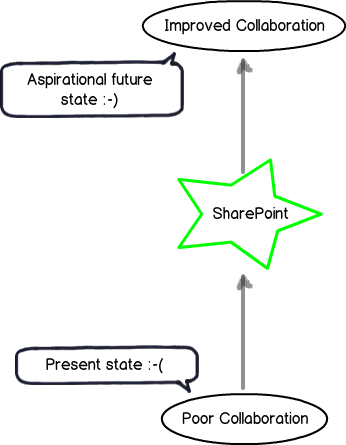
The next f-law that we will explore provides an explanation to why organisations so consistently and persistently apply the wrong approaches to SharePoint-type projects. IT departments have genetic predisposition to falling into this trap, as do other service delivery departments such as Finance and HR when they put in ERP systems. To explain my assertion, we are going to revisit the governance diagram that I used in the first f-law. You can see it below:
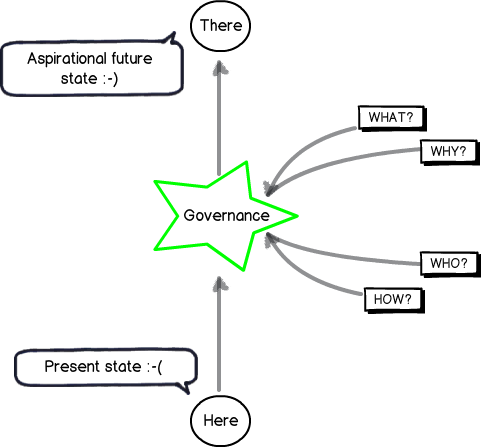
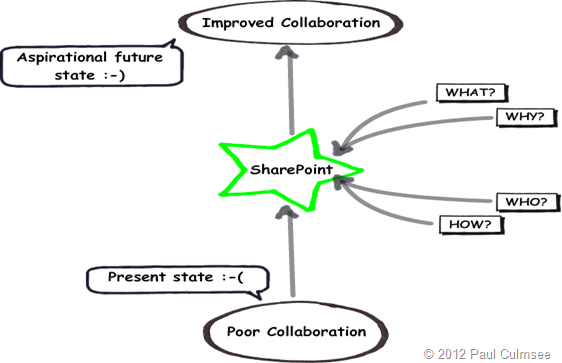
I used the above diagram to to explain f-law 1 which was “The more comprehensive the definition of governance is, the less it will be understood by all”. The above diagram serves to point out that governance is not the end in mind, but the means by which you achieve a desirable future state. Without any context to an end in mind, we have to accommodate many vague potential ends. To deal with this uncertainty, we inevitably look to definitions to provide clarity about what governance means. Unfortunately, this form of “definitionisation” tends to confuse more than clarify because it sneakily starts to drive the end, rather than be the means. This inevitably results in over-engineered, over-complicated and likely inappropriate governance approaches that do more harm than good.

It should be noted that “governance” is by no means the only word that falls into this trap. Words like quality, effective, “best practice” and even “SharePoint” should all be put in the green star above too because all of these words have no inherent meaning until they are applied to a given situation or context. This point is echoed by people like Andrew (“SharePoint by itself knows nothing”) Woodward, Dux (“SharePoint doesn’t suck – you suck.”) Sy and Ruven (“Can I use this diagram in my Information Architecture book?”) Gotz.

To that end, our next  f-law expands on this notion of means vs. ends and provides you with a practical way to assess the clarity of a SharePoint goal or outcome.

F-Law 3: The probability of SharePoint success is inversely proportional to the time taken to come up with a measurable KPI

Hmm… f-law 3 is a mouthful isn’t it. For a start I used the acronym of “KPI”, which in case you are not aware, stands for Key Performance Indicator – something that we can measure to visibly demonstrate that we have not sucked and actually achieved what we have set out to do. In essence, this f-law states that the longer it takes to determine a reasonable and measurable indicator that SharePoint has been a success, the less likely your SharePoint project is to succeed.

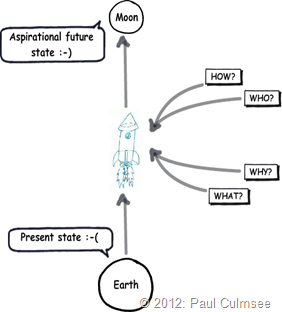
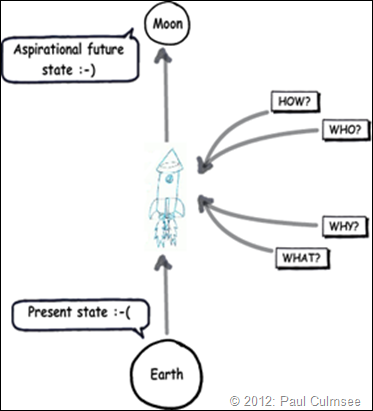
To demonstrate this, I am going to give you one of my patent pending techniques that is highly useful in client engagements to get people to think a little differently about their approach. Let’s reuse my “from here to there” diagram above to perform a basic experiment. Check out the project below and tell me … what project is this?
image

Hopefully, it did not take you long to work out that this project is the Apollo moon missions. Now, for the experimental bit. Grab a stopwatch, start the clock and answer this question:

“How do you know you have succeeded with this project?”

Once you have your answer, stop the clock and note the time. I’m willing to bet that you gave one or two answers:

  • You successfully landed a person on the moon
  • You got the person back to Earth again

I am also willing to bet that you worked out that answer within 2 to 15 seconds of pondering my diagram. Am I right?

Now, consider for a moment the sheer scale of of this project in terms of size, risk, innovation and level of expertise required to land a person on the moon and bring them back safely. Imagine the sheer number of projects within multiple programs of work that had to be aligned. Imagine the tens of thousands of people who directly and indirectly worked on this epic project. It is mind boggling when you think about it and it is little wonder that putting a man on the moon is regarded one of mankind’s greatest technical achievements.

And then we have SharePoint…

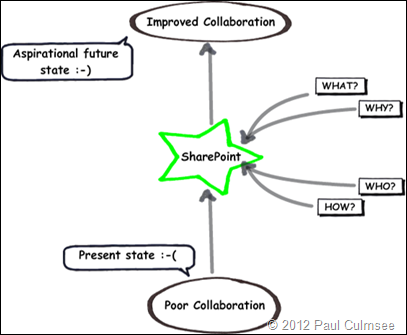
Now let’s contrast the moon project with another one likely to be very familiar with readers. So once again, tell me what project this is…
image

This one takes some people a bit longer to answer, but when I ask this in workshops and conferences I sometimes get people jokingly saying “my SharePoint project!” or “a nightmare.” So once again I want you to answer the following question:

“How do you know you have succeeded with this project?”

I bet this one has you a little more stumped and is much harder to answer than the moon example above. What is funny with this one is that, when you consider that in terms of scope and size, using SharePoint to improve collaboration is a mere pimple on the butt of sending a rocket to the moon. Yet, despite the moon example being much larger in scope, cost, degree of innovation and engineering, the success criteria is clear and unambiguous to all. People can identify what success looks like very quickly. No-one will point to Venus and say “I think that’s the moon.”  You either got there or you didn’t.

Yet, when I show a SharePoint project that is framed like the above example, people have a much (much) harder time describing what success would look like. In fact, I have asked this question many times around the world and most of the answers I am offered do not hold up to any serious form of scrutiny. Consider these common suggestions of SharePoint success and my response to them:

  • “People are using it.” My response: “Yeah, but people use email and the file system now, so why are you putting SharePoint in?”
  • “People are happy.” My response: “I bet if I replaced the crappy coffee with a top of the range espresso machine I could make people really happy and it’s a fraction of the cost of SharePoint.”

Sorry folks, but this isn’t good enough… in fact it’s a recipe for a situation where, in the name of “governance,” you deliver a bloated, over-engineered failure.

When problems are complicated…

My two project examples above highlight a particular characteristic of problems that is at the root of the difference between the moon and SharePoint example. Consider the following common IT projects:

  • Replacing your old email system with Microsoft Exchange
  • Consolidating Active Directory
  • Replacing your old phone system with Voice over IP system
  • Upgrading your storage area network  to new infrastructure

All of these are like the moon example. None of them are easy – in fact you need specialist expertise to get them successfully implemented. But when you put each of these in the green star of my “here to there” picture, criteria for success is fairly clear and unambiguous. For example, if email comes in and goes out of everyone’s inboxes, Exchange is a usually success. If you can pick up the phone, get a dial tone and make a call, then the VOIP upgrade has been a success.

These are all examples of complicated problems. With complicated problems, the criteria for success is clear and unambiguous and there is a strong relationship between cause and effect. You can be highly confident that doing X will lead to Y. In these sorts of problems, experts can come together and analyse the problem by breaking the problem down neatly into its parts to develop a high-confidence solution. Furthermore, there are likely to be many best practices that have emerged from years of collective wisdom of implementing solutions because of that relationship between cause and effect.

Wouldn’t it be nice if reality was always like this. Project Managers and tech people would actually get on with each other! But of course, reality paints a different picture…

When complicated approaches fail…

In a 2002 discussion paper about reform of the Canadian health system, authors Sholom Glouberman and Brenda Zimmerman make a statement that is completely applicable to how most organisations approach SharePoint:

In simple problems like cooking by following a recipe, the recipe is essential. It is often tested to assure easy replication without the need for any particular expertise. Recipes produce standardized products and the best recipes give good results every time. Complicated problems, like sending a rocket to the moon, are different. Formulae or recipes are critical and necessary to resolve them but are often not sufficient. High levels of expertise in a variety of fields are necessary for success. Sending one rocket increases assurance that the next mission will be a success. In some critical ways, rockets are similar to each other and because of this there can be a relatively high degree of certainty of outcome. Raising a child, on the other hand, is a complex problem. Here, formulae have a much more limited application. Raising one child provides experience but no assurance of success with the next. Although expertise can contribute to the process in valuable ways, it provides neither necessary nor sufficient conditions to assure success. []

In this paper we argue that health care systems are complex, and that repairing them is a complex problem. Most attempts to intervene [] treat them as if they were merely complicated. [] We argue that many of these dilemmas can be dissolved if the system is viewed as complex.

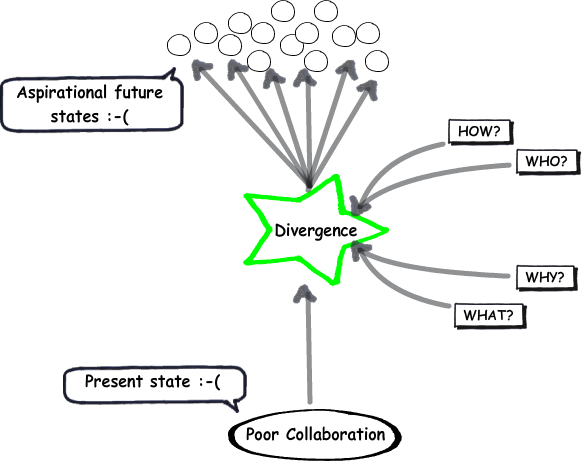
The key point in the above quote is that the tools and approaches that work well with complicated problems actually cause a lot of trouble in complex problems, where certainty of an outcome is much less clear. My point is that while the notion of using SharePoint to get from “poor collaboration” to “improved collaboration” might seem logical on the surface, it is hard to come up with any sensible criteria for success. Therefore you are setting yourself up for a fail because you have made SharePoint take on the characteristics of complex problems. Without unpacking these implicit assumptions about “Improved Collaboration,” our aspirational future state will look like the diagram below. The reality is we have many aspirational future states, all hidden beneath the seductive veneer of “improved collaboration” that in reality tells us nothing.
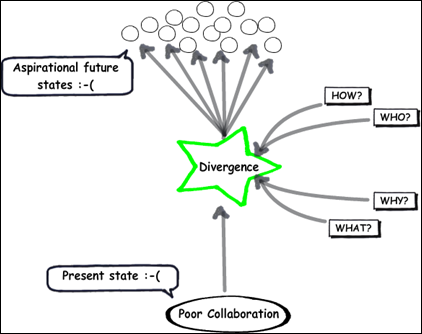
image

What blows me away is that to this day most project governance material published consistently fail to realise this core issue while trying to treat the very symptoms caused by this issue!  They provide you with the tools, means and methods to chase goals which are little better than an illusion, with no means to measure progress and therefore guide the very decisions that are made in name of governance.

Without unpacking and aligning all of these different future states above, how can any SharePoint architect be sure that they are providing the right SharePoint-based enabler? If you cannot tell me the difference made by implementing a project, how can anyone else know the difference? Even if you can, how do you know that everybody else sees it the same way as you?

Is it little wonder then, that after more than a decade of trying, SharePoint projects (complex problems) continue to go haywire? While approaches to governance force a complicated lens on a complex problem and assume the goal as stated is understood by all, governance itself will be one of the root causes of poor outcomes. Why? Because governance will require people to focus in all the areas except the one that matters. When this gap in focus manifests visibly (for example SharePoint site sprawl), governance is seen as the means to address the gap. Thus governance becomes a self-fulfilling prophecy “We will get it right this time” is the mantra, all the while, we still chase those rainbows of “improved collaboration.”

Conclusion and coming next

I do not recall where I first heard the distinction between “Complicated” and “Complex” problems because I came across it some time after I discovered the term “wicked problem.” I suspect that it was the Cynefin model that first pushed my cognitive buttons on the idea, although I distinctly recall Russell Ackoff also making the distinction between complex and complicated. Irrespective of the source, I find this a hugely valuable frame of reference to examine problems and understand why SharePoint projects are routinely tackled in an inappropriate manner. With it, I have been able to give IT departments in particular, a frame of reference to understand why they have trouble with particular kinds of projects like SharePoint.

Many people in organisations do not discern the difference between a complicated and complex problem and use the tools of the “complicated problem toolkit” to address complex problems when they are inappropriate at best and will kill your project at worst. I will expand on why this happens in the next and subsequent posts. But my key takeaway is that addressing the issue of multiple interpretations of the future is not only the key SharePoint governance challenge, it is the key challenge for any complex project.

The sorts of tools and approaches that are part of the “complex problem” utility belt are numerous and are really starting to gain traction which is great. There is plenty to read on this topic elsewhere on this blog as well as people like Andrew Woodward and Ruven Gotz. The great irony is that if you do manage align people to a shared sense of what the end in mind will look like, things that might have been seen as complex will now become complicated and the traditional tools and approaches will have efficacy because outcomes are clear and the path to get there makes more sense.

In the next post and f-law, I am going to outline another chronic issue that further explains why we get suckered into chasing false goals…


Thanks for reading

Paul Culmsee

www.sevensigma.com.au
HGBP_Cover-236x300


Confessions of a (post) SharePoint architect: Do not penalise people for learning

Hi all and welcome to another small piece of my SharePoint architect manifesto. In the previous post I introduced you to the notion of f-laws, which were first coined in a book co-authored by Russell Ackoff. In the process of developing a SharePoint governance and information architecture class, I was inspired to use the idea of an f-law because they appealed to my contrarian sense of humour and also contained some interesting nuggets of wisdom. I ended up coming up with a heap of f-Laws for SharePoint, and plan to write an article to cover each one.

In the last post, we learnt that f-Law 1 was all about the contention that the more you try and define what governance is, the less anyone will actually understand it. If you never read the first SharePoint Governance f-law then I suggest you do so, because these articles do tend to build on the foundation set from the previous. On that note, the focus of todays f-law extends on one that Ackoff himself came up with. All I am doing it putting a SharePoint bent on it…

F-Law 2: There is no point in asking users, who don’t know what they want, to say what they want.

This f-law comes with an additional corollary: There is even less point in thinking that you already know what they want! (IT departments – I am looking at you here!)

The definitive way to explain this f-law is to leverage the work of one of my mentors – Jeff Conklin. In 2007 I read a paper of his that literally changed my career. It was titled “Wicked problems and social complexity” and despite me reading many papers since, to this day it is one of the best introductions to complex problem solving you could ever read.

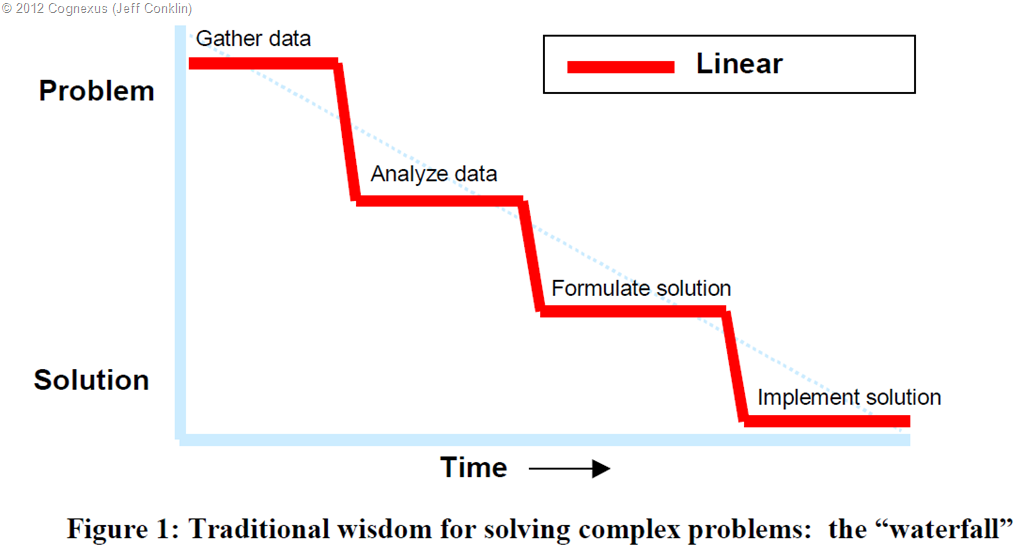
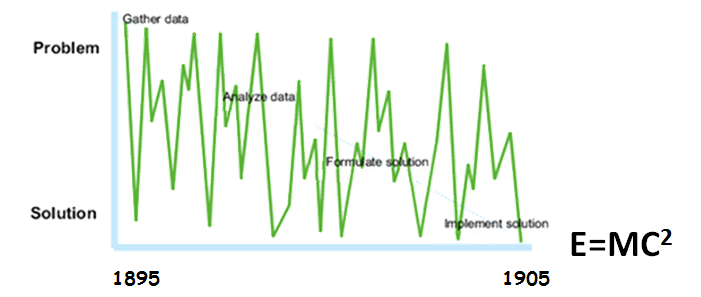
In this paper, Jeff talks about the fact that many prevailing methodologies suggest that the best way to work on a problem is to follow an orderly and linear “top-down” process, working from the problem to the solution. You begin by understanding the problem, including gathering and analysing “requirements” from customers or users. Once you have the problem specified and the requirements analysed, you are ready to formulate a solution and eventually implement that solution. This is illustrated by the red line in the figure below.

image

Now many project managers, cheque signers and just about every program management office I have ever worked with try to operate this way because it promises order, certainty and control. This is understandable when ones performance is being judged on getting stuff done to an agreed time and cost. It is also understandable if you are a manager and will get your ass kicked if you blow your budget. There is only one teeny issue. For some scenarios, it simply does not work.

In Conklin’s paper, he detailed a 1980’s case study at the Microelectronics and Computer Technology Corporation (MCC) that looked into how people solve problems. A number of designers participated in an experiment where they were give a one page problem statement – not too different to many SharePoint business cases I have seen. Participants in the experiment had to design an elevator control system for an office building. Despite participants being experienced and expert integrated-circuit designers, none had ever worked on elevator systems before. Each participant was asked to think out loud while they worked on the problem. The sessions were videotaped and analysed in detail.

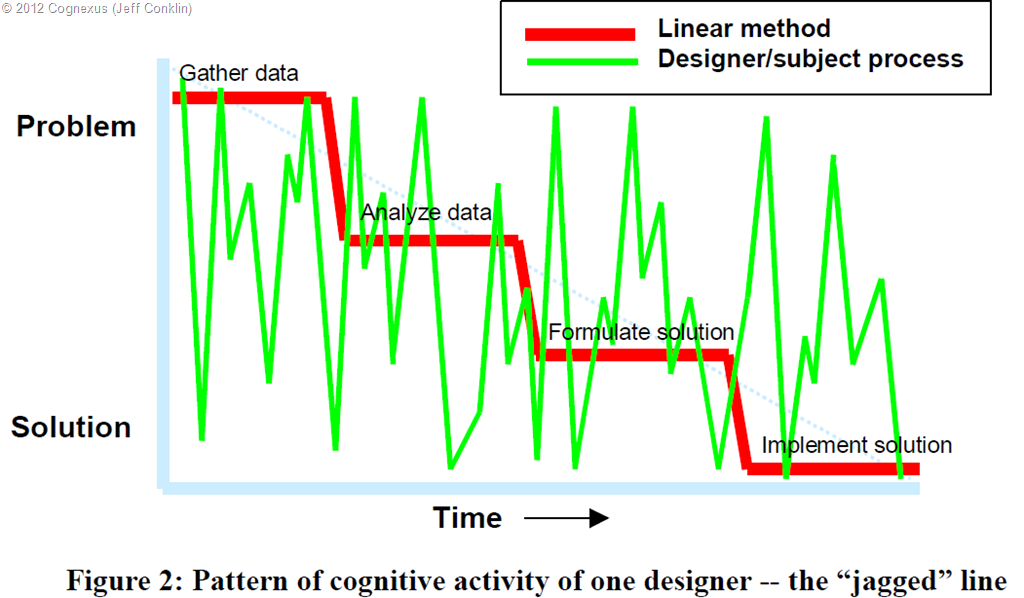
Below is what really happened. Check out the green line…

image

Clearly, the subjects in the elevator experiment did not follow a linear approach. They would start by trying to understand the problem, but they would immediately jump into formulating potential solutions. Then they would jump back up to refining their understanding of the problem. Rather than being orderly and staged like the red line, the line plotting the course of their thinking looked more like a seismograph for an earthquake. Now if you are looking at the green line and thinking “my god I better put a stop to that sort of shenanigans,” consider what Conklin had to say about it in his paper:

These designers are not being irrational. They are not poorly trained or inexperienced. Their thought process was something like: “Let’s see, idle elevators should return to the first floor, but then, you only need one elevator on the first floor, so the others could move to an even distribution among the floors. But the elevators need to be vacuumed regularly. I suppose we could add a switch that brought idle elevators down to the first floor. But then what happens in an emergency?” In other words, what is driving the flow of thought is some marvellous internal drive to make the most headway possible, regardless of where the headway happens, by making opportunity-driven leaps in the focus of attention. It is precisely because these expert designers are being creative and because they are learning rapidly that the trace of their thinking pattern is full of unpredictable leaps.

When I am speaking at conferences I like to mess with project managers in particular (who doesn’t eh?), because they are an easy target and already an insecure lot to begin with. I will ask the audience if anybody has an industry certification, such as a PMP or Prince II. Several hands usually go up. I then point to the phases of the above diagram and ask them if – when they were studying hard to obtain their certification – they actually followed the discrete phases that everybody else is supposed to follow. No single person has ever suggested that they did, instead all acknowledging that their process of learning looked more like the green line. I then point out that I’ve always found this perversely funny that people follow the green line to learn a process that tries to insist that everybody else must follow the red line. Ironic huh?

Knowing vs. learning problems

It should be stated at this point that you can use the red-line approach for certain types of problems so I am not outright dismissing it. In fact, within SharePoint projects there are indeed elements that can work quite well this way. The green line on the other hand, represents a phenomenon that Conklin called “Opportunity driven problem solving” and is the de-facto way we work on problems that are new or novel. For example, if you have ever experienced an “aha” moment, it was probably a leap of cognition that followed the jagged green line up or down, where you suddenly saw the problem in a different light. (Shhhh… don’t let your project manager know because you will have to fill in a form of some description!)

In these types of problems, we do not start by gathering and analysing data about the problem because the problem itself is moving target and varies depending on different stakeholders and their world views. Thus, there is no pure and concrete understanding of “the problem” because it is still forming as you think about solutions. In short, the jagged green line is a picture of learning. Quoting again from Conklin:

The more novel the problem, the more the problem solving process involves learning about the problem domain. In this sense the waterfall is a picture of already knowing – you already know about the problem and its domain, you know about the right process and tools to solve it, and you know what a solution will look like. As much as we might wish it were otherwise, most projects in the knowledge economy operate much more in the realm of learning than already knowing. You still have experts, but it’s no longer possible for them to guide the project down the linear waterfall process. In the current business environment, problem solving and learning are tightly intertwined, and the flow of this learning process is opportunity-driven

I believe that many innovations stem from the opportunity driven, creative leap of faith of the green line. On that note, I’d say that one of the greatest opportunity driven learners had to be Einstein. An article by Mort Orman suggests that Einstein was intrigued by “holes” in prevailing theories and enjoyed posing “mind riddles” to himself, just to see if present theories could satisfactorily explain them. Unlike many others who might have given up when they got stuck, Einstein was persistent and kept at it for 10 years before he came up that little formula everyone knows. After explaining this story at conferences, I sometimes ask people “Do you think Einstein used waterfall when he came up with relativity?” No one has said yes yet…

image

Implications…

The pattern of behaviour between the red and green lines represents the difference between a knowing problem and a learning problem. With a knowing problem, the problem is clear to all participants and even though it might require specialist expertise to solve, many of the variables are well understood. But for a problem that is novel or requires learning from participants Conklin’s case study illustrates that:

  1. People will examine potential solutions just to explain the problem.
  2. Each instance of examining the solution will impact the understanding of the problem.

Given that SharePoint is almost always starts out as a learning problem for the majority of participants, I do not see the point in trying to fight that green line. Instead, it is critical that you work with it rather than against it. The difficulty people have with this is that to do so conflicts with that promise of certainty, order and control that the red appears to offer. Why? Well among other things, you have to:

  1. Expect fluid requirements and scope changes
  2. Involve stakeholders from the start (they have to live with the result and their up-take is presumably a key KPI)
  3. Expect resistance and pullback from stakeholders (because people attribute more to what they perceive to lose compared to what they might gain)

Above all, you have to avoid penalising people for their learning. If you put barriers in front of people who are trying to improve their understanding of a multi-faceted problem they will eventually disengage from you. If you want to guarantee this sort of disengagement, go right on ahead and solve some problem before your stakeholders even realise there is a problem. Then when they do realise, smack them with the metaphorical baseball bat known as the scope variation form. One of two of those babies and those annoying stakeholders are guaranteed to go away. A pity your solution will go away with them but hey, it was in scope right?

Confessions…

I deal with this core issue of not penalising learning in a number of ways… some of which I have outlined in blog posts and many that I will cover in detail as we progress in this series and examine more f-laws. If you simply can’t wait for me and want “the answer” then I have news for you. If it were that easy there would be a “best practice” for it and someone would have created a certification by now!

So instead I will give you a couple of KPI’s to work to.

  • KPI 1: You get to a stage where your clients questions are “informed”. It is pretty easy to tell as a SharePoint professional where your stakeholders are at in their understanding of SharePoint. Over time there is a certain level of maturity in the questions asked of you and the way they are asked. This reflects both stakeholder learning as well as your ability to teach. If you get to this stage, you have increased your chances of SharePoint success significantly, which leads onto the next KPI…
  • KPI 2: You get to the stage where your clients are asking you well informed questions that you don’t know the answer to. Trust me that they will not mind that you don’t because their awareness of the product will no longer be naively simplistic anyways. You will also have developed a great collaborative partnership by then too. Also don’t forget my quote from Horst Rittel in the midwives post. There is a symmetry of ignorance with complex problems. The knowledge required to solve a complex problem never resides with a single person.

This leads me onto the final KPI:

  • KPI 3: Your clients should start telling you stuff about SharePoint that they have done that you have never done before or didn’t know you could do. In short, they will start teaching you stuff.

If you can create those conditions, be happy that they don’t need you that much anymore.


Thanks for reading


Paul Culmsee

www.hereticsguidebooks.com

www.sevensigma.com.au


On the decay (or remarkable recurrence) of knowledge

“That’s only 10%…”

One of my mentors who is mentioned in the book I wrote with Kailash (Darryl) is a veteran project manager in the construction and engineering industry. He has been working as a project manager more than 30 years, is a fellow of the Institute of Engineers and marks exams at the local university for those studying a Masters Degree in Project Management. His depth of knowledge and experience is abundantly clear when you start working with him and I have learned more about collaborative project delivery from him than anyone else.

Recently I was talking with him and he said something really interesting. He was telling some stories from the early days of alliancing based project delivery in Australia (alliancing is a highly interesting collaborative project governance approach that we devote a chapter to in our book). He stated that alliancing at its core is the application of good project management practice. Now I know Darryl pretty well and knew what he meant by that, but commented to him that when you say the word “project management practice,” some would associate that statement with (among other things) a well-developed Gantt chart listing activities with names, tasks and times.

His reply was unsurprising: “at best that’s only 1/10th of what project management is really about.”

Clearly Darryl has a much deeper and holistic view of what project management is than many other practitioners I’ve worked with. Darryl argues that those who criticise project management are actually criticising a small subset of the discipline, based on their less than complete view of what the discipline entails. Thus by definition, the remedies they propose are misinformed or solve a problem that has already been solved.

Whether you agree with Darryl or not, there is a pattern here that occurs continually in organisation-land. Fanboys of a particular methodology, framework model or practice (me included) will waste no time dumping on whatever they have grown to dislike and swear that their “new approach” addresses the gaps. Those with a more holistic view like Darryl might argue that crusaders aren’t really inventing anything new and that if a gap exists, it’s a gap in the knowledge of those doing the criticising.

As Ambrose Bierce said, “There is nothing new under the sun but there are lots of things we don’t know.”

From project management to systems thinking…

Now with that in mind, here’s a little anecdote. A few weeks back I joined a Design Thinking group on LinkedIn. I had read about Design Thinking during its hype phase a couple of years ago and my immediate thought was “Isn’t this just systems thinking reinvented?” You see, I more or less identify myself as a bit of a pragmatic systems thinker, in that I like to broaden a discussion, but I also actually get shit done. So I was curious to understand how design thinkers see themselves as different from systems thinkers.

I followed several threads on the LinkedIn group as the question had been discussed a few times. Unfortunately, no-one could really put their finger on the difference. Eventually I found a recent paper by Pourdehnad, Wexler and Wilson which went into some detail on the two disciplines and offered some distinctions. I won’t bother you with the content, except to say it was a good read, and left me with the following choices about my understanding of systems and design thinking:

  • That my understanding of systems thinking is wrong and I am in fact a design thinker after all
  • That I am indeed a systems thinker and design thinking is just systems thinking with a pragmatic bent

Of course being a biased human, I naturally believe the latter point is more correct. clip_image002

From systems to #stoos

Like the Snowbird retreat that spawned the agile manifesto, the recent stoos movement has emerged from a group of individuals who came together to discuss problems they perceive in existing management structures and paradigms. Now this would have been an exhilarating and inspiring event to be at – a bunch of diverse people finding emergent new understandings of organisations and how they ought to be run. Much tacit learning would have occurred.

But a problem is that one has to have been there to truly experience it. Any published output from this gathering cannot convey the vibe and learning (the tacit punch) that one would get from experiencing the event in the flesh. This is the effect of codifying knowledge into the written form. Both myself and Kailash were fully cognisant of this when we read the material on the stoos website and knew that for us, some of it would cover old ground. Nevertheless, my instinctive first reaction to what I read was “I bet someone will complain that this is just design thinking reinvented.”

Guess what… a short time later that’s exactly what happened too. Someone tweeted that very assertion! Presumably this opinion was offered by a self-identified design thinker who felt that the stoos crowd was reinventing the wheel that design thinkers had so painstakingly put together. My immediate urge was to be a smartarse and send back a tweet telling this person that design thinking is just pragmatic systems thinking anyway so he was just as guilty as the #stoos crowd. I then realised I might be found guilty of the same thing and someone might inform me of some “deeper knowing” than systems thinking. Nevertheless I couldn’t resist and made a tweet to that effect.

The decay (or remarkable recurrence) of knowledge…

(At this point I discussed this topic with Kailash and have looped him into the conversation)

Both of us see a pattern of a narrow focus or plain misinterpretation of what has come before. As a result, it seems there is a tendency to reinvent the wheel and slap a new label on claiming it to be unique or profound. We wonder therefore, how much of the ideas of new groups or movements are truly new.

Any corpus of knowledge is a bunch of memes – “ideas, behaviours or styles that spread from person to person within a culture.” Indeed, entire disciplines such as project management can be viewed as a bunch of memes that have been codified into a body of knowledge. Some memes are “sticky,” in that they are more readily retained and communicated, while others get left behind. However, stickiness is no guarantee of rightness. Two examples of such memes that we covered in our book are the waterfall methodology and the PERT scheduling technique Though both have murky origins and are of questionable utility, they are considered to be stock standard in the PM world, at least in certain circles. While it would take us too far afield to recount the story here (and we would rather you read our book Smile ) the point is that some techniques are widely taught and used despite being deeply flawed. Clearly the waterfall meme had strong evolutionary characteristics of survival while the story of its rather nuanced beginnings have been lost until recently.

A person indoctrinated in a standard business school curriculum sees real-life situations through the lens of the models (or memes!) he or she is familiar with. To paraphrase a well-known saying – if one is familiar only with a hammer, every problem appears as a nail. Sometime (not often enough!) the wielder of the metaphorical hammer eventually realises that not all problems yield to hammering. In other words, the models they used to inform their actions were incomplete, or even incorrect. They then cast about for something new and thus begin a quest for a new understanding. In the present day world one doesn’t have to search too hard because there are several convenient corpuses of knowledge to choose from. Each supply ready-made models of reality that make more sense than the last and as an added bonus, one can even get a certification to prove that one has studied it.

However, as demonstrated above with the realisation that not all problems yield to hammering, reality can truly be grasped only through experience, not models. It is experience that highlights the difference between the real-world and the simplistic one that is captured in models. Reality consists of complex, messy situations and any attempt to capture reality through concepts and models will always be incomplete. In the light of this it is easy to see why old knowledge is continually rediscovered, albeit in a different form. Since models attempt to grasp the ungraspable, they will all contain many similarities but will also have some differences. The stoos movement, design thinking and systems thinking are rooted in the same reality, so their similarities should not be surprising.

Coming back to Darryl – his view of project management with 30 years experience includes a whole bunch of memes and models, that for whatever reason, tend to be less sticky than the ones we all know so well. Why certain memes are less successful than others in being replicated from person to person is interesting in its own right and has been discussed at length in our book. For now, we’ll just say that those who come up with new labels to reflect their new understandings are paradoxically wise and narrow minded at the same time. They are wise in that they are seeking better models to understand the reality they encounter, but at the same time likely trashing some worthwhile ones too. Reality is multifaceted and cannot be captured in any particular model, so the finders of a new truth should take care that they do not get carried away by their own hyperbole.

Thanks for reading

Paul Culmsee (with Kailash Awati)

www.hereticsguidebooks.com


An opportunity to learn about aligning SharePoint to business goals in Vancouver

Hi all

Just a quick note to mention that I’m off travelling again, this time swapping 39 degree Celsius summer weather of Perth for somewhere between –6 to 5 degrees of Canada. I’ll be spending a week in Canada running two classes – one public and one private. The first class is a public SharePoint Governance and Information Architecture class running in Vancouver. MVP Michal Pisarek of SharePointAnalystHQ fame will be there and it should be a terrific two days of learning how to think a little differently to govern SharePoint strategy and deployment. You will learn a bunch of new skills, techniques and perspectives. Best of all, the skills learnt are applicable for many other types of complex projects.

The class flyer is here: http://www.sevensigma.com.au/wp-content/uploads/downloads/2011/02/SPIA.pdf

The registration site is here: http://spiavancouver.eventbrite.com/

In terms of course coverage and content it is worth noting the research performed by the Eventful group (who run the Share conferences). According to them, the hot topic areas for SharePoint are governance, user adoption, change management, information architecture and user empowerment. These sort of topics are the sort where plenty of people tell you what the issues are, but are typically lighter on what to do about them. This class covers why this is, as well as dealing with all of these areas and presents detailed strategies, tools and methods to address them. Furthermore, aside from the 500+ page manual of meaty governance goodness, as a take home, we supply a CD for attendees with a sample performance framework, governance plan, SharePoint ROI calculator and sample mind maps of Information Architecture.

At last count there were 5 places left for the Vancouver class, so if you have been pondering if it is a worthwhile class, check out some of the feedback from the class web site. Also, if you know anybody who might be interested in attending, please pass the course flyer and registration site details to them. We always end up with people who tell us “Ah – if only I knew about the class!!”

Thanks for reading

Paul Culmsee

www.sevensigma.com.au
www.hereticsguidebooks.com


Why can’t people find stuff on the intranet?–Final summary

Hi

Those of you who get an RSS feed of this blog might have noticed it was busy over last week. This is because I pushed out 4 blog posts that showed my analysis using IBIS of a detailed linear discussion on LinkedIn. To save people getting lost in the analysis, I thought I’d quickly post a bit of an executive summary from the exercise.

To set context, Issue Mapping is a technique of visually capturing rationale. It is graphically represented using a simple, but powerful, visual structure called IBIS (Issue Based Information System). IBIS allows all elements and rationale of a conversation to be captured in a manner that can be easily reflected upon. Unlike prose, which is linear, the advantage of visually representing argument structure is it helps people to form a better mental model of the nature of a problem or issue. Even better, when captured this way, makes it significantly easier to identify emergent themes or key aspects to an issue.

You can find out all about IBIS and Dialogue Mapping in my new book, at the Cognexus site or the other articles on my blog.

The challenge…

On the Intranet Professionals group on LinkedIn recently, the following question was asked:

What are the main three reasons users cannot find the content they were looking for on intranet?

In all, there were more than 60 responses from various people with some really valuable input. I decided that it might be an interesting experiment to capture this discussion using the IBIS notion to see if it makes it easier for people to understand the depth of the issue/discussion and reach a synthesis of root causes.

I wrote 4 posts, each building on the last, until I had covered the full conversation. For each post, I supplied an analysis of how I created the IBIS map and then exported the maps themselves. You can follow those below:

Part 1 analysis: http://www.cleverworkarounds.com/2012/01/15/why-cant-users-find-stuff-on-the-intranet-in-ibis-synthesispart-1/
Part 2 analysis: http://www.cleverworkarounds.com/2012/01/15/why-cant-users-find-stuff-on-the-intranet-an-ibis-synthesispart-2/
Part 3 analysis: http://www.cleverworkarounds.com/2012/01/16/why-cant-users-find-stuff-on-the-intranet-an-ibis-synthesispart-3/
Part 4 analysis: http://www.cleverworkarounds.com/2012/01/16/why-cant-users-find-stuff-on-the-intranet-an-ibis-synthesispart-4/

Final map: http://www.cleverworkarounds.com/maps/findstuffpart4/Linkedin_Discussion__192168031326631637693.html

For what its worth, the summary of themes from the discussion was that there were 5 main reasons for users not finding what they are looking for on the intranet.

  1. Poor information architecture
  2. Issues with the content itself
  3. People and change aspects
  4. Inadequate governance
  5. Lack of user-centred design

Within these areas or “meta-themes” there were varied sub issues. These are captured in the table below.

Poor information architecture Issues with content People and change aspects Inadequate governance Lack of user-centred design
Vocabulary and labelling issues

· Inconsistent vocabulary and acronyms

· Not using the vocabulary of users

· Documents have no naming convention

Poor navigation

Lack of metadata

· Tagging does not come naturally to employees

Poor structure of data

· Organisation structure focus instead of user task focussed

· The intranet’s lazy over-reliance on search

Old content not deleted

Too much information of little value

Duplicate or “near duplicate” content

Information does not exist or an unrecognisable form

People with different backgrounds, language, education and bias’ all creating content

Too much “hard drive” thinking

People not knowing what they want

Lack of motivation for contributors to make information easier to use

Google inspired inflated expectations on search functionality on intranet

Adopting social media from a hype driven motivation

Lack of governance/training around metadata and tagging

Not regularly reviewing search analytics

Poor and/or low cost search engine is deployed

Search engine is not set up properly or used to full potential

Lack of “before the fact” coordination with business communications and training

Comms and intranet don’t listen and learn from all levels of the business.

Ambiguous, under-resourced or misplaced Intranet ownership

The wrong content is being managed

There are easier alternatives available

Content is structured according to the view of the owners rather than the audience

Not accounting for two types of visitors… task-driven and browse-based

No social aspects to search

Not making the search box available enough

A failure to offer an entry level view

Not accounting for people who do not know what they are looking for versus those who do

Not soliciting feedback from a user on a failed search about what was being looked for

So now you have seen the final output, be sure to visit the maps and analysis and read about the journey on how this table emerged. One thing is for sure, it sure took me a hell of a lot longer to write about it than to actually do it!

Thanks for reading

Paul Culmsee

www.sevensigma.com.au

www.hereticsguidebooks.com


« Previous PageNext Page »

Today is: Wednesday 3 June 2026 -