Back to Cleverworkarounds mainpage
 

I’m published in a PM Journal

Hi all

Just a quick note for those of you who are of the academic persuasion or who have an interest in research and academic literature. Kailash and I wrote a paper for the International Journal for Managing Projects in Business. The article is called “Towards a holding environment: building shared understanding and commitment in projects”. The paper is about how to improve shared understanding on projects – particularly at the early stages where ambiguity around objectives tends to be at its highest. While it covers a similar territory to the Heretics Guide, it covers some literature that we did not use for the book. Plus it is peer reviewed of course.

This paper presents a viewpoint on how to build a shared understanding of project goals and a shared commitment to achieving them. One of the ways to achieve shared understanding is through open dialogue, free from political and other constraints. In this paper (and in the Heretics Book) we flesh out what it takes for this to happen and call an environment which fosters such dialogue a holding environment. We illustrate, via a case study:

  1. How an alliance-based approach to projects can foster a holding environment.
  2. The use of argument visualisation tools such as IBIS (Issue-Based Information System) to clarify different points of view and options within such an environment.

This was my first experience with the peer review process of writing a journal paper. I have to say that, despite the odd bit of teeth gnashing, the review process did make this paper much better than it originally was. Of course, none of this would have even happened without Kailash. This was definitely his baby, and this paper would not exist without his intellect and wide-ranging knowledge.

Thanks for reading

Paul Culmsee

www.hereticsguidebooks.com


An opportunity to learn about aligning SharePoint to business goals in Vancouver

Hi all

Just a quick note to mention that I’m off travelling again, this time swapping 39 degree Celsius summer weather of Perth for somewhere between –6 to 5 degrees of Canada. I’ll be spending a week in Canada running two classes – one public and one private. The first class is a public SharePoint Governance and Information Architecture class running in Vancouver. MVP Michal Pisarek of SharePointAnalystHQ fame will be there and it should be a terrific two days of learning how to think a little differently to govern SharePoint strategy and deployment. You will learn a bunch of new skills, techniques and perspectives. Best of all, the skills learnt are applicable for many other types of complex projects.

The class flyer is here: http://www.sevensigma.com.au/wp-content/uploads/downloads/2011/02/SPIA.pdf

The registration site is here: http://spiavancouver.eventbrite.com/

In terms of course coverage and content it is worth noting the research performed by the Eventful group (who run the Share conferences). According to them, the hot topic areas for SharePoint are governance, user adoption, change management, information architecture and user empowerment. These sort of topics are the sort where plenty of people tell you what the issues are, but are typically lighter on what to do about them. This class covers why this is, as well as dealing with all of these areas and presents detailed strategies, tools and methods to address them. Furthermore, aside from the 500+ page manual of meaty governance goodness, as a take home, we supply a CD for attendees with a sample performance framework, governance plan, SharePoint ROI calculator and sample mind maps of Information Architecture.

At last count there were 5 places left for the Vancouver class, so if you have been pondering if it is a worthwhile class, check out some of the feedback from the class web site. Also, if you know anybody who might be interested in attending, please pass the course flyer and registration site details to them. We always end up with people who tell us “Ah – if only I knew about the class!!”

Thanks for reading

Paul Culmsee

www.sevensigma.com.au

www.hereticsguidebooks.com


Why SharePoint training sometimes doesn’t deliver (and what to do about it)

image

I was surprised to see the recent SharePoint Fatigue Syndrome post got some traction in the interweb. As it happened, that particular post was kicking around in an unfinished state for months. The thing is, its not the only “home truth” type of post that I have sitting in my “drafts” folder. I also have one on the state of the SharePoint training market. Given that I have a training announcement to make, I thought that I would combine them.

A day in the life…

We recently worked on a SharePoint upgrade project, where the previous developers did an excellent job overall. That is…if you judge them on the SharePoint governance metrics of writing clean and maintainable code, packaging it up properly, not hacking away at system files and actually writing documentation.

Unfortunately, although they did an excellent job through that lens, the actual solution, when judged on whether users found that it made their life easier, it was an epic fail. Users hated it with passion and like many solution that users hate, the system was soon relegated to being a little-used legacy platform where the maintenance costs now outweighed the benefits. The organisation had invested a couple-hundred thousand dollars on this solution and saw very little value for that money. Accordingly, they took their business elsewhere…to us. After a workshop, the client had one of those inverse “aha” moments when they realised that if they had taken a little more time to understand SharePoint, the custom solution would have never been developed in the first place.

This sort of example, to me, highlights where SharePoint governance goes so wrong. The care and diligence the developers exercised was necessary, but clearly not sufficient. No matter what the quality of the code, the unit testing regime and its packaging, at the end of the day a blueberry pie was baked and the client wanted an apple pie. The problem was not in the ingredients or the baking. The problem was that by the time they delivered the pie, it was clear that the wrong recipe was used. In the above case, the developer had omitted a whole raft of critical considerations in creating the solution – none of which were covered in developer training.

Necessary but not sufficient…

image

When you think about it, the current approach to SharePoint training seems not to be about recipes, but all about ingredients. Trainees get shipped off to “boot camps” for an indoctrination of all of the ingredients in the cupboard (and SharePoint is a bloody big cupboard!). SharePoint features and components are examined in individual detail, usually with an accompanying exercise or lab to demonstrate competency in that particular component. Graduates then return with a huge list of ingredients, but still no skills in how to develop the right recipes.

What exacerbates this problem is that training is siloed across disciplines. As an example: An “IT Pro” bootcamp will go into meticulous detail about performance, scalability and design aspects. Any considerations around development, information architecture and user engagement are seen through the lens of the infrastructure nerd. (Ah – who am I kidding… user engagement in an IT pro bootcamp has never happened. Smile)

Now consider for a second, how we design SharePoint sites. These days, it is common for people to actively discourage designing SharePoint solutions based on organisational departmental boundaries. (By organisational departmental boundaries I mean Marketing, HR, IT etc.) Why is this design approach frowned upon? Proponents claim that it tends to perpetuate  the problem of information silos and doesn’t stand the test of time, given that organisations tend to restructure just when your information architecture masterpiece is ready for prime time. In fact, the research organisation Jackob Neilsen did a study and found that task based structures (characterised by “My…” and “I need to…”) endured better than organisational based structures. Quoting from them:

In our study, task-based structures often endured better than intranets organized departmentally. In our user testing of intranets, we’ve also found that task-based navigation tends to facilitate ease-of-learning. Thus, the benefits for IA durability are just one more argument in favor of adopting a task-based structure for your intranet.

So what I find ironically funny is the second sentence of the Jackob Neilsen quote: “Ease-of-learning.” I wonder what sort of learning they are talking about? Presumably something other than delivering a failed solution with some really nice programming governance behind it! Yet the way SharePoint training is designed and marketed actually compartmentalises SharePoint training into similar silos. The result? Students get a rose coloured view of the SharePoint world, based on their discipline. This is because, as Ackoff brilliantly put it,  “complexity is in the eye of the beholder – the other persons job always looks simple”.

By the way, what I am highlighting is not the fault of the trainers because at the end of the day, they respond to what they think the market wants. Sadly, what the market thinks it wants is often not what it needs.

I feel that the missing link – and most critical aspect of SharePoint training for practitioners – is not about how many ingredients you know, but how you go about creating those recipes. Yet SharePoint training overly focuses on what each ingredient does in isolation – whether a job discipline or a particular component. Whilst I fully accept that knowing the ingredients is a necessity, it is clearly not sufficient. This is an airbrushed version of reality, without due consideration of how ingredients combine in unique scenarios. Accordingly, this training does nothing to teach how to achieve shared understanding between practitioner and the eventual users who have to live with the legacy of what is delivered.

When you think about it, shared understanding is what makes or breaks SharePoint success because it is the pre-requisite to shared commitment to a solution. As demonstrated by the example of great code underpinning a crap solution, lack of shared understanding and commitment will always trump any other good work performed.

What to do about it…

SharePoint is a product that often requires adaptive change on the part of users. Learning the capabilities of the product is one thing – changing entrenched collaborative practice is another altogether. In case you haven’t noticed before, users tend not to be charmed by new, shiny features if they cannot see how it will make their jobs easier. (Nerdy knowledge workers like you and me easily get seduced by shiny things but our world view is seriously skewed compared to those who live on the coal face of organisations). Thus, the skills required to facilitate change and align various roles, require a different type of training course: one that integrates rather than compartmentalises. One that teaches how to synthesise the whole, rather than reductionise into the parts.

For such a course, no virtual machines are needed because there are no labs to demonstrate competence in some SharePoint component that will be out of date by SharePoint vNext. Instead, such a course needs to focus on the concepts, patterns and practices that are typically not seen in the IT practitioners toolkit (and for that matter, not seen in many complex mainstream IT/PM methodologies). The added bonus for such a course is that the skills and learning’s it provides are applicable beyond SharePoint and even beyond IT itself. While a typical SharePoint might give you mileage for the current version, a course like what I describe will give you tools that you can use anywhere, irrespective of the technology and project.

Does such a class exist? (Is that the longest post you have ever read to get to such a rhetorical question? Smile )

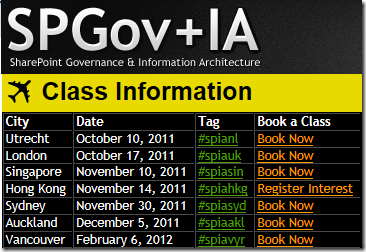
Of course it exists – I’ve been running it around the world for a couple of years now. It’s called the SharePoint Governance and Information Architecture Class (#SPGovIA) and it was a year in the making and comes with lots of goodies, such as a CD with a sample performance framework, governance plan, SharePoint ROI calculator (spreadsheet) and sample mind maps of Information Architecture. The class was originally designed for Microsoft New Zealand, on behalf of 3Grow for the Elite program that used to certify gold partners for serious SharePoint competence. Since then its been run in the UK, Netherlands, US, Australia and New Zealand. Next month I will run classes in Singapore and Hong Kong.

For my US readers, early next year I will be taking the course on the road, specifically Canada and the USA in Feb 2012. This course is not run often, because for me the US is a damn long way to travel and my time is tight these days! So I sincerely hope that if this sort of class sounds interesting to you, then you will consider being part of it. Michal Pisarek has already made an announcement for classes in Vancouver, and more details will be forthcoming for one or two US cities. I only have time for 2 classes in North America, so which city should it be?

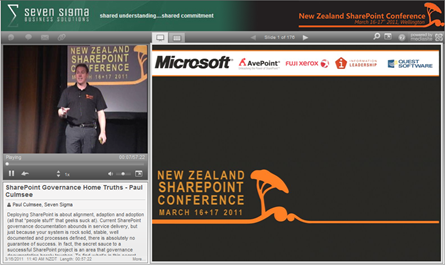
For more detail on the class, head on over to www.spgovia.com. While there, click the Media link and watch the first half hour of the class. I look forward to seeing you there.

image

Thanks for reading

Paul Culmsee

www.sevensigma.com.au


SharePoint Fatigue Syndrome

Hiya

I have been wrong about many things – I am happy to admit that. In SharePoint land, one of my bigger naive assumptions was that in early 2007, I figured I’d have maybe a 6 month head start before the rest of the industry began to learn from its initial SharePoint deployment mistakes and start delivering SharePoint “properly.” I thought that I’d better make hay while the sun shines, so to speak, as the market would tighten up as more players entered it.

Yet here we are, heading to the latter half of 2011 – some five years later. As I continue to go into organisations, whether in a SharePoint remedial capacity, or a training/architect capacity, I am still seeing the legacy of really poor SharePoint outcomes. Furthermore I am seeing other, frankly disturbing trends that leave me both concerned and pessimistic. I now have a label for this concern: “SharePoint Fatigue Syndrome.” SharePoint Fatigue Syndrome is hard to define, yet its effects are there for all to see. I suffer from it at times, and I am certain others do too. As an example, recently on the Perth SharePoint User Group on LinkedIn the following topic for discussion was raised:

Hi folks, as you already know we have a worrying skills shortage in SharePoint Development / Architecture in Perth and things are getting worse. It’s getting to the stage where companies have to suspend or worse still abandon their SharePoint projects due to lack of available talent. As the core of the SharePoint community in Perth your suggestions are vital towards finding real solutions to this growing problem. What can be done?

Now I know that this problem is not just limited to Perth. There are consistently reports online that speak of SharePoint people being in demand. So you would think that in a “hot” sector like SharePoint, where the industry is crying out for talent, that the rate of attrition would not outpace the uptake of new talent. After all – money talks, right? If you are a .NET developer with half a brain, there is serious money to be made in SharePoint development land. On top of that, there is the collective realisation in the marketplace that actually talking to people about how SharePoint could make their lives easier, leads to better outcomes. Hence the emergence of this notion of a “SharePoint Architect” with a more varied skill-set that just tech or dev. This role has further been legitimised by entire conferences now just catering to the business this end of the market (I am thinking the Share conferences here).

So, we have all of this newfound collective wisdom spreading through the community via various channels, in terms of the skills and roles required in SharePoint circa 2011 and beyond. We have the fat pay-packets being commanded as a result of demand for these skills. So, with that in mind, why is the attrition rate growing?

As an example, I know personally, several exceptional SharePoint practitioners who are no longer in SharePoint. I’ve also had various quiet conversations with many SharePoint practitioners, right up to SharePoint MCM’s, who vent their various frustrations on how difficult it is to get truly lasting SharePoint solutions in their clients and organisations. I’ve reflected on the various reasons I have come to the conclusion that SharePoint is just plain tiring. As a result, people are burning themselves out.

7 causes of SharePoint Fatigue Syndrome…

Burnout, in case you are not aware, is actually a lack of emotional attachment to what you are doing.  Quoting about.com:

The term “burnout” is a relatively new term, first coined in 1974 by Herbert Freudenberger, in his book, “Burnout: The High Cost of High Achievement.” He originally defined ‘burnout’ as “the extinction of motivation or incentive, especially where one’s devotion to a cause or relationship fails to produce the desired results.

SharePoint Fatigue Syndrome is SharePoint manifested burnout. The symptoms include feeling physically and emotionally drained, difficulty maintaining optimism and energy levels, feeling that you have less to give as the burden of work seems overwhelming. Sound familiar?

So why does SharePoint work run this risk? I see 7 major reasons.

1: Cost pressure leading to overwork

First up, the lure of the big dollar is a double edged sword. Not long ago I shared a beer with a SharePoint developer who’s work I respect greatly, yet I can’t afford to hire. This is because the percentage of chargeable hours he would need to work just so I can break even, is very high. This puts me (the employer) under pressure and at risk. As a result, I need to ensure that my newly minted SharePoint employee is productive from day 1 and I need him to work a lot of hours. But here is the irony. When I had my beer with this developer, the conversation started with him lamenting to me that he is already pulling ridiculous hours (60 to 80 per week). He was looking for a job with less hours and yet more money. This is simply not sustainable, both for employer and employee. The more you chase one (work hours vs. money), the more you lose the other it seems.

2: Structures that force an inappropriate problem solving paradigm (and wicked problems of course)

Then there is the broader problem where structure influences behaviour. As a basic example: from the developers’ perspective, they have to put up with sales guys who promise the world, and project managers who then make their life hell and force them to cut corners delivering the impossible. Project managers find out that their beloved work breakdown structure gets chopped and changed when their pain-in-the-ass developers whine that they can’t make the schedule. As I have stated many times previously, SharePoint project are likely to have wicked problem aspects to them. The structures that work well to deliver tame problems, such as Exchange, a VOIP system or a network upgrade, are much less effective for SharePoint projects. While organisations persist with approaches that consistently fail to deliver good outcomes, and don’t look at the structural issues, the attrition rate will continue. There is only so much that someone can take putting up with these sorts of stresses.

3: Technical complexity

SharePoint’s technical complexity plays a part too. No-one person understands the product in its entirety. The closest person I know is Spence and ages ago on twitter he remarked that even within Microsoft no-one understood it all. As a result, it is simply too easy to make a costly mistake via an untested assumption. (I thought the user profile service was tough – until I did federated claims authentication and multitenancy that is). The utter myriad of features, design options and their even greater number of caveats, mean that one can make a simple design mistake that causes the entire logical edifice of an information architecture to come crashing down. Many have experienced the feeling of having to tell someone that the project time and cost is about to blow out because nobody realised that, say,  Managed Metadata has a bunch of issues that precludes its use in many circumstances. Accordingly, SharePoint architects learn pretty quickly that it is hard to answer a definite “yes” to many questions, because to do so would require a question worded like a contractual clause, to ensure it is framed with appropriate caveats. Even then, consultants would know that lingering feeling in the back of their mind that they might have missed an assumption. This brings me onto…

4: Pace of change

This is BIG…and becoming more acute. Remember the saying ‘The only certainties in life are death and taxes?’ Outside of that, the future is always unpredictable.

In between SharePoint 2003 and SharePoint 2007, the wave of Web 2.0 and social networking broke, forever changing how we collaborate and work with information online (and some of those effects are still to be felt). Microsoft, like any smart organisation, responds to the sentiment of its client base. Microsoft also, like most mature organisations, tends to hedge its bets in terms of marketplace strategy in which it tries to get in on the act with the cool kids, yet tries not to kill the goose that laid the golden egg. Just look at Windows 8’s new interface, tablets, app stores and the cloud.

But that is one facet. Change happens in many forms and at many scales. For example, at a project level, it may mean a key team member leaves the organisation suddenly (SharePoint fatigue no doubt). At a global and organisational level, events like the odd global financial crisis force organisations to change strategic focus very quickly indeed.

I don’t know about you, but when Windows 8 was announced recently I was not excited (in fact I was not excited by SharePoint 2010 either). I thought to myself “So soon? I am still figuring out the current platform!”

As an example of the effect of pace of change, consider all the Government 2.0 initiatives around the world. Collaboration is in-vogue baby, so information should be free and government agencies should engage with the community. While that’s nice and all, there is the world of compliance, security and records management that takes a very different view. So, we end up with market forces that push against each other in combination with vendors hedging strategy of being all things to all people. It’s little wonder that SharePoint projects become very complex very fast.

By the way, it is worthwhile checking out what Bill Brantley in this post sums up the whole government 2.0 issue when he said:

What exactly is the nature of the Gov 2.0 challenge? This question was inspired by Andrew Krzmarzick’s post (What Gov 2.0 Needs Now: Managers, Money and Models) and Christina Morrison’s post (What is Gov 2.0? A survey of Government IT pros) on the recent GovLoop survey about Gov 2.0. As Andrew and Christina argued, the survey demonstrates many differing perspectives on Gov 2.0 in terms of what it actually means and how to implement Gov 2.0. To me, this suggests that Gov 2.0 is the classic wicked problem

5: SharePoint Entropy

One of my clients (who you will meet in my book when it’s published), once said to me “All good ideas eventually deteriorate into hard work.” This is a nice way to lead into the concept of SharePoint entropy, which in some ways is the inevitable outcome from the first four symptoms. The easiest way to understand entropy is to watch this awesome TV series called the “Wonders of The Universe.” In that show, the concept of entropy was discussed and for me made a lot of intrinsic sense. Without getting into the detail, entropy is the notion that over time things move from an organised to less organised state. Rather than have me waste your time trying to explain it in prose, let’s listen to the show in question. (Don’t skip the video – this is important!)

Now what does this has to do with SharePoint fatigue? Gordon Whyte saw what I am getting at with his post on entropy within organisations, especially in relation to change management.

For example, when we build a car we take raw materials such as metal, leather, plastic and glass and arrange them in a highly organised way to make a car. But if we then leave that car for long enough the metal will rust, the glass will become brittle and break and the leather will dry out and turn to dust. If the car is left for a very long time it will eventually disappear altogether. This thought left me wondering about the nature of organisations. If a progression from order to chaos is the natural order of the universe, then is this same pressure present in organisations and, perhaps more importantly, what is the optimum position for an organisation between the extremes of rigid inflexibility (low entropy) and complete chaos (high entropy)? This question is not as crazy as it might at first appear”

Gordon has nailed the issue in his post. Any SharePoint solution that has a low entropic nature requires more energy and effort to maintain that order and control. Complex SharePoint solutions often have complex governance wrapped around them. Governance that is process and structure centric by definition, has low entropy and accordingly, needs higher effort to maintain over time. In fact, if you do not maintain that effort and energy, then any SharePoint solution will usually disintegrate back into the sort of information management chaos that gave rise to SharePoint in the first place!  Rather like the sandcastle in the video.

By the way, I feel that email and file shares are high entropy solutions – all failed SharePoint projects lead back to these tools because they require less structure to maintain (in the short term).

In short, if SharePoint is implemented with low entropy, more energy is needed to maintain it. Remove the energy and very quickly, things become chaotic again. Governance approaches that are not cognisant of this will never stand the test of time. The question then becomes whether people feel that the end in mind is worth the perceived extra effort that is being asked of them.

6. Social complexity

Social complexity is also somewhat of a result of the first five symptoms. Most organisations have a blame culture. If they didn’t, then people wouldn’t spend so much time trying to position themselves for blame avoidance. Social complexity is the result of turf wars, ideological smackdowns and all of the other sort of things that result in the cliché of “the silos” where people are not talking to each-other in organisations. SharePoint exacerbates social complexity for two main reasons.

Firstly, because it is a collaboration tool, it actually requires some collaboration to put it in! This is often easier said than done. Secondly, because it is a pervasive and disruptive technology, it almost always clashes with an established tool, process or practice where proponents aren’t willing to change. In fact, they may not even recognise that there is a problem to solve – especially when SharePoint has been thrust upon them. (In an old post, I wrote about the notion of memeplexes and the ideological immune mechanisms that they create and why it is so hard to get shared understanding across departmental boundaries in organisations. Memetic smackdowns are the result).

The long and the short of social complexity is that there is only so much stress people can take. We all seem to have a pathological need to seek order and safety, rather then remain in a stressful situation. Once social complexity bites, the merry-go-round of staff attrition really starts to bite…

7. Meaning over motivation…

Now if I haven’t completely depressed you, let me offer you a perverse glimmer of light. For those of us who understand the preceding 6 fatigue symptoms, recognise them for what they are and take steps to mitigating them, there is one other symptom that contributes to SharePoint Fatigue Syndrome. This is the trickiest of all – and I am a somewhat willing victim of it.

I have spent a lot of time learning techniques to help address the symptoms I outlined here and as it turns out, these skills are universally applicable, whether in SharePoint, IT or beyond IT. For years now, I have metaphorically had one foot out of the SharePoint world door and the other foot into the world of construction, health and management sectors. Hell…I have written what I think is the first business book ever by a SharePoint person that is a non SharePoint and non IT. I also have clients with SharePoint deployments who do not know me as a SharePoint person at all, but only as a sensemaker (and for that I am grateful.)

The point is this: While the investment in these skills enables me to counter the effects of SharePoint fatigue syndrome, it is also inexorably pulling me away from SharePoint work. It seems that once you crack this nut a little, your skills are in demand across the entire problem solving spectrum. Right now this is my coping mechanism for SharePoint Fatigue Syndrome – I get to step away from SharePoint for periods and work on something else. Eventually…inevitably…I will also be one of those attrition statistics.

Conclusion:

The problem is that SharePoint Fatigue Syndrome is a negatively reinforcing cycle. As evidenced by the SharePoint attrition rate, money isn’t that great a motivator. If it was, then the void of skilled resources would have been filled by now. Paying more money might give you a short term gain, but in the long term is not going to address my seven causes of SharePoint Fatigue Syndrome.

I will leave this admittedly negative sounding post with the key to breaking this cycle. While you can attend my SharePoint Governance and Information Architecture class or Issue Mapping Class to learn many ways, the video below says it all. I encourage you to watch and reflect on it, because it’s the same key point to understanding how to do effective user engagement.


Thanks for reading


Paul Culmsee


Whatever you do, do not ignore legacy

On the twitterverse recently, someone stated that because of a problem of excessive SharePoint site sprawl, they were going to institute a new site approval process. On the surface this remedy seems to be perfectly reasonable. After all, there is a clear problem that has emerged and in the name of governance, we have taken steps to address it via this new process.

There is only one small problem with this. It’s probably the wrong thing to do or at best, a minor facet of what to do.

Before I explain why, consider another scenario that I am sure all of us have experienced. You have a problem so you call your bank, ISP or some other provider of services that you have paid for. You encounter an operator or customer service representative who seems hell-bent on closing your call at all costs, whether you think the problem is solved or not. Common examples of how this plays out is the oft used “well I will close this call and you can call back and log a new one if there is still an issue” line. A more subtle, yet equally frustrating one that even Microsoft have used on me is the “well you logged the problem as X, but in reality its Y. So you will need to close this call and re-log a new call for problem Y”.

The underlying reason for this is very likely that the performance of the person on the other end of the line is judged on time spent handling your call. The logic would be that the speedier a call is closed, means the less time users have spent on tech support, which indicates good outcomes for customers.

Alas, if only that were true. Anybody who has been on the receiving end of this sort of treatment knows full well that the opposite happens. As a customer, you get frustrated and pissed off. More dangerously for the organization, this sort of indicator conveys a warped representation of reality. Essentially the operator has altered their behaviour to maximise their performance according to this measure of “effectiveness”. Customers who are paying the money are not necessarily satisfied. In fact they are more often than not dissatisfied. Therefore, the notion that length of support calls somehow lead to happier customers is a fallacy. In the longer term, customers will tire of crappy outcomes and take their business elsewhere.

This success indicator is a mirage, and in actual fact contributes to the nastier, longer term problems of customers ending up with competitors.

So with that said, lets go back to our Sharepoint site sprawl issue. Before instituting such a policy, I ask the following simple question.

So why are there lots of sites?

Now there will be various reasons, but the most common answer I get back from this is:

Users don’t know any better.

This assertion is pretty easy to test too. Take a look at the sites in the wild west of a chaotic SharePoint install. Since most site templates in SharePoint have a single document library, it is common to see many hundreds of sites with a single document library in them. Clearly, people simply aren’t aware that they can do things like add more libraries or lists to a site or they are unwilling or unable to do so. I have experienced users telling me that if they had have known, they would have never created a site for a particular collaborative activity.

Side Note: SharePoint’s own attempts to be “intuitive” is the problem here. For a start, sites build navigation by default so people get duped into using sites to create navigational structure when its wholly inappropriate. Secondly, creating a new site is inferred as the right thing to do. To see why, go to the site actions menu and what is a default action there? You guessed it – create a site. SharePoint out of the box actually contributes to users forming this mental model of how SharePoint hangs together).

So clearly, many instances of excess site sprawl is symptomatic of something deeper. Users do not know that there are potentially better alternatives. This leads us to a somewhat rhetorical, yet critical question:

What does an approval process do about users not knowing any better?

Many times such approval processes shift the burden of creating the site to an authorised party like IT, after a requestor’s boss has given it the go ahead. Naturally, people will have to do more paperwork to get approval and it might take longer. Furthermore, maybe their request will be rejected under certain circumstances. But at what point will they learn that there is more to life than sub sites? Even after instituting the approval process, we still may end up with a heap of sites with a single document library in them. Have we really addressed the real issue?

Do you see the parallel? The sort of thinking that decided an approval policy is the answer to site sprawl is the same sort of thinking that decided that call times are a reliable indicator of customer outcomes being met. Both treat the superficial, visible symptoms of a problem, not the underlying cause. Furthermore, both end up leaving stakeholders with crappy outcomes in the longer term. Your support calls are still frustrating and you are still using SharePoint in a sub optimal fashion.

More scarily though is that we have deluded ourselves into thinking we have dealt with the problem. SharePoint governance is often built around this sort of superficial thinking. If a governance plan weighs as much as a door stop, and gets about as much attention as a door stop, then you might be making this mistake.

What about legacy?

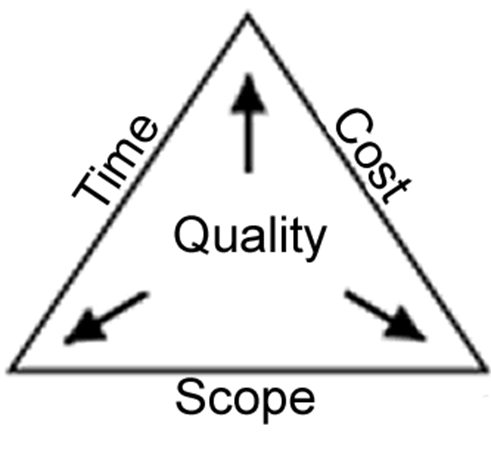
This problem is more common than you think. There is a more systematic pattern of delusion that can happen in project management. Check out the diagram below.

image

Seen this diagram before? It is very common on project management books and presentations. We have a pyramid that implying that to have quality, we have to have time, cost and scope balanced and understood. Like the site approval policy, this seems perfectly reasonable on the surface. But unfortunately, by its very nature can cloud us to what is really important.

Below is an example of a project output – the Sydney Opera House. During my classes, everyone recognises it and there is always someone who has been there. In fact people come to Sydney just to see it. In term of economic significance to Sydney, it is priceless and irreplaceable. the architect who designed it, Jørn Utzon, was awarded the Pritzker Prize (architecture’s highest honour) for it in 2003.

image

So I ask you the question:

Was this a successful project?

I ask this question to people all around the world and the answer is always a great big Yes. But if we look at this project through the lens of our quality triangle above, the view changes.

Why?

Well, here are a few fun filled facts about the Sydney Opera House.

  • The Opera House was formally completed in 1973, having cost $102 million.
  • The original cost estimate in 1957 was $7 million.
  • The original completion date set by the government was 1963.
  • Thus, the project was completed ten years late and over-budget by more than fourteen times.
  • Ultzon, the designer of the opera house never lived to set foot in it, having left Australia in disgust, swearing never to come back.

“Utzon soon found himself in conflict with the new Minister. Attempting to rein in the escalating cost of the project, Hughes began questioning Utzon’s capability, his designs, schedules and cost estimates. Hughes eventually stopped payments to Utzon. Unable to pay his staff, Utzon was forced to resign as chief architect in February 1966 and left the country never to return. Utzon has never seen the completed work that brought him international renown

Harsh huh? Clearly, when judged through the “quality” lens of time, cost and scope, this project was a unmitigated epic fail that makes SharePoint look like a walk in the park.

The example of the Sydney Opera House serves to remind us that when all is said and done, we judge quality across something deeper than time, cost and scope alone. That something is legacy.

People remember legacy, not scope

So when you look at the Opera house through the lens of the quality triangle, you are making the same mistake as the call-center KPI and the well intentioned site creation policy. You are taking a superficial view of things and in doing so, missing more subtle, but ultimately important factors. In fact you are treating symptoms and not looking for the “story beneath the story” that caused the visible symptoms in the first place.

Yet…

Why do we go to the time, effort and cost to put in tools like SharePoint? It is because we see that it can take us to a better place than we are now. After all, if we didn’t believe this fundamental truth, then we wouldn’t spend the that time and money working on it. This notion of a “better place” implies that we are trying to escape a legacy of the past – such as poor information management practices, inefficient process, silo organisations and so forth.

As illustrated by the Opera House example, people do not remember time, cost and scope. What they do remember acutely however is legacy.

So what is a more reliable indicator of quality? Who visits the Opera house and takes a photo of it because it was such a breathtakingly bad example of project management 101? No, they take their photo because it is unique, has value and people want to experience it for themselves. Its the legacy that they remember, cherish and want to be a part of.

As a result, there is a critical lesson here for all SharePoint practitioners (from the nerdiest of nerds to the hippiest of web 2.0 pundits). Ask yourself, “what legacy is my governance actions going to leave”, because if you fail to consider the legacy of your approaches to SharePoint delivery, you are probably dooming your organisation to the very same legacy you wanted to escape in the first place!

And that’s just tragic.

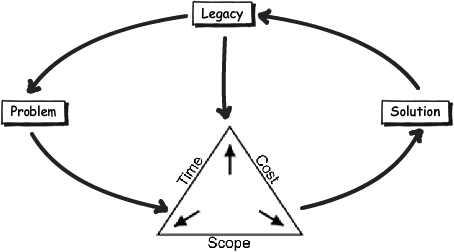
So I think that PM 101 diagram needs to be redrawn because it misleads – especially for complex, adaptive or wicked problems. To me, considering time, cost and scope without legacy is delusional and plain dumb. Legacy informs time, cost and scope and challenges us to look beyond the visible symptoms of what we perceive as the problem to what’s really going on.

image

When I get time, I will post several examples of how I was able to utilise this sort of thinking in a future post, but I hope this gives you some food for thought.


Thanks for reading


Paul Culmsee

www.sevensigma.com.au

www.spgovia.com


Seattle is go! SharePoint Governance and Information Architecture class

For one night only USA…

Ah, Erica Toelle – what a legend! Thanks to Erica and Fpweb, I’m thrilled to confirm that the Seattle SharePoint Governance and Information Architecture class is all systems go. Save the date as its very likely indeed to be the only SPIA class in the USA in 2011.  If it wasn’t enough that Erica will be joining me, but Ruven Gotz will be there too.

Thursday and Friday, May 05-06, 2011. (http://spiaseattle.eventbrite.com/)

The location is the Silvercloud Inn, 14632 SE Eastgate Way Bellevue, WA 98004

Map picture

In this multimedia extravaganza of a blog post, lets take a closer look at this class and what you can expect. Below is a snippet of a talk I did in New Zealand called “SharePoint Governance  Home Truths”. This clip shows a little diagnostic test that I do on my audience, to see whether they have experienced the visible signs of wicked problems. If you want to know why you should go to SPGov+IA, then take my 2 minute test yourself.

Do you need SPGov+IA? Take the two minute test to find out…

If the two minute test has taken your fancy, then you might want to see what is in store on the course itself. Below is the first half-hour of module 1 (in the form of a conference session), as well as the accompanying slide deck.

image 

View more presentations from paulculmsee

Course Information:

imageDownload Course Outline (PDF)

Download Class Flyer (PDF)

Most people understand that deploying SharePoint is much more than getting it installed.  Despite this, current SharePoint governance documentation abounds in service delivery aspects. However, just because your system is rock-solid, stable, well-documented and governed through good process, there is absolutely no guarantee of success.  Similarly, if Information Architecture for SharePoint was as easy as putting together lists, libraries and metadata the right way, then why doesn’t Microsoft publish the obvious best practices?

In fact, the secret to a successful SharePoint project is an area that the governance documentation barely touches.

This Master Class pinpoints the critical success factors for SharePoint Governance and Information Architecture and rectifies this blind spot.  Paul Culmsee’s style takes an ironic and subversive view on how SharePoint Governance really works within organizations while presenting a model and the tools necessary to get it right.

Drawing on inspiration from many diverse sources, disciplines and case studies, Paul Culmsee has distilled the "what" and "how" of governance down to a simple and accessible, yet rigorous and comprehensive set of tools and methods that organizations, large and small, can utilize to achieve the level of commitment required to see SharePoint become a successful part of your enterprise.

Some workshop sessions are hands on, we provide all of the tools and samples needed but please bring your own laptop.

Course Structure:

The course is split into 7 modules, run across two days.

Module 1: SharePoint Governance f-Laws 1-17:

Module 1 is all about setting context in the form of clearing some misconceptions about the often muddy topic of SharePoint governance. This module sheds some light onto these less visible SharePoint governance factors in the form of Governance f-Laws, which will also help to provide the context for the rest of this course

  • Why users don’t know what they want
  • The danger of platitudes
  • Why IT doesn’t get it
  • The adaptive challenge – how to govern SharePoint for the hidden organisation
  • The true forces of organisational chaos
  • Wicked problems and how to spot them
  • The myth of best practices and how to determine when a “practice” is really best

Module 2: The Shared Understanding Toolkit – part 1:

Module 2 pinpoints the SharePoint governance blind spot and introduces the Seven Sigma Shared Understanding Toolkit to counter it. The toolkit is a suite of tools, patterns and practices that can be used to improve SharePoint outcomes. This module builds upon the f-laws of module 1 and specifically examines the “what” and “why” questions of SharePoint Governance. Areas covered include how to identify particular types of problems, how to align the diverse goals of stakeholders, leverage problem structuring methods and constructing a solid business case.

Module 3: The Shared Understanding Toolkit – part 2:

Module 3 continues the Seven Sigma Shared Understanding Toolkit, and focuses on the foundation of “what” and “why” by examining the “who” and “how”. Areas covered include aligning stakeholder expectations, priorities and focus areas and building this alignment into a governance structure and written governance plan that actually make sense and that people will read. We round off by examining user engagement/stakeholder communication and training strategy.

Module 4: Information Architecture trends, lessons learned and key SharePoint challenges

Module 4 examines the hidden costs of poor information management practices, as well as some of the trends that are impacting on Information Architecture and the strategic direction of Microsoft as it develops the SharePoint road map. We will also examine the results from what other organisations have attempted and their lessons learned. We then distil those lessons learned into some the fundamental tenants of modern information architecture and finish off by examining the key SharePoint challenges from a technical, strategic and organisational viewpoint.

Module 5: Information organisation and facets of collaboration

Module 5 dives deeper into the core Information Architecture topics of information structure and organisation. We explore the various facets of enterprise collaboration and identify common Information Architecture mistakes and the strategies to avoid making them.

Module 6: Information Seeking, Search and metadata

Module 6 examines the factors that affect how users seek information and how they manifest in terms of patterns of use. Building upon the facets of collaboration of module 5, we examine several strategies to improving SharePoint search and navigation. We then turn our attention to taxonomy and metadata, and what SharePoint 2010 has to offer in terms of managed metadata

Module 7: Shared understanding and visual representation – documenting your Information Architecture

Module 7 returns to the theme of governance in the sense of communicating your information architecture through visual or written form. To achieve shared understanding among participants, we need to document our designs in various forms for various audiences.

Putting it all together: From vision to execution

Attendees will be taking home a manual ~480 pages, containing the Seven Sigma Shared Understanding Toolkit CD with a sample performance framework, governance plan, SharePoint ROI calculator (Spreadsheet), sample mind maps of Information Architecture. These tools are the result of years of continual development and refinement "out in the field" by Paul Culmsee and have only been recently released to the public through this Master Class.

More Information:

Refund Policy:

No refunds will be issued for attendee cancellations once payment is recieved.  Class cancellation by the organizer will result in a refund less transaction fees.

image

http://spiaseattle.eventbrite.com/


Praise for SharePoint Governance and IA Masterclass

I received this today and I had to post it. In New Zealand recently, Paul McTaggart of Gen-i stopped me and complimented the governance and information architecture course that some of his staff have attended. I am truly humbled by the feedback that he just sent through…

Practical, relevant and seriously funny: These attributes are seldom seen together in a training session.

However, Paul Culmsee has practical, real world experience having worked on complex (wicked) projects which provides him with the background and understanding of what works and why.

Discover the immutable f-laws of SharePoint projects. Cry and laugh when you identify the reality of you own organizational platitudes, but breathe a sigh of relief when you see that there is a way out and that SharePoint Governance and Information Architecture can be achieved with everyone sharing the same understanding of where you are now and where you are trying to get to.

Paul also supports you new found realization of what needs to be done by providing you with the guidance, tools and methods that you can take from the classroom and apply to your complex (wicked) problem projects to make them work.

Basically it is all about people (gaining shared understanding), process (knowing how to get from here to there) and then the technology (SharePoint).

My team now uses the concept of shared understanding and the tools that the Governance and Information Architecture Class has provided to get customers “on page” before we design and code in SharePoint land.

Paul McTaggart

ECM Business Manager

Gen-i a division of Telecom New Zealand

Thanks for reading

Paul Culmsee


The facets of collaboration part 5: It’s all Gen-Y’s fault – or is it?


Hi all

imageWelcome to another exploration of the collaborative world through a lens called the facets of collaboration. If you are joining us for the first time, I am writing a series of posts that looks at how our perception of collaboration influences our penchant for certain collaborative tools and approaches. SharePoint, given that it is touted as a collaboration platform, inevitably results in consultants never being able to give a straight answer. This is because SharePoint is so feature-rich (and as a result caveat-rich), that there are always fifty different ways a situation can be approached. Add the fact that many clients do not necessarily know what they want and learn about their problem by examining potential solutions, we have all the hallmarks of a wicked problem in the making.

These wicked problems, underpinning SharePoint, often results in Robot Barbie situations (cue the image to the left), which is the metaphor that I started this series with. Robot Barbie represents everything wrong about SharePoint deployments, as it is symptomatic of throwing features at a platitude, pretending to be solving a real problem and then wondering why the result doesn’t gel at all. It is a pattern of behaviour that is similar to an observation made by the very wise (and profane) Ted Dziuba who once spoke these words of wisdom.

If there’s one thing all engineers love to do, it’s create APIs. It’s so awesome because you can draw on a white board and feel like you put in a good day’s work, despite having solved no real, actual problems. Web 2.0 engineers, in addition to their intrinsic love of APIs, have a real hard-on for anything having to do with a social network. For example, developing a Facebook application lets them call their shitty little PHP program an "application" running on a "platform," like a real, live computer programmer does. Make-believe time is so much fun, even for adults.

Apart from making me giggle, Dziuba may have a point. Elsewhere on this blog I have spent time explaining that there are different types of problems that require different approaches to solving them (wicked vs. tame). My conjecture is that collaboration itself is exactly the same in this regard. People who espouse a particular type of tool or approach as the utopian solution to collaboration are taking a one size fits all approach to a multifaceted area and even worse, treating that area as a platitude. Anyone who calls themselves an Information Architect and doesn’t at least give cursory examination to the dimensions or facets of collaboration is likely to be doing their stakeholders a disservice.

All of us have certain biases, and I am no exception. For a start, I am generation X – the so-called cynical generation. Apparently we whinge and whine about everything and then blame it all on generation-Y. Thus, if cynicism is the gen-X stereotype, then I will happily accept being the poster child. I mean seriously, all of you vanity obsessed, self interested generation y’ers, if you spend a little less time preening and more time thinking, we might get some wisdom out of you (see – I am such a cynical gen-X right now).

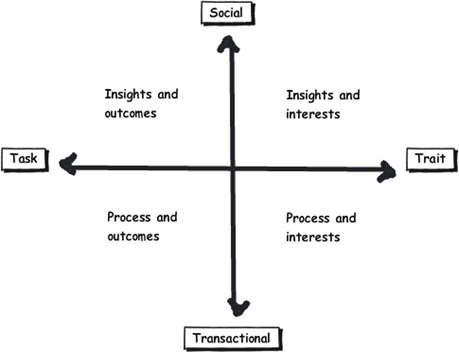
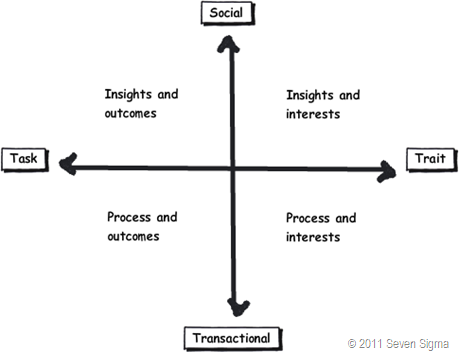
So let’s recap the facets of collaboration. The model I came up with identifies four major facets for collaborative work: Task, Trait, Social and Transactional.

  • Task: Because the outcome drives the members’ attention and participation
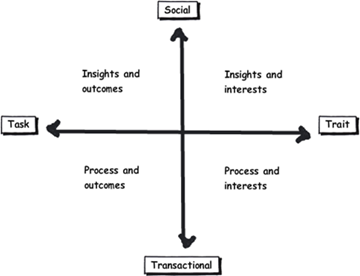
  • Trait: Because the interest drives the members’ attention and participation
  • Transactional: Because the process drives the members’ attention and participation
  • Social: Because the shared insight drives the members’ attention and participation

image

In the last post, I used the model to examine the notion of Business Process Management versus Human Process Management and looked at some of the claims and counter claims made by proponents of each. This time let’s up the ante and talk about something curlier. We will examine the notion that social networking in the enterprise is the answer to improving collaboration within the enterprise. On first thought, it makes perfect sense, given the incredible success of Facebook, LinkedIn and Twitter. Nevertheless, there is ongoing debate about the use and value of social tools in the enterprise driven by their rise outside of organisational contexts. One particularly strongly worded quote is from Aaron Fulkerson, co-founder and CEO of MindTouch who doesn’t mince his words:

This class of software forces business users to adopt the myopic social visions imagined by the developers, which are nearly identical to their corresponding consumer web implementations. In short, social software is not solving business problems. In fact, these applications only serve to treat symptoms of the problems businesses face. They exacerbate the real problems within businesses by creating distractions and, worse, proliferate more disconnected data and application silos.

Ouch! Even within the SharePoint community there is significant variation of opinions as to the value of social. While I better protect the innocent and not name names, I have spoken with several well known SharePointers who think social is a giant waste of time, versus those who see real value in it. Irrespective of your opinion, you cannot ignore the fact that social is a significant game changer with effects still being felt. While web 2.0 has dropped off the Gartner hype cycle, its effect on particular sectors has been far reaching. Now it seems that all sectors have a 2.0 on the end of their name. For example:

  • Enterprise 2.0
  • Education 2.0
  • Legal 2.0
  • Government 2.0

Clearly, if things were just a flash in the pan, why are governments around the world trying to revitalise their public sector by utilising these tools?

Look at Microsoft as another example. They have, I think smartly, recognised industry trends and reacted to them via the introduction of a number of new SharePoint features, such as tagging/folksonomy via managed metadata, ratings columns, enhanced wiki capabilities and a significant investment in the capabilities of my-sites. Their clients now have the option to leverage these features should they choose to do so.

So just as there are naysayers, there are the pundits. Many people cite the reasoning that these features are necessary to attract and retain the next generation of workers, who have grown up with these tools in their personal lives. Whether this claim is valid is debatable, but I have to say, I really like the Enterprise 2.0 slide deck below by Scott Gavin for a number of reasons. I think it encapsulates the 2.0 vision, underpinned by social/cloud technologies very nicely. I sometimes ask people to discuss this slide deck in my IA classes and discussion is equally polarising as social networking in the enterprise itself. Some people think it represents the vision for the future, and others think it is hopelessly idealistic and doesn’t reflect cold, hard reality. Take a look for yourself below…

And the survey says…

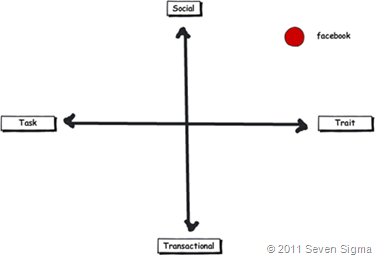
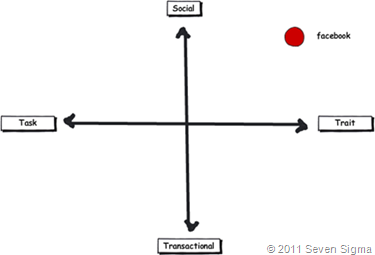
Using the facets quadrants, we can start to see patterns for success of these tools for the enterprise and whether Aaron Fulkerson’s argument has merit or whether Scott Gavin is on the right track. An interesting use of the facet diagram is to plot where various tools and technologies are located. in my classes, I ask people to plot where Facebook belongs on facets diagram. Guess where it is usually drawn? 
image

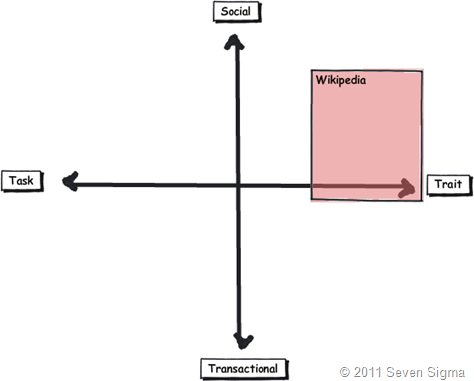
While some people will draw Facebook at various levels on the vertical axis, everyone pretty much describes Facebook (and LinkedIn)  as trait based, while being highly dominant on the social quadrant. As discussed in the last article, if I ask people to plot a crowdsourced tool like Wikipedia, the dominant characteristic is always trait/social. In other words, people maintain and update Wikipedia articles because of their interest in the topic area, not because it helps them get something done.
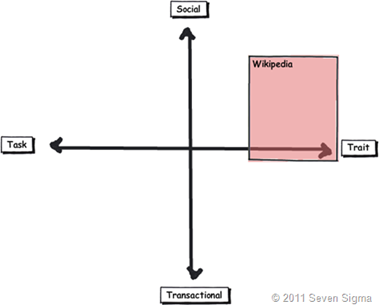
image_thumb29

Clearly, big social networking technologies are successful in the "trait based social” quadrant. In other words, we tend to use Facebook more for common interest collaboration than to solve a task based collaborative issue (such as deliver a project). Another interesting thing about a lot of social networking technologies is that for many, our work-based collaborative life tends to be more task based, compared to our non-work which is more trait based. In other words, for a lot of us, our work life revolves around working with a group of people for a common outcome and if it was not for that common outcome, we wouldn’t necessarily have much in common (I risk falling victim to my own generalisation here – so I will come back to this later in the section titled “Why User Buy-In Is Hard”).

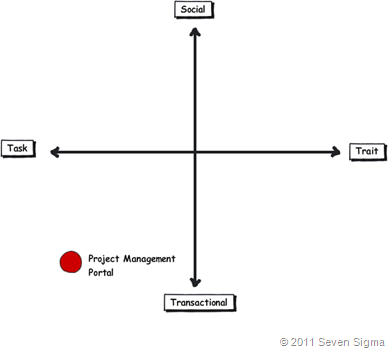
When you look at where Facebook sits in the quadrant, it begs the question of how well this type of tool (or the building blocks it is based on) would work in an organisation that is project (task) based and highly transactional. To that end, consider a project management information system, such as the basic one that Dux espouses in his book or the more complex one that Microsoft sell to organisations. Where do you think it belongs on the quadrant?

When I ask people to plot their project management information system, I typically get this response:
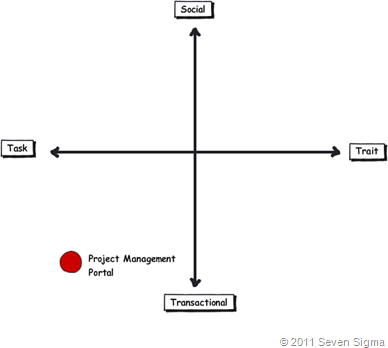
image

I speculate that the further away two tools lie on the spectrum, the more likely we are to have a robot-barbie solution if you blindly mix features that work well in each individual quadrant. The wiki argument I made in part 3 seems to support this contention. If you recall, in part 3 of this series, I mentioned that I ask every attendee of my classes if they had ever seen a successful project management wiki.  Irrespective of the location of the class, the answer was pretty much “no”. I noted that where I had seen successful wikis tended to be where the users of the wiki were linked by strong traits.

Looking Deeper

While that is interesting, I think the facets diagram tells you more than it intends. Obviously, it is clear that these project management systems such as MS Project Server are oriented toward task/transactional (“getting things done”) aspect of project delivery (ie, time, cost, scope, budget and the like). While some people might point to this and say “there you go – I told you all that social crap was a waste of time – bloody gen-Y and their social networking hubris”, I feel this is naive. If task based transactional tools are sufficient, then why do so many projects fail?

I have stated many times on this blog that shared commitment to a course of action requires shared understanding of the problem at hand. The act of aligning a team to project goals and developing this shared understanding is the realm of the task/social quadrant (the top left), where insights and outcomes come together. When I ask people to name tools that live in this space, few can name anything. Obviously, most project management systems are devoid here. Worst still, we subsequently delude ourselves to thinking that shared understanding can come from a few platitudinal paragraphs labelled as a “problem statement”.

Social networking pundits implicitly recognise this issue (and frequently butt heads against command and control type project managers as a result). But i feel they make the mistake in applying a one size fits all approach to collaboration and apply trait based tools as a panacea when they are not wholly appropriate. The social tools seem to fit exceptionally well into the top right quadrant, but not in the top left.

In fact the only tools that spring to mind that belong in the top left category are the sensemaking tools that my company practice, such as Dialogue Mapping.

Where’s the proof, Paul?

So I guess I am arguing that using social tools because they are the “choice of the new generation” ignores a few home truths about the nature of these tools versus the nature of organisational life. Just because Microsoft provide the tools for you, tells you that they are hedging their bets rather than having any more insight than you or me. So to test all of this, let’s use the facets model in a different way to back up some of my observations and suggestions in this post. Guess what happens when I ask people to plot SharePoint itself on the facets map?

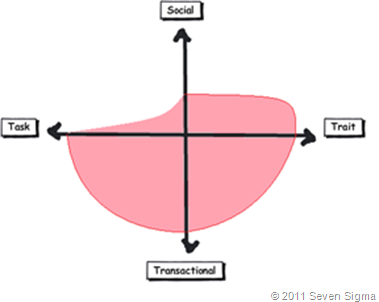
When I asked SharePoint practitioners to do this, they initially drew SharePoint 2007 as a circle over the entire model. Once they did so, they would very often adjust the drawing to emphasise transactional over social collaboration as shown below.
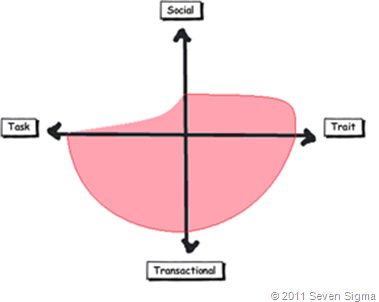
Sharepoint 2007 

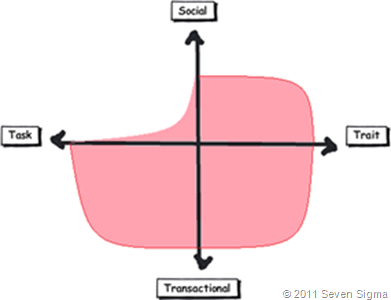
When practitioners were asked to draw SharePoint 2010, they usually indicated a higher representation in in the two social quadrants, but favoured the trait based social over task based social as shown below.
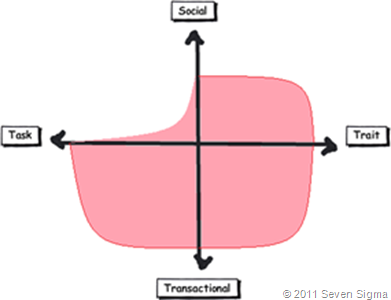
image

What was interesting about this experiment is that very few people drew SharePoint over the entire facets of collaboration. Social collaboration with SharePoint it seems, only stretches so far. This leads me onto more conjecture, and now we get to the bit in the post where we name a giant SharePoint elephant in the room.

Structured tools for social collaboration?

Many collaborative tools purport themselves as operating in the social space. SharePoint 2010 clearly does so, principally due to the Managed Metadata service, pimped MySites with tagging/rating capabilities. But SharePoint’s core heritage is database/metadata driven, document based collaboration. If we go back to our definition of social collaboration as dynamic, unstructured, with sharing of perspectives and insight through pattern sensing, then social collaboration is clearly not a predefined interaction.

Yet, database driven tools like SharePoint, and its building blocks like site columns and content types require considerable up-front planning to install and govern. Many, many inputs need to be well defined and furthermore, unless you have learnt through living the pain of things like content type definitions in declarative CAML, SharePoint buildings blocks are difficult to maintain/change over time. SharePoint suffers from a problem of reduced resiliency over time in that the more you customise it to suit your ends, the less flexible it gets. In the case of social collaboration the problem is worse because we are trying design for outputs where the inputs are not controlled. Trying to turn something that is inherently organic and emergent to something that has an X and Y on it may be misfocused and destined to fail in many circumstances. The realm of well-defined inputs is the realm of transactional collaboration, where workflow and business process management thrive and change is much more controlled before SharePoint ever gets a look in.

SharePoint excels at transactional scenarios as this is its heritage – after all, the majority of its feature set is oriented to transactional collaboration. The fact that people are prepared to draw SharePoint as dominating across across the transactional half of the facets diagram illustrates this.

But this raises interesting, if not slightly heretical question. If we need to use information architects to get a collaborative tool deployed for social collaboration (to get those inputs defined), then are we pushing the solution into the transactional side of the fence? Recall that in part 3 of this series, I looked at document collaboration and noted that when asked to draw team based document collaboration, people typically drew it operating in the social half of the matrix (pasted below for reference). I also noted in part 3 that for team based collaboration, rules and process are much less rigid or formalised with regards to document use and structure. I then referred to a recent NothingbutSharePoint article where a large organisation’s attempts to introduce the usage of content types largely failed. Like the seeming lack of success of wiki’s for task based collaboration, maybe content types simply are not the ideal construct as you move up the Y axis from transactional to social?
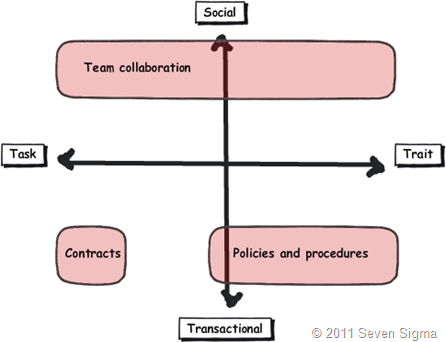
Now do not assume that I am anti metadata/content types here as this is not the case at all. Content types rock when it comes to search and surfacing of related information across a site collection (and beyond if you use search web parts). What I am calling out is the fact that if the SharePoint constructs that we have at our disposal were the panacea for social collaboration, where are the best practices that tell us how to leverage them for success? Perhaps the nature of the collaboration taking place plays a part in the lack of take-up reported in the aforementioned article? Those who advocate highly structured metadata as the only true solution may in fact be pushing a transactional paradigm onto a collaborative model that is ill-suited to it?

The knowledge worker paradox – one of the reasons why user buy-in is hard

Finally for now I’d like to cover one more aspect to this issue. Last year, one of my students looked at the facets and said “Now I know why my users aren’t seeing the value that I see in SharePoint”. When I asked him why, he explained:

“Many of my users are transactional and governed by process – that’s their KPI. Here I am as a knowledge worker, seeing all of these great collaborative features, but I am not judged by a process or transaction. I don’t live in that world. I forget that someone whose performance is judged by process consistency is not going to get all excited by a wiki or tagging or a blog.”

I call this the knowledge worker paradox and it is reminiscent of what I said in part 4 where we looked at BPM vs. HPM. Each role on an organisation is multifaceted. For many roles, there is varying degrees of transactional work taking place. Accordingly some people are very much process driven just as much as they are social driven. Gross generalisations that make statements that “80% of people are knowledge workers or perform knowledge work” do not help matters. In fact they serve to feed the one size fits all mentality that has proven to be detrimental to projects when people fail to recognise that some projects have wicked aspects.

SharePoint people are almost always knowledge workers. Thus if you, as a knowledge worker who is rarely governed by transactional process, think that you have the vision to prescribe a SharePoint driven meta-utopia to meet transactional needs without having lived that world, then if your results are not what you hoped for then to me its hardly surprising.  My student in this case realised that he had been approaching his user base the wrong way. Like Jane in part 1, he did not take into account the dominant facets of collaboration for the roles that he was trying to sell SharePoint into.

When you think about it, the whole argument around records management versus collaborative document management is in effect, an argument between a transactional oriented approach, versus a social oriented one. It is the same pattern as BPM vs. HPM. In records management, the paradigm is that management of the record is more important than the content of the record. Furthermore, that record shouldn’t change. Yet with team based document collaboration, without content there is no document as such and furthermore, the document will change frequently and require less strict controls to grease the gears of collaboration.

Both records oriented people and social pundits commonly make the same mistake of my student, where they force their dominant paradigm on everyone else.

Conclusion

Food for thought, eh?

This is probably my last facets of collaboration post for a while. It is one of these series of articles that I feel has value, but I know it won’t be read by too many 🙂 Nevertheless, I do hope that anyone who has gotten this far through has gotten some value from this examination and sees value in the model to help users make more informed Information Architecture decisions for SharePoint and beyond. I certainly use it now in most engagements and hope that it can be improved upon as a tool, or somehow incorporated into some of the SharePoint standards or maturity model stuff that is out there.

Remember the most important thing of all though. Despite all I have said, it is still definitely all generation y’s fault!

Thanks for reading


Paul Culmsee

www.sevensigma.com.au


Exciting news for Governance and Information Architecture classes

Hi all

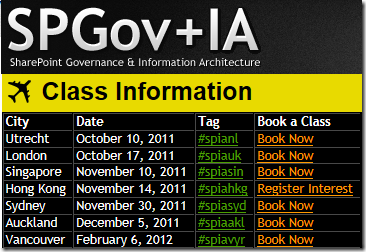
I just thought I would check-in with some updates on happenings and some upcoming travels. In less then 2 weeks now, I will be in London with Andrew Woodward and Ant Clay of 21apps for the second SharePoint Governance and Information Architecture Master Class. There are still places available on this class so if you have been thinking about attending, now is the time to act.

Also in Europe, a class is being run in Utrecht, Netherlands in May by Ant Clay.

I am proud to be chosen to be a keynote speaker at the Australian SharePoint conference in Sydney in March. I am still wondering if I should dialogue map 600 people! I will also be running a two-day class after this conference – the only one in Sydney for this year. The week after I am in NZ at the SharePoint conference there, also running a 2 day class and hopefully the first ever Issue Mapping class in New Zealand.

After a small break (begging forgiveness of clients who have to put up with my “international man of mystery” gallivanting), I’ll be heading to North American shores to run classes over there. Confirmed cities at this stage are Boston and Toronto, but DC and Chicago are in the works and I am hopeful to run one on the west coast, perhaps in San Francisco or Seattle.

If you are a SharePoint consultancy in these areas and would like to partner with us on this, please contact me on twitter @paulculmsee or email me via the address at the about page of this blog.

Below is the current itinerary for Governance and Information Architecture classes. Things are still being solidified, and will obviously change a little between now and then. Keep an eye on twitter @paulculmsee for more detail.

Date Location Class Hashtag Comments
Feb 21-22 London SharePoint Governance and Information Architecture #SPIAUK  
March 10-11 Sydney SharePoint Governance and Information Architecture #SPIAAU  
March 14-15 Wellington SharePoint Governance and Information Architecture #SPIANZ  
March 21-22 Wellington Issue Mapping Master Class #IBISNZ  
April 28-29 Washington DC SharePoint Governance and Information Architecture #SPIADC Tentative date: to be confirmed
May 2-3 Indianapolis SharePoint Governance and Information Architecture #SPIAIA Tentative date: to be confirmed
May 5-6 Boston SharePoint Governance and Information Architecture #SPIABN Tentative date: to be confirmed
May 9-10 Netherlands SharePoint Governance and Information Architecture #SPIANL Ant Clay of 21apps is running this class as I am in the USA
May 9-10 Chicago SharePoint Governance and Information Architecture ? Tentative date: to be confirmed
we will arrange some kind of hookup to the Netherlands class
May 12-13 Toronto SharePoint Governance and Information Architecture #SPIATO Announced
May 16-17 West coast USA SharePoint Governance and Information Architecture   Looking for a partner for this region
June London Issue Mapping Master Class   in the works…
July South Atrica SharePoint Governance and Information Architecture   in the works…

if you live in any of the regions that are either “tentative” or “in the works”, please contact me and register your interest so I can work with local partners on the ground in these locations.


Thanks for reading

Paul Culmsee


The facets of collaboration part 4–BPM vs. HPM


Hi all and welcome to part four of my series on unpacking this buzzword phenomenon that is “collaboration”. Like it or not, Collaboration is a word that is very in-vogue right now. I see it being used all over the place, particularly as a by-product of the success of x2.0 tools and technologies. Yet if you do your research, most of the values being espoused actually hark back to the 1950’s and even earlier. (More on that topic in my forthcoming Beyond Best Practices book).

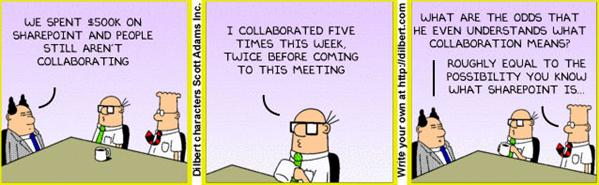
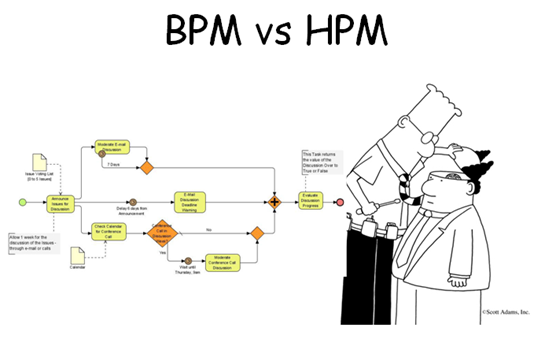
As it happens, Dilbert is quite a useful buzzword KPI. Once a buzzword graces a Scott Adams cartoon, you know that it has officially made it – as shown below:

image

So back to business! Way back in the first article, I introduced you to Robot Barbie, a metaphor that represents all of those horrid SharePoint sites remind you of a cross-dressing Frankenstein’s monster. I had an early experience with a client who championed a particular vision for a SharePoint project, only to find little buy-in within the organisation for that vision. This, and a bunch of other things, got me interested in the softer areas of SharePoint governance, where no tried and tested best practices really exist. If they did and were so obvious, Microsoft would published them as its in their interest to do so.

image

This all culminated in when I wrote a SharePoint Governance and Information Architecture training course last year. I read a lot of material where authors attempted to unpack what collaboration actually meant. My rationale for doing so would be to hopefully avoid creating SharePoint solutions that were Robot-Barbie Frankensteins. The model that I came up with is illustrated below:

image

The basic model is covered in detail in part 2. But to recap here is the basic summary: This model identifies four major facets for collaborative work: Task, Trait, Social and Transactional.

  • Task: Because the outcome drives the members’ attention and participation
  • Trait: Because the interest drives the members’ attention and participation
  • Transactional: Because the process drives the members’ attention and participation
  • Social: Because the shared insight drives the members’ attention and participation

In the last post, I used the model to compare and contrast the use of particular SharePoint features, such as wikis, SharePoint lists and the different aspects of document collaboration. With regards to the latter of these three, I l looked at the effectiveness of certain SharePoint building blocks like content types and site columns within the different facets.

In this post and the next, we will use the facets in a different manner. We will take a quick tour through some common philosophical smackdowns that manifest in organisational life. These smackdowns emanate because of the different viewpoints that people with particular job titles and respective bodies of knowledge have.

Any suggestion that a philosophy might be wrong or incomplete often calls into question the self-identify of the practitioner, which causes much angst among adherents. For this reason, I will leave the “agile is great” vs. “agile sucks” debate for another time, because if you search the internet for criticisms of agile you tend see really passionate programmers get all riled up and flame the hell out of you.

Instead, I will start with a relatively easy one…

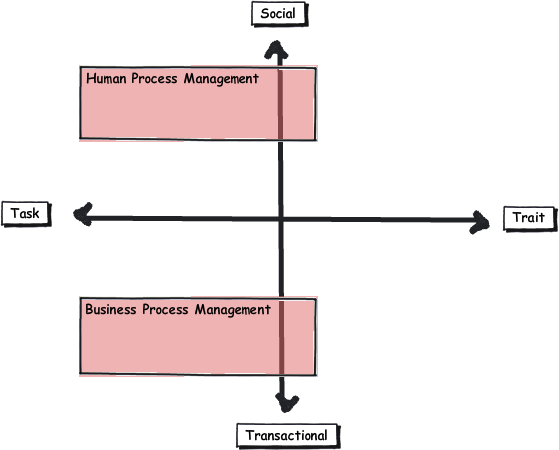
Business Process Management v.s. Human Process Management

image

What does painting the Golden Gate Bridge and Business Process Management have in common? With both, you find that by the time you get to the end, you need to go back to the beginning again. I have personally seen organisations fill an office full of people and take literally years to define and then document key processes all in the name of various best practice frameworks or a regulatory requirement. They then find that, once a thick process manual is created, no-one actually follows it unless an auditor is watching or their performance-based remuneration is directly measured by adherence to it. Of course, I’m not the only one to notice this. In fact, the entire discipline of business process management has taken a bit of a battering in recent years.

If we consider a “process” as the means by which we convert inputs of some description into outputs, Business Process Management has long been the discipline that concerns itself with process optimisation. But in a pattern that is seen in all disciplines like Project Management and Business Analysis, someone will inevitably come along, tell you that you have it wrong or are not being “holistic” and invent a new term to account for your wrongness. In the case of BPM, we now have people arguing for various terms: such as Human Interaction Management, Human Centric Business Process Management, Non-Linear Business Process (thanks Sadie!) or Human Process Management. We will use the latter term, but they are essentially talking about the same thing.

So before we see an example Human Process Management (HPM), let’s review Business Process Management and see what the HPM fanboys are whining about.

Business Process Management

image

BPM is a structured approach to analyse and continually improve and optimise process activities. Process structure and flow are modelled via diagrammatic tools, allowing organizations to abstract business process from technology infrastructure and organisational departmental/jurisdictional boundaries. This abstracted view allows business to holistically examine process and increase their efficiency and respond rapidly to changing circumstances. This in turn creates competitive advantage.

BPM is often used within the broader context of process improvement methodologies such as Six Sigma (which if you have never read about it, will finally prove to you that all that high-school mathematics that you found mind-numbingly boring was actually useful). While BPM on its own provides excellent visibility of process via modelling them, Six Sigma also incorporates additional analytical tools to solve difficult and complex process problems. Thus, BPM and Six Sigma augment each-other, because process improvement efforts can be more focused via BPM modelling. Thomas Gomez, in an article entitled “The Marriage of BPM and Six Sigma", had the following to say:

“Without BPM, Six Sigma may flounder because executives lack the critical data needed to focus their efforts. Instead, the executives bounce all over the place looking for performance weaknesses, or they focus on areas where successful performance improvements provide only marginal results. With BPM, Six Sigma projects can pinpoint problems and address the underlying causes.”

But that is where the fun ends according to the BPM critics. BPM nerds have had to suffer the indignation of hurtful labels like “Sick Sigma” and stories of long term problems with innovation because of such initiatives. They cite examples such as  George Buckley of 3M, who wound back many of his predecessor’s Six Sigma initiatives.

"Invention is by its very nature a disorderly process. You can’t put a Six Sigma process into that area and say, well, I’m getting behind on invention, so I’m going to schedule myself for three good ideas on Wednesday and two on Friday. That’s NOT how creativity works."

Ouch! Its enough to make a BPM feel all flustered and defensive of their craft. Nevertheless the above quote echoes the main points made by BPM critics. That many processes are not structured, predictable or logical and therefore, BPM approaches force a structured paradigm when none necessarily exists (Mind you, many other methodologies do precisely the same). In an appropriately titled article “The H-Bomb of Business Processes: Humans”, Ayal Steiner makes a point that also cuts to the heart of tame vs wicked problems debate too.

“The modern idea of BPM stresses a well-defined business process as the starting point but this is not always the case. Therefore, in a project that involves new practices or a cross-functional learning among participants, BPM has always had a tough time dealing with the humans.”

The notion of the well-defined starting or ending point is one of the characteristics of a tame problem. Wicked problems are often characterised by poorly defined staring and ending points. In fact with a wicked problem, often participants cannot agree on what the problem is in the first place!

Critics like Steiner also argue that many roles within an organisation, tend to deal with more tacit, dynamic situations and as such spend a large amount of their work time performing collaborative human work, when compared to transactional business process work (knowledge workers is the prevailing label for this type of role). While the main area of benefit for BPM’s is its ability to increase the efficiency of a core business process, the sort of thinking required to re-think processes in a systematic manner involves collaboration and systems thinking (in other words, beyond the process in front of us and how it interacts and interrelates more broadly since the whole of the broader system is greater than the sum of its parts). This is a human-driven activity as it is based on humans collaborating and innovating.

Closer to SharePoint home, Sadie Van Buren noted this same distinction in May 2010 which was around the same time I started the development of my IA class.

Human Process Management

So if BPM is incomplete, enter Human Process Management (HPM). HPM is concerned with process that is not easily defined, nor well structured, where it is hard to prescribe the execution of the process based on some model of the business. With human process, it is generally known how to achieve an intended result, but each case is handled separately and requires tacit judgment (for both decisions and flow) as part of the process. There is not enough standardization between instances of the process that allows for a formal, complete and rigorous description of the process end-to-end.

The obvious downside of human processes, say the critics, is that they are far too fluid and dynamic to be made part of an Enterprise BPM system. As a result, these processes tend to be handled through email, which in turn contributes to information overload and poor information worker productivity – precisely why we look to tools like SharePoint in the first place! The implication of HPM is that we need to shift emphasis to tools and practices that help us deal with unstructured or ad-hoc processes (and the information created/used during that process) more so than tools that deal with the well-defined world of BPM.

To be fair to the BPM crowd, these above criticisms will be seen by BPM practitioners as naive, since from their point of view, the less structured side is simply a part of the entire BPM spectrum. They argue that critics do not properly understand the principles and philosophy of BPM in the first place (Agile and PMBOK defenders say essentially the same thing when defending from critics). Supporting this counterargument is a key theme for BPM success that is regularly emphasised. That is, the critical pre-requisite of clarity of purpose and shared understanding of the end in mind. Mohamed Zairi, in a paper called “Business process management: a boundaryless approach to modern competitiveness” stated:

“The achievement of a BPM culture depends very much on the establishment of total alignment to corporate goals and having every employee’s efforts focused on adding value to the end customer.”

Therefore the BPM crowd are arguing for the same human process that HPM base their criticism on. Developing a culture of alignment to corporate goals is very much a human process. Are the HPM fanboy criticisms well founded or is it more a case that some BPM guys forget about strategic goal alignment and optimise process in isolation?

What do the facets say?

Clearly, there is a natural tension between these two polarities of BPM and HPM and this often plays out in organisational life in how we collaborate to deliver organisational outcomes. While there have always been process nazis, the emergence of social collaboration platforms that do not have a great deal of formal structure (think tagging and folksonomies) has led to a great deal of debate and self examination in BPM circles and beyond. Understanding these traits is critically important on the use of SharePoint tools, because SharePoint – and in particular SP2010 offers features for both BPM and HPM aficionados. Putting the two together however might risk Robot Barbie scenarios.

Straight away, it seems that the transactional vs. social axis of the facets of collaboration neatly explain the Business Process Management (BPM)/Human Process Management (HPM) challenge. Both areas are concerned with producing an output or getting something done. Therefore I have drawn BPM and HPM leaning toward the task side of the model. HPM proponents argue that human process is unstructured or semi-structured, dynamic, intertwined and borderless, which fits in well with the task/social trait of process and insight. BPM naturally fits into the lower transactional half where inputs are well defined.

image


While I would agree with the assertion that many processes are ill-defined and rely on tacit knowledge to be completed, HPM proponents go further though. For example, Ayal Steiner who I quoted earlier, argues that “analysts are now realising that human processes account for 80% of the business processes carried out in most organisations”. That is a big call, in effect, arguing that the majority of workplace interactions occupy the social quadrants above. I disagree. From my experience, most organisational roles have extremely varying degrees of transactional vs. social collaboration and some roles are in fact dominated by transactional collaboration. Perhaps there is some confirmation bias going on here, where knowledge workers who put in collaborative systems tend to think that everyone are knowledge workers too.

Here is an example. Mrs CleverWorkarounds used to be a medical nurse. When I first showed her this model I asked her to describe where nurses would fit in terms of their collaboration. She indicated two areas.

  • Firstly, nurses are strongly linked by trait and transaction. This is because they all have a minimum degree of knowledge and skill. As stated in part 2, the key tell-tale sign of a role with transactional collaboration is how easily individuals performing that role can be replaced by someone else with similar experience at short notice. Supporting this, if a nurse is sick or unavailable, a replacement nurse can be called in to perform the same tasks.  Collaboration between nurses according to Mrs Cleverworkarounds is quite transactional as well. Routine and process consistency via tracking the status of patient care is a critical task – patient status is everything. Thus, data driven tools with version history and well defined inputs make this form of collaboration easier. In fact, Mrs CleverWorkarounds taught herself InfoPath and SPD Workflows because she was so convinced that automated forms with consistent audit trails via workflow would make her job easier.
  • Yet at the same time, the sort of collaboration between nurses and patients is completely different and highly social in nature. No process is going to govern the interaction between nurse and patient. The type of care and counselling to get someone well is going to vary the type of interaction. A broken leg is one thing, health problems from say – alcoholism is something else entirely. The latter has much deeper symptoms than just the illness as presented. Here the focus is on patient well-being and goes beyond status of meds, when doctors have visited or accurate handover notes from one nursing shift to another.

State machine workflows?

Interestingly, even seemingly well-defined business processes tend to have ad-hoc and dynamic aspects to them. When there is an exception to the standard process, those exceptions tend to be handled in a relatively ad-hoc, case-by-case manner. Microsoft developer Pravin Indurkar cited an example of a seemingly transactional purchase ordering system.

“Often the business processes contain a prescribed path to the end goal but then there are a lot of alternate ways the same goal can be achieved. For example, a purchase order can contain a prescribed path where the PO goes from being created, to approved, to shipped, and then to completed. But then there a multitude of other ways in which the PO can be completed. The PO can get changed, or back ordered or cancelled and then Reopened. All these paths must be accounted for.”

Indurkar studied the purchase order system of a small business and found that apart from the one standard traditional order fulfilment process, there were about 65 different variations on the same process depending on the nature of the order. This is when BPM diagrams start to get scary. If you think that this workflow below is scary, then be more scared. It is page 12 of a 136 page process!

image

Naturally, trying to hardwire such a large number of alternate paths is very difficult and traditionally, there were two ways in which this was dealt with;

  • Either the business process was hard wired to accommodate all the paths as shown in figure 1, which made the implementation of the business process extremely complex, brittle and hard to maintain.
  • The alternate paths are simply not dealt with and any situation of the ordinary was dealt outside the domain of the process. This meant that tracking and visibility were lost because people would create manual systems to track such out of the ordinary situations. The facet diagram below illustrates this:

image

In Indurkar’s article that I quoted with the purchase order example, he argued that the solution to this sort of problem was via state-based or state-machine workflows which SharePoint has supported in a basic fashion, out of the box since SP2007. This kind of workflow, if you are not aware, is when the workflow waits for one or more events to move it into another state. There is no sequence as such, because this new target state can be any of the defined states in the workflow. This makes state workflows reflect the unpredictable nature of process variations.

Thus, it could be argued that BPM is not incomplete as what the HPM fanboys think, but that critics have a less than holistic understanding of the craft?

Conclusion: A Process Analysis Tool…

To be honest, I don’t want to answer the question of which fanboy is right because it is a bit of a zero sum game. When you think about process, many seem to have elements of transactional and social in them (just like job roles). For example, an “Approval” decision diamond in a business process diagram will determine the path a process takes. Apart from stating the fact that this process is a gateway where a decision is made, this says nothing about whether the activity of making that decision is transactional or social. In some processes the decision may be made by a rigorous data driven process (like a point-score based credit check for a loan applicant). In others it may be on gut feel (such as choosing the right applicant for a job position).

So to me, whether you are the most regimented process nazi or the most cowboyish non-conformist hippie, modelling a business process according to its ratio of transactional to social facets is probably very useful indeed to complement a BPM model. It help us understand how much tacit judgement is required in a given process and whether modelling every variation in a sequential workflow is worthwhile. Check out some examples on how this could be done below. In first example on the left, a business process where the majority of the steps are performed by tacit judgement might look like something like how I have drawn, with a task based social dominance. If the process in question indeed looks like this, then attempting to document every minute variation on the paths the process can take might not be worthwhile. Perhaps documenting the broad process (within the constraints of any compliance regime requirements) might be a better idea. In the second example, the process seems to be oriented around a repeatable set of choices (task based transactional dominant). As a result it may be worthwhile formally documenting these variations.

image  image

By combining these “process diagnostics” with the actual diagram, we might now offer additional insights into how the organisation really works with a certain process and do crazy stuff like produce something akin to my mockup below:

image

Hell, throw in a RACI chart and now you start to see process accountabilities as well!

image

Of course, you could always remove the task/trait axis if it is not needed and simply use a sliding scale. Nevertheless, what this shows is that the facets of collaboration model offers an extra dimension to any process being modelled and would help many to better understand the nature of the process being modelled, as well as strategies for improving that process via SharePoint.

Thanks for reading


Paul Culmsee

www.sevensigma.com.au

p.s If you are a real trainspotter/glutton for punishment and want to dive deeper, google “Human Interaction Management” and “Role Activity Diagrams”


« Previous PageNext Page »

Today is: Tuesday 19 May 2026 -