Back to Cleverworkarounds mainpage
 

Confessions of a (post) SharePoint Architect: Don’t define “governance”

Hi all and welcome to the second post of a series that I have been wanting to write for a while. In this series, I am going to cover some of the lesser considered areas of being a SharePoint architect and by association, key aspects to SharePoint governance. In the first confessional post I alluded to the fact that a good SharePoint architect also need to architect the right conditions for SharePoint success. As I work through this series of articles, I will elaborate further on what those conditions are and how to go about creating them.

To do this, I am drawing from my non IT work as a Dialogue Mapper and facilitator, and where applicable, will cover these case studies to see if they give us any insights for SharePoint. I also hope to dispel some common myths and misconceptions about SharePoint project delivery in organisations. Some of these might challenge some notions you hold dear. But for the most part, I hope that many of you reading this find this material to be instinctively compatible with what you have already come to believe. If you are in the latter group and feel as if you are an organisational agitator, this just might give you that rigour and ammo that you need when getting through to the powers that be. Better still, tell them to read this series and let them decide for themselves.

Backstory: Ackoff and f-Laws
image

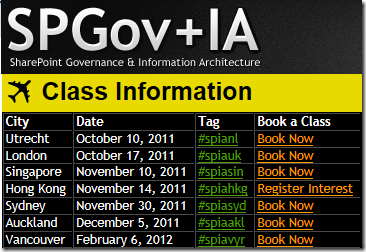
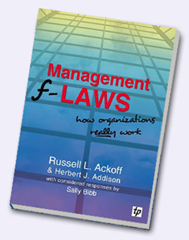
For what it’s worth, a fair chunk of this material comes from my book, as well as the first module of my SharePoint Governance and Information Architecture class that I run a few times a year in various places around the world. When I designed that class, I was inspired by Russell Ackoff, who co-wrote a funny and highly readable book called “Management f-LAWS: How organisations really work”. F-Laws were defined as:

“truths about organisations that we might wish to deny or ignore – simple and more reliable guides to everyday behaviour than the complex truths proposed by scientists, economists, sociologists, politicians and philosophers”

In case you hadn’t noticed, if you remove the hyphen, each f-law become a flaw. You could also consider them as #fail laws. Years ago, I laughed and at the same time, inwardly cringed when I read each f-Law that Ackoff and his co-authors had come up with. I came to realise that SharePoint problems are simply a microcosm of broader issues that plague organisations. If you read Ackoff’s book (and I highly recommend it), you will soon realise that the word “Management” could easily be substituted with “SharePoint” and it doesn’t take much to come up with a few of your own f-laws. This is exactly what I did and at last count, I have 17 of them. In this post, I will detail the very first one.

F-Law 1: The more comprehensive the definition of governance is, the less it will be understood by all

The first condition that I need to design as a SharePoint architect is to put to bed the many misconceptions about SharePoint governance. In this f-Law, I state that the more you try and define what SharePoint governance is, the less anybody will actually understand it. If you consider this counter-intuitive, then let me take it even further. For any project that has a change management aspect (SharePoint projects often are), definitonising not only doesn’t work, but it is actually quite dangerous to your projects health.

To explain why I have come to this conclusion, I’d like to tell you a little story from my non IT work. Several years ago, I was working in a sensemaking capacity with an organisation to help them come up with a strategic plan and performance framework for a new city. This was not a trivial undertaking. The aim was to create a framework with an aligned set of KPI’s to realise the vision for what the city needed to be in the year 2030. While the vision for the city had been previously agreed and understood, the path to realise that vision had not been.

Now if you have ever been involved in strategic plan development, and think that working out your corporate strategy is difficult, I have news for you. Aligning an organisation to a 3 year plan is one thing. Working with a diverse group to determine performance measures of a future city 25 years away is a different thing altogether. I never realised at the time we did this work, just how unique and (dare I say) “cutting edge” it was. Participants were highly varied in skills and areas of interest, and to say each had their own world-view was an… understatement to say the least.

I my book I describe this case study in detail but for the sake of post size, let’s just say that the opportunity to do this work arose from a failed first attempt to create the framework. The first time around an excel spreadsheet was projected onto the wall that looked like the example below. Attempts were made in vain to fill in the strategic outcomes, strategic objectives, key result areas, key performance indicators and measures. After a frustrating few hours of trying this approach, we gave up because participants spent all of their time arguing over the labels and got bogged down in a tangle of definitions and ambiguous terminology. Was it a KPI (Key Performance Indicator) or a KRA (Key Result Area)? Was it a Guiding Principle or a Strategic Objective? Was it a KRA or a Critical Success Factor?  Attempts to resolve this issue with definitions got nowhere because even the definitions could not be agreed upon.

image

In the end, we solved this issue via a rather novel use of Dialogue Mapping along with a problem structuring approach outlined in a book called Breakthrough Thinking. If you’d like to know more on how it was done, then take a look in chapter 12 of the Heretics Guide.

The criticality of context…

The core problem boiled down to context – or lack of it. What I learnt from this is that in situations without a shared context (and the wrong tools to deal with it), we fall back to using definitions to try and fill the gap. When faced with a blank spreadsheet and just some labels, participants attention was fixated on the definitions of the labels, rather than the empty cells where the focus needed to be. This resulted in a bunch of long winded discussions about what terms meant. This seriously stymied efforts aimed at making progress.

I have since performed many workshops, both SharePoint and non SharePoint ones and the pattern is clear. In fact I contend that if you proceed down the road of trying to build context via definitions for complex problems, one of three things will happen.

  1. The definition becomes more verbose. There are a couple of reasons for this:
    • – The definition is expanded to incorporate new aspects of the topic space. In an organisational setting, this creates confusion because the definitions of multiple disciplines can often seemingly contradict each other and thus, careful “wordsmithing” is required to navigate a path through it.
    • – New qualifications or exceptional situations have to be excluded. This leads to more new terms being used in the definition.
  2. As a result of #1, a broader, fundamental definition is developed. This broader definition encompasses more and so is prone to motherly sounding platitudes. Further, such definitions also run the risk of being interpreted in ways other than the one intended by those who worked so hard on the definition.
  3. As a result of #1 and #2, a new word is used or an existing word is used in a new context to try and convey the new meanings or concepts proposed. I have heard governance described as “stewardship”, “risk management” and (guilty as charged), “assurance”.

The effect of this can be far reaching in a bad way because definitionising has a habit of blinding people to what really matters. This leads to terrible project decisions being made up front that have serious consequences. To understand why, consider the image below:
Snapshot

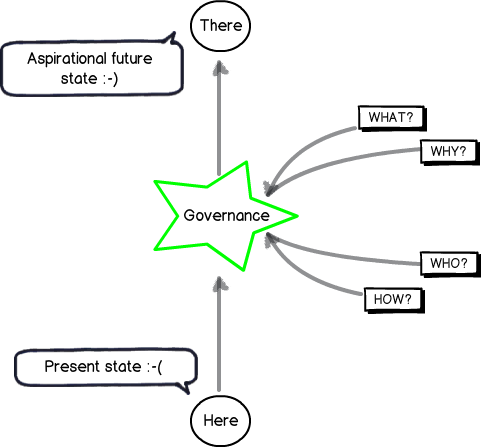
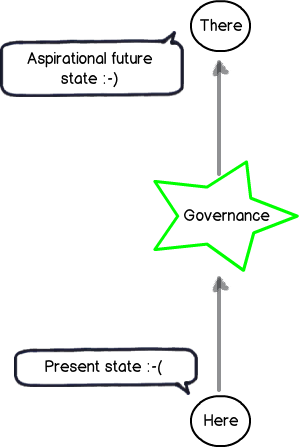
This image represents how governance of a SharePoint project should be viewed. A SharePoint initiative takes time and effort which costs money. We presumably have recognised that the present state is lacking in some way and want to get to somewhere better – an aspirational future place (if you look closely in the left above image note the happy and sad smilies). Accordingly we accept the cost of deploying SharePoint because we believe it will make a positive difference by doing so. If this was not the case, you would be wasting your time and resources on a pointless initiative. Therefore, it is the difference made by the initiative that will tell you if you have succeeded or not. As a result, we have to have a shared context on what that aspirational future looks like!

Don’t confuse the means with the ends…

Governance is, therefore, the means by which you will achieve the end of getting to some better place. It is informed by the end in mind and this is why I drew it in the star in the middle of the above diagram. For example; If the end in mind was compliance, then I will govern SharePoint a heck of a lot differently than say, if the end in mind was improving collaborative decision making.

But consider the diagram below. In this context, it should be clear why working from a definition of governance is often problematic. It implies that:

  1. Governance is not being informed by the end in mind;
  2. Your team do not have a shared understanding of what the end in mind actually looks like.

When this happens, project teams rarely realize it and respond by substituting the end with the means. We overly focus on governance via definition without any clarity or context as to what the aspirational future state actually is. Like the example of the blank spreadsheet example I started with, reality starts to look more like the diagram below: (note the happy smilie is gone now)
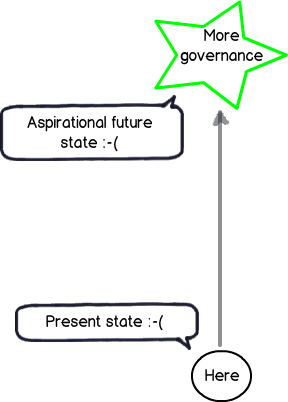
Snapshot

Steering…

So how do we steer out of this definition pickle? Interestingly “steer” is a appropriate choice of word if we look at the origin of the word “Govern”. This is because “Govern” is a nautical term from Latin and actually means “to steer”. So if your SharePoint project has been more like the Titanic, and hit a giant iceberg along the way, then clearly you need to focus your governance efforts to looking at what is in front of you, rather than scrubbing the deck or keeping the engine room well oiled. The latter tasks are important of course, but you can do all that, still hit an iceberg and waste a lot of money.

To steer, we all have to understand what the destination is, or at the very least, all agree on the direction. To help you with that journey, consider my final diagram. To steer SharePoint the right way for your organisation requires you to answer four key questions:

  1. What is the aspirational future state and what does it look like?
  2. Why is this the aspirational future state we want?
  3. Who will do what to get us to that state?
  4. How will we get to that state?

Snapshot

The fundamental problem with most SharePoint projects is that questions 1 and 2 are not answered sufficiently, if at all. The next few posts will explore why this is the case, but in the meantime, remember that we could do a SharePoint project that is to scope, time and cost, yet still have no user up-take if we are solving the wrong problem in the first place. Therefore remember that:

  1. Governance is a means to an end, and not the end in itself.
  2. We shouldn’t undertake a “SharePoint governance” project, or consider “SharePoint governance” as deliverable on a project plan. The act of developing a shared context of what the problems are and using that to always steer the governance decision making is paramount. Failure to do this and and your best plans will not save you.

Conclusions and coming next…

This is the second post on what will be a large series – possibly the largest series I have written so far. In the next post in this series, I will continue into our journey of SharePoint governance mistakes and along the way, start to identify what we can do to better answer the “What”, “Why”, “Who” and “How” questions. If you enjoy this series, then consider signing up to one of my classes if one is running in your neck of the woods.


Thanks for reading

Paul Culmsee

www.sevensigma.com.au

www.hereticsguidebooks.com


Confessions of a (post) SharePoint Architect: Midwives versus doctors

Bjørn Furuknap you have gone too far this time! There I said it.

On behalf of the SharePoint community, I feel that someone needs to speak up about your reprehensible behaviour, so I have taken it upon myself to right the wrongs that you so needlessly inflicted onto the community. You see, Bjørn has gone and written a non controversial post on the confused role of the SharePoint architect. I am extremely concerned about this abrupt change of behaviour and worry about the example he is setting for the young and impressionable members of the SharePoint community. If Bjørn keeps going down this rational road, then he will make the rest of us look irrational and tip the delicate balance of the SharePoint blogging ecosystem into unknown territory. In other words, we will lose the excuse of “Well, at least I’m not as nuts as Furuknap!”

That said, I have been meaning to write about insights from my life as a (post) SharePoint architect anyway. I have a few of my own lessons learnt and Bjorn has inspired me to finally get a few written down. So in this preamble post, and in a forthcoming series on common SharePoint governance mistakes, I will give you a dose of the opinionated world according to Paul, but I will back it up with some juicy references that you can check out for yourself if you are that way inclined.

Why (post) SharePoint Architect?

You might be wondering why I referred to myself as a “post” SharePoint architect. Unfortunately its hard to answer this question without sounding self-indulgent so I will keep it brief.

In 2007, I got my first non IT gig in a highly complex urban planning project. I had no contribution to make in terms of technical or discipline knowledge to this project at all. My job was to enable others to develop a shared understanding on a highly complex problem they all faced, to enable shared commitment to a course of action. Since that time, this non IT side of my work has continued to grow in terms of number of clients and the scale of the problems being tackled. Like any skill, I have gotten better with practice, which in turn has led to larger and more complex scenarios.

This year in particular, I’ve helped the executive teams of several large organisations re-find their purpose, realign their strategy and make some very difficult and courageous decisions in redesigning their organisations. Just to be clear, we are not talking SharePoint and we are not talking IT. I am talking about how these organisations adapt to changing conditions that, in some cases, affect their very existence. These organisations span the public and private sector across Australia.

From a SharePoint perspective, you could say I have moved from the server room to the meeting room and now to the boardroom. In spite of my self-indulgence warning earlier, you have to admit – this is damn cool!

Who’s misunderstood anyway?

So with that little preamble done, let me return to Bjørn’s post. He feels the SharePoint architect role is misunderstood and I agree with this, but in a different way. I feel the core issue is that SharePoint architects themselves are often the ones who misunderstand what they need to do and how they should go about it. This in turn manifests in the rest of the world not understanding what they ought to be doing.

To elaborate on this contention, let’s meet the four most common SharePoint architect stereotypes that I see in organisations:

The SharePoint architect who used to be a developer

This stereotype comes in two flavours. The alpha developer who had attained top dog status among peers via bluffed programming prowess, or the developer who always struggled and finds that this is a way to get out of hands on coding. Either way, this person still lives through the SharePoint object model. They will focus on ensuring that there are unit tests, solid source control and solutions packaging regime. Utilising the object oriented view means that metadata is king and folders are to be despised. They will not think twice about utilising content types in any situation because it is completely obvious that you would work this way. Their information architecture will be a work of art, and they are not shy in telling everyone so. To sum up, their SharePoint solutions will be logical, well coded to defined standards and completely useless to users.

The SharePoint architect who used to be an infrastructure guy

This stereotype tends to bewilder clients and colleagues alike with a seemingly endless set of options and considerations that need to be made up front. It is likely this architect will introduce SharePoint via the pie/frisbee diagrams, but discussions will focus on architecting for scalability, security and fault tolerance. This architect will likely mandate strict governance rules on those cowboy developers, untrustworthy site admins, and downright scary users to ensure that the environment remains pristine. Accordingly, SharePoint Designer will be outlawed – it’s so obvious that one shouldn’t even be asking why. Any burden imposed by these governance rules will be seen as a necessary evil and will be addressed by mandatory user training and besides, the next SharePoint version will definitely address the gaps. Their solutions will be scalable, architecturally sound and completely useless to users.

The SharePoint architect who thinks they are an enterprise architect

This stereotype – despite their obvious protests to the contrary – is the right brained equivalent of the infrastructure guy. This person absolutely gets off on making models because conceptual reality does not involve making any actual commitments. In fact as soon as there is any push to a commitment, they feel an irrepressible urge to resist and push everyone back into make-believe world. Over-utilising the line “Oh, I am business you see, not technical” as if it’s a sign of maturity, they will plan, plan and plan again, drawing many cool diagrams on whiteboards but never a task on a Gantt chart. The models they come up with are abstract, over-engineered and they always fall deeply in love with them. They won’t let anybody touch their models for fear of their abstract thing of beauty being messed with. The irony is that the basis for their models will actually be underpinned by some solid theoretical frameworks. Unfortunately, this person actually doesn’t understand them in any depth, but the terms used sound really cool. Their solutions will be … Wait, who am I kidding? They won’t have any solutions because they plan forever…

The SharePoint project manager who thinks they are an architect

This stereotype is arguably the most dangerous of the lot because they are driven by the need to “Get Things Done Now!” whether those “Things” make sense or not. Consequently, they jump into solution mode without a full understanding of the real problem the business is facing. Scope documents, plans, schedules and Gantt Charts abound, but the chances are that all these are geared towards solving the wrong problem. Talking to annoying stakeholders just gets in the way of the scope statement and besides, that’s what Business Analysts are put on this earth to do anyway. Their solutions will be built to time and cost, but completely useless to users.

“Let’s drill halfway…”

Bjørn also spoke of architects needing breadth of knowledge over depth of knowledge. This is completely true, but is not the full story. You see, there is a common bad habit that our stereotype architects often make; a bad habit that is in common with many other consultants who end up doing damage to organisations.

Irrespective of their breadth of knowledge or otherwise, these architects act like doctors prescribing remedies. They breeze into organisations, making sweeping statements that contain cool sounding maxims like “business value.” Then, using their clearly superior intellect based on years of experience and that cherished breadth of knowledge, they assess the organisational symptoms and prescribe the appropriate SharePoint medicine to address them.

I can hear it now… “Got an organisational headache? Just take this SharePoint content-type three times a day and see me if pain persists.”

I’m sure people can see the obvious problems with this approach (If you can’t then you are in the wrong business – seriously). One of the many issues is that organisational symptoms are often just visible manifestations of deeper underlying issues. The late, great Russell Ackoff once stated that you would not use brain surgery to cure a headache, despite the pain being felt in your head. Instead you would take a pill, even though there appears to be no direct relationship between the pill and the pain being experienced. Ackoff mused that organisations routinely use brain surgery for their headaches and tools like SharePoint are the blunt instrument of choice to do the drilling. Add to this, the technical complexity of SharePoint means that brain surgery has to happen in discrete phases.

“Okay guys we don’t have enough budget for this, so let’s drill halfway into the skull for phase 1.”

The SharePoint midwife…

SharePoint architects have to understand that the solutions they architect are actually not for them. “Gee Paul that’s profound,” I hear you say sarcastically. While this statement might sound obvious, why is it that many architects exhibit behaviours that contradict it?

If you want to know why this happens I suggest that you read part 1 of the Heretics book. But rather than rehash that here, let’s see what we can learn about problem solving from the insights of Horst Rittel and Ron Heifetz. In case you are wondering, no they are not SharePoint MVPs. Rittel coined the term “wicked problem” and is highly influential in various fields due to his early insights into complex problem solving. Heifetz is well known for his work on the theory and practice of adaptive leadership: how to mobilise people through what he termed adaptive change.

Note: If you have not heard of the term “wicked problem”, then go and read this old post of mine. It’s assumed knowledge here…

Rittel stated that when solving problems, nobody wants to be “planned at.” Additionally, the knowledge required to solve a complex (wicked) problem never resides with a single person. Instead, there is a symmetry of ignorance (I love that term). Rittel characterised symmetry of ignorance as situations “where both expertise and ignorance is distributed over all participants and no-one ‘knows better’ by virtue of degrees or status.” Accordingly, the process of problem solving must involve those who are directly affected by the problem. These are the key stakeholders “living” the problem, rather than experts who “know” the problem theoretically. The aforementioned experts should guide the process of dealing with a wicked problem but not impose solutions. In Rittel’s words, the planner is the “midwife of problems rather than the offerer of therapies.” It is the group that must come up with the answers.

Ron Heifetz echoed Rittel in his advice to leaders. One key strategy of adaptive leadership is to give the work back. Heifetz warned that when a leader undertakes to solve a problem, the leader becomes the problem in the eyes of many stakeholders. The implication is that the leader also becomes the convenient scapegoat if the solution goes awry as blame can be attributed to the leader. Instead by placing work where it belongs—with employees responsible for doing the work—Heifetz argued that issues will be internalized and owned by the parties best placed to deal with them. The best solutions, he maintained, are when the people with the problem become the people with the solution.

Confessions…

Given what Rittel and Heifetz have to say, it should be little wonder that I feel SharePoint architects should not be doctors prescribing remedies. SharePoint is often an adaptive change because you are asking people to change their behaviours. Those architects (and management consultants) who act like doctors tend to find out fairly quickly that the solutions they so lovingly come up with do not always get traction. Therefore, as Rittel suggests, a SharePoint architect needs to be more of a midwife than a doctor. It’s the client who is giving birth to this thing and you are there to create the conditions for them to make that journey as stress free as one can. Who is the one who has to adapt and live with the result anyway? Certainly not the consultant.

For some, this comes at a cost to architect ego because architects often have to let go of their creations. An architect cannot revel in the glory of their masterpiece if those affected by it do not buy into it. It will have a crappy legacy no matter what the intent. In letting go, one has to accept that stakeholders will also have an incomplete world view and will make mistakes. Therefore as an architect, how about architecting not just the SharePoint platform, but architecting the conditions by which SharePoint is delivered.

An obvious condition is one of real collaboration among stakeholders (which when you think about it, is kind of important when putting in collaborative systems!) Another condition that should be there is one that allows people to fail forward. Assume that mistakes will be made, take away the blame and architect SharePoint to be resilient in the face of change instead of making it brittle. Create the environment conducive to co-creation by painting part of the picture and allow participants to fill it in. After all, the learning that occurs via the journey is often just as important as the result achieved.

My confession is that I often say to my SharePoint clients that it is inherently more efficient for me to transfer my knowledge of SharePoint to them, than for them to transfer their deep knowledge of their organisation to me. To do the latter would be highly inefficient for both my clients and me, and my clients would not have the same opportunity to build their own SharePoint competencies and adaptive capacity. At the end of the day, they architect a lot of the solutions. Sure… I might offer suggestions here and there, and I might nudge them when I feel they need to be nudged, but more often than not, I lay some core foundations and they are the ones who do a lot of the legwork.

So to conclude, while I agree with everything Bjørn said in his post, I think the real key to being a good SharePoint architect is to architect the conditions by which SharePoint is delivered, just as much as SharePoint itself. While being a midwife may not be as glamorous as being a doctor, the solutions delivered will have more staying power.


Thanks for reading

Paul Culmsee


I’m published in a PM Journal

Hi all

Just a quick note for those of you who are of the academic persuasion or who have an interest in research and academic literature. Kailash and I wrote a paper for the International Journal for Managing Projects in Business. The article is called “Towards a holding environment: building shared understanding and commitment in projects”. The paper is about how to improve shared understanding on projects – particularly at the early stages where ambiguity around objectives tends to be at its highest. While it covers a similar territory to the Heretics Guide, it covers some literature that we did not use for the book. Plus it is peer reviewed of course.

This paper presents a viewpoint on how to build a shared understanding of project goals and a shared commitment to achieving them. One of the ways to achieve shared understanding is through open dialogue, free from political and other constraints. In this paper (and in the Heretics Book) we flesh out what it takes for this to happen and call an environment which fosters such dialogue a holding environment. We illustrate, via a case study:

  1. How an alliance-based approach to projects can foster a holding environment.
  2. The use of argument visualisation tools such as IBIS (Issue-Based Information System) to clarify different points of view and options within such an environment.

This was my first experience with the peer review process of writing a journal paper. I have to say that, despite the odd bit of teeth gnashing, the review process did make this paper much better than it originally was. Of course, none of this would have even happened without Kailash. This was definitely his baby, and this paper would not exist without his intellect and wide-ranging knowledge.

Thanks for reading

Paul Culmsee

www.hereticsguidebooks.com


Warts and all SharePoint caveats in Melbourne and Auckland

image   image

Hi all

There are a couple of conferences happening this month that you should seriously consider attending. The New Zealand and Australian SharePoint Community Conferences. This year things have changed. There are over 50 Sessions designed to cater to a wide audience of the SharePoint landscape and the most varied range of international speakers I have seen so far. What is all the more pleasing this year is that aside from 20 sessions of technical content, the business side of SharePoint focus has been given greater coverage and there are over 20 customer case studies, which give great insight into how organisations large and small are making the most of their SharePoint deployments. This stuff is gold because it is what happens in the trenches of reality, rather than the nuanced, airbrushed one you tend to get when people are trying to sell you something.

My involvement will include some piano accompaniment while Christian Buckley hits the high notes Smile, and in terms of talks, I will be “keeping it real“ by presenting a talk called “Aligning Business Objectives with SharePoint“. I will also be running a 1 day class on one of the hardest aspects of SharePoint delivery: Business goal alignment. This is workshop is the “how” of goal alignment (plenty of people can tell you the “what”). If you are a BA, PM or recovering tech dude, do not miss this session. It draws a lot of inspiration from my facilitation and sensemaking work and has been very well received wherever I have run it.
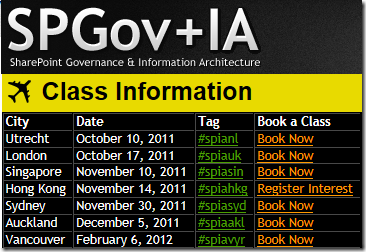
The other session I am really looking forward to is a talk called SharePoint 2010 Caveats: Don’t get caught out! Now anybody in SharePoint for long enough has learnt the hard way to test all assumptions. This is because SharePoint is a complex beast with lots of moving parts. Unfortunately these moving parts don’t always integrate the way they one would assume. Usually the result of such an untested assumption is a lot of teeth gnashing and heavily adjusted project plans.

I mentioned airburshed reality before – this is something that occasionally frustrates me, especially when you see SharePoint demonstrations full of gushing praise, via a use case that glosses over inconvenient facts. Michal Pisarek of SharePointAnlystHQ fame, is a SharePoint practitioner who shares my view and a while back, we both decided to present a talk about some of the most common, dangerous and some downright strange caveats that SharePoint has to offer. The session outline is below.

"Yes but…" is a common answer given by experienced SharePoint consultants when asked if a particular solution design "will work". One of the key reasons for this is that SharePoint’s greatest strength is one of its weaknesses. The sheer number of components or features jam packed into the product, means that there are many complex interactions between them – often with small gotchas or large caveats that were not immediately apparent while the sales guy was dutifully taking you through the SharePoint pie diagram.

Unfortunately, some organizations trip up on such untested assumptions at times, and in turn it can render the logical edifice of their solution design invalid. This is costly in terms of lost time to change approaches, but increased complexity since sometimes workarounds are worse than the caveats. In this fun, lively and interactive session, Michal Pisarek will put his MVP (not really) on the line, and with a little help from Paul Culmsee, examine some of SharePoint’s common caveats. Make no mistake, understanding these caveats and the approaches for mitigating them will save you considerable time, money and heartache.

Don’t miss this informative and eye opening session

Now let me state up front that our aim is not to walk into a session and just spent all of the time bitching about all the ills of SharePoint. In fact the aim and intent of this session was from the point of view of “knowing this will save you money”. To that end, if there is a workaround for an issue, we will outline it for you.

Now just about every person who I have mentioned this talk to, have said something along the lines of “Oh I could give you some good ones”. So to that end, we want to hear any of the weird and wacky things that have stopped you in your tracks. If you have any rippers, then leave a comment below or submit them to Michal (michalpisarek@sharepointanlysthq.com)

We will also make this session casual and interactive. So expect some audience participation!

Thanks for reading


Paul Culmsee

www.sevensigma.com.au

www.hereticsguidebooks.com


An opportunity to learn about aligning SharePoint to business goals in Vancouver

Hi all

Just a quick note to mention that I’m off travelling again, this time swapping 39 degree Celsius summer weather of Perth for somewhere between –6 to 5 degrees of Canada. I’ll be spending a week in Canada running two classes – one public and one private. The first class is a public SharePoint Governance and Information Architecture class running in Vancouver. MVP Michal Pisarek of SharePointAnalystHQ fame will be there and it should be a terrific two days of learning how to think a little differently to govern SharePoint strategy and deployment. You will learn a bunch of new skills, techniques and perspectives. Best of all, the skills learnt are applicable for many other types of complex projects.

The class flyer is here: http://www.sevensigma.com.au/wp-content/uploads/downloads/2011/02/SPIA.pdf

The registration site is here: http://spiavancouver.eventbrite.com/

In terms of course coverage and content it is worth noting the research performed by the Eventful group (who run the Share conferences). According to them, the hot topic areas for SharePoint are governance, user adoption, change management, information architecture and user empowerment. These sort of topics are the sort where plenty of people tell you what the issues are, but are typically lighter on what to do about them. This class covers why this is, as well as dealing with all of these areas and presents detailed strategies, tools and methods to address them. Furthermore, aside from the 500+ page manual of meaty governance goodness, as a take home, we supply a CD for attendees with a sample performance framework, governance plan, SharePoint ROI calculator and sample mind maps of Information Architecture.

At last count there were 5 places left for the Vancouver class, so if you have been pondering if it is a worthwhile class, check out some of the feedback from the class web site. Also, if you know anybody who might be interested in attending, please pass the course flyer and registration site details to them. We always end up with people who tell us “Ah – if only I knew about the class!!”

Thanks for reading

Paul Culmsee

www.sevensigma.com.au

www.hereticsguidebooks.com


Why SharePoint training sometimes doesn’t deliver (and what to do about it)

image

I was surprised to see the recent SharePoint Fatigue Syndrome post got some traction in the interweb. As it happened, that particular post was kicking around in an unfinished state for months. The thing is, its not the only “home truth” type of post that I have sitting in my “drafts” folder. I also have one on the state of the SharePoint training market. Given that I have a training announcement to make, I thought that I would combine them.

A day in the life…

We recently worked on a SharePoint upgrade project, where the previous developers did an excellent job overall. That is…if you judge them on the SharePoint governance metrics of writing clean and maintainable code, packaging it up properly, not hacking away at system files and actually writing documentation.

Unfortunately, although they did an excellent job through that lens, the actual solution, when judged on whether users found that it made their life easier, it was an epic fail. Users hated it with passion and like many solution that users hate, the system was soon relegated to being a little-used legacy platform where the maintenance costs now outweighed the benefits. The organisation had invested a couple-hundred thousand dollars on this solution and saw very little value for that money. Accordingly, they took their business elsewhere…to us. After a workshop, the client had one of those inverse “aha” moments when they realised that if they had taken a little more time to understand SharePoint, the custom solution would have never been developed in the first place.

This sort of example, to me, highlights where SharePoint governance goes so wrong. The care and diligence the developers exercised was necessary, but clearly not sufficient. No matter what the quality of the code, the unit testing regime and its packaging, at the end of the day a blueberry pie was baked and the client wanted an apple pie. The problem was not in the ingredients or the baking. The problem was that by the time they delivered the pie, it was clear that the wrong recipe was used. In the above case, the developer had omitted a whole raft of critical considerations in creating the solution – none of which were covered in developer training.

Necessary but not sufficient…

image

When you think about it, the current approach to SharePoint training seems not to be about recipes, but all about ingredients. Trainees get shipped off to “boot camps” for an indoctrination of all of the ingredients in the cupboard (and SharePoint is a bloody big cupboard!). SharePoint features and components are examined in individual detail, usually with an accompanying exercise or lab to demonstrate competency in that particular component. Graduates then return with a huge list of ingredients, but still no skills in how to develop the right recipes.

What exacerbates this problem is that training is siloed across disciplines. As an example: An “IT Pro” bootcamp will go into meticulous detail about performance, scalability and design aspects. Any considerations around development, information architecture and user engagement are seen through the lens of the infrastructure nerd. (Ah – who am I kidding… user engagement in an IT pro bootcamp has never happened. Smile)

Now consider for a second, how we design SharePoint sites. These days, it is common for people to actively discourage designing SharePoint solutions based on organisational departmental boundaries. (By organisational departmental boundaries I mean Marketing, HR, IT etc.) Why is this design approach frowned upon? Proponents claim that it tends to perpetuate  the problem of information silos and doesn’t stand the test of time, given that organisations tend to restructure just when your information architecture masterpiece is ready for prime time. In fact, the research organisation Jackob Neilsen did a study and found that task based structures (characterised by “My…” and “I need to…”) endured better than organisational based structures. Quoting from them:

In our study, task-based structures often endured better than intranets organized departmentally. In our user testing of intranets, we’ve also found that task-based navigation tends to facilitate ease-of-learning. Thus, the benefits for IA durability are just one more argument in favor of adopting a task-based structure for your intranet.

So what I find ironically funny is the second sentence of the Jackob Neilsen quote: “Ease-of-learning.” I wonder what sort of learning they are talking about? Presumably something other than delivering a failed solution with some really nice programming governance behind it! Yet the way SharePoint training is designed and marketed actually compartmentalises SharePoint training into similar silos. The result? Students get a rose coloured view of the SharePoint world, based on their discipline. This is because, as Ackoff brilliantly put it,  “complexity is in the eye of the beholder – the other persons job always looks simple”.

By the way, what I am highlighting is not the fault of the trainers because at the end of the day, they respond to what they think the market wants. Sadly, what the market thinks it wants is often not what it needs.

I feel that the missing link – and most critical aspect of SharePoint training for practitioners – is not about how many ingredients you know, but how you go about creating those recipes. Yet SharePoint training overly focuses on what each ingredient does in isolation – whether a job discipline or a particular component. Whilst I fully accept that knowing the ingredients is a necessity, it is clearly not sufficient. This is an airbrushed version of reality, without due consideration of how ingredients combine in unique scenarios. Accordingly, this training does nothing to teach how to achieve shared understanding between practitioner and the eventual users who have to live with the legacy of what is delivered.

When you think about it, shared understanding is what makes or breaks SharePoint success because it is the pre-requisite to shared commitment to a solution. As demonstrated by the example of great code underpinning a crap solution, lack of shared understanding and commitment will always trump any other good work performed.

What to do about it…

SharePoint is a product that often requires adaptive change on the part of users. Learning the capabilities of the product is one thing – changing entrenched collaborative practice is another altogether. In case you haven’t noticed before, users tend not to be charmed by new, shiny features if they cannot see how it will make their jobs easier. (Nerdy knowledge workers like you and me easily get seduced by shiny things but our world view is seriously skewed compared to those who live on the coal face of organisations). Thus, the skills required to facilitate change and align various roles, require a different type of training course: one that integrates rather than compartmentalises. One that teaches how to synthesise the whole, rather than reductionise into the parts.

For such a course, no virtual machines are needed because there are no labs to demonstrate competence in some SharePoint component that will be out of date by SharePoint vNext. Instead, such a course needs to focus on the concepts, patterns and practices that are typically not seen in the IT practitioners toolkit (and for that matter, not seen in many complex mainstream IT/PM methodologies). The added bonus for such a course is that the skills and learning’s it provides are applicable beyond SharePoint and even beyond IT itself. While a typical SharePoint might give you mileage for the current version, a course like what I describe will give you tools that you can use anywhere, irrespective of the technology and project.

Does such a class exist? (Is that the longest post you have ever read to get to such a rhetorical question? Smile )

Of course it exists – I’ve been running it around the world for a couple of years now. It’s called the SharePoint Governance and Information Architecture Class (#SPGovIA) and it was a year in the making and comes with lots of goodies, such as a CD with a sample performance framework, governance plan, SharePoint ROI calculator (spreadsheet) and sample mind maps of Information Architecture. The class was originally designed for Microsoft New Zealand, on behalf of 3Grow for the Elite program that used to certify gold partners for serious SharePoint competence. Since then its been run in the UK, Netherlands, US, Australia and New Zealand. Next month I will run classes in Singapore and Hong Kong.

For my US readers, early next year I will be taking the course on the road, specifically Canada and the USA in Feb 2012. This course is not run often, because for me the US is a damn long way to travel and my time is tight these days! So I sincerely hope that if this sort of class sounds interesting to you, then you will consider being part of it. Michal Pisarek has already made an announcement for classes in Vancouver, and more details will be forthcoming for one or two US cities. I only have time for 2 classes in North America, so which city should it be?

For more detail on the class, head on over to www.spgovia.com. While there, click the Media link and watch the first half hour of the class. I look forward to seeing you there.

image

Thanks for reading

Paul Culmsee

www.sevensigma.com.au


SharePoint Fatigue Syndrome

Hiya

I have been wrong about many things – I am happy to admit that. In SharePoint land, one of my bigger naive assumptions was that in early 2007, I figured I’d have maybe a 6 month head start before the rest of the industry began to learn from its initial SharePoint deployment mistakes and start delivering SharePoint “properly.” I thought that I’d better make hay while the sun shines, so to speak, as the market would tighten up as more players entered it.

Yet here we are, heading to the latter half of 2011 – some five years later. As I continue to go into organisations, whether in a SharePoint remedial capacity, or a training/architect capacity, I am still seeing the legacy of really poor SharePoint outcomes. Furthermore I am seeing other, frankly disturbing trends that leave me both concerned and pessimistic. I now have a label for this concern: “SharePoint Fatigue Syndrome.” SharePoint Fatigue Syndrome is hard to define, yet its effects are there for all to see. I suffer from it at times, and I am certain others do too. As an example, recently on the Perth SharePoint User Group on LinkedIn the following topic for discussion was raised:

Hi folks, as you already know we have a worrying skills shortage in SharePoint Development / Architecture in Perth and things are getting worse. It’s getting to the stage where companies have to suspend or worse still abandon their SharePoint projects due to lack of available talent. As the core of the SharePoint community in Perth your suggestions are vital towards finding real solutions to this growing problem. What can be done?

Now I know that this problem is not just limited to Perth. There are consistently reports online that speak of SharePoint people being in demand. So you would think that in a “hot” sector like SharePoint, where the industry is crying out for talent, that the rate of attrition would not outpace the uptake of new talent. After all – money talks, right? If you are a .NET developer with half a brain, there is serious money to be made in SharePoint development land. On top of that, there is the collective realisation in the marketplace that actually talking to people about how SharePoint could make their lives easier, leads to better outcomes. Hence the emergence of this notion of a “SharePoint Architect” with a more varied skill-set that just tech or dev. This role has further been legitimised by entire conferences now just catering to the business this end of the market (I am thinking the Share conferences here).

So, we have all of this newfound collective wisdom spreading through the community via various channels, in terms of the skills and roles required in SharePoint circa 2011 and beyond. We have the fat pay-packets being commanded as a result of demand for these skills. So, with that in mind, why is the attrition rate growing?

As an example, I know personally, several exceptional SharePoint practitioners who are no longer in SharePoint. I’ve also had various quiet conversations with many SharePoint practitioners, right up to SharePoint MCM’s, who vent their various frustrations on how difficult it is to get truly lasting SharePoint solutions in their clients and organisations. I’ve reflected on the various reasons I have come to the conclusion that SharePoint is just plain tiring. As a result, people are burning themselves out.

7 causes of SharePoint Fatigue Syndrome…

Burnout, in case you are not aware, is actually a lack of emotional attachment to what you are doing.  Quoting about.com:

The term “burnout” is a relatively new term, first coined in 1974 by Herbert Freudenberger, in his book, “Burnout: The High Cost of High Achievement.” He originally defined ‘burnout’ as “the extinction of motivation or incentive, especially where one’s devotion to a cause or relationship fails to produce the desired results.

SharePoint Fatigue Syndrome is SharePoint manifested burnout. The symptoms include feeling physically and emotionally drained, difficulty maintaining optimism and energy levels, feeling that you have less to give as the burden of work seems overwhelming. Sound familiar?

So why does SharePoint work run this risk? I see 7 major reasons.

1: Cost pressure leading to overwork

First up, the lure of the big dollar is a double edged sword. Not long ago I shared a beer with a SharePoint developer who’s work I respect greatly, yet I can’t afford to hire. This is because the percentage of chargeable hours he would need to work just so I can break even, is very high. This puts me (the employer) under pressure and at risk. As a result, I need to ensure that my newly minted SharePoint employee is productive from day 1 and I need him to work a lot of hours. But here is the irony. When I had my beer with this developer, the conversation started with him lamenting to me that he is already pulling ridiculous hours (60 to 80 per week). He was looking for a job with less hours and yet more money. This is simply not sustainable, both for employer and employee. The more you chase one (work hours vs. money), the more you lose the other it seems.

2: Structures that force an inappropriate problem solving paradigm (and wicked problems of course)

Then there is the broader problem where structure influences behaviour. As a basic example: from the developers’ perspective, they have to put up with sales guys who promise the world, and project managers who then make their life hell and force them to cut corners delivering the impossible. Project managers find out that their beloved work breakdown structure gets chopped and changed when their pain-in-the-ass developers whine that they can’t make the schedule. As I have stated many times previously, SharePoint project are likely to have wicked problem aspects to them. The structures that work well to deliver tame problems, such as Exchange, a VOIP system or a network upgrade, are much less effective for SharePoint projects. While organisations persist with approaches that consistently fail to deliver good outcomes, and don’t look at the structural issues, the attrition rate will continue. There is only so much that someone can take putting up with these sorts of stresses.

3: Technical complexity

SharePoint’s technical complexity plays a part too. No-one person understands the product in its entirety. The closest person I know is Spence and ages ago on twitter he remarked that even within Microsoft no-one understood it all. As a result, it is simply too easy to make a costly mistake via an untested assumption. (I thought the user profile service was tough – until I did federated claims authentication and multitenancy that is). The utter myriad of features, design options and their even greater number of caveats, mean that one can make a simple design mistake that causes the entire logical edifice of an information architecture to come crashing down. Many have experienced the feeling of having to tell someone that the project time and cost is about to blow out because nobody realised that, say,  Managed Metadata has a bunch of issues that precludes its use in many circumstances. Accordingly, SharePoint architects learn pretty quickly that it is hard to answer a definite “yes” to many questions, because to do so would require a question worded like a contractual clause, to ensure it is framed with appropriate caveats. Even then, consultants would know that lingering feeling in the back of their mind that they might have missed an assumption. This brings me onto…

4: Pace of change

This is BIG…and becoming more acute. Remember the saying ‘The only certainties in life are death and taxes?’ Outside of that, the future is always unpredictable.

In between SharePoint 2003 and SharePoint 2007, the wave of Web 2.0 and social networking broke, forever changing how we collaborate and work with information online (and some of those effects are still to be felt). Microsoft, like any smart organisation, responds to the sentiment of its client base. Microsoft also, like most mature organisations, tends to hedge its bets in terms of marketplace strategy in which it tries to get in on the act with the cool kids, yet tries not to kill the goose that laid the golden egg. Just look at Windows 8’s new interface, tablets, app stores and the cloud.

But that is one facet. Change happens in many forms and at many scales. For example, at a project level, it may mean a key team member leaves the organisation suddenly (SharePoint fatigue no doubt). At a global and organisational level, events like the odd global financial crisis force organisations to change strategic focus very quickly indeed.

I don’t know about you, but when Windows 8 was announced recently I was not excited (in fact I was not excited by SharePoint 2010 either). I thought to myself “So soon? I am still figuring out the current platform!”

As an example of the effect of pace of change, consider all the Government 2.0 initiatives around the world. Collaboration is in-vogue baby, so information should be free and government agencies should engage with the community. While that’s nice and all, there is the world of compliance, security and records management that takes a very different view. So, we end up with market forces that push against each other in combination with vendors hedging strategy of being all things to all people. It’s little wonder that SharePoint projects become very complex very fast.

By the way, it is worthwhile checking out what Bill Brantley in this post sums up the whole government 2.0 issue when he said:

What exactly is the nature of the Gov 2.0 challenge? This question was inspired by Andrew Krzmarzick’s post (What Gov 2.0 Needs Now: Managers, Money and Models) and Christina Morrison’s post (What is Gov 2.0? A survey of Government IT pros) on the recent GovLoop survey about Gov 2.0. As Andrew and Christina argued, the survey demonstrates many differing perspectives on Gov 2.0 in terms of what it actually means and how to implement Gov 2.0. To me, this suggests that Gov 2.0 is the classic wicked problem

5: SharePoint Entropy

One of my clients (who you will meet in my book when it’s published), once said to me “All good ideas eventually deteriorate into hard work.” This is a nice way to lead into the concept of SharePoint entropy, which in some ways is the inevitable outcome from the first four symptoms. The easiest way to understand entropy is to watch this awesome TV series called the “Wonders of The Universe.” In that show, the concept of entropy was discussed and for me made a lot of intrinsic sense. Without getting into the detail, entropy is the notion that over time things move from an organised to less organised state. Rather than have me waste your time trying to explain it in prose, let’s listen to the show in question. (Don’t skip the video – this is important!)

Now what does this has to do with SharePoint fatigue? Gordon Whyte saw what I am getting at with his post on entropy within organisations, especially in relation to change management.

For example, when we build a car we take raw materials such as metal, leather, plastic and glass and arrange them in a highly organised way to make a car. But if we then leave that car for long enough the metal will rust, the glass will become brittle and break and the leather will dry out and turn to dust. If the car is left for a very long time it will eventually disappear altogether. This thought left me wondering about the nature of organisations. If a progression from order to chaos is the natural order of the universe, then is this same pressure present in organisations and, perhaps more importantly, what is the optimum position for an organisation between the extremes of rigid inflexibility (low entropy) and complete chaos (high entropy)? This question is not as crazy as it might at first appear”

Gordon has nailed the issue in his post. Any SharePoint solution that has a low entropic nature requires more energy and effort to maintain that order and control. Complex SharePoint solutions often have complex governance wrapped around them. Governance that is process and structure centric by definition, has low entropy and accordingly, needs higher effort to maintain over time. In fact, if you do not maintain that effort and energy, then any SharePoint solution will usually disintegrate back into the sort of information management chaos that gave rise to SharePoint in the first place!  Rather like the sandcastle in the video.

By the way, I feel that email and file shares are high entropy solutions – all failed SharePoint projects lead back to these tools because they require less structure to maintain (in the short term).

In short, if SharePoint is implemented with low entropy, more energy is needed to maintain it. Remove the energy and very quickly, things become chaotic again. Governance approaches that are not cognisant of this will never stand the test of time. The question then becomes whether people feel that the end in mind is worth the perceived extra effort that is being asked of them.

6. Social complexity

Social complexity is also somewhat of a result of the first five symptoms. Most organisations have a blame culture. If they didn’t, then people wouldn’t spend so much time trying to position themselves for blame avoidance. Social complexity is the result of turf wars, ideological smackdowns and all of the other sort of things that result in the cliché of “the silos” where people are not talking to each-other in organisations. SharePoint exacerbates social complexity for two main reasons.

Firstly, because it is a collaboration tool, it actually requires some collaboration to put it in! This is often easier said than done. Secondly, because it is a pervasive and disruptive technology, it almost always clashes with an established tool, process or practice where proponents aren’t willing to change. In fact, they may not even recognise that there is a problem to solve – especially when SharePoint has been thrust upon them. (In an old post, I wrote about the notion of memeplexes and the ideological immune mechanisms that they create and why it is so hard to get shared understanding across departmental boundaries in organisations. Memetic smackdowns are the result).

The long and the short of social complexity is that there is only so much stress people can take. We all seem to have a pathological need to seek order and safety, rather then remain in a stressful situation. Once social complexity bites, the merry-go-round of staff attrition really starts to bite…

7. Meaning over motivation…

Now if I haven’t completely depressed you, let me offer you a perverse glimmer of light. For those of us who understand the preceding 6 fatigue symptoms, recognise them for what they are and take steps to mitigating them, there is one other symptom that contributes to SharePoint Fatigue Syndrome. This is the trickiest of all – and I am a somewhat willing victim of it.

I have spent a lot of time learning techniques to help address the symptoms I outlined here and as it turns out, these skills are universally applicable, whether in SharePoint, IT or beyond IT. For years now, I have metaphorically had one foot out of the SharePoint world door and the other foot into the world of construction, health and management sectors. Hell…I have written what I think is the first business book ever by a SharePoint person that is a non SharePoint and non IT. I also have clients with SharePoint deployments who do not know me as a SharePoint person at all, but only as a sensemaker (and for that I am grateful.)

The point is this: While the investment in these skills enables me to counter the effects of SharePoint fatigue syndrome, it is also inexorably pulling me away from SharePoint work. It seems that once you crack this nut a little, your skills are in demand across the entire problem solving spectrum. Right now this is my coping mechanism for SharePoint Fatigue Syndrome – I get to step away from SharePoint for periods and work on something else. Eventually…inevitably…I will also be one of those attrition statistics.

Conclusion:

The problem is that SharePoint Fatigue Syndrome is a negatively reinforcing cycle. As evidenced by the SharePoint attrition rate, money isn’t that great a motivator. If it was, then the void of skilled resources would have been filled by now. Paying more money might give you a short term gain, but in the long term is not going to address my seven causes of SharePoint Fatigue Syndrome.

I will leave this admittedly negative sounding post with the key to breaking this cycle. While you can attend my SharePoint Governance and Information Architecture class or Issue Mapping Class to learn many ways, the video below says it all. I encourage you to watch and reflect on it, because it’s the same key point to understanding how to do effective user engagement.


Thanks for reading


Paul Culmsee


Whatever you do, do not ignore legacy

On the twitterverse recently, someone stated that because of a problem of excessive SharePoint site sprawl, they were going to institute a new site approval process. On the surface this remedy seems to be perfectly reasonable. After all, there is a clear problem that has emerged and in the name of governance, we have taken steps to address it via this new process.

There is only one small problem with this. It’s probably the wrong thing to do or at best, a minor facet of what to do.

Before I explain why, consider another scenario that I am sure all of us have experienced. You have a problem so you call your bank, ISP or some other provider of services that you have paid for. You encounter an operator or customer service representative who seems hell-bent on closing your call at all costs, whether you think the problem is solved or not. Common examples of how this plays out is the oft used “well I will close this call and you can call back and log a new one if there is still an issue” line. A more subtle, yet equally frustrating one that even Microsoft have used on me is the “well you logged the problem as X, but in reality its Y. So you will need to close this call and re-log a new call for problem Y”.

The underlying reason for this is very likely that the performance of the person on the other end of the line is judged on time spent handling your call. The logic would be that the speedier a call is closed, means the less time users have spent on tech support, which indicates good outcomes for customers.

Alas, if only that were true. Anybody who has been on the receiving end of this sort of treatment knows full well that the opposite happens. As a customer, you get frustrated and pissed off. More dangerously for the organization, this sort of indicator conveys a warped representation of reality. Essentially the operator has altered their behaviour to maximise their performance according to this measure of “effectiveness”. Customers who are paying the money are not necessarily satisfied. In fact they are more often than not dissatisfied. Therefore, the notion that length of support calls somehow lead to happier customers is a fallacy. In the longer term, customers will tire of crappy outcomes and take their business elsewhere.

This success indicator is a mirage, and in actual fact contributes to the nastier, longer term problems of customers ending up with competitors.

So with that said, lets go back to our Sharepoint site sprawl issue. Before instituting such a policy, I ask the following simple question.

So why are there lots of sites?

Now there will be various reasons, but the most common answer I get back from this is:

Users don’t know any better.

This assertion is pretty easy to test too. Take a look at the sites in the wild west of a chaotic SharePoint install. Since most site templates in SharePoint have a single document library, it is common to see many hundreds of sites with a single document library in them. Clearly, people simply aren’t aware that they can do things like add more libraries or lists to a site or they are unwilling or unable to do so. I have experienced users telling me that if they had have known, they would have never created a site for a particular collaborative activity.

Side Note: SharePoint’s own attempts to be “intuitive” is the problem here. For a start, sites build navigation by default so people get duped into using sites to create navigational structure when its wholly inappropriate. Secondly, creating a new site is inferred as the right thing to do. To see why, go to the site actions menu and what is a default action there? You guessed it – create a site. SharePoint out of the box actually contributes to users forming this mental model of how SharePoint hangs together).

So clearly, many instances of excess site sprawl is symptomatic of something deeper. Users do not know that there are potentially better alternatives. This leads us to a somewhat rhetorical, yet critical question:

What does an approval process do about users not knowing any better?

Many times such approval processes shift the burden of creating the site to an authorised party like IT, after a requestor’s boss has given it the go ahead. Naturally, people will have to do more paperwork to get approval and it might take longer. Furthermore, maybe their request will be rejected under certain circumstances. But at what point will they learn that there is more to life than sub sites? Even after instituting the approval process, we still may end up with a heap of sites with a single document library in them. Have we really addressed the real issue?

Do you see the parallel? The sort of thinking that decided an approval policy is the answer to site sprawl is the same sort of thinking that decided that call times are a reliable indicator of customer outcomes being met. Both treat the superficial, visible symptoms of a problem, not the underlying cause. Furthermore, both end up leaving stakeholders with crappy outcomes in the longer term. Your support calls are still frustrating and you are still using SharePoint in a sub optimal fashion.

More scarily though is that we have deluded ourselves into thinking we have dealt with the problem. SharePoint governance is often built around this sort of superficial thinking. If a governance plan weighs as much as a door stop, and gets about as much attention as a door stop, then you might be making this mistake.

What about legacy?

This problem is more common than you think. There is a more systematic pattern of delusion that can happen in project management. Check out the diagram below.

image

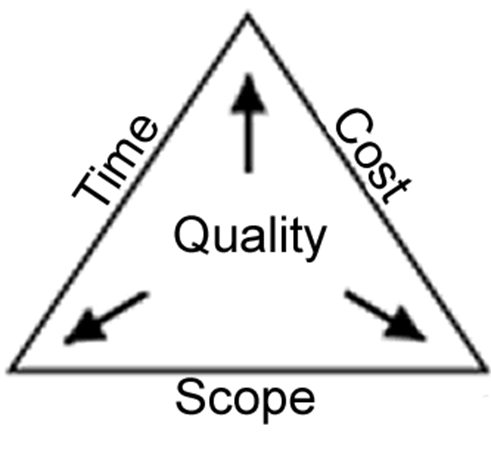
Seen this diagram before? It is very common on project management books and presentations. We have a pyramid that implying that to have quality, we have to have time, cost and scope balanced and understood. Like the site approval policy, this seems perfectly reasonable on the surface. But unfortunately, by its very nature can cloud us to what is really important.

Below is an example of a project output – the Sydney Opera House. During my classes, everyone recognises it and there is always someone who has been there. In fact people come to Sydney just to see it. In term of economic significance to Sydney, it is priceless and irreplaceable. the architect who designed it, Jørn Utzon, was awarded the Pritzker Prize (architecture’s highest honour) for it in 2003.

image

So I ask you the question:

Was this a successful project?

I ask this question to people all around the world and the answer is always a great big Yes. But if we look at this project through the lens of our quality triangle above, the view changes.

Why?

Well, here are a few fun filled facts about the Sydney Opera House.

  • The Opera House was formally completed in 1973, having cost $102 million.
  • The original cost estimate in 1957 was $7 million.
  • The original completion date set by the government was 1963.
  • Thus, the project was completed ten years late and over-budget by more than fourteen times.
  • Ultzon, the designer of the opera house never lived to set foot in it, having left Australia in disgust, swearing never to come back.

“Utzon soon found himself in conflict with the new Minister. Attempting to rein in the escalating cost of the project, Hughes began questioning Utzon’s capability, his designs, schedules and cost estimates. Hughes eventually stopped payments to Utzon. Unable to pay his staff, Utzon was forced to resign as chief architect in February 1966 and left the country never to return. Utzon has never seen the completed work that brought him international renown

Harsh huh? Clearly, when judged through the “quality” lens of time, cost and scope, this project was a unmitigated epic fail that makes SharePoint look like a walk in the park.

The example of the Sydney Opera House serves to remind us that when all is said and done, we judge quality across something deeper than time, cost and scope alone. That something is legacy.

People remember legacy, not scope

So when you look at the Opera house through the lens of the quality triangle, you are making the same mistake as the call-center KPI and the well intentioned site creation policy. You are taking a superficial view of things and in doing so, missing more subtle, but ultimately important factors. In fact you are treating symptoms and not looking for the “story beneath the story” that caused the visible symptoms in the first place.

Yet…

Why do we go to the time, effort and cost to put in tools like SharePoint? It is because we see that it can take us to a better place than we are now. After all, if we didn’t believe this fundamental truth, then we wouldn’t spend the that time and money working on it. This notion of a “better place” implies that we are trying to escape a legacy of the past – such as poor information management practices, inefficient process, silo organisations and so forth.

As illustrated by the Opera House example, people do not remember time, cost and scope. What they do remember acutely however is legacy.

So what is a more reliable indicator of quality? Who visits the Opera house and takes a photo of it because it was such a breathtakingly bad example of project management 101? No, they take their photo because it is unique, has value and people want to experience it for themselves. Its the legacy that they remember, cherish and want to be a part of.

As a result, there is a critical lesson here for all SharePoint practitioners (from the nerdiest of nerds to the hippiest of web 2.0 pundits). Ask yourself, “what legacy is my governance actions going to leave”, because if you fail to consider the legacy of your approaches to SharePoint delivery, you are probably dooming your organisation to the very same legacy you wanted to escape in the first place!

And that’s just tragic.

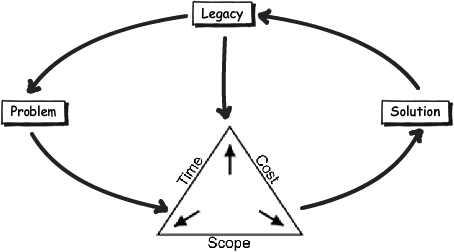
So I think that PM 101 diagram needs to be redrawn because it misleads – especially for complex, adaptive or wicked problems. To me, considering time, cost and scope without legacy is delusional and plain dumb. Legacy informs time, cost and scope and challenges us to look beyond the visible symptoms of what we perceive as the problem to what’s really going on.

image

When I get time, I will post several examples of how I was able to utilise this sort of thinking in a future post, but I hope this gives you some food for thought.


Thanks for reading


Paul Culmsee

www.sevensigma.com.au

www.spgovia.com


Seattle (and Bend) here we come!

Hi all

Just a quick post to let you all know that in around 11 hours I’m off on a long flight back to US shores – my first trip for quite some time. We will be in Seattle, Portland, Bend, San Francisco and Napa. I am really, really looking forward to this trip for a number of reasons.

  • Its my first ever SharePoint Governance and Information Architecture Class in the US and I intend to deliver a knockout class. The class has essentially sold out (at the time of writing one remaining place looks like its about to be filled). Erica Toelle has been absolutely brilliant, has placed a lot of faith in me and I do not intend to let her, or any of the attendees down.
  • I’m also speaking at the Seattle SharePoint User Group in early May 5th (with Ruven) and also speaking at the Bend SharePoint User Group on May 9th, both on some SharePoint Governance Home Truths. I don’t get to the US very often and that is not going to change anytime soon, so I suggest you don’t assume you can wait till next time, because that may be a while! If you know someone who needs a bit of an intervention or some governance “deprogramming”, then send them my way! Smile
  • A major, major milestone this year has been achieved. My Beyond Best Practices book is finally complete! I am super excited by this book too. I think we have really delved into areas that no other book has really done in terms of collaboration and dealing with complex, difficult to solve problems. We are sorting out publishers so hopefully there will be some face to face meetings when I am in San Francisco and I will be able to give you some relatively firm dates on when it might grace a bookshelf, iPad or Kindle. (I’ll cover some stuff from the book in the Seattle class).
  • I’ll have an opportunity to catch up with the likes of Erica Toelle, Ruven Gotz, Christian Buckley, Bill English, Jeff Conklin and a number of other people who I rarely get to see “in the flesh”. Maybe there is time to squeeze in another musical collaboration with Mr Buckley eh?
  • Best of all, my family is coming with me and we are taking a holiday while we are here – wohoo!

So if you are in Seattle between May 1-7, or the Bay Area between May 10-13, get in contact!

See you soon!

Paul


Seattle is go! SharePoint Governance and Information Architecture class

For one night only USA…

Ah, Erica Toelle – what a legend! Thanks to Erica and Fpweb, I’m thrilled to confirm that the Seattle SharePoint Governance and Information Architecture class is all systems go. Save the date as its very likely indeed to be the only SPIA class in the USA in 2011.  If it wasn’t enough that Erica will be joining me, but Ruven Gotz will be there too.

Thursday and Friday, May 05-06, 2011. (http://spiaseattle.eventbrite.com/)

The location is the Silvercloud Inn, 14632 SE Eastgate Way Bellevue, WA 98004

Map picture

In this multimedia extravaganza of a blog post, lets take a closer look at this class and what you can expect. Below is a snippet of a talk I did in New Zealand called “SharePoint Governance  Home Truths”. This clip shows a little diagnostic test that I do on my audience, to see whether they have experienced the visible signs of wicked problems. If you want to know why you should go to SPGov+IA, then take my 2 minute test yourself.

Do you need SPGov+IA? Take the two minute test to find out…

If the two minute test has taken your fancy, then you might want to see what is in store on the course itself. Below is the first half-hour of module 1 (in the form of a conference session), as well as the accompanying slide deck.

image 

View more presentations from paulculmsee

Course Information:

imageDownload Course Outline (PDF)

Download Class Flyer (PDF)

Most people understand that deploying SharePoint is much more than getting it installed.  Despite this, current SharePoint governance documentation abounds in service delivery aspects. However, just because your system is rock-solid, stable, well-documented and governed through good process, there is absolutely no guarantee of success.  Similarly, if Information Architecture for SharePoint was as easy as putting together lists, libraries and metadata the right way, then why doesn’t Microsoft publish the obvious best practices?

In fact, the secret to a successful SharePoint project is an area that the governance documentation barely touches.

This Master Class pinpoints the critical success factors for SharePoint Governance and Information Architecture and rectifies this blind spot.  Paul Culmsee’s style takes an ironic and subversive view on how SharePoint Governance really works within organizations while presenting a model and the tools necessary to get it right.

Drawing on inspiration from many diverse sources, disciplines and case studies, Paul Culmsee has distilled the "what" and "how" of governance down to a simple and accessible, yet rigorous and comprehensive set of tools and methods that organizations, large and small, can utilize to achieve the level of commitment required to see SharePoint become a successful part of your enterprise.

Some workshop sessions are hands on, we provide all of the tools and samples needed but please bring your own laptop.

Course Structure:

The course is split into 7 modules, run across two days.

Module 1: SharePoint Governance f-Laws 1-17:

Module 1 is all about setting context in the form of clearing some misconceptions about the often muddy topic of SharePoint governance. This module sheds some light onto these less visible SharePoint governance factors in the form of Governance f-Laws, which will also help to provide the context for the rest of this course

  • Why users don’t know what they want
  • The danger of platitudes
  • Why IT doesn’t get it
  • The adaptive challenge – how to govern SharePoint for the hidden organisation
  • The true forces of organisational chaos
  • Wicked problems and how to spot them
  • The myth of best practices and how to determine when a “practice” is really best

Module 2: The Shared Understanding Toolkit – part 1:

Module 2 pinpoints the SharePoint governance blind spot and introduces the Seven Sigma Shared Understanding Toolkit to counter it. The toolkit is a suite of tools, patterns and practices that can be used to improve SharePoint outcomes. This module builds upon the f-laws of module 1 and specifically examines the “what” and “why” questions of SharePoint Governance. Areas covered include how to identify particular types of problems, how to align the diverse goals of stakeholders, leverage problem structuring methods and constructing a solid business case.

Module 3: The Shared Understanding Toolkit – part 2:

Module 3 continues the Seven Sigma Shared Understanding Toolkit, and focuses on the foundation of “what” and “why” by examining the “who” and “how”. Areas covered include aligning stakeholder expectations, priorities and focus areas and building this alignment into a governance structure and written governance plan that actually make sense and that people will read. We round off by examining user engagement/stakeholder communication and training strategy.

Module 4: Information Architecture trends, lessons learned and key SharePoint challenges

Module 4 examines the hidden costs of poor information management practices, as well as some of the trends that are impacting on Information Architecture and the strategic direction of Microsoft as it develops the SharePoint road map. We will also examine the results from what other organisations have attempted and their lessons learned. We then distil those lessons learned into some the fundamental tenants of modern information architecture and finish off by examining the key SharePoint challenges from a technical, strategic and organisational viewpoint.

Module 5: Information organisation and facets of collaboration

Module 5 dives deeper into the core Information Architecture topics of information structure and organisation. We explore the various facets of enterprise collaboration and identify common Information Architecture mistakes and the strategies to avoid making them.

Module 6: Information Seeking, Search and metadata

Module 6 examines the factors that affect how users seek information and how they manifest in terms of patterns of use. Building upon the facets of collaboration of module 5, we examine several strategies to improving SharePoint search and navigation. We then turn our attention to taxonomy and metadata, and what SharePoint 2010 has to offer in terms of managed metadata

Module 7: Shared understanding and visual representation – documenting your Information Architecture

Module 7 returns to the theme of governance in the sense of communicating your information architecture through visual or written form. To achieve shared understanding among participants, we need to document our designs in various forms for various audiences.

Putting it all together: From vision to execution

Attendees will be taking home a manual ~480 pages, containing the Seven Sigma Shared Understanding Toolkit CD with a sample performance framework, governance plan, SharePoint ROI calculator (Spreadsheet), sample mind maps of Information Architecture. These tools are the result of years of continual development and refinement "out in the field" by Paul Culmsee and have only been recently released to the public through this Master Class.

More Information:

Refund Policy:

No refunds will be issued for attendee cancellations once payment is recieved.  Class cancellation by the organizer will result in a refund less transaction fees.

image

http://spiaseattle.eventbrite.com/


« Previous PageNext Page »

Today is: Wednesday 3 June 2026 -