Back to Cleverworkarounds mainpage
 

BPC 09 August Wrap-up

It’s been quite some time since I have blogged, and the months of July/August were really pretty full-on professionally. High work demands and preparation for the Best Practices Conference meant that blogging and any sort of public work really took a back-seat.

So now that it is over and I am sitting here in an airport lounge reflecting, I have one word to say about the BPC 09 in DC that I just attended.

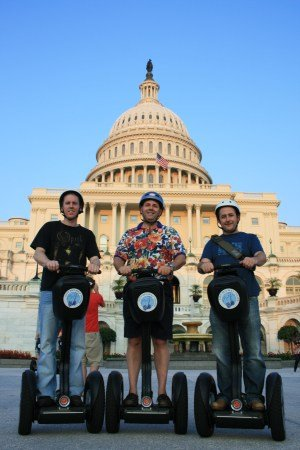
Segways rock!
image

You have not lived until you have ridden a segway – and I mean the new ones where you lean to control it. Even better than riding a segway is to ride it through DC, a city that blew me away with its amazing campus-like vibe. Never before has a city really pushed my buttons like this place. As you can see above, Ruven Gotz, Andrew Woodward and I visited some of the amazing DC sights and this photo in particular of Capitol Hill behind us, looking out toward the Lincoln memorial is something I’ll never forget. One thing is for sure, I am definitely coming back here for at least 2-3 weeks with the family just to absorb everything – sooner rather than later.

These best-practices events are really the conference where the material goes beyond the tech-stuff and caters additionally for an audience of consultants, business analysts, project managers and CIO’s. Some sessions are completely strategic, yet some delve deep into the guts of tech. In short, there is something for everyone.

Since the San Diego event back in Feb 09, my fellow kindred spirits, Ruven Gotz, Andrew Woodward, Dux Sy and I have been collaborating to bring our respective messages together and put a cohesiveness around what we have to say. This conference was the first peek of the fruit of that collaborative effort and as far as audience feedback went, it went down really well. In my last session of the conference I had a little Jerry Springer moment, when describing a particular slide that was a part of all of our respective talks, when I asked the audience to describe the slide and they all answered in perfect unison – hehe the message was heard 🙂

I presented 3 sessions, one on my own, and two co-presented with Ruven Gotz and Peter Serzo respectively. Ruven and I have been unhappy with the current (mis)understanding of governance around SharePoint and the culmination of our efforts over the last new months was a talk called “Governance – the other 90%”, although next time I will rename it to “Zen and the art of SharePoint Governance”. This was an umbrella talk to introduce our concepts and thinking, and then it was followed up later in the conference by talks by Ruven, myself and Andrew Woodward. Andrew took out the best overall speaker award too for the conference and we are all super-excited by the fruits of this collaboration so far, and I *know* that bigger and better things are to come from it.

For what its worth, if you want to be “one with SharePoint governance”, remember the key takeaway – beer is the best governance tool you’ve got. 🙂

The session with Peter Serzo was also such fun – we hit upon the idea of doing a Zoolander themed talk to introduce SQL Reporting Services to people who had not seen it. SSRS is one of those tools and technologies where even some well known SharePoint practitioners have not used it. With a title of “Reporting Services for the Really Really Good Looking”, we attracted a good turnout and managed to create and publish a report in 5 minutes, explain the architecture by getting members of the audience to stand up, wear aprons and “model” the various components and show how with no code, information workers could include drill down reports as well as personalised reports via parameters and filter web parts. The very awesome Brett Lonsdale (the guru behind BDC Meta Man), interrupted proceedings, claiming that the BDC was a better option and there was only one way to settle it – he and I had to do a BDC vs SSRS “walk off” which I *of course*, won easily :-).

Brett was a great sport, and I think for a minute audience members actually thought he was serious 🙂

(Now here comes the gushing love people..)

Also this time around, I’ve gotten to know more people and the rare opportunity to hook up again and spend some quality time with various friends was really the thing that makes the 36hr transit from Perth worth it. From the BBQ at Dux Sy’s house, to some great dialogue with Ben Curry of Mindsharp, Judy Cowan of Microsoft, Evan Burfield and the Synteractive people and my SamePage amigo’s (Dux, Ruven and Andrew Woodward). Ben Curry is an out and out genius, and our CV’s seem to read from the same script and I wish I had more opportunity to work with him. Evan Burfield is so scary smart that he automatically become my hero with his amazing understanding of stuff that I am interested in, yet only scratching the surface of the surface 🙂

Special callout to Laura Rogers (aka @wonderlaura). I had to look up what a muse was after she told me I was hers (I am a little sheltered over in Perth 🙂 ). Love her work – in fact, it is *her* work at endusersharepoint.com that inspired me to get back into more end-user content and try this whole screencasting thing. Laura, we are going to have to do something on EUSP together if you’d be up for it – it was a lot of fun hanging out and I think Peter Serzo would be up for something fun as well.

To the people who sat around the bar/restaurant/lobby table and supplied great laughs and great conversation. Zlatan Dzinic is utterly brilliant but is genetically programmed to be unable to whisper in someone else’s session 🙂 ). Mike Ferarra from SharePointReviews.com, Dan Usher, Lori Gowin, Ben Curry for messing with my head constantly, Paul Kolasky (the self-confessed poster boy for wicked problems who Laura eventually discovered *is* harmless 🙂 ) and special mention to Paul Stork – who was labelled as “that nerd who always has to jump ahead” during the Zoolander session.

Final thanks – Peter Serzo and his wife, Stacey. Peter is the most “Australian Amercian” who I have ever met. I think he must have been an Aussie in a former life. He is a tireless worker who’s imagination and inventiveness always sets off sparks of inspiration for me. I am going to try and find a way to get him over to Perth for a local training workshop or user group thing – they’d love his sense of humour.

Sorry if I missed anybody, I apologise. Also, please send me any photos, as many were taken, but I really was quite unsure about who’s camera was clicking at the time 🙂

Thanks for reading

Paul Culmsee

www.sevensigma.com.au


It’s going to be quiet around here (again)

banner604x75-speaker (3)

Just a quick note to say that it’s Best Practices Conference season again and this means I am a very busy boy. No doubt many other presenters are too because this is a conference that takes a disproportionally large amount of time to prepare and deliver compared to most conferences. As a result, blogging takes a back seat when preparing for such an event.

Why is this?

Well, for a start, we all don’t just get up there and rattle off a bunch of “oh, isn’t this cool” product features (that’s for Vegas ;-). On the contrary, the Best Practice Conferences are all about the real-life world of IT trying to empower business through tough, competitive and fast-moving times. To deliver at such a conference, you need to be at your best, and with top-notch, tried and tested solutions to what are often people as much as they are technical challenges.

Best Practices is about quality, resilience and adaptability in the face of constant change and competing priorities. The Best Practices Conference is where you’ll find great ideas, activities and techniques to apply in your organisation. You will come away with many new kung-fu skills, allowing you to:

  • Sort through the best solutions to any task
  • Reach consistent, confident decisions at every level
  • Break the cycle of avoidance, disagreement and subpar results
  • Eliminate design, deployment, organisational and administrative confusion
  • Enhance communication, collaboration and efficiency while lowering costs
  • Avoid technological errors, misconceptions and pitfalls
  • Leverage the hard-won experience of industry leaders
  • Gain early competitive advantages
  • Replace disorder with clarity, direction and confidence
  • Last time I was at a BPC, I met some brilliant people and we are now working together in a collaborative and commercial sense. We are all back again, and this time have decided to align all of our sessions and topics in such a way that we may offer a great end-to-end advice. If you attend this conference, look out for a group of related sessions by myself, Dux, Ruven and Andrew.

    My first topic, co-presenting with Ruven Gotz is called “Governance, the other 90%”. This, in a way, serves as an umbrella session for our other talks. In this particular session, Ruven and I have found a way to frame governance in a manner that seems to resonate with people and demystify the topic in a manner that we have not seen elsewhere. From the synopsis

    This session dissects the broader challenges of SharePoint governance, far beyond service delivery and assurance. It demystifies the grey fog of "people" issues and highlights the real factors that will make or break a SharePoint project.

    The next session in this series of talks is called “Wicked problems and SharePoint – The one best practice to rule them all”. Presumably regular readers of this blog will have a fair idea of what I am going to talk about 🙂

    Andrew Woodward is up next with his “Agile SharePoint Development – Is it Wicked?” session. This session continues the examination of why traditional approaches to SharePoint projects often result in failures or delivery of solutions that attain only a fraction of what is possible. This session looks at how adoption of agile development techniques helps deal with the wicked problems presented in SharePoint projects. We look at the thinking behind and trends in agile development and at the challenges companies face when adopting agile development.

    Next in the series is “7 Ways to Leverage SharePoint for Project Management Success” by Dux Sy. In this presentation, Dux provides a practical approach to using SharePoint to address the challenges of inefficient communication among stakeholders, poor document management practices and undefined project collaboration standards.

    Ruven then takes the stage with his “Content Types and Site Columns – Working with stakeholders to build the taxonomy” session. This session is centred around stakeholder understanding of the concepts of metadata, a process that is iterative in nature. Ruven will introduce various tools and methods that have proven to be successful for explaining these concepts and then organizing an information architecture.

    There are of course, a whole raft of brilliant speakers from all over the world converging for this talk and this promises to be the best BPC yet

    Hope to see you there!

    Thanks for reading


    Paul Culmsee

    www.sevensigma.com.au


    The secret to understanding governance

    I’m very tempted to start this post like a dodgy wealth-guru infomercial. You know the ones with lots of imagery of people living the dream of financial freedom. I am thinking a montage of a resort, a large yacht anchored in a topical bay, carving up the water with a jet-ski and then a shot of me standing next to my Ferrari, champagne in hand, with Megan Fox on my arm. My message would be that for a “small” fee of $10,000, you too could learn the secrets to your financial freedom in an intimate, exclusive but “intensive” weekend workshop. Just you and the 15,000 other people that pack into the convention hall 🙂

    Alas, we both know that this is never going to happen but this post may have a little of that feeling to it. I have titled it “The secret to understanding governance”, because I think there is a way to understand governance that will help you, your colleagues and your team members significantly. Like all good “wealth guru” infomercials, I’m going to give you some hints and I’m kind of hoping that you will then be interested in attending a workshop to find out the rest.

    The one difference between the wealth guru and me, though, is that I will never have Megan Fox hanging off my arm, and I am actually going to tell you something useful in this post.

    So, what is this big “secret”, anyway?

    Definitions definitions definitions

    One thing that we all tend to get suckered into doing at times is feeling the urge to define “stuff”. Academics do it all the time. I’ve read countless papers where the authors start out with a ten page examination of all the past definitions of their given topic, before proceeding to tell you why those definitions are inadequate in some way, followed by their own revised definitions. They spend the rest of their essays justifying why their definitions are more correct than their predecessors.

    Defining stuff is a time consuming and tiring exercise. Since we live in a world of constant change there will always be new influences which shape and frame perceptions. Therefore, the definition that you spent so much effort on coming up with is redefined by the next academic or blogger who follows the path that you took. Sometimes a whole new word is invented, or an existing word is suddenly used in a new context and the whole cycle starts all over again.

    I once explained the philosophical and process aspects of Agile/Scrum to a seriously experienced project manager. This was a fellow who was the PM when skyscrapers were erected. He listened carefully to my explanation, sat back and said “I’ve been doing that for 30 years. There’s nothing new there”. I also found a similar observation in “The Small Business Guerrilla Guide to Six Sigma” by Jay Arthur.

    Over the years, I’ve had a chance to learn and study just about every “brand name” systematic improvement methodology. Guess what…they are all pretty much the same. To appear different, consultants have changed:
    – the name to Six Sigma (from Total Quality Management)
    – the acronyms to confuse the unwary (PDCA to DMAIC)
    – the number of tools required for success
    – the number of steps in the process (5 to 14 steps)
    but…
    – the key tools are the same
    – the process for using the tools is the same
    – and the results are identical assuming you can figure out how to use the wide range of tools and processes

    In my opinion, defining things to the nth degree is a zero sum game. Often you confuse the issue more than you clarify it because in your attempts to explain something, you incorporate new words that you then have to explain.

    Some ROI Wisdom

    Several years ago I was attending a job interview for a promotion and the topic of return on investment came up. I had made the point that most things could be quantified and one of the interviewers fired back “Well tell me how you measure quality?”

    That was a curveball that I wasn’t expecting, and I didn’t have an answer (and never got the job either).

    Some time later, I read a terrific book by Douglas Hubbard on measurement and return on investment called “How To Measure Anything”. It armed me with some new kung-fu skills and also gave me the perfect comeback answer that I sorely needed during that interview. The question “How do you measure quality?” actually makes very little sense to ask. The reason is quite simple. “Quality is not what you measure. It is the effect it has on something that you measure”.

    It is very easy to illustrate the logic behind this important point. Undertaking a quality initiative costs time, money and resources. You are only spending that money and investing those resources because you believe that undertaking this quality initiative will make a positive difference in some way. Otherwise, why bother? If you do not believe that it will make a positive difference, why throw money away?

    So, if asked “How do you measure quality?”, you can answer by asking questions back, along the lines of:

    • “What does improved quality look like to you?”
    • “What is the effect of quality?”
    • “How do you know your quality initiative is working?”

    The answers to these questions tend to start with “increased this” or “decreased that”. It now should be abundantly clear why asking “How do you measure quality?” actually makes no sense. In fact it is completely the wrong question to ask. Instead, by re-framing the question slightly, you suddenly have answers that can be quantified using the techniques that I detailed in my “Learn to speak to your CFO” series and provided in my free SharePoint ROI modelling spreadsheet.

    This same logic applies to other words that are better understood by examining their effect, rather than trying to (re)define them. Examples:

    • Security
    • Flexibility
    • Collaboration
    • Resilience
    • Wellbeing

    All of these share the same characteristic as “governance” in that they are easily understood by the effect they have, but harder to define in a universal way.

    The secret to understanding governance

    The really silly thing about all this is that I did a talk on SharePoint ROI at the Best Practice Conference in Feb 09. In that talk, I explained the above chain of logic and made the point that the way to find measurable success factors with anything that seems “unquantifiable” is to ask the “what will it look like if we do this?” type question. I used this logic to come up with measurable key performance indicators that enabled me to simulate the future financial return (internal rate of return and net present value) of a large SharePoint investment for a mid sized organisation (slide deck and spreadsheet can be downloaded here).

    But despite writing several articles and speaking on this topic, the ROI stuff was one of several clouds of “stuff” that was floating around my brain. SharePoint governance was also floating in one of those clouds too, as well as broader governance in a planning and sustainability context. It took a casual comment from Bjørn Furuknap that suddenly gave me one of those wonderful bolts of inspiration and clarify, where these disparate clouds of thought suddenly coalesced and I made a significant breakthrough in my understanding.

    Define “governance” in any way you want. I really don’t care – so long as you understand the difference it makes *for you* and you ask the same question of your other stakeholders and participants. Put aside the need to define governance for a while, and instead view “governance” as a means to attain a desirable future state. Agree with each-other on what that state is going to look like. Now tell me the differences between where you are now and that desirable future state.

    By asking the question this way, you not only stimulate much more meaningful debate, you will have a much better understanding of everybody else’s frame of reference and the emphasis that they place on various aspects of that difference. The “definition” of governance that you are trying to find will start to suggest itself through those differences between the current and desired state. At the end of the day, that is what really matters.

    Instead of reading a methodology like COBiT or ITIL, or following what people like me, Joel, Robert Bogue, Andrew Woodward, Dux Sy and Ruven Gotz say, look at your own needs as an individual, a team and then an organisation. Determine where you want to be, include IT and non IT views and then start to think about what you need to do to get to your desired state.

    Congratulations, you’re now officially “governing”. Wasn’t that hard, was it? 🙂

    Best practices versus worst practices

    This same “secret” to understanding governance also provides the answer to why experts disagree on what is a “best practice”. I sometimes will read a “best practice” and think to myself “No way, that would never work”. Yet, although it doesn’t work for me, I rarely come away thinking the person making the recommendation is actually wrong. When you understand that the “best practice” made a positive difference, and it moved the organisation further along the road from the undesired present state toward the desired future state, then it is perfectly clear why one man’s best practice is another man’s worst practice. No matter what you did, you moved forward – and that is a good thing.

    Furthermore, if you agree with the notion that the “best” solution to a problem is the one that has the most shared commitment among participants to seeing it through, then I argue that a perceived “worst practice” with deep commitment and buy-in among stakeholders will deliver a better solution than a “best practice” with poor buy-in and commitment among stakeholders.

    Want to argue that point with me? (I’ve got more ammo than this!) Then you can spend 3 days doing that if you want!

    …for a small fee 🙂

    My intent with this post was to try and lift some of the fog and confusion that surrounds this nebulous thing called governance by suggesting that defining it to the nth degree is not the way forward. “Best and worst” practices? Both are commonly context and culture dependant. Instead, your (multidisciplinary) team needs to agree on and understand your desired future state and where you are now. By starting with the end in mind you will be able to collectively determine what processes, tools and methods to use to get to that place.

    The philosophical approaches that I have described in this article are just the tip of the iceberg in relation to the work that I have been doing with Andrew Woodward, Dux Sy and Ruven Gotz for the planned “Governance Mentoring Workshop”, to run for 3 days prior to the August Best Practices Conference. This workshop will be unlike any other SharePoint governance training that is currently in existence and much of the material is completely original and not borrowed from any of the traditional SharePoint governance material that exists today.

    Finally, to go back to infomercial mode…

    This offer is for a limited time only. Act now! If you’re not completely satisfied, we offer a full “return to base” warranty 🙂

    Act Now!

    This offer is strictly limited!

    Act Now!

    Pick up the phone and take the first step toward the new life that is waiting for you!

    Act Now!

    Thanks for reading

    Paul Culmsee


    Who wants to spend 3 days with me and the gang?

    A quick bit of background. My last 2 trips to the USA were particularly fruitful in meeting many like-minded SharePoint pros, all of which are well known and highly regarded. Some close friendships were made and what was really cool was that some people I met, despite having very different skills and experience (and physical locations!), seemed to connect on a level that gave us the desire and impetus to to work together very closely idealistically and commercially. More on that soon enough… 🙂

    So who are the members of this global group of SharePoint mystery men?

    • Andrew (Agile Boy) Woodward – Agile extraordinaire. So damn agile in fact that blink and you’d never know he was there. Able to demolish long SharePoint projects into bite sized chunks in a single bound
    • Ruven (Magneto) Gotz. Mind mapping maestro with the ability to bend information architecture to his will, and able to know what you want before you even have formed the question
    • Dux (Mr Myagi) Sy. A sensei project Manager who will teach you the wax-on/wax-off approach to successful SharePoint delivery. He might even get you to paint his fence if you are lucky

    and me (aka Dr Wicked) round it off – pushing the boundaries of pop-culture metaphors for cheap laughs and the odd bit of work on shared understanding, ROI and SharePoint governance.

    So why does any of this matter?

    image

    It just so happens that all four of us are soon to be in the same place at the same time. This is actually a frustratingly rare occasion, given that Andrew is in the UK, I am in Western Australia, Dux is in DC and Ruven is in Toronto. But in August, we will all be presenting at the SharePoint Best Practices Conference in DC. We are all tremendously honoured to be presenters at this event and this time around, we have been collaborating together to try and really deliver some great sessions that capture the essence of our common philosophical approaches.

    It takes me around 30 hours of transit to get to the east coast, and Andrew also has to travel a fair distance too. Therefore when these sorts of opportunities present themselves, we like to make the most of it – and we are *not* just talking beer! (ok well that’s not strictly true – beer is a significant motivation :-D)

    Accordingly, we are planning a special “SharePoint Governance Mentoring” workshop that will run over a period of 3 days (August 19-21, 2009), prior to the conference itself. It will be a unique, one-off event and numbers will be strictly limited. We think that our combined skills cover the broad spectrum of the SharePoint universe very well, with a particularly strong governance underpinning. Participants will be able to delve into topics such as how to manage a SharePoint project, practical techniques in gathering requirements, achieving shared understanding and buy-in, information architecture, team dynamics and the root causes of organisational chaos that make SharePoint an attractive proposition in the first place. We will also cover making a great business case and understanding return on investment, how to approach application development on the SharePoint platform and above all, learning what governance is really all about, and applying the right sort of governance at the right time. 

    Additionally, plenty of time will be allocated for participants to discuss their SharePoint challenges in an open forum, so if you bring your SharePoint baggage, we will lend a sympathetic ear and then arm you with some new kung-fu skills to take back to your organisation.

    Does this event sound like your cup of tea? If so, we need to hear from you! We will publish the workshop details and outline in mid-July but we need to gauge interest now. The cost for this three day event will be $1750 per attendee, although anyone who is registered for SharePoint Best Practices Conference will be entitled to a 10% discount.

    So if this sounds good to you, then please register your interest at Dux’s site below:

    http://sp.meetdux.com/workshop_interest.aspx

    Thanks for reading (and we hope to see you there!)

    Paul Culmsee

    www.sevensigma.com.au


    Listen to me blab on about crap ;-)

    Hi

    I have been very busy on a number of fronts – which is why the blog hasn’t had much attention lately. I’ll be back soon enough though – once I get a few big jobs done.

    For those of you that are not aware, there is a podcast interview that I did with Brett Lonsdale at Sharepoint Pod Show where he allowed me to blab on and on and on and on 🙂 Poor Brett – he didn’t know what he was getting himself into at all!

    So if you think my posts are boring and wordy, wait till you hear me talk! 🙂

    Paul


    Perth SharePoint Users Group wrap

    Today I presented a session at the Perth SharePoint Users Group. I was a little unsure whether my non-technically focussed content would be of interest to the geeks but the turnout was terrific and the feedback has been brilliant. (The 3 copies I gave away of Dux’s excellent “SharePoint for Project Management” book may have sweetened the deal – hehe )

    My sincere thanks to new user group president Sezai Komur for giving me the opportunity to present this material as it was the first time it has seen the light of day in Perth.

    If you want to check out the slide deck from the session, you will find it below. Expanded information that builds on this content can be found at the Seven Sigma site, as well as here at CleverWorkarounds.

    Thanks for reading

    Paul Culmsee

    www.sevensigma.com.au


    « Previous Page

    Today is: Wednesday 3 June 2026 -