Back to Cleverworkarounds mainpage
 

Powerful questions part 3: The “I told you so” question

Hi all

I just recorded the third video on the topic of powerful questions. The purpose of this series of videos is to help facilitators, project managers, business analysts and SharePoint peeps ask better questions of their stakeholders. The first video introduced the platitude buster question and the second video unveiled the key focus area question. Both are hugely important – especially for SharePoint projects and any SharePoint governance efforts because failure to answer these two will positively kill your project. This 3rd powerful question is related to risk perception and how you can frame questions to get a much better sense of what the real risks are in projects or problems. In this video, I made the contention that asking “What are the risks” is not a great way to identify and subsequently manage risks. The inference for SharePoint people here is that if you think you have done your job by creating a risks and issues list (ala Project Server) and asking for people to fill it in, I am here to tell you that there is much more to the story…

Don’t believe me? Then watch the video. 

Like the previous post, I suggest you watch this video in full screen. Enjoy!

How to find out what the real risks are…


High school students showing us SharePoint consultants how it’s done

Hi all

Once in a while, you can come across a case study that not only showcases innovative and brilliant solutions, but tells a much deeper story that both inspires and teaches. I am writing this post to tell you such a story – a story about genuine collaboration and what it can enable when the right conditions exist to foster it.

To explain this story, I first need to talk about the work of an academic named Richard Hackman. Here is a guy who spent most of his working life examining the factors that make teams work really well. Over the years he studied hundreds of high performing teams, trying to distil the magical ingredients that would lead to success for other teams. He would come up with theories, then create models that looked great on a whiteboard, but when applied to real teams in the real world, reality never fitted the models.

From causes to conditions…

After years of doing this, Hackman started to wonder whether he was leaning the ladder against the wrong wall. In other words, he wondered if trying to determine the causes of team efficacy by looking at successful teams retrospectively was the wrong approach. In the end, he changed his focus and asked himself a different question. What are the enabling conditions that need to exist that give rise to great teams?

He came up with six conditions arguing that irrespective of what else you did or what methodology you used, usually led to better results. I will give you a super brief summary below:

  1. A real team: Interdependence among members, clear boundaries distinguishing members from non-members and moderate stability of membership over time
  2. A compelling purpose: A purpose that is clear, challenging, and consequential. It energizes team members  and fully engages their talents
  3. Right people: People who had task expertise, self organised and skill in working collaboratively with others
  4. Clear norms of conduct: Team understands clearly what behaviours are, and are not, acceptable
  5. A supportive organisational context: The team has the resources it needs and the reward system provides recognition and positive consequences for excellent team performance
  6. Appropriate coaching: The right sort of coaching for the team was provided at the right time

Now my interest in Hackman and his conditions stemmed from reviewing the published “models” for SharePoint governance. Whether it is the 7 “pillars”, the 5 “steps”, or the 6 “focus areas”, all are developed in a retrospective way – by looking at a mythically perfect SharePoint solution and then breaking it down into all the things that need to be done to enable it. You see, for a long time now, I have deliberately not started with one of the models up front and Hackman offered me a reason why. Instead I first strive to create the conditions that Hackman lists above and develop governance as it is needed, rather than follow a fixed model.

Meet Louis Zulli Jr and his students

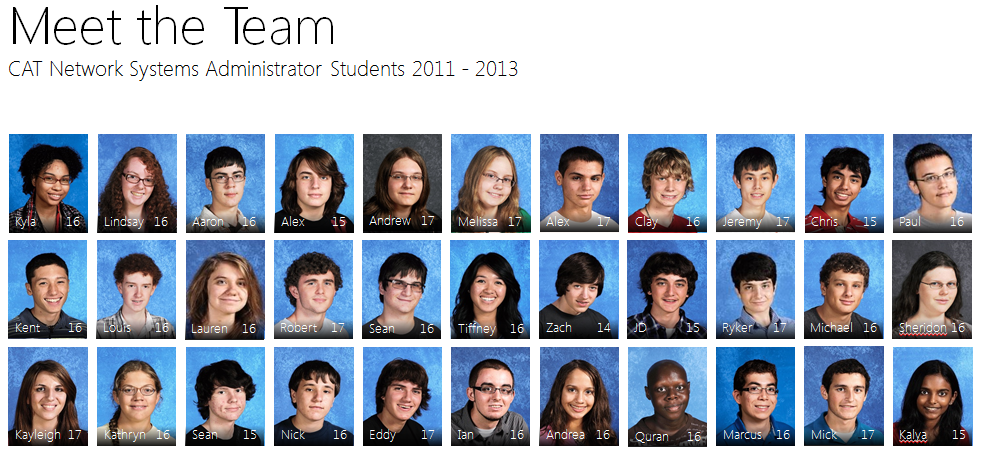
Earlier this year, I met Louis Zulli Jnr – a teacher out of Florida who is part of a program called the Centre of Advanced Technologies. We were co-keynoting at a conference and he came on after I had droned on about common SharePoint governance mistakes. Louis then gave a talk that blew me away, and at the same time proved Hackman completely right. The majority of Lou’s presentation showcased a whole bunch of SharePoint powered solutions that his students had written. The solutions themselves were very impressive, as this was not just regular old SharePoint customisation in terms of a pretty looking site with a few clever web parts. Instead, we were treated to examples like:

  • IOS, Android and Windows Phone  apps that leveraged SharePoint to display teacher’s assignments, school events and class times;
  • Silverlight based application providing a virtual tour of the campus;
  • Integration of SharePoint with Moodle;
  • An Academic Planner web application allowing students to plan their classes, submit a schedule, have them reviewed, track of the credits of the classes selected and whether a student’s selections meet graduation requirements;
  • An innovative campus Hall Pass system that leveraged jQuery, HTML5, CSS3, XML, JSON, REST, List Data Web Services and features integration with IOS, Windows 8 and swipe card hardware.

All of this and more was developed by 16 to 18 year olds and all at a level of quality that I know most SharePoint consultancies would be jealous of. To any of Lou’s students who read this – and I have consulted and delivered SharePoint since 2006, as well as speaking to people around the world on SharePoint – the work quality that I saw is world-class and you all have lucrative careers ahead of you in the SharePoint space and beyond.

image

So the demos themselves were impressive enough, but that is actually not what impressed me the most. In fact, what had me hooked was not on the slide deck. It was the anecdotes that Lou told about the dedication of his students to the task and how they went about getting things done. He spoke of students working during their various school breaks to get projects completed and how they leveraged each other’s various skills and other strengths. Lou’s final slide summed his talk up brilliantly, and really spoke to Hackman’s six conditions. The slide made the following points:

  • Students want to make a difference! Give them the right project and they do incredible things.
  • Make the project meaningful. Let it serve a purpose for the campus community.
  • Learn to listen. If your students have a better way, do it. If they have an idea, let them explore it.
  • Invest in success early. Make sure you have the infrastructure to guarantee uptime and have a development farm.
  • Every situation is different but there is no harm in failure. “I have not failed. I’ve found 10,000 ways that won’t work” – Thomas A. Edison

If you look at the above 5 points and think about Hackman’s conditions of compelling direction, supportive context, real team and coaching in particular, you can see that Lou ensured those conditions were present. The results of course spoke for themselves.

About halfway through Lou’s talk, I decided that whether he liked it or not, he was coming out to Australia to tell this story. So we sat down together and talked for a long while and I asked him all sorts of questions about his students, the projects, how he coached his students and how his own teaching style developed. I ended up showing him Hackman’s six conditions for great teams performance and he said “that’s what we do”.

The real lesson…

So as I write this, Lou is on his long journey home after similarly blowing away the attendees of the Australian SharePoint conference with his story about what he and his students have done. His talk was the hit of the conference and I hope that the staff and students of Lakewood High School read this post because it’s important for them to know that their story and examples were the topic of much conversation amongst attendees and highly inspiring. I also hope that people in the SharePoint community read this because CAT shows precisely why SharePoint can be such an amazing enabler within organisations when the right conditions are in place for it. Governance models are great and all, but without these enabling conditions in place, cannot deliver great outcomes on their own.

This leads me onto one final cautionary point – directed at Lou’s students, but applicable to all readers who aspire to improve collaboration in their organisations and their projects.

There are plenty of clever people in this world – in fact most IT people from my experience are intellectually very clever (IQ), but some have all the emotional maturity (EQ) of a baseball bat. IQ is what you are born with, but EQ is caught and lived. What makes great SharePoint practitioners (and in fact great leaders) is EQ, not just IQ and the CAT program shows what happens when clever people are given discretionary freedom with supportive conditions in place. My advice is to never forget that it is the conditions in which a team or organisation finds itself that a strong predictor of outcome. Take the same clever people and change the conditions (for example, from a supportive educational institution to an organisation with a blame culture and silo based fiefdoms) and you will get very different outcomes indeed.

What students may not realise is that what the CAT program is really teaching them is the experience of living those enabling conditions and therefore teaching them EQ. These students will eventually move into organisations that do not necessarily have the same enabling conditions as what exists for them now. So look past the cool API’s, the development tools, technical whitepapers, the certifications, endless debates as to whether X vs Y is the best practice, and understand the conditions like Hackman did. Strive to (re)create those conditions in all your future work and you will go further than a SharePoint laden CV ever will.

This of course, took me around 18 years of working in IT before I figured it out and have been making amends ever since. So whatever you do, wise up earlier than I did!


Thanks for reading

Paul Culmsee

www.cleverworkarounds.com

www.hereticsguidebooks.com

HGBP_Cover-236x300


Introduction to Dialogue Mapping class in Melbourne June 13-14

Hi all

We have all felt the pain of a meeting or workshop where no-one is engaged, the conversation is being dominated by the loudest or everyone is mired in a tangle of complexity and there is no sense of progress. Not only is it incredibly frustrating for participants, but it is really inefficient in terms of time and effort, reduced collaboration and can lead to really poor project outcomes.

The big idea behind the technique of Dialogue Mapping is to address this problem. Dialogue Mapping is an approach where a project manager or business analyst acts as a facilitator while visually mapping the conversation of a group onto a projected display. This approach reduces repetition by acknowledging contributions, unpacks implicit assumptions and leads to much better alignment and understanding among a group.

For SharePoint projects, this is a must and I have been using the technique for years now. Other SharePoint luminaries like Michal Pisarek, Ruven Gotz and Andrew Woodward also use the approach, and Ruven even dedicated a chapter to Dialogue Mapping in his brilliant Information Architecture book.

In Melbourne, I am going to be running a 2 day Introduction to Dialogue Mapping class to teach this technique. There are only 10 places available and this is one of the few public classes I will be running this year. So if you are attending the Australian SharePoint conference, or live near Melbourne and deal with collaborative problem solving, stakeholder engagement or business analysis, this is a great opportunity to come and learn this excellent problem solving technique.

Hope to see you there!

Paul


An Organisational Psychologist is keynoting a SharePoint conference? What the…

Collaborate

Yup you heard right. I am particularly excited for the Melbourne SharePoint conference in June because I get to unleash “Dr Neil” onto the SharePoint world. Neil (who’s full name is Neil Preston) is an Organisational Psychologist who I have been working with for several years now in all sorts of novel and innovative projects. He’s not a SharePoint guy at  all – but that doesn’t matter for reasons that will soon become clear…

I spent January 2013 on holiday in New Zealand and caught up with Debbie Ireland in her home town of Tauranga. We talked about the state of SharePoint conferences around the world and mused about what we could do to raise the bar, particularly with the Melbourne SharePoint conference in June 2013. Both of us felt that over the last few years, the key SharePoint message of “It’s all about business outcomes” was now:

  1. well understood by the SharePoint community; and
  2. getting a little stale

So the challenge for Debbie and I – and for that matter, all of us in the SharePoint community – is how to go beyond the paradigm of “It’s not about SharePoint, it’s about the business”, and ask ourselves the new questions that might lead to new SharePoint powered innovations.

The theme that emerged from our conversation was collaboration. After all, one of the most common justifications for making an investment in SharePoint is improved collaboration within organisations. Of course, collaboration, like SharePoint itself, means different things to different people and is conflated in many different ways. So we thought that it is about time that we unpacked this phenomena of collaboration that everyone seeks but can’t define. This led to a conversation about what a SharePoint conference would look like if it had the theme of collaboration at its core. Who would ideal to speak at it and what should the topics be?

As Debbie and I started to think more about this theme, I realised that there was one person who absolutely had to speak at this event. Dr Neil Preston. Neil is a world expert on collaboration, and his many insights that have had a huge influence on me personally and shaped my approach to SharePoint delivery. If you like what you read on this blog, or in my book, then chances are that those ideas came from conversations with Neil.

Debbie then suggested that we get Neil to keynote the conference to which he graciously accepted. So I am absolutely stoked that attendees of the Melbourne SharePoint conference will have the opportunity to learn from Neil. I can guarantee you that no SharePoint conference in the world has ever had a keynote speaker with his particular set of skills. Thus, I urge anyone with more than a passing interest in developing a more collaborative culture in their organisations should come to the conference to learn from him.

Then, in one of those serendipitous moments, a few weeks later I was in the US and met an amazing schoolteacher named Louis Zulli Jnr who presented a case study on how he enabled 16-19 year old students to develop SharePoint solutions that would be the envy of many consultancies. As I listened to him speak, I realised that he was the living embodiment of the collaborative maturity stuff that Neil Preston preaches and I asked Debbie about bringing him to Melbourne to speak as well.

So there you have it. On June 11, you get to hear from one of the most brilliant people I have ever met who’s understanding of collaboration and collaborative maturity is second to none. You also get to hear an inspiring case study of what how the incredible potential of enthusiastic and engaged students can enable SharePoint to do amazing things.

That is not all either – we have Craig Brown (of betterprojects.net and LAST conference fame) introducing Innovation Games and we also have John Denegate from collaborative governance specialists Twyfords, speaking on the curse of the expert.

So don’t miss this event – I think it will be amazing. In the next blog post I will write about the 2 day post-conference workshops


Thanks for reading

Paul Culmsee

SPC MEL 2013 Im speaking        SPC MEL 2013 connect with us


Powerful questions part 2: The key focus area question

Hiya

I just recorded the second video on the topic of powerful questions. These powerful questions are the result of the years I’ve spent dialogue mapping many different groups of people on many different problems. As time has gone on, I’ve learnt a lot about collaborative problem solving, and concluded that some questions tend to lead to breakthrough more than others.

In the previous video, I introduced you to the platitude buster question. This time around, I have recorded a video on one of the best questions you can ask in any form of strategy development meeting – the key focus area question. For all you SharePoint types, I always use this question during SharePoint governance planning and when drawing up a project charter, but it is equally effective when working with an executive team who are working out their short and long term strategies.

Like the previous post, I suggest you watch this video in full screen. Enjoy!

How to eke out key focus areas from a discussion

Thanks for reading

Paul Culmsee

HGBP_Cover-236x300


Making Sense of SharePoint and Digital Records Management…

Hi all

One of the conversation areas in SharePoint life that is inevitably complex is that of records management since there are just as many differing opinions on records management as there are legal jurisdictions and different standards to choose from. Accordingly, a lot of confusion abounds as we move into a world dominated by cloud computing, inter-agency collaboration, changes in attitudes to information assets via the open data/government 2.0 movements, and of course, the increasing usage of enterprise collaboration systems like SharePoint. As a result, I feel for record managers because generally they are an unloved lot and it is not really their fault. They have to meet legal compliance requirements governed by various acts of legislation, but their job is made all the harder by the paradox that the more one tries to enforce compliance, the less likely one is to be compliant. This is because more compliance generally equates to more effort on the part of users for little perceived benefit. This results in direct avoidance of using record management systems or the plain misuse of those systems (both which in turn results in a lack of compliance).

As it happens, my company works with many government agencies primarily in the state of Western Australia, both at a state agency and local government level. We have seen most enterprise document management systems out there such as HP Trim, Objective, Hummingbird/OpenText and have to field questions on how SharePoint should integrate and interact with them (little known fact – I started my career with Hummingbird in 1998 when it was called PCDOCS Open and before SharePoint existed).

Now while I am sympathetic to the plight of your average records management professional, I have also seen the other side of the coin, where records management is used to create fear, uncertainty and doubt. “You can’t do that, because of the records act” is a refrain that is oft-levelled at initiatives like SharePoint or cloud based solutions to try and shut them down or curtail their scope. What makes it hard to argue against such statements is that few ever read such acts (including those who make these sort of statements). So being a sucker for punishment, I decided to read the Western Australian State Records Act 2000 and the associated standard on digital recordkeeping, published by the State Records Office. My goal was to understand the intent of these standards and the minimum compliance requirements they mandate, so I could better help clients integrate potentially disruptive tools into their compliance strategies.

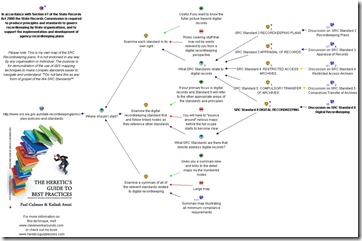
I did this by starting out with the core standard in Western Australia – SRC Standard 8: Digital Recordkeeping. I created an IBIS Issue Map of this standard using Compendium software. What I soon discovered was that Standard 8 refers to other standards, such as Standard 2: Recordkeeping Plans and Standard 3: Appraisal of Records. That meant that I had to add these to the map, as well as any other documents they referred to. In the end, I followed every standard, policy or guideline in a recursive fashion, until I was back at the digital recordkeeping standard where I started. This took a while, but I eventually got there. You can click the image below to examine the standards in all of their detail and watch the video to see more about how I created it.

Map   

Now I need to make it clear that my map is not endorsed by the State Records Office, so it is provided as-is with a disclaimer that it is not intended to drive policy or be used as anything more than an example of the mapping approaches I use. I felt that by putting the standards into a IBIS based issue map, I feel I was able to reduce some of the complexity of understanding them, because now one can visually see how the standards relate to each other. Additionally, by taking advantage of Compendiums ability to have the same node in multiple maps, it allowed me to create a single ‘meta map’ that pulled in all of the compliance requirements into a single integrated place. One can look at the compliance requirements of all the standards in one place and ask themselves “Am I meeting the intent of these standards?”

Reflections…

In terms of my conclusions undertaking this work, there are a few. For a start, everything is a record, so people should just get over the whole debate of “is it or isn’t it”. In short, if you work for a government agency and are doing actual work, then your work outputs are records. The issue is not what is and is not a record, but how you control and manage them. Secondly, the notion that there has to be “one RMS system to rule them all” to ensure compliance is plain rubbish and does not stand up to any form of serious scrutiny. While it is highly desirable to have a single management point for digital recordkeeping, it is often not practical and insistence in doing this often makes agencies less compliant because of the aforementioned difficulties of use, resulting in passive resistance and outright subversion of such systems. It additionally causes all sorts of unnecessary stress in the areas of new initiatives or inter-agency collaboration efforts. In fact, to meet the intent of the standards I mapped, one by definition, has to take a portfolio approach to the management of records as data will reside in multiple repositories. It was Andrew Jolly who first suggested the portfolio idea to me and provided this excellent example: There is nothing stopping records management departments designating MS Exchange 2013 Site mailboxes as part of the records management portfolio and at the same time having a much better integrated email and document management story for users.

For me, the real crux of the digital records management challenge is hidden away in SRC Standard 8, Principle 5 (preservation). One of the statements of compliance in relation to preservation is that “digital records and their metadata remain accessible and usable for as long as they are required in accordance with an approved disposal authority.”  In my opinion, the key challenge for agencies and consultancies alike is being able to meet the requirements of Disposal Authorities (DA’s) without over burdening users. DA’s are the legal documents published by the State Records Commission that specify how data is handled in terms of whether it is archived or deleted and when this should happen. They are also quite prescriptive (some are mandated), and their classification of content from a retention and disposal point of view poses many challenges, both technically and organisationally. While for the sake of size, this article is not going to get into this topic in detail, I would advise any SharePoint practitioner to understand the relevant disposal authorities that their organisation has to adhere to. You will come away with a new respect for the challenges that record managers face, an understanding on why they use the classification schemes that they do, why records management systems are not popular among users of the systems and why the paradox around “chasing compliance only to become non-compliant” happens.

Maybe you might come away with some insights on how to better integrate SharePoint into the story? Then you can tell the rest of us Smile

Thanks for reading

Paul Culmsee

paul.culmssee@sevensigma.com.au


Interested in learning the craft of Dialogue Mapping in Auckland?

Hi all

I have spent a bit of time in New Zealand over the last few years, met a lot of really interesting people and frequently get asked about conducting a Dialogue Mapping training workshop over there. I’m really happy to announce that this is finally going to happen in Auckland on May 30th. It should be a really interesting session with a mix of SharePoint people, community development practitioners and organisation development consultants.

Just to be clear, this is not a SharePoint class. I am teaching the techniques of Issue Mapping, the core technique that enables you to become a great Dialogue Mapper. The class is very activity driven and helps you acquire a hugely valuable life skill that not only equips you with a great technique for tasks like business analysis and requirements elicitation, but also allows you to get involved with more complex problem solving scenarios like strategic planning. If you enjoyed my book, the Heretics Guide to Best Practices, this course teaches you the same techniques outline there.

To sign up for the class, head on over to eventbrite. For a full breakdown of the class structure then check out the class brochure.

The workshop will be held at the following venue:

Quality Hotel Parnell
20 Gladstone Rd
Parnell, Parnell 1052
New Zealand
Thursday, May 30, 2013 at 8:30 AM – Friday, May 31, 2013 at 5:00 PM (NZST)

If you would like to see and hear more about Dialogue Mapping, then take a look at these two video’s hot off the press by workshopbank.com. In the first video I speak about Dialogue mapping in general and the second is a very apt demonstration of the approach given that the next class is in New Zealand Smile

Experiences of a practicing Dialogue Mapper
Lord of the rings IBIS style

Thanks for reading

Paul Culmsee

HGBP_Cover-236x300


Confession of a (post) SharePoint architect… “Thou shalt NOT”

Hi all

*sigh*

This post comes to you during my reality check of returning to work after the bliss of 1 month of vacation in New Zealand. After walking on a glacier, racing around in jetboats and relaxing in volcanic hot springs, the thought of writing SharePoint blog posts isn’t exactly filling me with excitement right now. But nevertheless I am soldiering on, because as Ruven Gotz frequently tells his conference attendees – I do it because I love you all.

Now this is article ten (blimey!) in a series of posts about my insights of being a cross between a SharePoint architect and facilitator/sensemaker. In case this is your first time reading this series, I highly recommend that you go back to the beginning as we have covered a lot of ground to get to here. Inspired by the late, great Russell Ackoff, I used his notion of f-laws – sometimes inconvenient truths about what I think is critical for successful SharePoint delivery. At this point in proceedings, we have covered 6 f-laws across 9 articles.

The next f-law we are going to cover is a bit of a mouthful. Are you ready?

F-Law 7: The degree of governance strictness is inversely proportional to the understanding of the chaos its supposed to prevent

So to explain this f-law, here is a question I often ask clients and conference attendees alike…

What is the opposite of governance?

The answer that most people give to this question is “Chaos”. So what I am implying? Essentially that the stricter you are in terms of managing what you deem to be chaos, the less you actually understand the root causes of chaos in the first place.

Ouch! Really?

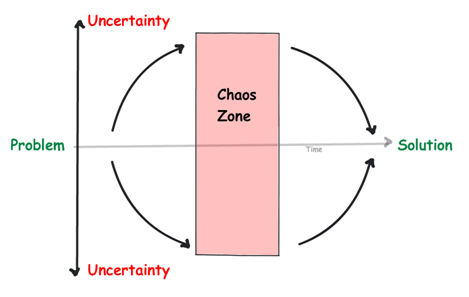
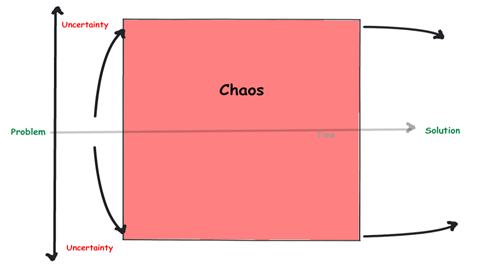
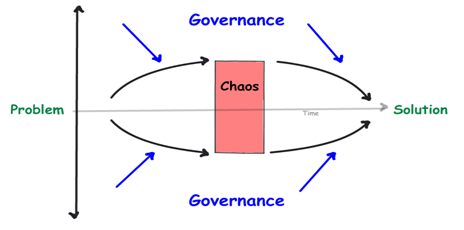
To explain, let’s revisit f-law 5, since this is not the first time the theme of chaos has come up in this series. If you recall f-law 5 stated that confidence is the feeling you have until you understand the problem. In that article, I drew the two diagrams below, both of them representing the divergence and convergence process that comes with most projects. The pink box labelled chaos illustrated that before a group can converge to a lasting solution, they have to cross the ‘peak’ of divergence. This is normally a period of some stress and uncertainty – even on quite straightforward projects. But commonly in SharePoint things can get quite chaotic with lots of divergence and very little convergence as shown by the rightmost diagram where there appears to be little convergence.

image  image

“Thou shalt not…”

There are clearly forces at play here… forces that push against convergence and manifest in things like scope creep, unreconciled stakeholder viewpoints and the stress of seeing the best laid plans messed with. The size and shape of the pink ‘chaos’ box reflects the strength of those underlying forces.

To manage this, many (if not most) SharePoint practitioners take a “thou shalt not” approach to SharePoint delivery in an attempt to head things off before they even happen. After the dissection in f-law 6 of how IT people channel Neo and focus on dial tone issues, it is understandable why this approach is taken. Common examples of this sort of thinking are “Thou shalt not use SharePoint Designer” or “Thou shalt use metadata and not folders” or “Thou shalt use the standard site template no matter what.”

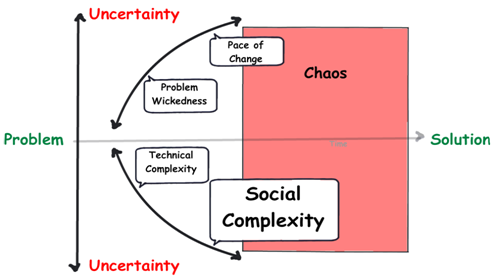
These sort of commandments may be completely appropriate, but these is one really important thing to make sure you consider. If having no governance indeed results in chaos, then it stands to reason that we need to understand the underlying divergent forces behind chaos to mitigate chaos and better govern it. In other words, we need look inside pink box labelled chaos and see what the forces are that push against convergence. So lets modify the diagrams above and take a look inside the pink box.

image

For me, there are four forces that govern the amount of chaos in SharePoint projects, namely:

  1. Pace of Change
  2. Problem Wickedness
  3. Technical Complexity
  4. Social Complexity

Let’s examine each one in turn…

Pace of change

image

Remember the saying “The only certainty in life are death and taxes”? Outside of that, the future is always unpredictable. In between SharePoint 2003 and SharePoint 2007, the wave of web 2.0 and social networking broke, forever changing how we collaborate and work with information online. In between SharePoint 2010 and SharePoint 2013, the wave of cloud computing broke, which is slowly but surely changing the way organisations view their IT assets (both systems and people). The implications of this are huge and Microsoft have to align their product to tap into these opportunities. Net result? We all have a heap of new learning to do.

If you read the last post, you might recall that pace of change was a recurring theme when people answered the question about what is hard with SharePoint. But let’s look beyond SharePoint for a second… change happens in many forms and at many scales. At a project level, it may mean a key team member leaves the organisation suddenly. At an organisational level, there might be a merger or departmental restructure. At a global level, events like the Global Financial Crisis forced organisations to change strategic focus very quickly indeed.

The point is that change breeds innovation yet it is relentless and brings about fatigue. Continual learning and relearning is required and even the best laid plans will inevitably be subject to changing circumstances. The key is not to fight change but accept that it will happen and work with it. In terms of SharePoint, this is best addressed by an iterative delivery model that has a high degree of key stakeholder involvement, recognises the learning nature of SharePoint and fosters meaningful collaboration.

Problem “Wickedness”

image

Some problems are notoriously hard to solve because they evoke a lot of diverse, often conflicting viewpoints and it can be difficult even agreeing on what the core problem actually is. F-law 1 examined how we sometimes fixate on the means of governance when the end goal of SharePoint is uncertain. Over-reliance on definitions is the result. F-law 2 looked at how users understanding of a problem changes over time and f-Law 4 looked at the folly in chasing platitudes. The underlying cause for all of these f-laws is often the very nature of the problem you are trying to solve.

You might have heard me talk about wicked problems or read about it in my blog or my book. In short, some problems are exceptionally tough to solve. Just trying to explain the problem can be hard, and analysis-paralysis is common because it seems that each time the problem is examined, a new facet appears which seemingly changes the whole concept of the problem. This phenomenon was named as a wicked problems by Horst Rittel in 1970. One of the most extreme examples right now of a wicked problem in the USA would be the gun control debate since depending on your values and ideology, you would describe the underlying problem in different ways and therefore, the potential solutions offered are equally varied and contentious.

While there are actually many different management gurus who have also come up with alternate names for this sort of complexity (“mess”, “adaptive problem”, “soft systems”), the term wicked problem has become widely used to describe these types of problems. I suspect this is because Rittel listed a bunch of symptoms that suggest when your problem has elements of wickedness. Here are some of the commonly cited ones:

  1. There is no definitive formulation of a wicked problem (defining wicked problems is itself a wicked problem).
  2. The problem is not understood until after the formulation of a solution.
  3. There is no immediate and no ultimate test of a solution to a wicked problem.
  4. Every solution to a wicked problem is a “one-shot operation”; because there is no opportunity to learn by trial and error, every attempt counts significantly.
  5. Wicked problems do not have an enumerable (or an exhaustively describable) set of potential solutions, nor is there a well-described set of permissible operations that may be incorporated into the plan.
  6. Every wicked problem is essentially unique.
  7. Every wicked problem can be considered to be a symptom of another problem.
  8. The existence of a discrepancy representing a wicked problem can be explained in numerous ways. The choice of explanation determines the nature of the problem’s resolution.
  9. Stakeholders have radically different world views and different frames for understanding the problem.
  10. The constraints that the problem is subject to and the resources needed to solve it change over time.
  11. The problem is never solved definitively

Can you tick off some of those symptoms with SharePoint? I’ll bet you can… I’ll also bet that for other IT projects (say MS Exchange deployments) these symptoms are far less pronounced.

Guess what the implication is of wicked problems. They tend to resist the command-and-control approach of delivery and require meaningful collaboration to get them done. That is kind of funny when you think about it since SharePoint is touted as a collaboration tool yet falls victim to wicked elements. That suggests that there was not enough collaboration to deliver the collaboration platform!

Technical Complexity

image

Technical complexity involves difficulties in fact finding, technical information and the systematic identification and analysis of options and their likely consequences. It is an understatement to say that SharePoint is full of technical complexity. In fact, it is one of the most complex products that Microsoft has ever produced (and that’s before you get to dependencies like SQL Server, IIS, FIM, Federated authentication and the myriad of other things you need to know)

A typical characteristic of technical complexity is information overload in fact finding. There is far too much information to make sense of and as a result, no one person has the cognitive capacity to understand it all. Thus, stakeholders have to rely on each other and, on occasions, rely on outside experts to collaboratively work towards a solution. Technical complexity requires a lot of cognitive load to manage and it is easy to get caught up in the minute detail and lose the all important bigger picture.

Problems also arise when different technical experts come to opposite conclusions. This gives rise to the last and most insidious divergent force underlying SharePoint chaos and the governance that goes with it – social complexity.

Social Complexity

image

The first three symptoms tend to create a perfect storm of complexity, since we have a situation where there is a lot of uncertainty. Many people hate this because unknown unknowns creates fear if sufficient trust does not exist between all key parties. Developing trust is made all the harder because we are all a product of our experiences, with different values, cultural beliefs, personality styles and biases so reconciling different world views on various issues can be difficult. Then you have the issue that many organisations have a blame culture and people position themselves to avoid it. This my friends is social complexity and I know that all of you live this sort of stuff everyday.

Yet under the right circumstances, groups can be remarkably intelligent and are often smarter than the smartest people in group. Groups do not need to be dominated by exceptionally intelligent people in order to be smart – in fact diversity of group makeup is a much more important factor than individual IQ. Without this diversity, groups are less likely to arrive at a good answer to a given problem because they are likely to fall into groupthink. Groupthink is when highly cohesive groups make unsound decisions due to group pressures, ignoring possible alternatives. Every management team that only wants to hear the good news is likely to have fallen foul of groupthink. The same applies to dismissing all SharePoint governance except for the dial tone stuff.

However, there is an inherent paradox here:

  • The more parties involved in a collaboration, the more socially complex;
  • The more different these parties are, the more diverse, the more socially complex; and
  • This creates tension, resentment and lack of communication and a strong desire to go back to business as usual

This paradox between diversity and harmony is the toughest aspect of the four forces to tackle.

Key takeaways…

Way back in the very first post I stated that a key job of a SharePoint architect is to architect the conditions by which SharePoint is delivered. By this I mean that the architect has to grease the gears of collaboration between stakeholders and provide an environment that has the safety and structure for people to raise their issues, speak their truths and not get penalised for improving their understanding of the problem.

To enable this to happen, we need to tackle all four of the forces behind chaos that we have covered here. In short, if you focus governance efforts only on one of the forces you will simply inflame the others. Accordingly, the final diagram illustrates the key takeaway from f-Law 7. Since the four forces behind chaos push out and create divergence, our governance efforts needs to push back. But the important thing to note is the direction of my arrows. It is not necessarily appropriate to provide a direct counterforce via the “thou shalt not” type of all-or-nothing approach. Governance always has to steer towards the solution. The end always drives the means and not the other way around! Arbitrarily imposing such restrictions is often done without due consideration of the end in mind and therefore gets in the way of the steering process. This is why my arrows point inwards, but always push toward the solution on the right.


image

In this context, it can be seen why envisioning, stakeholder and goal alignment is so critical. Without it, its too easy for governance to become a self fulfilling prophecy. So when you look at your own projects, draw my divergence/convergence diagram and estimate how big the pink box is. If you sense that there is divergence, then look at where your gaps are and make sure you create the conditions that help mitigate all of the forces and not just one one of them.

Thanks for reading

Paul Culmsee

www.hereticsguidebooks.com


Confession of a (post) SharePoint architect… What are you polishing?

Hi and welcome to the latest exciting instalment in my epic series of posts on my confessions of a post SharePoint architect. I was motivated to write this series because the mild mannered shrinking violet known as Bjorn Furuknap wrote an insightful series of articles on what it takes to be a SharePoint professional. I had always planned to write on this topic as well and opted to frame it as SharePoint “confessions” because some of my approaches do not always seem mainstream (but work!) so it feels like I am confessing my sins for using them. I chose to use the word “(post)” because SharePoint is not my fulltime gig anymore. I am very lucky to do a lot of non IT work, helping organisations deal with highly complex problems. This side of my work is where most of my insights have come from and what inspired the Heretics Guide to Best Practices book.

Thus far, we have traversed a fair bit of territory via the use of f-laws – home truths about successful SharePoint delivery that focuses on areas often overlooked for various reasons. In case this is your first visit to this series, we have covered 6 f-laws so far and I strongly suggest that you read them first…

In this post, we are continuing with f-law 6, focusing on aspects to SharePoint delivery where geeks have a habit of being crap…

No matter how much you polish it…

In Australia, there is an old saying, that no matter how much you try and polish a turd, it will always be a turd. In the last post, I more or less stated that some geeks have a tendency to polish turds. They do this because of a combination of an inflated view of their self-importance, mental scars from ghosts of disaster recoveries past, and a bias toward something I termed dial tone governance.

Dial tone governance refers to all of the stuff that ensures that the SharePoint platform remains pristine, consistently reliable and high performing. I noted in the previous post that this echoes what quality assurance aspires to do. This type of IT assurance for SharePoint is completely necessary, but it is definitely not sufficient. If it was, lavish praise would be heaped upon us heroic geeks for consistent fantastic SharePoint delivery.

In the last post I also channelled Neo from the Matrix and suggested that being a hero like Neo is a thankless job since, for many stakeholders, the assurance of dial tone is assumed to be there. Whether this is right or wrong is not the point, because geeks do not survive their own hypocrisy on this matter. After all, no one thanks the telephone company for providing them with dial tone when they pick up the phone to make a call – they just get pissed when it is not there.

Now while I can sympathise with unloved telephone company engineers, they actually have it easy because once they provide dial tone, their job is done. This also applies to tools like Microsoft Exchange, Virtualisation, IP networks and storage. Unfortunately with SharePoint, successful delivery is not judged on whether the level of dial tone is appropriate. At the end of the day no amount of turd polishing via awesome support, consistent process or fast response time will make a crap solution anything other than a crap solution.

So this raises a couple of questions that readers should consider:

  1. Am I focusing too much (or too little) on dial tone governance?
  2. What are the other governance areas that I need to focus on?

As it happens, I have some data we can use to answer them.

The hardest thing…

In 2009 I created my SharePoint Governance and Information Architecture class. The class is attended by a wide variety of roles, from BAs to PMs, CIOs as well as developers and tech dudes. It has been delivered around the world with students representing just about every industry sector (including Microsoft employees). This combination of varied audience, varied industry sectors and geographic location has provided a lot of insight, because at the start of every class, I ask students to introduce themselves, and tell the class what they feel is the hardest thing about SharePoint delivery and I dialogue map the answers.

Can you see the logic of this question? By listing all of the areas that is hard about SharePoint delivery, what should emerge are the areas we should be focusing on. Why? Well the hard bits are likely to be the areas of most risk when it comes to a failed or stressed deployment.

So let’s go through the answers given to me from a few SPGovIA classes. Maybe there are some consistent patterns that emerge. It will also be interesting to see how much of it is dial tone governance.

Brisbane 2012 and Melbourne 2010

First up, here are the answers I captured from a small class in Brisbane in 2012:

  • Explaining what SharePoint is
  • User uptake (“People do not like new things”)
  • Managing proliferation of SharePoint sites
  • Too much IT ownership (“Sick of IT people telling me that SP is the solution”)
  • Users don’t know what they want
  • Difficulties around SP ownership because of a lack of accountability

For me some interesting things emerge already, but before we get into detail, let’s look at a Melbourne class answering this question two years earlier and see if any consistent patterns.

  • Every project is “new” (“Traditional ASP.NET web site development is ‘same old same old’)
  • In SharePoint you can do things in many ways so the initial design takes longer
  • The solution is never the same as the initial design and the end client may not realise this. The implication is gaps between expectation and delivery
  • Stakeholders don’t know what they want (“First time around what they sign off on is not what they want “)
  • Projects launched as “IT projects” with no clear deliverable and no success indicators
  • Lack of visibility as to what other organisations are doing
  • Determining limits and boundaries (“Doing anything ‘practically’ in SharePoint is hard”).
    • For example: We improved Ux in certain areas, but to extend to the entire feature set would take too long”
  • Managing expectations around SharePoint.
    • Clients with no experience think it can do everything
    • Difficulties getting information from and translating into design, so it can be implemented
  • Legacy of bad implementations makes it hard to win the business owner
  • Lack of governance
    • Viral spread of unmanaged sites
    • No proper requirements of “why”
    • No-one managing it

Some analysis…

The first thing that I notice is that if you go back to the start of this post and review the six f-laws, four are clearly represented here. We have stakeholders not knowing what they want which makes design hard (f-law 2), the gap between expectation and delivery (f-law 5), the problem of SharePoint projects being done as “IT projects” (f-law 6) with “no clear deliverables and no success indicators” (f-law 3). Other themes include lack of accountability and managing viral growth of sites, but the overwhelming theme that comes through for me is that of managing user expectations and buy-in.

A telling part about what is listed is that aside from the ever present issue of managing site sprawl, not too much of it is dial tone at this point. To see if this pattern continues, let’s head to Auckland New Zealand and see if the Kiwis are any more geeky than their Australian cousins…

Auckland 2011

  • Gap between expectations and reality
  • Accountabilities and role clarity around delivery
  • Knowledge transfer and ongoing maintenance (“Not everything is written down and when people leave, key critical information is lost. For example: Business rules set up at the start are lost over time”)
  • Helping people change practices (“Getting people to use it “)
  • Managing the growth over time (“the challenge of a large user base wanting to use it in different ways”)
  • It’s a big, complex product
  • The perception of “mystique” around SharePoint (“hard to know what not to do”)
  • Seen as another “IT service”
    • product selected because it’s Microsoft
    • the people who chose the product/delivering the product are IT
  • Translating the capabilities of the product to the needs of the user
    • Getting the business to understand SharePoint’s capability
    • Restrictions vs freedom
  • Ramp up time: The learning curve across all roles (tech and non tech)
  • The challenge of user requirements: Knowing the right questions to ask

Some more analysis…

It is clear that the themes that emerged from the two classes in Australia are also consistent here. The issue of stakeholder expectations came up straight away as well as the “IT driven project” issue (“seen as another ‘IT’ service”). Once again, the only real dial tone governance issue was the problem of managing site growth over time, but even then, it was framed more of an expectations issue (“the challenge of a large user base wanting to use it in different ways”). F-law 4 also copped a mention in terms of knowing the right questions to ask to get the right user requirements.

The additional themes that I noted from this group were:

  • complexity (“It’s a big, complex product“)
  • change management (“helping people change practices”)
  • the high learning curve of SharePoint for users
  • knowledge transfer over time the challenge of a large user base wanting to use the product in different ways.

<geek alert>Now if you are reading this and you manage complex infrastructure, let me assure you that tech people were in the classes</geek alert>. Also, since Australia and New Zealand are culturally quite similar to each other, it could be argued that we are not taking into account different cultures. So let’s find out what a 2012 class in Singapore had to say…

Singapore 2012

  • Trying to deal with the sheer number of features
  • “A totally different kind of concept”
    • A little knowledge can be dangerous
    • If you start with the wrong footing, you end up messing it up
  • Trying to deal with “I need SharePoint”
  • SharePoint for an external web site was difficult to use. Unfriendly structure for a public facing website
  • Trying to get users to use it (Steep learning curve for users)
  • The need for “deep discussion” to ensure SharePoint is put in for the right reasons. Without this, the result is messy, disorganised portals
  • The gap between the business and IT results in a sub optimal deployment
  • Demonstrating value to the business (SharePoint installed, but its potential is not being realized)
  • Stakeholders not appreciating the implication of product versus platform
  • You are working across the entire business (The disconnect between management/coalface)
  • “Everything hurts with SharePoint”
  • Facilitating the discussion at the business level is hard when your background is IT

Final Analysis

Once again the answers provided by Singapore attendees is extraordinarily consistent with the other three classes we looked at. User expectations and adoption were at the forefront, complexity was there, as was the business/IT disconnect as well as demonstrating business value. The theme of platitudes (f-law 4) and confusing the means from the ends (f-law 1) was apparent with the comment about dealing with the “I need SharePoint” issue.

I also note that the Singapore group seemed to have a greater recognition of their weaknesses – particularly with SharePoint as a “totally different type of concept” quote and last comment about difficulties facilitating discussion “when your background is IT”. I also noted one potential dial-tone comment about the difficulty of deploying SharePoint as a public facing website. Another emergent complexity related theme here is the perennial problem of SharePoint’s ample supply of features (and caveats) which risks an inappropriate up-front design decision that has negative consequences later (“Trying to deal with the sheer number of features,“ “A little knowledge can be dangerous” & “If you start with the wrong footing, you end up messing it up.”)

Finally, I particularly liked the comment about the “need for “deep discussion” to ensure SharePoint is put in for the right reasons” – that one was made by one of the Microsofties who attended the class.

Conclusions and takeaways

My own conclusion from this examination is that the responses from class attendees illustrate that dial tone governance (which is best termed as IT assurance) is necessary, but certainly not sufficient. The focus on IT assurance is a reflection of the lens that IT looks through. After all, when your performance is judged on keeping things running smoothly and reliably, it makes sense that you will focus on this.

But as illustrated by the responses, it seems that IT assurance isn’t all that hard. If it was, then why didn’t dial tone topics come up with more frequency in the responses?

So IT people, always remember f-law 1. The word ‘govern’ means to steer. We aim to steer the energy and resources available for the greatest benefit to all. Assurance on the other hand provides confidence in a product’s suitability for its intended purpose. It is a set of activities intended to ensure that customer requirements are satisfied in a systematic, reliable fashion. (I didn’t make that up by the way – that is how the ISO9000 family of standards for quality management described assurance).

The key takeaway is that to be effective and successful you actually need to apply both governance and assurance. You cannot have one without the other. Whether you have the balance right between dial tone and all the other stuff is for you to decide. So rather than focus on the stuff you already know well, perhaps it is worth asking yourself what you find hard and focus there as well.


Thanks for reading


Paul Culmsee

www.hereticsguidebooks.com


Confessions of a (post) SharePoint architect: Black belt platitude kung-fu

Hello kung-fu students and thanks for dropping by to complete your platitude training. If you have been dutifully following the prior 5 articles so far in this series, you will have now earned your yellow belt in platitude kung-fu and should be able to spot a platitude a mile away. Of course, yellow belt is entry level – like what a Padwan is to a Jedi. In this post, you can earn your black-belt by delving further into the mystic arts of the (post) SharePoint architect and develop simple but effective methods to neutralise the hidden danger of platitudes on SharePoint projects.

If this is your first time reading this series, then stop now! Go back and (ideally) read the other articles that have led to here. Now in reality I know full well that you will not actually do that so read the previous post before proceeding. Of course, I know you will not do that either, so therefore I need to fill you in a little. This series of articles outline much of what I have learnt about successful SharePoint delivery, strongly influenced from my career in sensemaking. I have been using Russell Ackoff’s concept of f-laws – truth bombs about the way people behave in organisations – to outline all of the common mistakes and issues that plague organisations trying to deliver great SharePoint outcomes.

So far in this series we have explored four f-laws, namely:

In the last post, we took a look at the danger of conflating a superlative (like biggest, best, improved and efficient) with a buzzword like (search, portal, collaboration, social). The minute you combine these and dupe yourself into thinking that you now have a goal, you will find that your project starts to become become complex, which in turn results in over-engineered solutions solving everything and anything, and finally your project will eventually collapse under its own weight after consuming far too many financial (and emotional) resources.

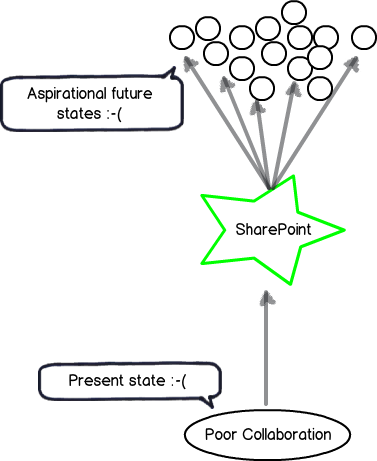
This is because the goal you are chasing looks seductively simple, but ultimately is an illusion. All of your stakeholders might use the same words, but have very different interpretations of what the goal actually looks like to them. The diagram that shows the problem with this is below. On the left is the mirage and to the right is the reality behind the mirage. Essentially your fuzzy goal actually is a proxy for a whole heap of unaligned and often unarticulated goals from all of your stakeholders.
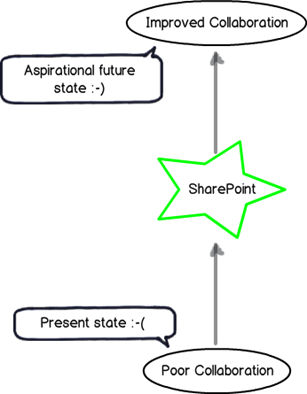
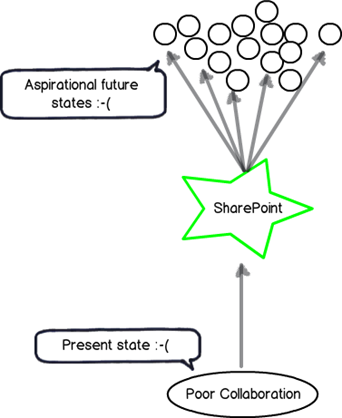
Snapshot   Snapshot

Now in theory, you have read the last post and now have a newly calibrated platitude radar. You will sit at a table and hear platitudes come in thick and fast because you will be using Ackoff’s approach of inverting a goal and seeing if a) the opposite makes any logical sense and b) could be measured in any meaningful way. As an example, here are three real-world strategic objectives that I have seen adorning some wordy strategic plans. All three set off my platitude radar big time…

“Collaboration will be encouraged”

“A best-practice collaboration platform”

“It’s a SharePoint project” Smile

I look at the first statement and think “so… would you discourage collaboration? Of course not.” Ackoff would take a statement like that and say “Stop telling me what you need to do to survive, and tell me what you need to do to thrive”.

What do you mean by?

So if I asked you how to unpack a platitude into reality, what might you do?

For many, it might seem logical to ask people what they really mean by the platitude. It might seem equally logical to come up with a universal definition to bring people to a common understanding of the platitude. Unfortunately, both are about as productive as a well-meaning Business Analyst asking users “So, what are your requirements?”

With the “what do you mean by [insert platitude here]” question, the person likely won’t be able to articulate what they mean particularly well. That is precisely why they are unconsciously using the platitude in the first place! Remember that a platitude is a mental shortcut that we often make because it saves us the cognitive effort of making sense of something. This might sound strange that we would do this, but in the rush to get things done in organisations, it is unsurprising. How often do you feel a sense of guilt when you are reflecting on something because it doesn’t feel like progress? Put a whole bunch of people feeling that way into a meeting room and of course people will latch into a platitude.

By the way, the “mental shortcut” that makes a platitude feel good seems to be a part of being human and sometimes it can work for us. When it works, it is called a heuristic, When it doesn’t its called a cognitive bias. Consult chapter 2 in my book for more information on this.

Okay, so asking what someone means by their platitude has obvious issues. Thus, it might seem logical that we should develop a universal definition for everyone to fall in behind. If we can all go with that then we would have less diversity in viewpoints. Unfortunately this has its issues too – only they are a little more subtle. As we discovered in part 2 of this series appropriately entitled “don’t define governance”, definitions tend to have a limited shelf life. Additionally, like best-practice standards, there are always lots of them to choose from and they actually have an affect of blinding people to what really matters.

So is there a better way?

It’s all in the question and its framing…

If there is one thing I have learnt above all else, is that project teams often do not ask the right question of themselves. Yet asking the right question is one of the most critical aspects to helping organisations solve their problems. The right question has the ability to cast the problem in a completely different light and change the cognitive process that people are using when answering it. In other words, the old saying is true: ask a silly question, get a silly answer.

Let me give you a real life example: Chris Tomich is a co-owner of Seven Sigma and was working with some stakeholders to understand the rationale for how content had been structured in a knowledge management portal. Chris is a dialogue mapper like me – and he’s extremely good at it. One thing Dialogue Mapping teaches you is to recognise different question types and listen for hidden questions. The breakthrough question in this case when he got some face time with a key stakeholder and asked:

  • What was your intent when you designed this structure for your content?

The answer he got?

  • “Well, we only did it that way because search was so useless”
  • “So if I am hearing you, you are saying that if search was up to scratch you would not have done it that way”
  • “Definitely not”

Neat huh? By asking a question that took the stakeholder back to the original outcome sought for taking a certain course of action, we learnt that poor search was such a constraint they compensated by altering page template design. Up until that point, the organisation itself did not realise how much of an impact a crappy search experience had made. So guess where Chris focused most of his time?

In a similar fashion, my platitude defeater question is this:

So if we had [insert platitude here], how would things be different to now?

Can you see the difference in framing compared to “what do you mean by [insert platitude here]?”. Like Chris with his “What was your intent”, we are getting people to shift from the platitude, to the difference it would make if we achieved the platitude. No definitions required in this case, and the answer you will get almost by definition has to be measurable. This is because asking what difference something would make involves a transition of some kind and people will likely answer with “increased this”  or “decreased that”.

Now be warned – a hard core middle manager might serve you up another platitude as an answer to the above question. To handle this, just ask the question again and use the new platitude instead. For example:

  • Me: Okay so if you had improved collaboration, how would things be different to now?
  • Them: We would have increased adoption
  • Me: And what difference would that make to things?

I call this the KPI question because if you keep on prodding, you will find themes start to emerge and you will get a strong sense of potential Key Performance Indicators. This doesn’t mean they are the right ones, but now people are thinking about the difference that SharePoint will make, as opposed to arguing over a definition. Trust me – its a much more productive conversation.

Now to validate that these emerging KPI’s are good ones, I ask another question, similarly framed to elicit the sort of response I am looking for…

What aspects should we consider with this initiative to [insert platitude here]?

This question is deliberately framed as neutral is possible. I am not asking for issues, opportunities or risks, but just aspects. By using the term aspects I open the question up to a wider variety of inputs. Like the KPI question above, it does not take long for themes to emerge from the resulting conversation. I call this the key focus area question, because as these themes coalesce, you will be able to ensure your emerging KPI’s link to them. You can also find gaps where there is a focus area with no KPI to cover it. As an added bonus, you often get some emergent guiding principles out of a question like this too.

The thing to note is that rather than follow up with “what are the risks?” and “what should our guiding principles be?”, I try and get participants to synthesize those from the answers I capture. I can do this because I use visual tools to collect and display collective group wisdom. In other words, rather than ask those questions directly, I get people to sort the answers into risks, opportunities and principles. This synthesis is a great way to develop a shared understanding among participants of the problem space they are tackling.

If we were unconstrained, how would we solve this problem?

This is the purpose question and is designed to find the true purpose of a project or solution to a problem. I don’t always need to use this one for SharePoint, but I certainly use it a lot in non IT projects. This question asks people to put aside all of the aspects captured by the previous question and give the ideal solution assuming that there were no constraints to worry about. The reason this question is very handy is that in exploring these “pie in the sky” solutions, people can have new insights about the present course of action. This permits consideration of aspects that would not otherwise be considered and sometimes this is just the tonic required. As an example, I vividly recall doing some strategic planning work with the environmental division of a mining company where we asked this exact question. In answering the question, the participants had a major ‘aha’ moment which in turn, altered the strategy they were undertaking significantly.

Note: If you want some homework, then check Ackoff’s notion of idealised design and the Breakthrough Thinking principle called the purpose principle. Both espouse this sort of framed question.

Sharpening the saw…

Via  the use of the above questions, you will have a  better sense of purpose, emergent focus areas and potential measures. That platitude that was causing so much wheel spinning should be starting to get more meaty and real for your stakeholders. For some scenarios, this is enough to start developing a governance structure for a solution and formulating your tactical approaches to making it happen. But often there is a need to sharpen the saw a bit and prioritise the good stuff from the chaff. Here are the sort of questions that allow you to do that:

No matter what happens, what else do we need to be aware of?

This question is called the criterial question and I learnt it when I was learning the art of Dialogue Mapping. When Dialogue Mapping you are taught to listen for the “no matter what…” preamble because it surfaces assumptions and unarticulated criteria that can be critical to the conversation and will apply to whatever the governance approach taken. Thus I will often ask this question in sessions, towards the end and it is amazing what else falls out of the conversation.

What are the things that keep you up at night?

I picked this up from reading Sue Hanley’s excellent whitepaper a while back and listening to hear speak at Share2012 in Melbourne reminded me why it is so useful. This question is very cleverly framed and is so much better than asking “What are your issues?”. It pushes the emotive buttons of stakeholders more and gets to the aspects that really matter to them at an gut level rather than purely at a rational level. (I plan to test out dialogue mapping a workshop with this as the core question sometime and will report on how it goes)

What is the intent behind [some blocker]?

This is the constraint buster question and is also one of my personal favourites. If say, someone is using a standard or process to block you with no explanation except that “we cannot do that because it violates the standards”, ask them what is the intent of the standard. When you think about it, this is like the platitude buster question above. It requires the person to tell you the difference the standard makes, rather than focus on the standard itself. As I demonstrated with my colleague Chris earlier, the intent question is also particularly useful for understanding previous context  by asking users to outline the gap between previous expectation and reality.

Conclusion…

To there you go – a black belt has been awarded. Now you should be armed with the necessary kung-fu skills required to deflect, disarm and defeat a platitude.

Of course, knowing the right questions to ask and the framing of them is one thing. Capturing the answers in an efficient way is another. For years now, I have advocated the use of visual tools like mind mapping, dialogue mapping and causal mapping tools as they all allow you to visually represent a complex problem. So as we move through this series, I will introduce some of the tools I use to augment the questions above.

Thanks for reading


Paul Culmsee


« Previous PageNext Page »

Today is: Wednesday 3 June 2026 -