Back to Cleverworkarounds mainpage
 

Dialogue Mapping: The Ying to SharePoint Yang

I don’t know about you, but as a SharePoint practitioner, I love the fact that I do not do SharePoint full-time anymore. I’d like to take some time to explain why this is the case, and how my non IT work helps me be a better SharePoint practitioner. To do so, I will talk about a recent non IT project I worked on. Who knows? This may give you some insights into how you view and approach collaborative work.

Western Australia is BIG

File:Kimberley region of western australia.JPGIn case you don’t know already, I live in Perth, Western Australia. You can see Perth if you squint at the map on your left and look to the south west area.

Western Australia is a bloody big land area and extremely isolated. One claim to fame about living in Perth is its distinction for being one of the most isolated cities in the world. In fact we has a population density is on par with Mongolia (this is dead-set true – I researched this fact). Of the 2.2 million people that live in the state, 1.8 million live in the Perth metropolitan area and the rest are scattered far and wide. In terms of distribution, there are no other major cities in Western Australia. The next most populated town outside of Perth is Mandurah with some 83,000 people. 

In the north of Western Australia, these towns are often separated by anywhere from a couple hundred to more than a thousand kilometres. The weather is very hot, the landscape is breathtakingly beautiful and the isolation here is hard to comprehend without visiting. The wealth of Western Australia (“GFC? What GFC?”) comes from the north of this vast state, via huge mineral deposits that China seems happy to buy from us, which in turn keep me and my colleagues busy putting in SharePoint around the place.

Now if you think Western Australia is big, get this: The Kimberley region of Western Australia (the top section marked in red) is almost as big as the entire country of Germany. For American readers, it alone is three fifths the size of Texas. For all that space, only around 45000-50000 people live there.

These wide distances create all sorts of challenges. At a most basic level, think about the cost of basic services to such a remote location with such a small population density. Cost of living is high and services like health care are always stretched and people living here have to accept that they will never be able to enjoy the same level of service enjoyed by their city slicker cousins.

Now that I have painted that picture in your mind, let me intersect that with one of Australia’s biggest wicked problems. The indigenous people’s of Australia have many social and health issues that have had a massive human cost to them. We are talking chronic alcoholism, physical and sexual abuse, depression, suicide and the whole range of mental illnesses. Families and communities tear themselves apart in a seemingly an endless negatively reinforcing cycle. Like many indigenous groups around the world, intervention approaches from earlier periods have had catastrophic long term consequences that were never considered at the time (a classic wicked problem characteristic). When you read the stories about the stolen generations, you cannot help but be deeply moved by the long term effects, the damage done and the sad legacy left behind.

Continue reading “Dialogue Mapping: The Ying to SharePoint Yang”


Improve your stakeholders “Crapness Calibration ™” for SharePoint Information Architecture success

Hi All

Here is my simple, patent pending method to use to help users design good SharePoint sites. It combines two very effective IA methods into one and its amazing how it turns people from wanting 1990’s era sites complete with horizontal scrolling banners with animated GIF’s into usability and IA gurus within minutes.

The tools of the trade you need for this method is:

So now you know the ingredients, let’s run through the recipe

  1. Put key stakeholders into a room (ensure the ones with poor taste are there together)
  2. Visit websitesthatsuck.com and review the 2010 contenders for worst websites of the year. (For what its worth, my personal vote is Yale School of Art)
  3. Have a good laugh and discuss all the crappy aspects to those sites – make particular note of the write-up on websitesthatsuck for each contender
  4. With the group’s sucky website radar now primed, have them load up their existing intranet (if they are really big organisation, go around to various departmental sites around the intranet). This time they will not laugh, due to the effect of your “crapness calibration” ™ exercise, they will see many faults in the existing site straight away.
  5. At this point, crank out Balsamiq and start to wireframe what the site should look like while you have the fleeting moment of clarity (crapness calibration fades with time and needs to be re-primed). The wisdom of the crowd should ensure that most of the common mistakes will be avoided there and then.
    • Statistically, one of every three times you do this, there is always one user who’s taste is so bad that calibration will take another round of deprogramming. So if you have someone that persists with crap taste or has ideas that 99% of the user base would balk at, move to the 2009 hall of shame for sucky sites. Faced with the reaction from their peers, as well as the parallels that can be drawn between their current site and the contenders, it usually does the trick.
    • Also be sure to draw attention to sites that have similar underlying concepts, but where one works well and the other has agonising lameness. For example, the New York Times compared to Havenworks. Discuss the layout, colours, fonts, images, navigation, search and the like and relate back to the site being envisioned.

In about 30-90 minutes, one of two things will happen.

  1. You will have a pretty good wireframe or three
  2. The group will realise that they have more soul searching to do.

Although your business development manager will whine at you if outcome 2 happens, consider it a good thing. You will be saving yourself and the participants a mountain of stress later and have them thinking more holistically about the outcomes they are trying to achieve.

(Final serious bit at the end alert)

What you will notice when performing this process, is that with a recent and clear frame of reference, some of the biases that people carry with them can be temporarily lifted. In some ways, this exercise is very similar to the “down the pub” calibration of estimates exercise that I wrote about previously. The trick is to find ways to change the lens people look through to see other aspects or facets to the problem at hand.

To that end, if you are in the UK or nearby, consider coming to my Governance and Information Architecture Master Class in London with Andrew Woodward and Ant Clay. Lots of other (more serious and rigorous) methods for developing shared understanding will be covered.

Thanks for reading

Paul Culmsee

www.sevensigma.com.au


Why I’ve been quiet…

As you may have noticed, this blog has been a bit of a dead zone lately. There are several very good reasons for this – one being that a lot of my creative energy has been going into co-writing a book – and I thought it was time to come clean on it.

So first up, just because I get asked this all the time, the book is definitely *not* “A humble tribute to the leave form – The Book”! In fact, it’s not about SharePoint per se, but rather the deeper dark arts of team collaboration in the face of really complex or novel problems.

It was late 2006 when my own career journey took an interesting trajectory, as I started getting into sensemaking and acquiring the skills necessary to help groups deal with really complex, wicked problems. My original intent was to reduce the chances of SharePoint project failure but in learning these skills, now find myself performing facilitation, goal alignment and sensemaking in areas miles away from IT. In the process I have been involved with projects of considerable complexity and uniqueness that make IT look pretty easy by comparison. The other fringe benefit is being able to sit in a room and listen to the wisdom of some top experts in their chosen disciplines as they work together.

Through this work and the professional and personal learning that came with it, I now have some really good case studies that use unique (and I mean, unique) approaches to tackling complex problems. I have a keen desire to showcase these and explain why our approaches worked.

My leanings towards sensemaking and strategic issues would be apparent to regular readers of CleverWorkarounds. It is therefore no secret that this blog is not really much of a technical SharePoint blog these days. The articles on branding, ROI, and capacity planning were written in 2007, just before the mega explosion of interest in SharePoint. This time around, there are legions of excellent bloggers who are doing a tremendous job on giving readers a leg-up onto this new beast known as SharePoint 2010.

BBP (3)

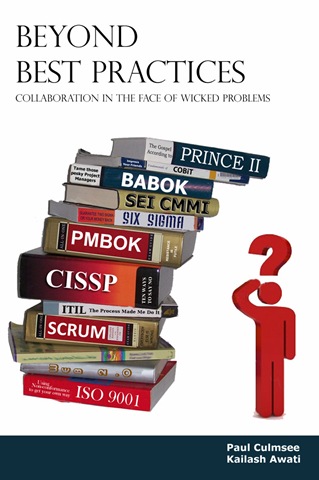
So back to the book. Our tentative title is “Beyond Best Practices” and it’s an ambitious project, co-authored with Kailash Awati – the man behind the brilliant eight to late blog. I had been a fan of Kailash’s work for a long time now, and was always impressed at the depth of research and effort that he put into his writing. Kailash is a scarily smart guy with two PHD’s under his belt and to this day, I do not think I have ever mentioned a paper or author to him that he hasn’t read already. In fact, usually he has read it, checked out the citations and tells me to go and read three more books!

Kailash writes with the sort of rigour that I aspire to and will never achieve, thus when the opportunity of working with him on a book came up, I knew that I absolutely had to do it and that it would be a significant undertaking indeed.

To the left is a mock-up picture to try and convey where we are going with this book. See the guy on the right? Is he scratching his head in confusion, saluting or both? (note, this is our mockup and the real thing may look nothing like this)

This book dives into the seedy underbelly of organisational problem solving, and does so in a way that no other book has thus far attempted. We examine why the very notion of “best practices” often makes no sense and have such a high propensity to go wrong. We challenge some mainstream ideas by shining light on some obscure, but highly topical and interesting research that some may consider radical or heretical. To counter the somewhat dry nature of some of this research (the topics are really interesting but the style in which academics write can put insomniacs to sleep), we give it a bit of the cleverworkarounds style treatment and are writing in a conversational style that loses none of the rigour, but won’t have you nodding off on page 2. If you liked my posts where I use odd metaphors like boy bands to explain SharePoint site collections, the Simpsons to explain InfoPath or death metal to explain records versus collaborative document management, then you should enjoy our journey through the world of cognitive science, memetics, scientific management and Willy Wonka (yup – Willy Wonka!).

Rather than just bleat about what the problems with best-practices are, we will also tell you what you can do to address these issues. We back up this advice by presenting a series of practical case studies, each of which illustrates the techniques used to address the inadequacies of best practices in dealing with wicked problems. In the end, we hope to arm our readers with a bunch of tools and approaches that actually work when dealing with complex issues. Some of these case studies are world unique and I am very proud of them.

Now at this point in the writing, this is not just an idea with an outline and a catchy title. We have been at this for about six months, and the results thus far (some 60-70,000 words) have been very, very exciting. Initially, we really had no idea whether the combination of our writing styles would work – whether we could take the degree of depth and skill of Kailash with my low-brow humour and my quest for cheap laughs (I am just as likely to use a fart joke if it helps me get a key point across)…

… But signs so far are good so stay tuned 🙂

Thanks for reading


Paul Culmsee

www.sevensigma.com.au


A simple way to improve your estimating (and a cool pub trick) – Conclusion

…and we’re back!

Well… that was a long commercial break wasn’t it 🙂

In case you missed part 1 of our version of the show “deal or no deal”, you missed the big cliff-hanger and you really should read part 1 first. For the rest of you, to quickly recap, I came out of the closet and admitted by secret teenybopper shame, told the world that my wife had a teenage thing for Jean Claude Van Damme, showed the effect of beer goggles and introduced the notion of cognitive bias and how it can affect judgement.

i also demonstrated how, by altering the frame of reference, to a problem something that at first seems completely unquantifiable “how the hell do I know how many SharePoint developers drive yellow cars?”, is actually not as “impossible” as you may first think.

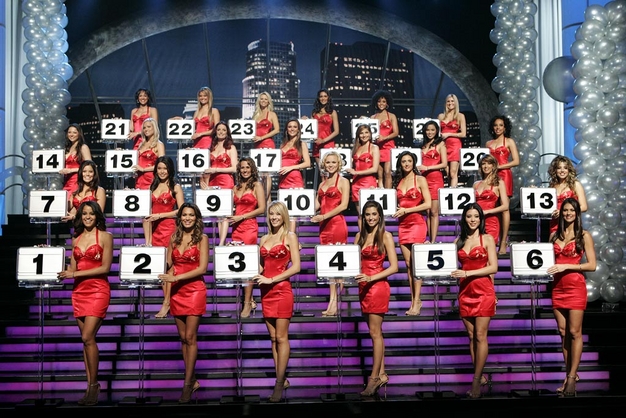
At the end of the last post I left you with a $10000 dilemma. You had to make a “deal or no deal” decision about going with your estimate about SharePoint developers who own yellow cars, or to instead cast your lot with a bag of marbles with a 9 in 10 chance of winning the prize. Just to refresh your memory, here is the salient part of the pub conversation.

  • Me: Okay, so you are 90% sure that here are between 300 and 2000 SharePoint developers in the world with a yellow car?
  • Them: Yes
  • Me: So, let’s make this like the game show “deal or no deal”. If you are right and the answer is within your range, you will win $10000. BUT you have an alternative…
  • Them: Ok…
  • Me: What if I were to present you with a bag containing 9 red marbles and 1 black marble and offer you $10000 if you pull out a red marble. Pull the one black marble, and you miss out on the money. Do you want to stick to your estimate or do you want to draw a marble?

So have you decided? Now be honest and see how you went against the 4 outcomes that I have experienced when trying this on people. Here are the possible answers in order of popularity…

  1. The person chooses to pull from the bag of marbles rather than their ranged estimate. (This is the predominant answer for all people I have tried this with – perhaps 70-75% of all responses).
  2. The person chooses to use their estimate over the bag of marbles. (perhaps 25% of people have answered with this option)
  3. Upon hearing the bag option, the person wants to change their ranged estimate. (Happened to me once)
  4. The person doesn’t care which method.. (never happened to me)

So which is the right answer to this question?

(drumroll) Lets tackle the possible answer in order of likelihood.

“Take the marble! take the maaaaaarble!”

For the 70 odd percent of you who opted to take your chances with the bag of marbles, GONG! you lose!

Better double check your estimates in future because you have demonstrated that you are over-confident in your estimates. In other words, you are suffering from optimism bias. To explain why, think about the original question carefully. I asked originally for a ranged estimate that you were 90% confident with.

I then presented an alternative that has a 9 out of 10 chance of success – also 90%. From a statistical point of view, you should be completely ambivalent as to which option to use. Therefore, despite being asked for a range that you were 90% confident with, the range you actually estimated is not really 90% at all. It has to be less than 90% for you to prefer a clear 9/10 probability.

So that is why you are so stressed and busy! You keep giving crap estimates that make life harder for you! 🙂 Either that or you are too nice and when your project manager looks at you with those big, sad project manager eyes, your heart melts and you relent.

Isn’t that cool in a nerdy way? It is very interesting to see people’s faces as the penny drops to this logic and they suddenly realise just how bad some of their past estimates have been as a result. The consolation prize is just about 4 out of 5 people do exactly the same as you and take the marbles.

“No deal, I will stick with my estimate”

For the smaller group who decide that their estimate is preferred, you also lose.

In this case, the reason why should be pretty obvious. You are so paranoid about getting it wrong, that you have made an estimate that is more like 95% or even 99% confident. Why? your range is too wide for 90% because when presented with a clear 9/10 chance of success, you chose your original estimate. While that may sound like you are confident, in reality you are a bit of a wuss, because in fact you are under confident with your estimate. So grow some balls you weenie 🙂

Honorary mention – “I want to change my estimate”

At the Best Practice Conference in DC, I attempted this pub trick on Yoav Lurie from Synteractive, who is much more of a business and strategic thinker than us IT nerds. His response I think, deserves an honorary mention for being the closest to winning the game. In this example, I asked him to estimate in feet, the wingspan of a Boeing 747. I knew instantly that he was a good estimator because of the logic he used to come to a range.

“Hmm, well an aircraft seat is maybe one and a half feet, and there will be 10 seats in the cabin, with two passages that are probably two feet in width…so that ads up to…”

What do you notice about what Yoav did? Straight away, he related the wingspan of an aircraft (a clear unknown), to something he could make a reasonable estimate of (the width of an aircraft seat). After all, we have all sat in an aircraft seat in sardine (economy) class and know how cramped it is. He knew there were three rows of seats and related this to the width of the cabin, which he then related to the size of the wing. Deducing that the wing might be 4 to 6 times the width of the cabin, he then was able to make a very good ranged estimate of the overall wingspan of the plane.

I was very impressed at his estimate and how he arrived at it, but I still got him 🙂

As soon as I presented him with the bag of marbles alternative, without missing a beat he said “I want to change my estimate”. It took only a split second of presenting a clear 90% probability made Yoav realise that his estimate was not 90% and he was still a little overconfident.

That being said, Yoav’s method of relating something known to help frame the reference to something unknown is the only time anyone has used any sort of rigour in forming an estimate and very impressive for the pub setting 🙂

The right answer

Okay, so as you may have guessed by now, the right answer is to shrug your shoulders and say “I don’t care” or wave your hand at me and say “pfft, whatever”. (This is one of the few times saying you couldn’t care less is the right answer). In doing so, you have placed equal weight upon the choices, based on the assumption that both are 90% probabilities.

Neat pub trick huh? It certainly gets people thinking.

How to calibrate yourself

Douglas Hubbard talks about “calibrated estimates” in his books and has an appendix of calibration questions, that are designed to help you perceive and account for cognitive bias in your estimating.

What you should take away from this exercise is that when asked to estimate on something you are uncertain about, make your initial estimate. Then, pretend you are in the game show and you have to pick between this estimate and the marble. If you feel that you would take the marble over your estimate, increase the width of your range until you feel that it doesn’t matter which option you pick.

Conversely, if you are one of the wimps who are under confident, then reduce the width of your range, until you feel that you have no particular preference of your estimate vs. the marbles.

In the same way that reframing a problem led from something being unquantifiable to something that indeed had a upper and lower range, by reframing the estimate against a unambiguous probability such as a bag of 10 marbles with 9 red, helps you to account for cognitive bias in your estimates.

Conclusion

So to reiterate my key points to this post

  1. Many things that seem unquantifiable are easier to quantify than you think, once you think in terms of ranged estimates and probability.
  2. Your bad taste in fashion and music when you were a teenager still manifests itself today and it is called cognitive bias.
  3. There are easy methods that you can use to calibrate yourself better so that your estimating radar is more finely tuned.

Most importantly of all however, you learned that my wife liked Jean Claude Van Damme in the 80’s and you know that I am in big trouble when she reads this! 😛

Thanks for reading

Paul



A simple way to improve your estimating (and a cool pub trick) – Part 1

Okay I’ll admit it, I used to really suck as a time and effort estimator. I happen to have a business partner who is much better at it than me (hey Peter), and every time I sought a second opinion from him on my estimates, he would almost always make a much less optimistic assessment then me. Of course, Peter was almost always right too, dammit.

So, why was Peter much more accurate with his estimates?

The answer to this question, all one has to do is think back to their teenage years, where they went through that awkward stage where you look back and cringe at the posters that were on your wall and your choice of fashion. For many, this period demonstrates some utterly appalling choices of taste. Mine are particularly cringe-worthy, given that these days I am a bit of a metalhead. My favourite song at the time was Respectable by Mel and Kim. I thought that Karate Kid II was the best film of all time (and that the girl in it was hot). Mind you, my wife has an even more shameful secret. She had a crush on Jean Claude Van Damme! Mwahahahah 🙂

These are examples of a phenomenon I like to call “Teenybopper bias” 🙂

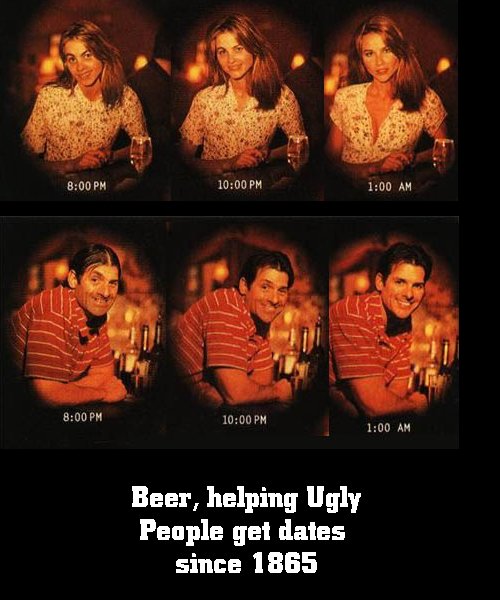
Now, there is a point in telling you about my wife’s secret shame and it isn’t to see her reaction when she reads this (okay, well maybe a teenie bit). These examples of “what the hell was I thinking” are a form of cognitive bias that took place at the time the opinion was formed. In terms of teenybopper bias, the root of the bias is likely the same hormones that caused your face to break out with acne and hair to grow in funny places. Another very common cognitive bias that afflicts people whether young or old is good old “beer goggle” bias illustrated below.

There are many, many forms of cognitive bias documented, such as optimism bias, anchoring, hindsight bias and the recency effect to name a few. Now let’s take the final image above and pretend we asked someone at the pub for an estimate on a project at 8pm, 10pm and 1am. I’d be willing to bet that the estimate gets more optimistic on a par with how optimistic the perception of the people in the image above become.

Overcoming cognitive bias

Kailash writes about the risk that cognitive bias can play in project failure, particularly in the perception of risks.

overcoming biases requires an understanding of the thought processes through which humans make decisions in the face of uncertainty.  Of particular interest is  the role of  intuition and rational thought in forming judgements, and the common mechanisms that underlie judgement-related cognitive biases.   A knowledge and awareness of these mechanisms  might help project managers in consciously countering the operation of cognitive biases in their own decision making.

The essential difference between Peter and myself in our estimating, is that Peter happens to have a much more finely tuned radar to optimism bias in particular. Douglas Hubbard of Applied Information Economics fame, writes about the effect of cognitive bias extensively in his two books and offers a simple, yet highly useful method to quickly improve the quality of estimates which I will explain with an example below.

The great thing about learning about your cognitive biases and the methods for mitigating them, is that you can use it in the pub too. While I don’t recommend this method for picking up members of the opposite sex, it’s a pretty cool icebreaker.

Thus, I will demonstrate how to improve your estimating accuracy by a mythical pub conversation. Imagine you are onto your third beer…

  • Me: “How many SharePoint developers worldwide own a yellow car?
  • Them: “What the…I haven’t the faintest idea!”
  • Me: “Well, I can understand that, so let’s do an estimate. Give me a range that the answer could fall in, that you are 90% confident with.”
  • Them: “I still can’t give you an estimate, I can’t possibly know something like that.”
  • Me: “Well, could there be a million SharePoint developers who like yellow cars?”
  • “Them: “Don’t be ridiculous, there would be nowhere near a million SharePoint developers – period.”
  • Me: “So you do have an upper bound then, less than a million. Remember this is not about the exact answer, I want a range that you would be 90% confident with.”
  • Them: “Okay I get it. I think it is somewhere between three hundred and two thousand.

Note that at this point, we have already made the initial breakthrough. At first the person found it impossible to make an estimate, yet when I related it to something they did have a fair idea of (the thought of a million people), they made some mental associations and realised they did have some idea of limits after all. Thus, by presenting a better frame of reference that they could use to approach the problem, they were able to move from “I have no idea” to a wide range of possible values.

The width of the range reflects the uncertainty that someone has about the answer. The more the uncertainty, the wider the range. Some project mangers hate being given a ranged value because it really mucks up their task or project work breakdowns. As a result, they always want the “ball park” or something that is a single value. I completely understand why this happens, but what these people forget is that an estimation is uncertain by definition. The obvious way to express uncertainty is with a range of values! So asking someone for an estimation and then complaining that it is not accurate enough actually makes no sense. A manager might not like the “width” of the range, but you can’t force someone to reduce their uncertainty just because it doesn’t fit the plan. Unless you provide them with the means to reduce this uncertainty, you cannot and should not try and artificially reduce this range through pressure and coercion.

But despite my observation of the flawed logic of dealing with uncertainty in estimating, a ranged estimate alone is not enough yet. We still have not accounted for the sorts of cognitive bias that I described earlier in the article. So without further adieu, I present a simplified version of Hubbards ‘calibration’ techniques that account for bias. Let’s continue the bar conversation.

  • Me: Okay, so you are 90% sure that here are between 300 and 2000 SharePoint developers in the world with a yellow car?
  • Them: Yes
  • Me: So, let’s make this like the game show “deal or no deal”. If you are right and the answer is within your range, you will win $10000. BUT you have an alternative…
  • Them: Ok…
  • Me: What if I were to present you with a bag containing 9 red marbles and 1 black marble and offer you $10000 if you pull out a red marble. Pull the one black marble, and you miss out on the money. Do you want to stick to your estimate or do you want to draw a marble?


I’d like readers to think about this before continuing with this article. Make a ranged estimate of the number of SharePoint developers worldwide who drive a yellow car, and then decide whether you want to stick to your estimate or take your chances with the marbles.


(Cue game show music where you have 10 seconds to decide with a little ping sound at the end.)

The suspense is now killing you I am sure. Want to know the correct answer?

Find out after this short commercial break (game show speak for wait till part 2 of this series 🙂 )


Thanks for reading


Paul Culmsee

www.sevensigma.com.au


« Previous Page

Today is: Wednesday 3 June 2026 -