Back to Cleverworkarounds mainpage
 

Introduction to Dialogue Mapping class in Melbourne June 13-14

Hi all

We have all felt the pain of a meeting or workshop where no-one is engaged, the conversation is being dominated by the loudest or everyone is mired in a tangle of complexity and there is no sense of progress. Not only is it incredibly frustrating for participants, but it is really inefficient in terms of time and effort, reduced collaboration and can lead to really poor project outcomes.

The big idea behind the technique of Dialogue Mapping is to address this problem. Dialogue Mapping is an approach where a project manager or business analyst acts as a facilitator while visually mapping the conversation of a group onto a projected display. This approach reduces repetition by acknowledging contributions, unpacks implicit assumptions and leads to much better alignment and understanding among a group.

For SharePoint projects, this is a must and I have been using the technique for years now. Other SharePoint luminaries like Michal Pisarek, Ruven Gotz and Andrew Woodward also use the approach, and Ruven even dedicated a chapter to Dialogue Mapping in his brilliant Information Architecture book.

In Melbourne, I am going to be running a 2 day Introduction to Dialogue Mapping class to teach this technique. There are only 10 places available and this is one of the few public classes I will be running this year. So if you are attending the Australian SharePoint conference, or live near Melbourne and deal with collaborative problem solving, stakeholder engagement or business analysis, this is a great opportunity to come and learn this excellent problem solving technique.

Hope to see you there!

Paul


Powerful questions part 2: The key focus area question

Hiya

I just recorded the second video on the topic of powerful questions. These powerful questions are the result of the years I’ve spent dialogue mapping many different groups of people on many different problems. As time has gone on, I’ve learnt a lot about collaborative problem solving, and concluded that some questions tend to lead to breakthrough more than others.

In the previous video, I introduced you to the platitude buster question. This time around, I have recorded a video on one of the best questions you can ask in any form of strategy development meeting – the key focus area question. For all you SharePoint types, I always use this question during SharePoint governance planning and when drawing up a project charter, but it is equally effective when working with an executive team who are working out their short and long term strategies.

Like the previous post, I suggest you watch this video in full screen. Enjoy!

How to eke out key focus areas from a discussion

Thanks for reading

Paul Culmsee

HGBP_Cover-236x300


Powerful questions part 1: The platitude buster question

Hi all

I’ve been a little busy lately so haven’t had sufficient time to write many articles. This will likely continue for a while as I’m also planning the next heretical book with Kailash.

But the other day on a whim, I decided to record a short video on the topic of powerful questions. As I do more and more facilitation, strategic planning and team development work, I am constantly learning about the patterns of group conversation. This has helped me develop insights into the sort of questions that have the potential to cut through complexity to achieve breakthroughs in complex situations. I call these questions “powerful” for that reason.

It should be noted that a powerful question is not necessarily the question itself, but sometimes the the way a question is asked. To that end, in this first video, I take you through the best way I know to cut through organisational platitudes. Platitudes are phrases that often sound impressive and authoritative, ultimately hide the fact that there is not a lot of substance underneath them. While its easy to cite a blatant example like “best practice organisational excellence,” most of the time platitudes are used unconsciously and in much more subtle and dangerous ways. In fact often people ask questions or conduct workshops in such a way that actually encourage platitude answers.

So how do I bust or disarm a platitude? Watch this video to find out! Smile

How to disarm a platitude with one question…

Now I plan to do a few of these videos, with each building on the last with a new powerful question. Also, I will utilise Compendium and Dialogue Mapping techniques, so you also get a better idea of the sort of non SharePoint work that myself and my colleagues get to perform. So please let me know what you think of the clip. (oh – before I forget, I strongly suggest you watch the video in full screen)

Thanks for reading

Paul Culmsee

www.hereticsguidebooks.com

HGBP_Cover-236x300


New videos: Demonstrating the value of Dialogue Mapping

Hi

In December I recorded a podcast with Nick Martin over at workshopbank.com. This was a fun interview for two reasons. Nick is a really smart guy and great to talk to, and it was Friday afternoon, close to Christmas and I was drinking a beer Smile

In any event, these two videos present an overview of what Dialogue Mapping is all about, some of the case studies where I have used it, and a demonstration of its utility. You will learn:

  • What Dialogue Mapping is and what it can do for you and your stakeholders
  • Learn when to use Dialogue Mapping and when not to
  • Learn how there is no setup or training that the participants have to go through when they’re in a Dialogue Mapping session
  • Learn how all participants feel like they’re being heard when being Dialogue Mapped
  • Hear an great case study when I used Dialogue Mapping for the first time…
  • Hear how as a mapper, you don’t need to be an expert in the subject being discussed
  • Glean a few insights about the Heretics guide to best practices book

To view the interview and demonstration, head on over to workshopbank.com

image

thanks for reading

Paul Culmsee

www.hereticsguidebooks.com


Making Sense of SharePoint and Digital Records Management…

Hi all

One of the conversation areas in SharePoint life that is inevitably complex is that of records management since there are just as many differing opinions on records management as there are legal jurisdictions and different standards to choose from. Accordingly, a lot of confusion abounds as we move into a world dominated by cloud computing, inter-agency collaboration, changes in attitudes to information assets via the open data/government 2.0 movements, and of course, the increasing usage of enterprise collaboration systems like SharePoint. As a result, I feel for record managers because generally they are an unloved lot and it is not really their fault. They have to meet legal compliance requirements governed by various acts of legislation, but their job is made all the harder by the paradox that the more one tries to enforce compliance, the less likely one is to be compliant. This is because more compliance generally equates to more effort on the part of users for little perceived benefit. This results in direct avoidance of using record management systems or the plain misuse of those systems (both which in turn results in a lack of compliance).

As it happens, my company works with many government agencies primarily in the state of Western Australia, both at a state agency and local government level. We have seen most enterprise document management systems out there such as HP Trim, Objective, Hummingbird/OpenText and have to field questions on how SharePoint should integrate and interact with them (little known fact – I started my career with Hummingbird in 1998 when it was called PCDOCS Open and before SharePoint existed).

Now while I am sympathetic to the plight of your average records management professional, I have also seen the other side of the coin, where records management is used to create fear, uncertainty and doubt. “You can’t do that, because of the records act” is a refrain that is oft-levelled at initiatives like SharePoint or cloud based solutions to try and shut them down or curtail their scope. What makes it hard to argue against such statements is that few ever read such acts (including those who make these sort of statements). So being a sucker for punishment, I decided to read the Western Australian State Records Act 2000 and the associated standard on digital recordkeeping, published by the State Records Office. My goal was to understand the intent of these standards and the minimum compliance requirements they mandate, so I could better help clients integrate potentially disruptive tools into their compliance strategies.

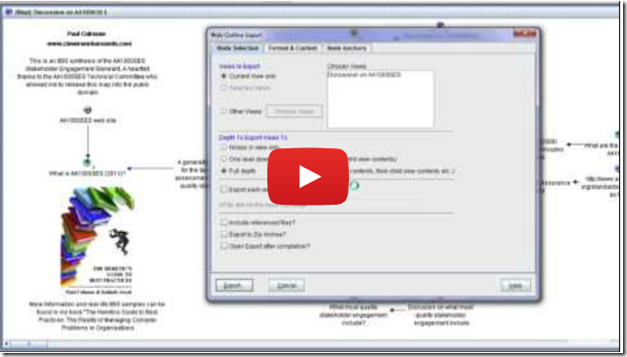
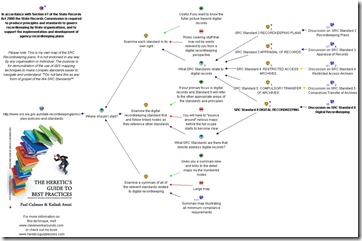
I did this by starting out with the core standard in Western Australia – SRC Standard 8: Digital Recordkeeping. I created an IBIS Issue Map of this standard using Compendium software. What I soon discovered was that Standard 8 refers to other standards, such as Standard 2: Recordkeeping Plans and Standard 3: Appraisal of Records. That meant that I had to add these to the map, as well as any other documents they referred to. In the end, I followed every standard, policy or guideline in a recursive fashion, until I was back at the digital recordkeeping standard where I started. This took a while, but I eventually got there. You can click the image below to examine the standards in all of their detail and watch the video to see more about how I created it.

Map   

Now I need to make it clear that my map is not endorsed by the State Records Office, so it is provided as-is with a disclaimer that it is not intended to drive policy or be used as anything more than an example of the mapping approaches I use. I felt that by putting the standards into a IBIS based issue map, I feel I was able to reduce some of the complexity of understanding them, because now one can visually see how the standards relate to each other. Additionally, by taking advantage of Compendiums ability to have the same node in multiple maps, it allowed me to create a single ‘meta map’ that pulled in all of the compliance requirements into a single integrated place. One can look at the compliance requirements of all the standards in one place and ask themselves “Am I meeting the intent of these standards?”

Reflections…

In terms of my conclusions undertaking this work, there are a few. For a start, everything is a record, so people should just get over the whole debate of “is it or isn’t it”. In short, if you work for a government agency and are doing actual work, then your work outputs are records. The issue is not what is and is not a record, but how you control and manage them. Secondly, the notion that there has to be “one RMS system to rule them all” to ensure compliance is plain rubbish and does not stand up to any form of serious scrutiny. While it is highly desirable to have a single management point for digital recordkeeping, it is often not practical and insistence in doing this often makes agencies less compliant because of the aforementioned difficulties of use, resulting in passive resistance and outright subversion of such systems. It additionally causes all sorts of unnecessary stress in the areas of new initiatives or inter-agency collaboration efforts. In fact, to meet the intent of the standards I mapped, one by definition, has to take a portfolio approach to the management of records as data will reside in multiple repositories. It was Andrew Jolly who first suggested the portfolio idea to me and provided this excellent example: There is nothing stopping records management departments designating MS Exchange 2013 Site mailboxes as part of the records management portfolio and at the same time having a much better integrated email and document management story for users.

For me, the real crux of the digital records management challenge is hidden away in SRC Standard 8, Principle 5 (preservation). One of the statements of compliance in relation to preservation is that “digital records and their metadata remain accessible and usable for as long as they are required in accordance with an approved disposal authority.”  In my opinion, the key challenge for agencies and consultancies alike is being able to meet the requirements of Disposal Authorities (DA’s) without over burdening users. DA’s are the legal documents published by the State Records Commission that specify how data is handled in terms of whether it is archived or deleted and when this should happen. They are also quite prescriptive (some are mandated), and their classification of content from a retention and disposal point of view poses many challenges, both technically and organisationally. While for the sake of size, this article is not going to get into this topic in detail, I would advise any SharePoint practitioner to understand the relevant disposal authorities that their organisation has to adhere to. You will come away with a new respect for the challenges that record managers face, an understanding on why they use the classification schemes that they do, why records management systems are not popular among users of the systems and why the paradox around “chasing compliance only to become non-compliant” happens.

Maybe you might come away with some insights on how to better integrate SharePoint into the story? Then you can tell the rest of us Smile

Thanks for reading

Paul Culmsee

paul.culmssee@sevensigma.com.au


Interested in learning the craft of Dialogue Mapping in Auckland?

Hi all

I have spent a bit of time in New Zealand over the last few years, met a lot of really interesting people and frequently get asked about conducting a Dialogue Mapping training workshop over there. I’m really happy to announce that this is finally going to happen in Auckland on May 30th. It should be a really interesting session with a mix of SharePoint people, community development practitioners and organisation development consultants.

Just to be clear, this is not a SharePoint class. I am teaching the techniques of Issue Mapping, the core technique that enables you to become a great Dialogue Mapper. The class is very activity driven and helps you acquire a hugely valuable life skill that not only equips you with a great technique for tasks like business analysis and requirements elicitation, but also allows you to get involved with more complex problem solving scenarios like strategic planning. If you enjoyed my book, the Heretics Guide to Best Practices, this course teaches you the same techniques outline there.

To sign up for the class, head on over to eventbrite. For a full breakdown of the class structure then check out the class brochure.

The workshop will be held at the following venue:

Quality Hotel Parnell
20 Gladstone Rd
Parnell, Parnell 1052
New Zealand
Thursday, May 30, 2013 at 8:30 AM – Friday, May 31, 2013 at 5:00 PM (NZST)

If you would like to see and hear more about Dialogue Mapping, then take a look at these two video’s hot off the press by workshopbank.com. In the first video I speak about Dialogue mapping in general and the second is a very apt demonstration of the approach given that the next class is in New Zealand Smile

Experiences of a practicing Dialogue Mapper
Lord of the rings IBIS style

Thanks for reading

Paul Culmsee

HGBP_Cover-236x300


Learn about Dialogue Mapping in Auckland Jan 31st

Hi all

This message comes to you from New Zealand where I have been for the last three weeks with the family. While here, I am doing a talk on Dialogue Mapping for Tepu (a partnership between Unitec & Rosebank Business Association). If you are in Auckland or close by, then register to attend this free event and learn more about the techniques that inspired the award winning Heretics Guide to Best Practices book. I will provide a background to Dialogue Mapping and emergent design practice, cover some case studies and provide a live demo.

If you are in any sort of role that has to deal with complex problems (strategy, planning and policy development, sustainability, stakeholder engagement, etc), then the session should be well worthwhile.

When: Thursday, Jan. 31st
Where: Building 172, Room 2018, Unitec Mt. Albert campus

Door opens at 8:30 for coffee & tea
Presentation and workshop 9:00 a.m. – 10:00 a.m.
Coffee and networking, closes at 10.30a.m

Although this is not a SharePoint specific event, I urge any SharePointers in Auckland to come and be part of the discussion. The registration site with further detail can be found here:

www.catalystco.eventbrite.com


Thanks for reading


Paul Culmsee

www.hereticsguidebooks.com


Confessions of a (post) SharePoint architect: The dangers of dial tone governance…

Hi all and welcome to the next exciting instalment of my confessions from my work as a SharePoint architect and beyond. This is the eighth post and my last for 2012, so I will get straight into it.

To recap, along the way we have examined 5 f-laws and learned that:

Now, as a preamble to today’s mini-rant, I need to ‘fess up. I know this might come as a shock, but there was once a time when I was not the sweet, kind hearted, gentle soul who pens these articles. In my younger days, I used to judge my self-worth on my level of technical knowledge. As a result of this, I knew my stuff, but was completely oblivious to how much of a pain in the ass I was to everyone but geeks who judged themselves similarly. Met anyone like that in IT? Smile

This brings me onto my next SharePoint governance f-law – one that highlights a common blind spot that many IT people have in their approach to SharePoint governance.

F-Law 6: Geeks are far less important than they think they are

All disciplines and organisational departments have a particular slant on reality that is based on them at the centre of that reality. If this was not true, then departments would not spend so much time bitching about other departments and I would have no Dialogue Mapping work. The IT department is no better or worse in this regard than any other department, except that the effects of their particular slant of reality can be more pronounced and far reaching on everyone else. Why? Because the IT slant of reality sometimes looks like a version of Neo from the Matrix. Many, if not most people in IT, have a little Neo inside of them.

image

We all know Neo – an uber hero. He is wise, blessed with super powers, can manipulate your very reality and is a master of all domains of knowledge. Neo is also your last hope because if he goes down, we all go down. Therefore, everything Neo does – no matter how over the top or what the consequences are – is necessary to save the world from evil.

All of the little Neos in IT have a few things in common with bullet stopping big Neo above. Firstly, little Neo has also been entrusted with ensuring that the environment is safe from the forces of evil. Secondly, Little Neo can manipulate the reality that everybody else experiences. And finally, little Neo is often the last hope when things go bad. But that is where the similarities end because big Neo has two massive advantages over little Neo. First, big Neo was a master of a lot of domains of knowledge because he had the convenience of being able to learn any new subject by downloading it into his brain. Little Neo does not have this convenience, yet many little Neos still think they are all-knowing and wise. Secondly, big Neo was never mentally scarred from a really bad tequila bender…

Bad tequila bender? What the…

Never again…

Years ago when I was young and dumb, I was at a party drinking some tequila using the lemon and salt method. My brother-in-law thought it would be hilarious to switch my tequila shots with vodka double shots. Unfortunately for me, I didn’t notice because the lemon and salt masked the taste. I downed a heap of vodkas and the net result for me was not pretty at all. Although I wasn’t quite as unfortunate as the guy in the picture below I wasn’t that far off. As a result, to this day I cannot bring myself to drink tequila or vodka and the smell of it makes me feel sick with painful memories best left supressed.

image

I’m sure many readers can relate to a story like this. Most people have had a similar experience from an alcohol bender, eating a dodgy oyster or accidentally drinking tap water in a place like Bali. So take a moment to reflect on your absolute worst experience until you feel clammy and queasy. Feeling nauseous? Well guess what – there is something even worse…

Anyone who has ever worked in a system administrator role or any sort of infrastructure support will know the feeling of utter dread when the after hours pager goes off, alerting you some sort of problem with the IT infrastructure on which the business depends. Like many, I have lived through disaster recovery scenarios and let me tell you – they are not fun. Everyone turns to little Neo to save the day. It is high pressure and stressful trying to get things back on track, with your boss breathing down your neck, knowing that the entire company is severely degraded until you to get things back online.

Now while that is bad enough, the absolute nightmare scenario for every little Neo in IT is having to pick up the pieces of something not of their doing in the first place. In other words, somehow a non-production system morphed into production and nobody bothered to tell Little Neo. In this situation, not only is there the pressure to get things back as quickly as possible, but Little Neo has no background knowledge of the system being recovered, has no documentation on what to do, never backed it up properly and yet the business expects it back pronto.

So what do you expect will happen in the aftermath of a situation like the one I described above? Like my aversion to tequila, Little Neo will develop a pathological desire to avoid reliving that sort of pain and stress. It will be an all-consuming focus, overriding or trivialising other considerations. Governance for little Neo is all about avoiding risk and just like Big Neo, any actions – no matter how over the top or what the consequences are – will be deemed as necessary to ensure that risk is mitigated. Consequently, a common characteristic of lots of little Neos is the classic conservative IT department who defaults to “No” to pretty much any question that involves introducing something new. Accordingly, governance material will abound with service delivery aspects such as lovingly documented physical and logical architecture, performance testing regimes, defining universal site templates, defining security permissions/policies, allowed columns, content types and branding/styling standards.

Now all of this is nice and needs to be done. But there is a teeny problem. This quest to reduce risk has the opposite effect. It actually increases it because little Neo’s notion of governance is just one piece of the puzzle. It is the “dial tone” of SharePoint governance.

The thing about dial tone…

What is the first thing you hear when you pick up the phone to make a call? The answer of course is dial tone.

Years ago, Ruven Gotz asked me if I had ever picked up the phone, heard dial tone and thought “Ah, dial tone… Those engineers down at the phone company are doing a great job. I ought to bake them a  cake to thank them.” Of course, my answer was “No” and if anyone ever answered “Yes” then I suspect they have issues.

This highlights an oft-overlooked issue that afflicts all Neos. Being a hero is a thankless job. The reality is that the vast majority of the world could not care less that there is dial tone because it is expected to be there – a minimum condition of satisfaction that underpins everything else. In fact, the only time they notice dial tone is when it’s not there.

Yet, when you look at the vast majority of SharePoint governance material online, it could easily be described as “dial tone governance.” It places the majority of focus on the dial tone (service delivery) aspects of SharePoint and as a result, de-emphasises much more important factors of governance. Little Neo, unfortunately, has a governance bias that is skewed towards dial tone.

Keen eyed readers might be thinking that dial tone governance is more along the lines of what quality assurance is trying to do. I agree. Remember in part 2 of this series, I explained that the word ‘govern’ means to steer. We aim to steer the energy and resources available for the greatest benefit to all. Assurance, according to the ISO9000 family of standards for quality management, provides confidence in a product’s suitability for its intended purpose. It is a set of activities intended to ensure that requirements are satisfied in a systematic, reliable fashion. Dial tone governance is all about assurance, but the key word for me in the previous sentence is “intended purpose.”

Dial tone governance is silent on “intended purpose” which provides opportunities for platitudes to fetser and governance becoming a self fulfilling prophecy.

and finally for 2012…

So, all of this leads to a really important question. If most people do not care about dial tone governance, then what do they care about?

As it happens, I’m in a reasonable position to be able to answer that question as I’ve had around 200 people around the world do it for me. This is because in my SharePoint Governance and Information Architecture Class, the first question I ask participants is “What is the hardest thing about SharePoint delivery?”

The question makes a lot of sense when you consider that the hardest bits of SharePoint usually translate to the highest risk areas for SharePoint. Accordingly, governance efforts should be focused in those areas. So in the next post in this series, I will take you through all the answers I have received to this question. This is made easier because I dialogue mapped the discussions, so I have built up a nice corpus of knowledge that we can go through and unpack the key issues. What is interesting about the answers is that no matter where I go, or whatever the version of SharePoint, the answers I get have remained extremely consistent over the years I have run the class.

Thanks for reading…


Paul Culmsee

p.s I am on vacation for all of January 2013 so you will not be getting the next post till early Feb


Confessions of a (post) SharePoint architect: Black belt platitude kung-fu

Hello kung-fu students and thanks for dropping by to complete your platitude training. If you have been dutifully following the prior 5 articles so far in this series, you will have now earned your yellow belt in platitude kung-fu and should be able to spot a platitude a mile away. Of course, yellow belt is entry level – like what a Padwan is to a Jedi. In this post, you can earn your black-belt by delving further into the mystic arts of the (post) SharePoint architect and develop simple but effective methods to neutralise the hidden danger of platitudes on SharePoint projects.

If this is your first time reading this series, then stop now! Go back and (ideally) read the other articles that have led to here. Now in reality I know full well that you will not actually do that so read the previous post before proceeding. Of course, I know you will not do that either, so therefore I need to fill you in a little. This series of articles outline much of what I have learnt about successful SharePoint delivery, strongly influenced from my career in sensemaking. I have been using Russell Ackoff’s concept of f-laws – truth bombs about the way people behave in organisations – to outline all of the common mistakes and issues that plague organisations trying to deliver great SharePoint outcomes.

So far in this series we have explored four f-laws, namely:

In the last post, we took a look at the danger of conflating a superlative (like biggest, best, improved and efficient) with a buzzword like (search, portal, collaboration, social). The minute you combine these and dupe yourself into thinking that you now have a goal, you will find that your project starts to become become complex, which in turn results in over-engineered solutions solving everything and anything, and finally your project will eventually collapse under its own weight after consuming far too many financial (and emotional) resources.

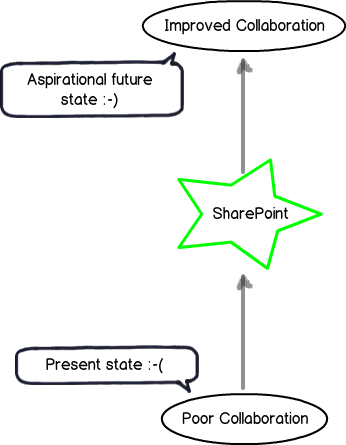
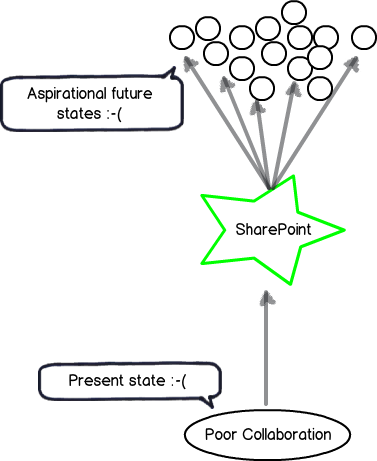
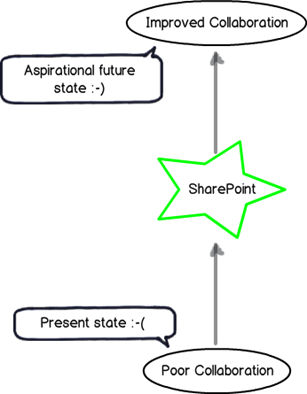
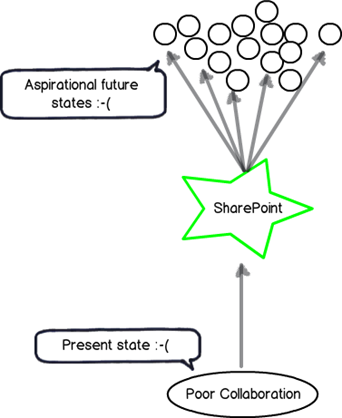
This is because the goal you are chasing looks seductively simple, but ultimately is an illusion. All of your stakeholders might use the same words, but have very different interpretations of what the goal actually looks like to them. The diagram that shows the problem with this is below. On the left is the mirage and to the right is the reality behind the mirage. Essentially your fuzzy goal actually is a proxy for a whole heap of unaligned and often unarticulated goals from all of your stakeholders.
Snapshot   Snapshot

Now in theory, you have read the last post and now have a newly calibrated platitude radar. You will sit at a table and hear platitudes come in thick and fast because you will be using Ackoff’s approach of inverting a goal and seeing if a) the opposite makes any logical sense and b) could be measured in any meaningful way. As an example, here are three real-world strategic objectives that I have seen adorning some wordy strategic plans. All three set off my platitude radar big time…

“Collaboration will be encouraged”

“A best-practice collaboration platform”

“It’s a SharePoint project” Smile

I look at the first statement and think “so… would you discourage collaboration? Of course not.” Ackoff would take a statement like that and say “Stop telling me what you need to do to survive, and tell me what you need to do to thrive”.

What do you mean by?

So if I asked you how to unpack a platitude into reality, what might you do?

For many, it might seem logical to ask people what they really mean by the platitude. It might seem equally logical to come up with a universal definition to bring people to a common understanding of the platitude. Unfortunately, both are about as productive as a well-meaning Business Analyst asking users “So, what are your requirements?”

With the “what do you mean by [insert platitude here]” question, the person likely won’t be able to articulate what they mean particularly well. That is precisely why they are unconsciously using the platitude in the first place! Remember that a platitude is a mental shortcut that we often make because it saves us the cognitive effort of making sense of something. This might sound strange that we would do this, but in the rush to get things done in organisations, it is unsurprising. How often do you feel a sense of guilt when you are reflecting on something because it doesn’t feel like progress? Put a whole bunch of people feeling that way into a meeting room and of course people will latch into a platitude.

By the way, the “mental shortcut” that makes a platitude feel good seems to be a part of being human and sometimes it can work for us. When it works, it is called a heuristic, When it doesn’t its called a cognitive bias. Consult chapter 2 in my book for more information on this.

Okay, so asking what someone means by their platitude has obvious issues. Thus, it might seem logical that we should develop a universal definition for everyone to fall in behind. If we can all go with that then we would have less diversity in viewpoints. Unfortunately this has its issues too – only they are a little more subtle. As we discovered in part 2 of this series appropriately entitled “don’t define governance”, definitions tend to have a limited shelf life. Additionally, like best-practice standards, there are always lots of them to choose from and they actually have an affect of blinding people to what really matters.

So is there a better way?

It’s all in the question and its framing…

If there is one thing I have learnt above all else, is that project teams often do not ask the right question of themselves. Yet asking the right question is one of the most critical aspects to helping organisations solve their problems. The right question has the ability to cast the problem in a completely different light and change the cognitive process that people are using when answering it. In other words, the old saying is true: ask a silly question, get a silly answer.

Let me give you a real life example: Chris Tomich is a co-owner of Seven Sigma and was working with some stakeholders to understand the rationale for how content had been structured in a knowledge management portal. Chris is a dialogue mapper like me – and he’s extremely good at it. One thing Dialogue Mapping teaches you is to recognise different question types and listen for hidden questions. The breakthrough question in this case when he got some face time with a key stakeholder and asked:

  • What was your intent when you designed this structure for your content?

The answer he got?

  • “Well, we only did it that way because search was so useless”
  • “So if I am hearing you, you are saying that if search was up to scratch you would not have done it that way”
  • “Definitely not”

Neat huh? By asking a question that took the stakeholder back to the original outcome sought for taking a certain course of action, we learnt that poor search was such a constraint they compensated by altering page template design. Up until that point, the organisation itself did not realise how much of an impact a crappy search experience had made. So guess where Chris focused most of his time?

In a similar fashion, my platitude defeater question is this:

So if we had [insert platitude here], how would things be different to now?

Can you see the difference in framing compared to “what do you mean by [insert platitude here]?”. Like Chris with his “What was your intent”, we are getting people to shift from the platitude, to the difference it would make if we achieved the platitude. No definitions required in this case, and the answer you will get almost by definition has to be measurable. This is because asking what difference something would make involves a transition of some kind and people will likely answer with “increased this”  or “decreased that”.

Now be warned – a hard core middle manager might serve you up another platitude as an answer to the above question. To handle this, just ask the question again and use the new platitude instead. For example:

  • Me: Okay so if you had improved collaboration, how would things be different to now?
  • Them: We would have increased adoption
  • Me: And what difference would that make to things?

I call this the KPI question because if you keep on prodding, you will find themes start to emerge and you will get a strong sense of potential Key Performance Indicators. This doesn’t mean they are the right ones, but now people are thinking about the difference that SharePoint will make, as opposed to arguing over a definition. Trust me – its a much more productive conversation.

Now to validate that these emerging KPI’s are good ones, I ask another question, similarly framed to elicit the sort of response I am looking for…

What aspects should we consider with this initiative to [insert platitude here]?

This question is deliberately framed as neutral is possible. I am not asking for issues, opportunities or risks, but just aspects. By using the term aspects I open the question up to a wider variety of inputs. Like the KPI question above, it does not take long for themes to emerge from the resulting conversation. I call this the key focus area question, because as these themes coalesce, you will be able to ensure your emerging KPI’s link to them. You can also find gaps where there is a focus area with no KPI to cover it. As an added bonus, you often get some emergent guiding principles out of a question like this too.

The thing to note is that rather than follow up with “what are the risks?” and “what should our guiding principles be?”, I try and get participants to synthesize those from the answers I capture. I can do this because I use visual tools to collect and display collective group wisdom. In other words, rather than ask those questions directly, I get people to sort the answers into risks, opportunities and principles. This synthesis is a great way to develop a shared understanding among participants of the problem space they are tackling.

If we were unconstrained, how would we solve this problem?

This is the purpose question and is designed to find the true purpose of a project or solution to a problem. I don’t always need to use this one for SharePoint, but I certainly use it a lot in non IT projects. This question asks people to put aside all of the aspects captured by the previous question and give the ideal solution assuming that there were no constraints to worry about. The reason this question is very handy is that in exploring these “pie in the sky” solutions, people can have new insights about the present course of action. This permits consideration of aspects that would not otherwise be considered and sometimes this is just the tonic required. As an example, I vividly recall doing some strategic planning work with the environmental division of a mining company where we asked this exact question. In answering the question, the participants had a major ‘aha’ moment which in turn, altered the strategy they were undertaking significantly.

Note: If you want some homework, then check Ackoff’s notion of idealised design and the Breakthrough Thinking principle called the purpose principle. Both espouse this sort of framed question.

Sharpening the saw…

Via  the use of the above questions, you will have a  better sense of purpose, emergent focus areas and potential measures. That platitude that was causing so much wheel spinning should be starting to get more meaty and real for your stakeholders. For some scenarios, this is enough to start developing a governance structure for a solution and formulating your tactical approaches to making it happen. But often there is a need to sharpen the saw a bit and prioritise the good stuff from the chaff. Here are the sort of questions that allow you to do that:

No matter what happens, what else do we need to be aware of?

This question is called the criterial question and I learnt it when I was learning the art of Dialogue Mapping. When Dialogue Mapping you are taught to listen for the “no matter what…” preamble because it surfaces assumptions and unarticulated criteria that can be critical to the conversation and will apply to whatever the governance approach taken. Thus I will often ask this question in sessions, towards the end and it is amazing what else falls out of the conversation.

What are the things that keep you up at night?

I picked this up from reading Sue Hanley’s excellent whitepaper a while back and listening to hear speak at Share2012 in Melbourne reminded me why it is so useful. This question is very cleverly framed and is so much better than asking “What are your issues?”. It pushes the emotive buttons of stakeholders more and gets to the aspects that really matter to them at an gut level rather than purely at a rational level. (I plan to test out dialogue mapping a workshop with this as the core question sometime and will report on how it goes)

What is the intent behind [some blocker]?

This is the constraint buster question and is also one of my personal favourites. If say, someone is using a standard or process to block you with no explanation except that “we cannot do that because it violates the standards”, ask them what is the intent of the standard. When you think about it, this is like the platitude buster question above. It requires the person to tell you the difference the standard makes, rather than focus on the standard itself. As I demonstrated with my colleague Chris earlier, the intent question is also particularly useful for understanding previous context  by asking users to outline the gap between previous expectation and reality.

Conclusion…

To there you go – a black belt has been awarded. Now you should be armed with the necessary kung-fu skills required to deflect, disarm and defeat a platitude.

Of course, knowing the right questions to ask and the framing of them is one thing. Capturing the answers in an efficient way is another. For years now, I have advocated the use of visual tools like mind mapping, dialogue mapping and causal mapping tools as they all allow you to visually represent a complex problem. So as we move through this series, I will introduce some of the tools I use to augment the questions above.

Thanks for reading


Paul Culmsee


Confessions of a (post) SharePoint Architect: Don’t define “governance”

Hi all and welcome to the second post of a series that I have been wanting to write for a while. In this series, I am going to cover some of the lesser considered areas of being a SharePoint architect and by association, key aspects to SharePoint governance. In the first confessional post I alluded to the fact that a good SharePoint architect also need to architect the right conditions for SharePoint success. As I work through this series of articles, I will elaborate further on what those conditions are and how to go about creating them.

To do this, I am drawing from my non IT work as a Dialogue Mapper and facilitator, and where applicable, will cover these case studies to see if they give us any insights for SharePoint. I also hope to dispel some common myths and misconceptions about SharePoint project delivery in organisations. Some of these might challenge some notions you hold dear. But for the most part, I hope that many of you reading this find this material to be instinctively compatible with what you have already come to believe. If you are in the latter group and feel as if you are an organisational agitator, this just might give you that rigour and ammo that you need when getting through to the powers that be. Better still, tell them to read this series and let them decide for themselves.

Backstory: Ackoff and f-Laws

image

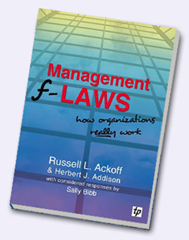
For what it’s worth, a fair chunk of this material comes from my book, as well as the first module of my SharePoint Governance and Information Architecture class that I run a few times a year in various places around the world. When I designed that class, I was inspired by Russell Ackoff, who co-wrote a funny and highly readable book called “Management f-LAWS: How organisations really work”. F-Laws were defined as:

“truths about organisations that we might wish to deny or ignore – simple and more reliable guides to everyday behaviour than the complex truths proposed by scientists, economists, sociologists, politicians and philosophers”

In case you hadn’t noticed, if you remove the hyphen, each f-law become a flaw. You could also consider them as #fail laws. Years ago, I laughed and at the same time, inwardly cringed when I read each f-Law that Ackoff and his co-authors had come up with. I came to realise that SharePoint problems are simply a microcosm of broader issues that plague organisations. If you read Ackoff’s book (and I highly recommend it), you will soon realise that the word “Management” could easily be substituted with “SharePoint” and it doesn’t take much to come up with a few of your own f-laws. This is exactly what I did and at last count, I have 17 of them. In this post, I will detail the very first one.

F-Law 1: The more comprehensive the definition of governance is, the less it will be understood by all

The first condition that I need to design as a SharePoint architect is to put to bed the many misconceptions about SharePoint governance. In this f-Law, I state that the more you try and define what SharePoint governance is, the less anybody will actually understand it. If you consider this counter-intuitive, then let me take it even further. For any project that has a change management aspect (SharePoint projects often are), definitonising not only doesn’t work, but it is actually quite dangerous to your projects health.

To explain why I have come to this conclusion, I’d like to tell you a little story from my non IT work. Several years ago, I was working in a sensemaking capacity with an organisation to help them come up with a strategic plan and performance framework for a new city. This was not a trivial undertaking. The aim was to create a framework with an aligned set of KPI’s to realise the vision for what the city needed to be in the year 2030. While the vision for the city had been previously agreed and understood, the path to realise that vision had not been.

Now if you have ever been involved in strategic plan development, and think that working out your corporate strategy is difficult, I have news for you. Aligning an organisation to a 3 year plan is one thing. Working with a diverse group to determine performance measures of a future city 25 years away is a different thing altogether. I never realised at the time we did this work, just how unique and (dare I say) “cutting edge” it was. Participants were highly varied in skills and areas of interest, and to say each had their own world-view was an… understatement to say the least.

I my book I describe this case study in detail but for the sake of post size, let’s just say that the opportunity to do this work arose from a failed first attempt to create the framework. The first time around an excel spreadsheet was projected onto the wall that looked like the example below. Attempts were made in vain to fill in the strategic outcomes, strategic objectives, key result areas, key performance indicators and measures. After a frustrating few hours of trying this approach, we gave up because participants spent all of their time arguing over the labels and got bogged down in a tangle of definitions and ambiguous terminology. Was it a KPI (Key Performance Indicator) or a KRA (Key Result Area)? Was it a Guiding Principle or a Strategic Objective? Was it a KRA or a Critical Success Factor?  Attempts to resolve this issue with definitions got nowhere because even the definitions could not be agreed upon.

image

In the end, we solved this issue via a rather novel use of Dialogue Mapping along with a problem structuring approach outlined in a book called Breakthrough Thinking. If you’d like to know more on how it was done, then take a look in chapter 12 of the Heretics Guide.

The criticality of context…

The core problem boiled down to context – or lack of it. What I learnt from this is that in situations without a shared context (and the wrong tools to deal with it), we fall back to using definitions to try and fill the gap. When faced with a blank spreadsheet and just some labels, participants attention was fixated on the definitions of the labels, rather than the empty cells where the focus needed to be. This resulted in a bunch of long winded discussions about what terms meant. This seriously stymied efforts aimed at making progress.

I have since performed many workshops, both SharePoint and non SharePoint ones and the pattern is clear. In fact I contend that if you proceed down the road of trying to build context via definitions for complex problems, one of three things will happen.

  1. The definition becomes more verbose. There are a couple of reasons for this:
    • – The definition is expanded to incorporate new aspects of the topic space. In an organisational setting, this creates confusion because the definitions of multiple disciplines can often seemingly contradict each other and thus, careful “wordsmithing” is required to navigate a path through it.
    • – New qualifications or exceptional situations have to be excluded. This leads to more new terms being used in the definition.
  2. As a result of #1, a broader, fundamental definition is developed. This broader definition encompasses more and so is prone to motherly sounding platitudes. Further, such definitions also run the risk of being interpreted in ways other than the one intended by those who worked so hard on the definition.
  3. As a result of #1 and #2, a new word is used or an existing word is used in a new context to try and convey the new meanings or concepts proposed. I have heard governance described as “stewardship”, “risk management” and (guilty as charged), “assurance”.

The effect of this can be far reaching in a bad way because definitionising has a habit of blinding people to what really matters. This leads to terrible project decisions being made up front that have serious consequences. To understand why, consider the image below:

Snapshot

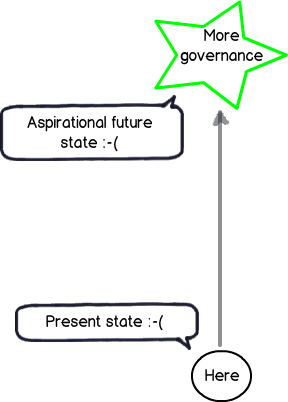
This image represents how governance of a SharePoint project should be viewed. A SharePoint initiative takes time and effort which costs money. We presumably have recognised that the present state is lacking in some way and want to get to somewhere better – an aspirational future place (if you look closely in the left above image note the happy and sad smilies). Accordingly we accept the cost of deploying SharePoint because we believe it will make a positive difference by doing so. If this was not the case, you would be wasting your time and resources on a pointless initiative. Therefore, it is the difference made by the initiative that will tell you if you have succeeded or not. As a result, we have to have a shared context on what that aspirational future looks like!

Don’t confuse the means with the ends…

Governance is, therefore, the means by which you will achieve the end of getting to some better place. It is informed by the end in mind and this is why I drew it in the star in the middle of the above diagram. For example; If the end in mind was compliance, then I will govern SharePoint a heck of a lot differently than say, if the end in mind was improving collaborative decision making.

But consider the diagram below. In this context, it should be clear why working from a definition of governance is often problematic. It implies that:

  1. Governance is not being informed by the end in mind;
  2. Your team do not have a shared understanding of what the end in mind actually looks like.

When this happens, project teams rarely realize it and respond by substituting the end with the means. We overly focus on governance via definition without any clarity or context as to what the aspirational future state actually is. Like the example of the blank spreadsheet example I started with, reality starts to look more like the diagram below: (note the happy smilie is gone now)

Snapshot

Steering…

So how do we steer out of this definition pickle? Interestingly “steer” is a appropriate choice of word if we look at the origin of the word “Govern”. This is because “Govern” is a nautical term from Latin and actually means “to steer”. So if your SharePoint project has been more like the Titanic, and hit a giant iceberg along the way, then clearly you need to focus your governance efforts to looking at what is in front of you, rather than scrubbing the deck or keeping the engine room well oiled. The latter tasks are important of course, but you can do all that, still hit an iceberg and waste a lot of money.

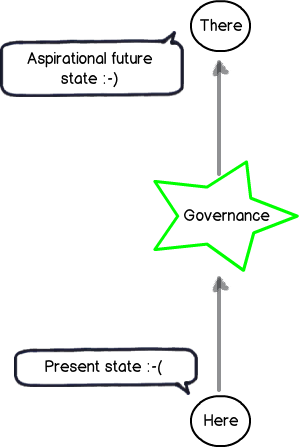
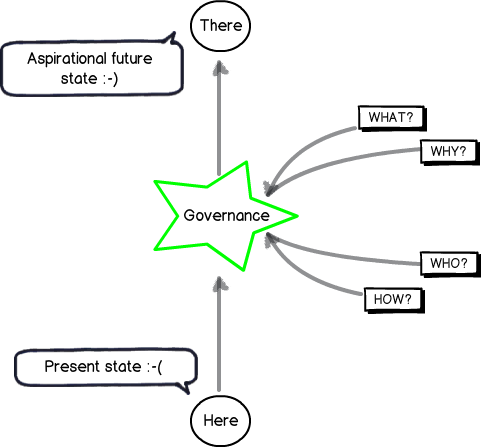
To steer, we all have to understand what the destination is, or at the very least, all agree on the direction. To help you with that journey, consider my final diagram. To steer SharePoint the right way for your organisation requires you to answer four key questions:

  1. What is the aspirational future state and what does it look like?
  2. Why is this the aspirational future state we want?
  3. Who will do what to get us to that state?
  4. How will we get to that state?

Snapshot

The fundamental problem with most SharePoint projects is that questions 1 and 2 are not answered sufficiently, if at all. The next few posts will explore why this is the case, but in the meantime, remember that we could do a SharePoint project that is to scope, time and cost, yet still have no user up-take if we are solving the wrong problem in the first place. Therefore remember that:

  1. Governance is a means to an end, and not the end in itself.
  2. We shouldn’t undertake a “SharePoint governance” project, or consider “SharePoint governance” as deliverable on a project plan. The act of developing a shared context of what the problems are and using that to always steer the governance decision making is paramount. Failure to do this and and your best plans will not save you.

Conclusions and coming next…

This is the second post on what will be a large series – possibly the largest series I have written so far. In the next post in this series, I will continue into our journey of SharePoint governance mistakes and along the way, start to identify what we can do to better answer the “What”, “Why”, “Who” and “How” questions. If you enjoy this series, then consider signing up to one of my classes if one is running in your neck of the woods.


Thanks for reading

Paul Culmsee

www.sevensigma.com.au

www.hereticsguidebooks.com


« Previous PageNext Page »

Today is: Wednesday 3 June 2026 -