Back to Cleverworkarounds mainpage
 

Speaking at BA World conference in Perth

BAW Logo w Globe

Hi all

Just a quick note to let you know that I will be speaking at the Perth leg of the BusinessAnalystWorld conference this week. My topic is called “IBIS: The one best practice for managing wicked problems" and I will be talking about the characteristics of wicked problems and how IBIS and Issue Mapping can help to manage them. I will also cover off some other sense-making tools in this talk like debategraph.

The BA World conference is the only one of its kind in Australia and will cover all sorts of interesting topics such as requirements elicitation, change management, business process modelling, Agile, stakeholder management and BABOK. The theme for the event is “Work Smarter. Plan Harder” and will allow BA leaders to ensure that projects are clearly defined and flawlessly executed, enabling them to make the right decisions at every level in the organisation and increase project success.

I am really looking forward to participating and it will be interesting to see what sort of feedback I get from a non SharePoint audience. As you may have gathered, this is not a SharePoint event and although I will still be talking about SharePoint as a collaborative platform to support working smarter, the main focus is on the power of IBIS and issue Mapping to help elicit real and tacit requirements and fast-track the path to shared understanding.

Thanks for reading

Paul Culmsee

www.sevensigma.com.au


The practice of Dialogue Mapping – Part 1

Hiya

For those who do not regularly read CleverworkArounds, I have a bit of a split career-personality where half my working life is spent as a SharePoint practitioner and the other half as a sort of facilitator, based around the craft of dialogue mapping. This series of articles will delve a little deeper into dialogue mapping and how I have used it.

I previously introduced the topic of IBIS and Issue Mapping to a SharePoint audience in the “One best practice” series of posts. That series of posts focussed on the issue mapping side of things because it dissected a debate that had already taken place (Joel’s ‘Just say “no” to site definitions’). While this is an effective demonstration of the way that IBIS can break down a seemingly complex argument into more easily digested chunks, I never really wrote about the craft of dialogue mapping, which is a much more difficult, mentally exhausting, yet ultimately fulfilling practice.

Now I have to tell you, as an IT consultant who has managed to not get *too* messed-up over the last 20 years, I don’t get too intimidated with IT these days. But first time dialogue mapping for a group of stakeholders on a non IT project, where I had no buy in to that project, and my sole purpose was to craft a good issue map to help them work through their complex issue, I was so nervous that I couldn’t sleep the night before.

So first up, let’s clear up the terms I using so that we are all on the same page.

  • IBIS: The grammar that is used to create an issue map. When I talk about issues, ideas, pros and cons, I am describing the elements of IBIS grammar. You can read about this elsewhere on my blog, my mentor, Jeff Conklin or the amazing work by Kailash Awati.
  • Issue mapping: The craft of creating an map based on IBIS notation. Some examples are in this article.
  • Dialogue Mapping: The facilitation process where a facilitator works with a group to create an issue map and translate discussion into Issue Maps.

Why dialogue mapping?

If you have ever uttered the cliché “They don’t know what they want”, then you have your answer. Many problems are rather difficult to define and pin down because, even to define them, requires you to think about possible solutions to the problem. Based on our experience, values (and DNA), we will form our own interpretations of the problem space and then spend considerable time “fumbling around” when working with the rest of the group to clearly articulate our understanding to others, only to find that our understanding is not universal. Disagreements, therefore, are inevitable and are amplified by the sheer number of stakeholders, the fluidity of the problem space and the constraints around the problem, such as a time deadline. This has a way of making life unpleasant and stressful; a situation nobody particularly enjoys.

People deal with this in different ways. For many, the natural reflex to this situation is avoidance – to try and return to the “business-as-usual” or status quo that existed before. True believers may don the boxing gloves and spar for a few rounds with other true believers. Some may become the ninja, invisible and striking silently. Either way, this sort of chaos that represents organisational pain is fairly familiar to most.

Now, there are many methods that you can use to remedy this situation. But for me, there are some key ingredients required for the really effective methods.

  1. The method should not take you too far away from the problem space. So, for example, you are trying to grapple with a difficult organisational problem. You decide to adopt a methodology. Now you are focussing on learning the methodology, obsessing if you are doing it ‘right’ and then still trying to gain a shared understanding of the problem space.
  2. The method should be simple enough that people do not have to be trained just to participate.
  3. The method needs to be inclusive, and all voices (not just the metaphorical boxers) need to be heard
  4. The method should be easy to adapt and grow as understanding of the problem changes over time.
  5. Most importantly of all, the method needs to allow a group to start from what they know now. Half the battle with organisational chaos is the continual “going in circles” pain from feeling that all of the questions need to be answered now and if not, we are doing something wrong.

One of my clients recently summed it up well when he said to me “In dealing with complexity we persist in creating complex methods and wonder why its still complex.” – I found that very profound, but it might have been the beer I was drinking at the time.

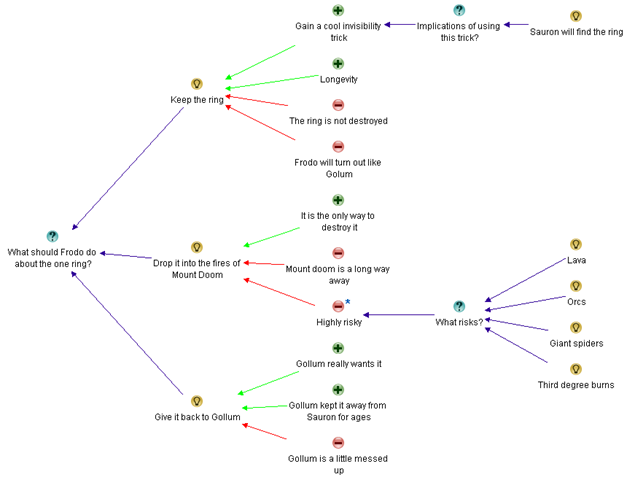
Anyway, I digress. Below is an IBIS based issue map discussing Frodo’s dilemma. Note that I didn’t need to tell you how to read the map. it is inherently readable due to the symbolism in the nodes. This is the sort of output to expect from a dialogue mapping session in Middle Earth.

image

So, how would such a map be produced from a meeting or workshop?

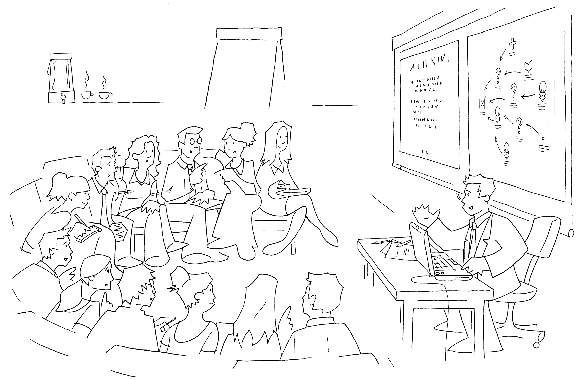
Ideally the room would be set up as per the illustration below. This image below is from the Cognexus site, the home of Dialogue Mapping. Note how one person is sitting at a laptop, with a projected map behind them, facing the rest of the group. The rest of the group is interacting with the mapper and map, discussing arguments, asking for additions or modifications and building out a chain of logic around the problem space.

image

The facilitator is the key here. This person knows the IBIS grammar and is taking the group deliberations and translating it to the issue map in real-time. Using software and a projector, as opposed to flip charts, restructuring or refactoring the map live and on the fly is quick and painless. By using the IBIS grammar, the map is inherently readable and very clear, compared to a normal meeting where there is no tool to provide the sort of “holding environment” to allow people to keep collective focus and explore the different perspectives on the problem space.

This notion of the holding environment also is critically important. If you are lucky enough to work in a job you love, with a team you love, for a visionary CEO who you admire and respect, then that CEO has created the ultimate holding environment and you should consider yourself very lucky (and your CEO is worth all that money they earn). For the other 99.9% of us, we have to make do with what we have. The point here is that any tool or method you use needs to augment the understanding process, not complicate it. If it is over-complicated it will not improve understanding and the group will fall back to business-as-usual and participants will likely wind up resenting the method.

Consider dialogue mapping as a holding environment versus traditional meeting decorum. Inevitably, a group will start out with one question, and fairly quickly realise there are underlying or deeper questions that also need to be answered. In a regular meeting governed by a strict agenda and roles (as is recommended by many books and facilitators), problem exploration will be stifled. All too often, changes in understanding of the problem is seen as an unwanted tangent that derails the agenda of the meeting. In other words, the system works against the problem exploration space and that sort of meeting decorum is a poor option for this sort of exploration. Why did we invent such systems to keep meetings on track? Because meetings alone are a crappy container for problem exploration! However with the IBIS grammar and the shared space of the dialogue map, underlying questions can be captured and explored with an organised, evolving point of reference.

The shared space also has a positive effect on the decorum of exploring prickly issues. The group’s attention is now fixed on an evolving map on the wall. A skilled dialogue mapper can utilise IBIS grammar to take a lot of the heat out of argumentation and the process becomes more about building a chain of logic, than cheap point scoring. Typical meeting tactics like pulling rank or personal attacks thinly veiled as “questions” are easily dealt with by the dialogue mapper and never make it to the map in the form intended. The desire to pull back to business is usual is mitigated by the neutrality of the IBIS language and the improved quality of deliberation.

Perhaps the most important benefit of all, is the capture of rationale, or organisational memory. For me, this is precisely where my SharePoint world intersects with this craft because IBIS maps have for me been one of the best artefacts I have seen for the capture of implicit or tacit knowledge. These maps ultimately are an extremely rich exploration of a given problem and demonstrate very effectively, the circumstances and understanding of a problem at that point in time. With issue maps, gone are the days of looking at a process, policy or report years later and wondering “what the hell were they thinking?”.

image

So finally for part 1, let’s sum up by examining dialogue mapping in relation to my earlier criteria for the really effective methods of collaborating on difficult problems.

The method should not take you too far away from the problem space. So, for example, you are trying to grapple with a difficult organisational problem, so you decide to adopt a methodology. Now you are focussing on learning the methodology, obsessing if you are doing it ‘right’ and then still trying to gain a shared understanding of the problem space.

With Dialogue Mapping, only the mapper needs any training. All other participants do not need any previous IBIS or Issue Mapping experience. Participants do not need to wonder if they are doing it right, because just by articulating their opinion on issues, ideas and arguments, they are doing it right.

The method should be simple enough that people do not have to be trained just to participate.

Cut and paste my last answer. Aside from the mapper, all other participants do not need any previous IBIS or Issue Mapping experience.

The method needs to be inclusive, and all voices (not just the metaphorical boxers) need to be heard

Two things that positively kill meetings is death by repetition and grenade lobbing. Death by repetition is when we tend to find a way to suggest our solution, no matter what question is asked. This behaviour has the opposite effect than intended on other participants. But once an idea is captured, it idea is visible along with all of the other ideas. If the repetition continues, all the dialogue mapper needs to do is ask the person if they have anything more to add to the map for that idea. This is surprisingly effective as the disruptive behaviour becomes very obvious to the serial repeater.

Grenade lobbing happens when someone challenges the whole context of the conversation in some way. When this is a dialogue mapped meeting or workshop, the map comes into its own. The dialogue mapper will capture the challenge as an issue and restructure the map to accommodate this issue. The previous disruptive power of the grenade lob is significantly mitigated and the map now has richer argumentation.

The method should be easy to adapt and grow as understanding of the problem changes over time.

IBIS is founded on the principle that problems and solutions are intertwined closely and that exploration of one will change the other in a cyclical fashion. As discussed, refactoring maps over time is critical to managing a problem that is a moving target. But also being able to save the state of understanding at a given point in time, and then being able to examine the evolution of that understanding and rationale (tacit knowledge) over time is capturing a snapshot of organisational memory. Even better, put that snapshot into SharePoint, classify it with metadata and now your collaborative portal includes findable, organised tacit knowledge!

Most importantly of all, the method needs to allow a group to start from what they know now.

The exploration of what we know now actually can offer a lot of clarity and insights when integrated into a coherent map. Instead of a long, laborious meeting where various people have lost the thread of the conversation, we have a point of reference on the wall. Furthermore, in breaking down the arguments into simple to follow IBIS structure, participants are better equipped to make the sort of connections between chains of logic to better understand the frame of reference of the other participants. The map is an output of this collective effort, which is visible and available for others to explore. Rather than starting out by trying to peel the onion of problems understanding in ever widening scope, we simply start. We put up a question on the map and attempt to answer it.

Conclusion

Hopefully, I have managed to convey a little of what the dialogue mapping experience looks like. In part 2, I will expand upon this topic and discuss my baptism of fire experience with dialogue mapping, the factors that have helped me improve my skills in it, as well as working with the master in action – Jeff Conklin

Thanks for reading

Paul Culmsee

www.sevensigma.com.au


The secret to understanding governance

I’m very tempted to start this post like a dodgy wealth-guru infomercial. You know the ones with lots of imagery of people living the dream of financial freedom. I am thinking a montage of a resort, a large yacht anchored in a topical bay, carving up the water with a jet-ski and then a shot of me standing next to my Ferrari, champagne in hand, with Megan Fox on my arm. My message would be that for a “small” fee of $10,000, you too could learn the secrets to your financial freedom in an intimate, exclusive but “intensive” weekend workshop. Just you and the 15,000 other people that pack into the convention hall 🙂

Alas, we both know that this is never going to happen but this post may have a little of that feeling to it. I have titled it “The secret to understanding governance”, because I think there is a way to understand governance that will help you, your colleagues and your team members significantly. Like all good “wealth guru” infomercials, I’m going to give you some hints and I’m kind of hoping that you will then be interested in attending a workshop to find out the rest.

The one difference between the wealth guru and me, though, is that I will never have Megan Fox hanging off my arm, and I am actually going to tell you something useful in this post.

So, what is this big “secret”, anyway?

Definitions definitions definitions

One thing that we all tend to get suckered into doing at times is feeling the urge to define “stuff”. Academics do it all the time. I’ve read countless papers where the authors start out with a ten page examination of all the past definitions of their given topic, before proceeding to tell you why those definitions are inadequate in some way, followed by their own revised definitions. They spend the rest of their essays justifying why their definitions are more correct than their predecessors.

Defining stuff is a time consuming and tiring exercise. Since we live in a world of constant change there will always be new influences which shape and frame perceptions. Therefore, the definition that you spent so much effort on coming up with is redefined by the next academic or blogger who follows the path that you took. Sometimes a whole new word is invented, or an existing word is suddenly used in a new context and the whole cycle starts all over again.

I once explained the philosophical and process aspects of Agile/Scrum to a seriously experienced project manager. This was a fellow who was the PM when skyscrapers were erected. He listened carefully to my explanation, sat back and said “I’ve been doing that for 30 years. There’s nothing new there”. I also found a similar observation in “The Small Business Guerrilla Guide to Six Sigma” by Jay Arthur.

Over the years, I’ve had a chance to learn and study just about every “brand name” systematic improvement methodology. Guess what…they are all pretty much the same. To appear different, consultants have changed:
– the name to Six Sigma (from Total Quality Management)
– the acronyms to confuse the unwary (PDCA to DMAIC)
– the number of tools required for success
– the number of steps in the process (5 to 14 steps)
but…
– the key tools are the same
– the process for using the tools is the same
– and the results are identical assuming you can figure out how to use the wide range of tools and processes

In my opinion, defining things to the nth degree is a zero sum game. Often you confuse the issue more than you clarify it because in your attempts to explain something, you incorporate new words that you then have to explain.

Some ROI Wisdom

Several years ago I was attending a job interview for a promotion and the topic of return on investment came up. I had made the point that most things could be quantified and one of the interviewers fired back “Well tell me how you measure quality?”

That was a curveball that I wasn’t expecting, and I didn’t have an answer (and never got the job either).

Some time later, I read a terrific book by Douglas Hubbard on measurement and return on investment called “How To Measure Anything”. It armed me with some new kung-fu skills and also gave me the perfect comeback answer that I sorely needed during that interview. The question “How do you measure quality?” actually makes very little sense to ask. The reason is quite simple. “Quality is not what you measure. It is the effect it has on something that you measure”.

It is very easy to illustrate the logic behind this important point. Undertaking a quality initiative costs time, money and resources. You are only spending that money and investing those resources because you believe that undertaking this quality initiative will make a positive difference in some way. Otherwise, why bother? If you do not believe that it will make a positive difference, why throw money away?

So, if asked “How do you measure quality?”, you can answer by asking questions back, along the lines of:

  • “What does improved quality look like to you?”
  • “What is the effect of quality?”
  • “How do you know your quality initiative is working?”

The answers to these questions tend to start with “increased this” or “decreased that”. It now should be abundantly clear why asking “How do you measure quality?” actually makes no sense. In fact it is completely the wrong question to ask. Instead, by re-framing the question slightly, you suddenly have answers that can be quantified using the techniques that I detailed in my “Learn to speak to your CFO” series and provided in my free SharePoint ROI modelling spreadsheet.

This same logic applies to other words that are better understood by examining their effect, rather than trying to (re)define them. Examples:

  • Security
  • Flexibility
  • Collaboration
  • Resilience
  • Wellbeing

All of these share the same characteristic as “governance” in that they are easily understood by the effect they have, but harder to define in a universal way.

The secret to understanding governance

The really silly thing about all this is that I did a talk on SharePoint ROI at the Best Practice Conference in Feb 09. In that talk, I explained the above chain of logic and made the point that the way to find measurable success factors with anything that seems “unquantifiable” is to ask the “what will it look like if we do this?” type question. I used this logic to come up with measurable key performance indicators that enabled me to simulate the future financial return (internal rate of return and net present value) of a large SharePoint investment for a mid sized organisation (slide deck and spreadsheet can be downloaded here).

But despite writing several articles and speaking on this topic, the ROI stuff was one of several clouds of “stuff” that was floating around my brain. SharePoint governance was also floating in one of those clouds too, as well as broader governance in a planning and sustainability context. It took a casual comment from Bjørn Furuknap that suddenly gave me one of those wonderful bolts of inspiration and clarify, where these disparate clouds of thought suddenly coalesced and I made a significant breakthrough in my understanding.

Define “governance” in any way you want. I really don’t care – so long as you understand the difference it makes *for you* and you ask the same question of your other stakeholders and participants. Put aside the need to define governance for a while, and instead view “governance” as a means to attain a desirable future state. Agree with each-other on what that state is going to look like. Now tell me the differences between where you are now and that desirable future state.

By asking the question this way, you not only stimulate much more meaningful debate, you will have a much better understanding of everybody else’s frame of reference and the emphasis that they place on various aspects of that difference. The “definition” of governance that you are trying to find will start to suggest itself through those differences between the current and desired state. At the end of the day, that is what really matters.

Instead of reading a methodology like COBiT or ITIL, or following what people like me, Joel, Robert Bogue, Andrew Woodward, Dux Sy and Ruven Gotz say, look at your own needs as an individual, a team and then an organisation. Determine where you want to be, include IT and non IT views and then start to think about what you need to do to get to your desired state.

Congratulations, you’re now officially “governing”. Wasn’t that hard, was it? 🙂

Best practices versus worst practices

This same “secret” to understanding governance also provides the answer to why experts disagree on what is a “best practice”. I sometimes will read a “best practice” and think to myself “No way, that would never work”. Yet, although it doesn’t work for me, I rarely come away thinking the person making the recommendation is actually wrong. When you understand that the “best practice” made a positive difference, and it moved the organisation further along the road from the undesired present state toward the desired future state, then it is perfectly clear why one man’s best practice is another man’s worst practice. No matter what you did, you moved forward – and that is a good thing.

Furthermore, if you agree with the notion that the “best” solution to a problem is the one that has the most shared commitment among participants to seeing it through, then I argue that a perceived “worst practice” with deep commitment and buy-in among stakeholders will deliver a better solution than a “best practice” with poor buy-in and commitment among stakeholders.

Want to argue that point with me? (I’ve got more ammo than this!) Then you can spend 3 days doing that if you want!

…for a small fee 🙂

My intent with this post was to try and lift some of the fog and confusion that surrounds this nebulous thing called governance by suggesting that defining it to the nth degree is not the way forward. “Best and worst” practices? Both are commonly context and culture dependant. Instead, your (multidisciplinary) team needs to agree on and understand your desired future state and where you are now. By starting with the end in mind you will be able to collectively determine what processes, tools and methods to use to get to that place.

The philosophical approaches that I have described in this article are just the tip of the iceberg in relation to the work that I have been doing with Andrew Woodward, Dux Sy and Ruven Gotz for the planned “Governance Mentoring Workshop”, to run for 3 days prior to the August Best Practices Conference. This workshop will be unlike any other SharePoint governance training that is currently in existence and much of the material is completely original and not borrowed from any of the traditional SharePoint governance material that exists today.

Finally, to go back to infomercial mode…

This offer is for a limited time only. Act now! If you’re not completely satisfied, we offer a full “return to base” warranty 🙂

Act Now!

This offer is strictly limited!

Act Now!

Pick up the phone and take the first step toward the new life that is waiting for you!

Act Now!

Thanks for reading

Paul Culmsee


SharePoint book review – Seamless Teamwork by Michael Sampson

Hi all

Some time back a publisher sent me a self-help SharePoint book pitched at end users. I figured that I don’t really represent an end user and the best way to review it would be to make Mrs Cleverworkarounds review the book. I mean, after all, getting the spouse to bring home the bacon is part of my quest to eventually be a kept man! However, my grand plan ran aground after a while – she got around halfway through the book and came back and said “It’s easy to follow and all, but I don’t understand *why* I am doing these things.”

As a result, I never published the review of that particular book.

If you are wondering what the point behind that little anecdote is, then read on. 

“Seamless Teamwork” by Michael Sampson is a book that I knew I had to review – from when I first heard about it and read one of the chapters at its web site. Its subtitle is “Using Microsoft SharePoint Technologies to Collaborate, Innovate and Drive Business in New Ways” and as expected, this is a book that looks at SharePoint through a different lens to most of the technical books that I review (with the exception of Dux’s great project management book).

In fact Dux’s book is actually a great frame of reference when reading this book because both authors have adopted a similar approach. Rather than focussing on the technology, both books focus on a specific problem domain and explain how to leverage the technology through the exploration of that problem. In doing so, they avoid the pitfalls of “end user” SharePoint books that lack coherence like the one that my wife was dissatisfied with. Why? Because there is a clear outcome to achieve by the end of the book.

Here is the funny thing, though. Both authors approach the subject matter from the perspective of a new project that needs to be successfully implemented, yet Michael actually uses SharePoint in a very different manner to how Dux does in his book. Does that mean one of them is wrong? Not at all. In fact it really hit home to me that if you can achieve *true* buy-in and shared commitment to a particular solution, then the technology aspects can be implemented in a number of different ways. Michael actually makes this very clear in his preface when he says

In a book of this nature, it is impossible to cover every eventuality, every situation, and every approach. What I hope you get out of it is a vision of how you can apply the capabilities of SharePoint to the work of your team, rather than a prescription of what you need to do at each and every point of a teaming process. Embrace the ideas that work for you and ignore the ones that don’t.

This book explores SharePoint through the “fly on the wall” view of “Project Delta” where an up and coming MBA holding brown-noser named Roger has kissed enough butts to be handed a high profile project to drive growth in the overseas market for his company. (Okay, so I am embellishing the back-story just a teensy bit). Through Roger’s eyes, we discover why email based collaboration is not sufficient for project collaboration, along with some teamwork theory, cleverly interwoven around the storyline. "Project collaboration” is broken down into more specific outcomes and explored individually, illustrating what capabilities of SharePoint are suited to these outcomes.

  • Collaborating
  • Finding
  • Accessing
  • Using for decision making
  • Enforcing structure
  • Publishing and managing

.. and that was just chapter 1!

Chapter 2 introduces the project management model used by Roger and the intrepid heroes of Project Delta. I like this chapter because he offers enough meat to theory nuts like me, while balancing useful and relevant SharePoint content. First up, five project phases are defined and explained, namely:

  • Creating a shared vision
  • Understanding the options
  • Analysing the options
  • Making a decision
  • Concluding the project

This particular choice of wording has no references or footnotes and googling the exact terms leads me straight to Michael’s book so I presume that he is applying his own world view here. Next, we focus on getting the right people involved in the project. Roger has to identify the people with the right mix of skills, background and experiences to participate and this provides a nice dovetail to introduce SharePoint user profiles and “My sites”. As well as explaining the concepts and workings of this SharePoint feature, practical tips are offered to get the best out of it as well. The chapter concludes with a project team identified, assembled and ready to rock and roll.

Chapter 3 now focuses on the different audiences involved in a project, namely the project team, the project sponsors and stakeholders and “everyone else”. SharePoint team sites are introduced by examining the information needs of each of these groups and illustrating that one size does not fit all. The chapter walks through creating a site for each of these groups using a site and subsite hierarchy and the permissions required. Blank site templates are used (something I also tend to start with) and then some “projecty type” out of the box lists are created, as well as the ubiquitous wiki library and a blog site. Finally, some out of the box web parts are added to the mix.

All in all, a great example of a practical project oriented site that one could use or build upon.

Chapter 4 expands on these sites by switching focus from creation to actual use of the site. Michael writes about the “Seamless Teamwork Approach” to project collaboration and then uses this as a platform to explain alerting, RSS, basic usage of the lists, wiki and blog. The key theme of this chapter is the section about “teamworking protocol” – in other words, team members need to agree on the general approach to how they will work together. The most important point  in this chapter deserves its own entire chapter.

It is expected – and absolutely beneficial – that people have disagreements and differences of opinion about key matters in the project. If everyone thinks the same, a team would not be necessary. However the key is that we will not allow disagreements to derail the progress of the project, because we agree to listen carefully and resolve our disagreements through candid dialogue and debate.

Chapter 5 through 9 now examines each of the five project phases  that were outlined in chapter 2.

Chapter 5 is all about creating a shared vision. We examine the different types of vision (again from my research this view of vision seems to be Michael’s ideas and not based on any of the methodologies or academic stuff that I have read). We cover planning for engagement with stakeholders using a wiki, before the actual engagement process itself. Once again, this chapter is a deft mix of the product, the process and the rationale behind the approach. This chapter does not stick strictly with SharePoint either as we have the scenario of a PowerPoint presentation being viewed over a live meeting session for geographically dispersed stakeholders.

Chapter 5 also delves a little into some of the factors that cause the “chaos” that derails projects. The importance of timely notification of changing constraints or circumstances is covered by reviewing how the RSS and email notifications (tasks list connected to Outlook) are used. Finally, for some odd reason, Michael devotes two pages to placating those annoying mac users who, no matter that the problem is, has already tried to convince everyone that buying a mac is the solution…hehehe!

Chapter 6 is all about identifying options and starts out by examining how to effectively brainstorm using the SharePoint wiki (and confluence gets a mention also). OneNote is also covered and I found the shared OneNote notebook idea quite interesting as I have not tried that myself. This chapter is heavy on guidance and decorum around how brainstorming should be approached to get the most out of it. The chapter concludes with consolidating and synthesising the ideas.

Chapter 7 is all about analysing the options from the collated list. The key question here is “what could we realistically do?” This chapter is the first one to introduce the notion of a custom list. In the example, a custom list is used to track further analysis on each option. I loved the little governance interlude here, where Roger, being the angel user that he is, contacts Gareth, the ever friendly and helpful SharePoint support person to get advice on the best way to structure the custom list. (What sort of utopian fantasy world are you painting here Michael? :-D). Seriously though, this is actually quite an advanced chapter in terms of SharePoint conceptual stuff, given that document based content types are also introduced here too and various permutations of mixing and matching document libraries, wikis and the perennial folder vs metadata debate. Thankfully, Michael did not poo-poo folders outright and instead gives one of the best write-ups I’ve seen on the pros and cons of folders vs metadata. He also covers site columns and how they can be scoped. This is great stuff.

The final section from this chapter is on meetings, with participants are either in the same location or separate locations. There are different types of meetings for different purposes and advice is offered on how best to run these meetings and when and what technology is appropriate to augment them. Microsoft’s free conferencing tool, “SharedView” is covered (something I never knew existed until I read this book – duh, Paul!) SharePoint meeting workspaces and Groove 2007 are covered also. The technology detail covered in this section is matched by great, practical advice on how best to use the tools, given the circumstances.

Chapter 8 is entitled “Making a decision.” Now our intrepid Roger has come to the crunch and gets a recommendation made, circulated and signed off. Here we use SharePoint surveys to do the task, but in reality, this chapter is not about SharePoint at all. The meat of this chapter is around the processes needed and advice on decorum in particular situations. There is a smattering of wiki and a good section introducing workflows in context of the feedback process, but fundamentally, the value of this chapter is in the non SharePoint material.

Chapter 9 is all about concluding the project. Roger’s butt kissing and pandering to stakeholders’ whims are finally at an end with confirmation that the final recommendation on project Delta has been accepted by senior management. Tasks include updating participants “My sites” with the project details as well as any skills learned, a blog post about the project in my-site, and the essential, but unpopular task of cleaning up all the loose ends of the projects from a compliance, archival and retention point of view. Some final housekeeping and we are done!

My favourite chapter of the book is actually not in the book at all. It is a separate chapter available from the Seamless Teamwork website and is all about SharePoint governance. I highly recommend this chapter, as it one of the best write-ups that I have seen on the topic so far. 

Overall this is a terrific book, yet there are sections where advice is given that I would personally not take. Some things I flat out disagree with. But I need to fair here. I am currently surrounded by a dozen books on team dynamics, facilitation, soft systems methodology and risk management so I am not the intended audience for this book. Just because I have different philosophical approaches to some aspects does not detract from this book at all. In fact, it comes with the territory of a book like this and this is why I think it is such a great read. I personally find it quite easy to write technically oriented articles, but to delve into ‘soft’ topics like team dynamics, project chaos, developing shared vision and the like is actually much more subjective and I think, ambitious and difficult to write well.

If I was to make a broad comparison with Dux’s book, which is about the closest thing to a comparison out there, I would say that Dux covered more SharePoint feature areas than Michael and stuck fairly close to the project management body of knowledge. Michael on the other hand, delved deeper into some of the softer topics around how teams can deliver great projects. Apples and oranges really, and I think that both books compliment each-other exceptionally well.

The other commonality with Dux’s book is that readers with a technical audience who skip the preface will probably not like this book or consider it too light on in terms of low level SharePoint coverage. Michael is very clear in his preface here. This book is for users, information workers and project team members who want to make the best use of SharePoint for their team. To this end, Michael has completely nailed what he set out to do and should be commended for delivering the goods.

It is great to see SharePoint books coming out that delve deeper into the mechanics of team collaboration, before diving straight into product features and capabilities. Previous books have tended to gloss over the non technical side of team collaboration and this book fills the gap nicely.


Thanks for reading


Paul Culmsee

www.sevensigma.com.au 


“Governance Man” has fallen into my trap! :-)

image

This post was supposed to be called “SharePoint Governance is not a deliverable” – hence the pizza above, but my secret evil plan has worked faster than expected! Read on…

When I met with Dux Sy for breakfast the other day in a diner that looked remarkably like the set from Happy Days, our conversation covered various areas of topics around US vs Australian culture, SharePoint governance, project management, food, wicked problems, sense-making and my two kilograms of Vietnamese coffee beans that came from a weasel’s digestive tract :-). Smart guy, is our Mr Sy indeed; good business acumen – well suited to being a SharePoint sensei.

But one part of that conversation triggered a memory about a post that I was supposed to write and then completely forgot about. Thanks for jogging my memory, Dux.

Right in the middle of writing said post, SharePoint Joel has just posted some thoughts about his recent excellent governance document, inspired in part by some twitter conversations with Andrew Woodward. Andrew, like me, dislikes the word “governance” because he has seen the same confusion that can arise. Joel in his post, nailed totally what I was going to write about here, and referred to an old post of mine written in October 2008 where I undertook an experiment on whether I could make my own buzzword.

So, I think I will kill two birds with one stone here. I’ll post my original idea – in effect echoing what Joel said with regards to how to best use his governance plan, and I will also talk about the exciting adventures of intrepid hero “Governance Man” and vain attempts to defeat his arch nemesis “Dr Wicked” :-).

The precedent…

I have had a couple of experiences now, where I have been called in by clients who have the typical SharePoint chaos. Things have gotten out of hand and as a result, key stakeholders started to lose faith, and the project team really felt the pressure from the powers to be. There were strong undercurrents of desperation to get things sorted, like… yesterday. Under these circumstances, they asked for help on “governance”. They needed “governance”, they must have “governance”  and they spoke about governance as if it was something that a pizza driver can deliver to their door (and if it was not there in 30 minutes, it was free).

I was being a bit flippant when I talked to Dux about it, because both times I was dealing with the project manager in charge of each SharePoint implementation. I recall saying something along the lines of “some project managers have a lot to answer for here”. What I meant by that was “governance” in their eyes was a 1 line item on a work breakdown structure on their project plan – a project deliverable. As a result, they had this impression that by getting me to produce a “governance document” would somehow solve the chaos. Therefore, I had to answer the standard HMHL question (how much, how long) so it slotted nicely into the work breakdown structure.

*Sigh* if only it was that simple.

This hopefully provides an insight to why I am uncomfortable with the word. What these clients, in fact, were dealing with, was a crisis of confidence with the platform. They were unable to provide a level of assurance to the organisation that the platform could meet their needs. The lack of confidence turned to user pessimism, and the pessimism turned to outright rejection of the platform by some sectors.

Adding to that, Joel Oleson recently published a major revision of his sample governance plan, which I had the opportunity to review and made a few suggestions here and there. It is a great template to use for many organisations, but my fear is that people will think that this plan alone will be all that is needed because it has “governance” in its name. I mean, as a template, it is the best thing by far that is out there right now and adds significantly more meat than the governance checklist guide does.

“Governance Man” vs “Dr Wicked” (and “Agile Boy")

I have listened to the governance godfather Robert Bogue suggest that governance is a process and I think that is pretty close to the mark. He has also suggested that governance at its core is about risk management which I also agree with – or at least I do partly. As previously stated, I’ve always found that “governance” never really succinctly nailed this risk management emphasis. Isn’t risk management about providing assurance to stakeholders? It certainly makes more logical sense than saying “providing governance to stakeholders”.

So, in October last year, I wrote a post about the curse of “governance” now achieving buzzword status which makes life confusing for all, given that “governance” is talked about a lot, yet seemingly hard to understand and/or execute. To make it interesting, I blamed it all on my arch nemesis – “Governance Man”. You can see him in the photo below (check the T-shirt). Although the disguise is almost perfect (like mine), can you pick who he is? 🙂

image

In that October 08 post, I also executed my “secret evil plan ™” which actually had little to do with the governance/assurance debate itself. I simply wanted to see how long it would take for a new buzzword to take hold. I spoke of “SharePoint Assurance” and with a little help from my trusted super-friend Andrew “Agile Boy” Woodward, my arch nemesis – that meddlesome “Governance Man” fell into my wicked trap by blogging about it!

Mwaahahahahah… more people debating it! Another piece of Dr Wicked’s secret evil buzzword plan falls into place :-).

The unified theory of everything…

I recently did some Dialogue Mapping work for a local government organisation. In performing that work, I finally came across a definition of governance that I liked because it was simple and succinct and did not come from IT. It also has the positive side effect of putting my assurance instinct into the right perspective, too. Governance was defined in these terms:

“The word ‘govern’ means to ‘steer’. We aim to steer the energy and resources available for the greatest benefit to all”

Now we look at the definition of assurance (ripped from quality assurance)

“Assurance provides confidence in a product’s suitability for its intended purpose. It is a set of activities intended to ensure that customer requirements are satisfied in a systematic, reliable fashion.”

I see these as quite distinct activities and the key words in the above definition are “intended purpose”. Defining and maintaining “intended purpose” is the realm of governance via ‘steering’. Thus, governance is all about achieving shared commitment among stakeholders to a solving business problem, whereas assurance is all about achieving and maintaining confidence in the solution.

Paradoxically, you actually need both governance and assurance, for each to stand on their own individually. I mean, how can you achieve shared commitment without confidence? How can you have confidence without a shared commitment to a course of action? This is wicked problem fodder right here, and for a more detailed exploration in the relationship between shared understanding, shared commitment and project failure, then read the one best practice to rule them all series.

This, I think gets, to the root of why I get nervous when I hear the term “governance” bandied around. So, I take Joel’s point that assurance may “lack legs”, but assurance, to me, has a clearer meaning for the “confidence” side of governance. As I mentioned earlier, a nice little test is to say out loud these two statements and see which one ‘feels’ right.

  • “We have to provide better SharePoint assurance to the business.”
  • “We have to provide better SharePoint governance to the business.”

For what it’s worth, this article is not the first one to try and unify these concepts in this way. John Miller previously wrote a nice article that relates these two concepts together neatly way before me.

Are we splitting hairs? Yup, totally. In fact the next section is really what is important.

It’s all in the attitude…

Joel talks about governance in terms of “defining a service offering” as well as “mitigating conflict within an organisation”. No objections to both of these arguments as that is not really assurance. But my own “high level” governance guides are usually 2-5 pages, and guess what? I define the service offering, the guiding principles and define the roles and then refer to the other documents where the bulk of the material ends up. More often than not, these documents are assurance oriented documents.

Let’s talk for a minute about the “mitigating conflict within an organisation”. If you have read my “project fail…” and especially the “one best practice” series of posts, the “conflict resolution” aims of governance is definitely not served by a “governance document”. This is the world of what Jeff Conklin calls social complexity – or put perhaps in a simpler way: people, strategy and politics.

This is where I differ slightly from Robert Bogue. I attended his Feb 09 Best Practices Conference session where he spoke of SharePoint governance as a process. I personally believe that SharePoint governance is more in common with a methodology, and should be looked at through similar lens to other methodologies, like Agile software development, PMBOK, SEI CMMI and the like. Agile is not considered a ‘process’, although process is a significant part of it. I think the difference is that a methodology requires attitude to support the process. It is the latter area where the problems are. Without the commitment to back up the process, “governance” will be nothing more than just another document that few will ever read and even less will understand.

A document cannot alone drive the shared commitment required to make governance work.

When you look at SharePoint governance through the “methodology lens”, you will see that the reasons for governance failure are the same as why methodologies themselves have a hit and miss fate. Most methodologies require significant attitude to support the rigour to succeed.

Lessons from Agile

Not so long ago, I spoke to SharePoint’s own Agile/TDD guru Andrew Woodward about the topic of rigour and attitude to make Scrum projects a success. I had read this terrific real life story on the attitude factor required in Agile and was interested in Andrew’s experience with this, specifically in the SharePoint realm. Andrew confirmed that attitude and shared commitment among the team were particularly critical. Here is what he had to say.

When discussing agile teams and why they fail, Malcom Gladwells theory about Broken Windows is often quoted.   The premise is that if a broken window is left unrepaired, people will conclude that no one cares and will stop caring themselves. This is a very relevant to agile development teams where they rely on team ownership; where the team as a whole have to care about what they are developing and the way it is developed.

Agile processes quickly start to fail if some team members don’t care;  the broken window could be something as seemingly small as a failed unit test not being fixed or continually forgetting what they did yesterday at the scrum, eventually if this broken window is not fixed other team members will stop caring and the team will reach their tipping point.

The rigor needed by all team members is significantly greater than traditionally applied to development,  the myths around lack of control and process could not be further from the truth.  To be successful with agile processes you need every team member to care

I think you would agree, that Andrew could have been talking about being successful with SharePoint itself. 

Finally something practical

I thought that I would end this post by being practical as the post thus far has been a bit of a theory-fest. If you take some lessons from why methodologies such as Agile/Scrum fail, then it is pretty easy to list some practices that are likely to help you with your SharePoint governance effort.

One size definitely does not fit all

  • Organisations vary in terms of size, industry and culture. A template cannot possible cover all scenarios.
  • It is unwise to submit Joel’s sample plan without a real concerted effort to make that plan your own

Systems thinking and commitment

  • We all rely on each other in complex and implicit interdependencies. Without a shared understanding among all participants, you will not have shared commitment among participants.
  • Without shared commitment, a governance plan is just another document that will be out of date within months.

Governance affects different participants in different ways

  • Culture is only changed if strong leadership makes it so, or participant accountabilities are crystal clear and completely unambiguous; therefore
  • Split accountability into service ownership (“service”, being the SharePoint platform, is the domain of the IT department) and the Information Asset ownership (the applications and running on the service) are the domains of the business; and
  • Identify owners versus custodians. Make sure that owners realise they are *always* accountable, even if they delegate day to day operational matters to custodians. If something goes wrong, the finger is pointed at *owners*. This has the benefit of making them suddenly much more interested in service and information assurance.
  • It is more than the geeks. Geeks are custodians 99% of the time. In fact, SharePoint chaos comes more from Information Architecture and poor strategic planning as much as from a poor installation.
  • Communicating the governance plan to more than the geeks is paramount. We should work to keep at least the high level material in planning as buzzword free as possible, my grandma should be able to read this stuff.
  • Provide training for custodians and owners (if an owner refuses, then they may not appreciate their accountabilities as described in the second point).

Use common sense

  • It doesn’t have to be bigger than Ben Hur. Doggedly following the written word to the last letter ignores the cultural commitment required by participants to make it work
  • People only want to read what applies to their responsibilities. Make your documentation relevant to the key roles.
  • One big document is just like meeting minutes – most will never read it. Split the document up if you have to.
  • User evangelism is a good thing; be too controlling and you will lose it. Once lost it takes a long time to recover (look at Microsoft who have spent years trying to win back support from the days when they acted like bullies in the marketplace).
  • Why put in SharePoint and then use a paper based change control or configuration management system? 

Put the supporting structures in place

  • Targeted training. For key roles in the governance framework bring someone into your organisation. Targeted training for this group is better than some generic course.

In short, attitude and commitment is a problem of social complexity. The documented plan is great, but that is unfortunately the tame bit.


Thanks for reading

Paul Culmsee

www.sevensigma.com.au


The one best practice to rule them all – Part 5

gandalv17

Hi again and welcome to the fifth article on this series of posts on the topic of group sense-making and the pursuit of shared understanding among a group of participants trying to solve a problem. If you haven’t read the previous articles of this series, then I strongly recommend you go back and read the previous articles in order.

If you have read through the first 4 posts, you should have a pretty good appreciation now for the sort of “lens” that I view the world of problems and the projects undertaken to try and solve those problems. You should also have a pretty solid appreciation of the concept of wicked problems, their characteristics, and the ways and means that those characteristics can turn a happy project into a toxic wasteland, destroying all of the initial enthusiasm and commitment among the participants. Microsoft’s Jason Guthridge recently nailed SharePoint’s place in it all when he wrote the immutable law of SharePoint that “By itself, SharePoint can neither create nor destroy organizational chaos, but does an excellent job of reflecting the level of organizational chaos that existed at the time of deployment” – hehe love that!

I approach all my engagements these days from the point of view that project failure is not due to a lack of rigour or governance around any project management methodology. More often than not, the root cause is in “organisational chaos” and this is *not* a process problem. It all boils down to the fact that shared understanding among a diverse team is an illusive goal which is deceptively difficult to achieve and maintain. That is because SharePoint’s technical complexity gives rise to social complexity. At the end of the day, we all have vastly varying behavioural and learning styles, we all come from varying organisational cultures, have different skills in varying disciplines and have different value sets and life skills. A collaborative platform almost by definition forces us to confront and work through this social complexity and that is where chaos and wicked problem characteristics find a fertile breeding ground.

It is this same underlying social complexity that makes SharePoint governance so hard. That is because governance at its essence is about accountabilities and risk. In short, governance is an attitude and the fact that it is a shared responsibility among participants gives rise to those same “people issues”.

But of course, none of this is helped by the common misdiagnosis that project failure is a failure of process. Although I believe that process is part of the answer, when we look at project failure as a process issue only, we inevitably apply process oriented tools and methods to get things back on track. But if you agree with me that a lot of the time, the real issue is the lack of shared understanding among participants, then it is clear that we are missing a critical step before we dive into process oriented solutions. How do we know that we are all on the same page? Will a 40 page project charter and project management plan do the trick? History tells us fairly convincingly that the answer is no.

Thus, in my last post I described IBIS (Issue based Information System). IBIS is an issue based argumentation system developed in the 1970’s by Horst Rittel and further refined by Jeff Conklin. I described the craft of Dialogue Mapping – a *practical* method that leverages a simple grammar and a shared display, to help groups gain understanding of complex problems right at the very beginning of the journey. This prevents the usual problem of jumping past the sense-making phase too quickly by diving headlong into process and rigour. Even before a project charter is committed to paper, IBIS fills that sense-making void that most of the other methodologies presume exists, but is rarely there in sufficient detail.

For an interesting little experiment, if you have found this series to your liking, now go back and look at your last project management plan and specifically re-read the charter and problem statement. Is it more than two paragraphs? Would all stakeholders read it and then tell you the exact same understanding of the problem being solved?

More IBIS and Issue Mapping

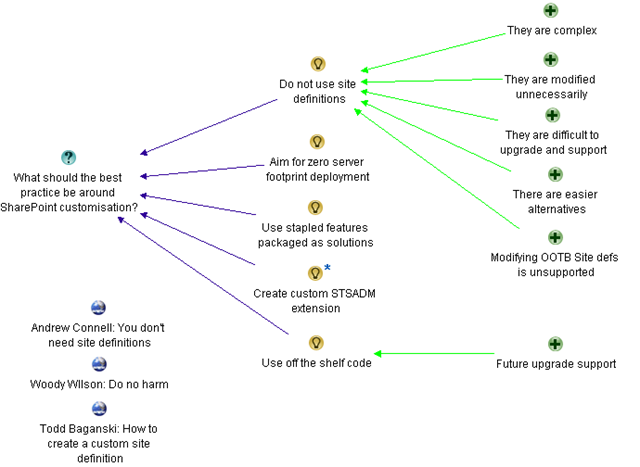
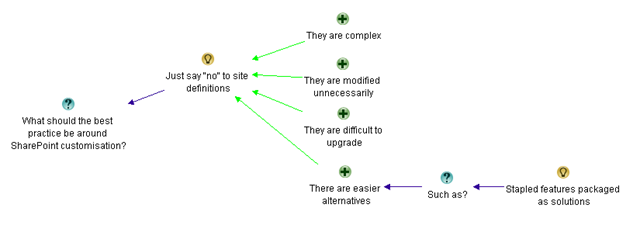
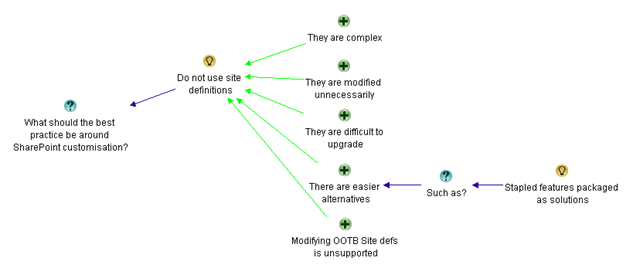
Now if you recall part 4, I created an IBIS issue map to demonstrate the arguments made by Joel Oleson some time back, when he wrote an article that was originally entitled “Just say no to site definitions”. It caused some vigorous debate at the time, and I demonstrated how I was able to both simplify and objectify Joel’s post into a simple issue map that was very easy for any reader to understand. That map is below and this is our starting point for part 5. Have a good look and if you need a refresher on how it was created, refer to part 4.

image

Now it is time to map some of the counter arguments made by those who responded to Joel’s ideas. The first response was anonymous and made various counter points. Let’s take a look at the first half of the counter spray :-).

Are you serious? You prefer STP files over a custom site definition? Man, you obviously have never had to try to build a solution around STP files before.

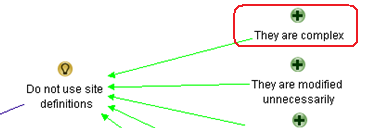
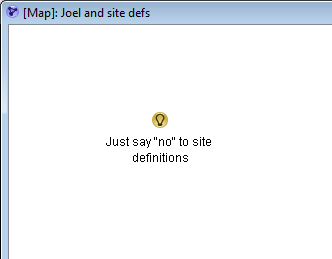
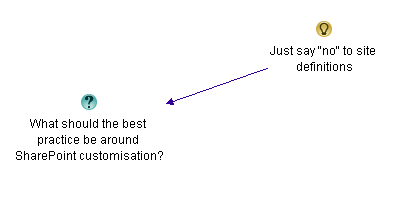
The first line of the response is actually very interesting from an IBIS nerd viewpoint because and it a perfect example of social complexity playing out and it made decide to change major aspects of the map. The above respondent immediately honed in on something that wasn’t actually all that clear to me to begin with. When I first mapped Joel’s statement in part 4, I never actually put the idea of using site templates into the issue map. Why? because Joel never actually suggested it! The closest he came was the statement “Site Templates as tough to work with as they are, are better than custom site definitions”. But I interpreted this as using the example of site templates to highlight the complexity shortcomings of site definitions. I simply captured the argument of “complexity”, supporting the idea “Do not use site definitions”.

image

But look here! Our first respondent interpreted it completely differently to me. They inferred (likely correctly) that Joel prefers site templates over site definitions. But the response then takes a shot at Joel’s credibility.

Are you serious? You prefer STP files over a custom site definition? Man, you obviously have never had to try to build a solution around STP files before

If that exchange happened in a meeting, you may as well call it quits, because it would be very likely that very little valuable dialogue would be obtained after such an exchange. Participants are on the defensive and the meeting will likely get derailed on this tangent. But this is a terrific example of how using IBIS grammar is extremely effective at teasing out ambiguous or poorly formed argumentation, thereby removing the “sting” out of these sorts of debates.

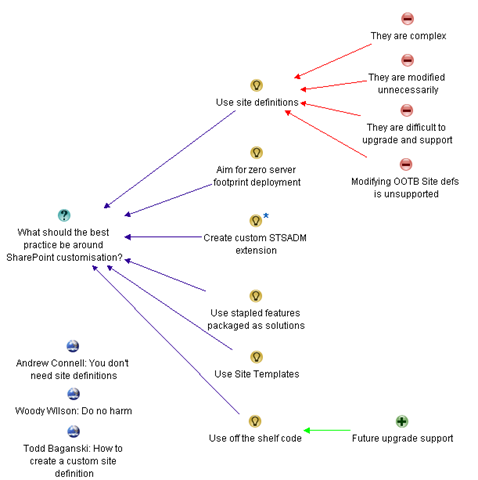
So what should this map look like then? Below is a new version with a few key adjustments.

image

The most obvious change that I have made to the argumentation presented above is Joel’s original idea. I have removed the negative connotation of “Do not use site definitions” to “Use site definitions”. As a result, the previous pros now become cons, because they are no longer supporting the idea. I did this because I have also added the idea “Use Site Templates”, so now we have presented the two ideas without any inferred bias and can simply examine the characteristics, pros and cons of each idea.

For what it’s worth, engineers sometimes unconsciously word questions in a manner that non engineers find biased because of the implied connotation. You can read more about this in my “it’s all how you ask the question” post.

Finally, I also removed the “there are easier alternatives” pro from the map altogether. I did this because this argument has became somewhat redundant. Note how we are now exploring all of the alternatives as separate ideas in the map anyway. More importantly, what does “easier” mean anyway? What is “easier” for an IT pro type person like Joel may be very different to what is “easier” for a SharePoint developer”.

Stepping back

The ability to restructure a map on the fly is one of the key benefits of IBIS. A skilled IBIS practitioner is able to quickly restructure the map as the conversation moves around the various topics, all the time leveraging collective intelligence of the group as they dissect the problem together.

Another key improvement from the previous map is that we have further objectified things. Our first respondent also supplied some great factual counter arguments to Joel, but hid it behind an initial barb that could easily be inferred as a cheap shot.

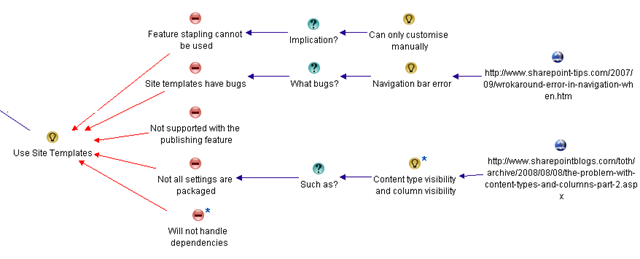
Nevertheless, here is the portion of the map with showing the additional argumentation from the respondent about using site templates. Now we are getting somewhere!

image

Let’s examine each of the statements of the respondent. All of the arguments made were dumping on site templates in some way, so we capture them as cons to the “Use site templates” idea. The respondent actually did a very good job with his arguments and they were very easy to add to the map.

  • The statement “For one, you can’t feature staple to an STP file, so you are simply limited to the manual UI customizations. To run automation when a site is created, you need to use a site definition with a provision handler or feature stapling”, is a bundled up statement. There is the con argument “feature stapling cannot be used”, with an implication of that argument being “Can only customise manually”. I broke that out into three IBIS elements
  • “STP files are buggy, and sometimes you will randomly get errors like this one in your navigation bars” is stating that there are bugs, and supports that argument by stating a specific example of one. I split this out into separate IBIS elements and additionally linked to the specific example.
  • “STP Files do not support sites with the publishing feature activated” is a nice, simple argument that I captured as “Not supported with the publishing feature”.
  • “STP files do not package all your settings, especially content type visibility and column visibility on lists and libraries” is again a nice counter argument backed up with examples.
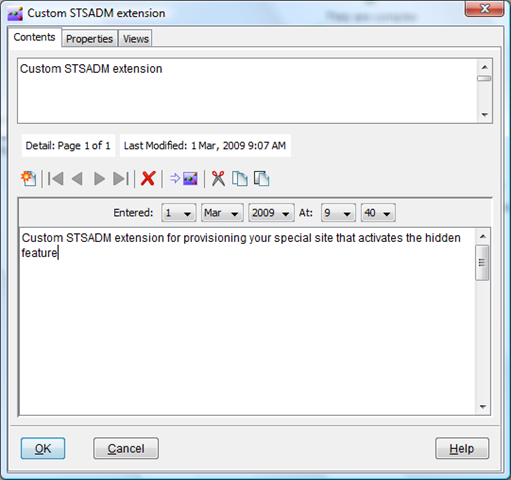
  • Finally, the comment “If an STP relies on elements from other higher-level sites or lower-level subsites, good luck”, is in effect stating a counter argument that site template files to not handle dependencies. In case this paraphrased statement is ambiguous, I added additional detail to this node with the original argument as shown below.

image

More arguments against?

Below is the rest of the response that is nowhere near as clear as the first half. Let’s drill down…

I disagree, I think it is lazy devs that want to use an STP file, instead of creating a custom site definition, just like it’s laziness to create a content type through the UI for a custom solution instead of in XML with a feature (which can then easily be moved from environment to environment).
And honestly, is it really easier to go through the machinations to customize the MySite template as recommended here (http://blogs.msdn.com/sharepoint/archive/2007/03/22/customizing-moss-2007-my-sites-within-theenterprise.aspx) to simply move a few web parts around, rather than just make a tweak to the original site definition? Honestly which is less maintenance for a customer, a quick documented change to an XML file in a folder, or a Feature+WebControl+Custom master page+stsadm commands to activate etc.?

I think you are way off base here, and painting with broad brushes.
(I do agree with zero footprint efforts, and only editing built-in site definitions for tiny tweaks).

The first argument is actually now a moot point. Joel did indulge in a bit of developer bashing in his post (and who doesn’t enjoy a bit of that from time to time) and this respondent is simply reacting to that. But since I have already objectified Joel’s original point then arguments about “lazy developers” is actually answering a different question altogether and does not belong here.

I previously removed Joel’s “it is easier” argument and what do we see here? We see the respondent questioning what is “easier”! This respondent argues that a documented tweak is “easier” than applying manual changes. Once again in a real meeting I can see where this would go. One party would probably then say “yeah but you lazy devs never document it” and we are off into a conversational tangent that will not achieve much. So like Joel’s arguments earlier, I am removing the “my easier is better then your easier” arguments.

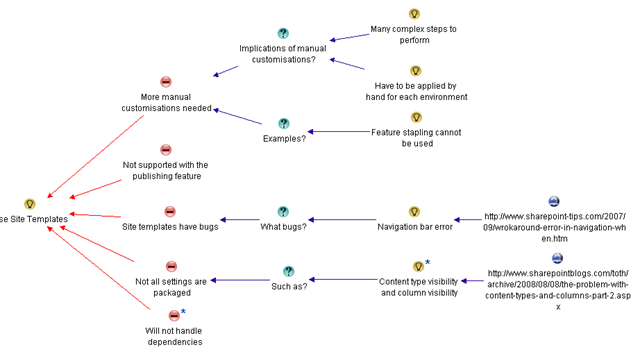
What’s left? Well, pretty much this entire bit of the conversation is talking about how much manual work is involved to manage changes when not utilising site definitions. So we can summarise this counter argument as “more manual customisation needed”. When I look at the map, I see that our existing argument “feature stapling cannot be used” is actually an example of this. So the adjusted arguments against site definitions now look like the map below. Note how I have removed the con of “Feature stapling cannot be used” and reworked it as an example of a new con, called “More manual customisations needed”. This now looks better.


image

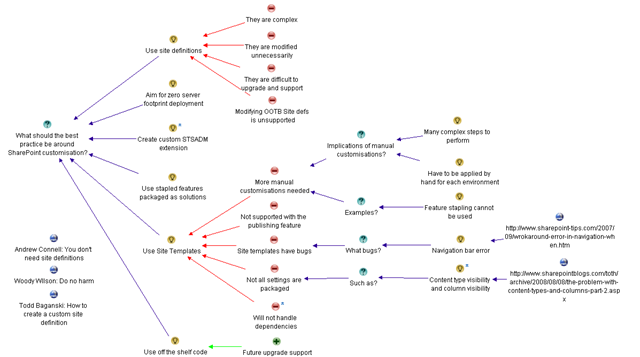
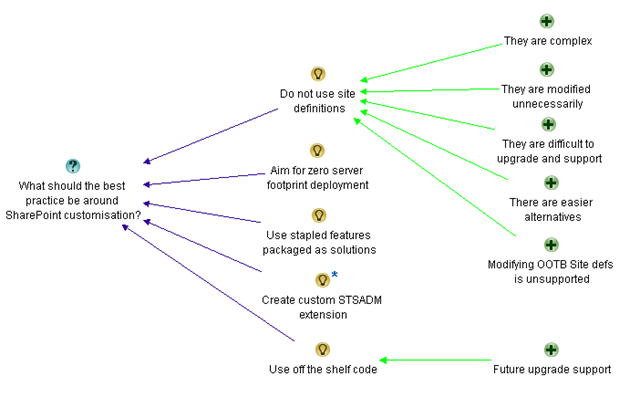
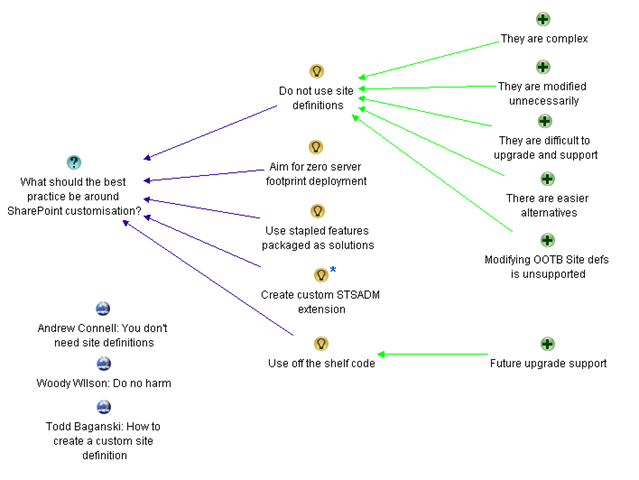
And finally for now, I have this consolidated map to represent our current understanding of the question “What should the best practice be around SharePoint customisation”. There are still other counterpoints, and we still have to add the pro argument into the map too. But by now, you should be getting the idea. Imagine yourself having this discussion in a meeting. Would this map, displayed on a projector have helped keep the meeting on track?

image

Thanks for reading

Paul Culmsee

www.sevensigma.com.au


Seven Sigma is officially a CogNexus Institute Designated Partner

image

Hi all

This is the culmination of a significant amount of effort and a long time in the making, but I am extremely proud that Seven Sigma, the company that I am a co-founder and partner of, is now officially recognised as the first CogNexus Institute "Designated Partner" in the world. I first came across the unique work of Jeff Conklin and CogNexus some time ago and it has changed forever the way that I and my Seven Sigma colleagues approach all of our client engagements. We have been using the CogNexus philosophy, teachings and methods for complex problem solving ever since and are now uniquely qualified in this craft – not only in Australia but much of the world.

This goes way beyond our original SharePoint competencies (and believe me, we are not too shabby at SharePoint!). We are regularly called upon to practice the craft of Issue and Dialogue Mapping outside of the traditional IT discipline, assisting clients to make sense of complex or wicked problems confronting them. Whether we are helping a group of stakeholders to decide issues of transport and road infrastructure, helping a board of directors determine their corporate strategy, or simply righting the ship of a SharePoint or IT project gone haywire, we have proven our competency in this craft. Hence, our skills are now formally recognised.

If you are wondering what this is all about, then it is best to to read my current "One Best Practice" series of articles found here. 

Does it work? Well, our clients seem to think so. Check out this quote from the ICT Manager of the Royal Flying Doctors of Western Australia

I can confirm that I have dealt with and are currently dealing with Seven Sigma Pty Ltd for our SharePoint implementation project. During the setup phase of our project we interviewed several SharePoint focused companies and found Seven Sigma to be above the rest with their overall knowledge of SharePoint and its underlying technologies.  Their approach and methodology to our project has been unique and refreshing and has been enthusiastically accepted by our project team and end-users. It is evident that their ability to map the underlying processes and clearly decipher these during the project kick-off will be a key success factor to our project. Their work to date has been a major factor in empowering our users which will directly assist in our intranet project becoming successful.

I can confidently recommend Seven Sigma Pty Ltd as a solid and reliable SharePoint supplier, and experts in their field.

Matthew Turany

ICT Manager

RFDS Western Operations

<plug>Want to learn more? Got a toxic wicked problem? Want to be trained on the Jedi-arts of IBIS? Then contact us and let’s talk!</plug>

Thanks for reading

Paul Culmsee

www.sevensigma.com.au


The one best-practice to rule them all – Part 4

image

Hi there

Welcome to the fourth post in my series on how to deal with the true root cause of project failure. The first three posts were really to set the scene for this post where I will explain the basics of my craft for resolving some of this. First up, I described my journey through the maze of of well known methodologies and best-practice standards, trying to make sense of a character known as “SharePoint vs Skype guy”. After seemingly taking one step back for every two steps forward, I finally found an area of research that I strongly identified with – the concepts and phenomena of wicked problems. I described how I have come to believe very strongly in the principle that understanding a problem comes from exploration of potential solutions, and that the act of exploring solutions will change your understanding of the problem. Traditional methodologies tend not to recognise this fact, and in fact, many force you into a problem solving model that precludes this perfectly natural sense-making activity.

This sense-making process is utterly critical to project success. The fact is, almost any project failure symptom (such as scope creep) can be traced back to a single root cause. That cause is a lack of shared understanding among participants of the problem behind the project. If you presume, however unlikely, that every stakeholder had an identical deep understanding of a problem and maintain that understanding, then almost by definition, things like “scope creep” and “unrealistic expectations” would not happen

In my last post, I turned my attention to the “inappropriate methods” that are all-too commonly used to tackle projects that have taken on wicked tendencies. We looked at the flawed logic of throwing “process” at a wicked problem, the sometimes misguided reasoning behind many scope restrictions, as well as the pros and cons of competitive and authoritative strategies. Finally, we examined the paradoxical effect where, to fully understand a problem, we have to understand all points of view. Yet in doing this, we leave ourselves susceptible to falling foul of wicked problem characteristics.

Hmm…Such a conundrum…Is there a way out?

From Rittel to Conklin (and IBIS)

Once again, we have to take a brief sojourn to the era of sideburns, flared jeans and excessive amounts of pubic hair…The 1970’s.

Years before Rittel wrote his seminal wicked problem paper in 1973, he had already come to the belief that the relationship of problem understanding was dependent on the solution being considered at any given time. He had also been thinking about tools and methods to overcome the problem. By 1970, Rittel had invented what he termed a “design augmentation” system that he called Issue-Based Information System (IBIS). Here is how IBIS was described back then.

Issue-Based Information Systems (IBIS) are meant to support coordination and planning of political decision processes. IBIS guides the identification, structuring, and settling of issues raised by problem-solving groups, and provides information pertinent to the discourse … Elements of the system are topics, issues, questions of fact, positions, arguments, and model problems.

For you trainspotters, You can read Rittel’s 1970 paper mentioning IBIS for the first time here. This paper is quite amusing when you read it nowadays as it is positively antiquated. But, hey, we are talking about a time before PC’s and when my father still had all his hair. The first time Rittel compared and contrasted “wicked to tame problems” was actually in a 1972 article. Rittel was also not alone in the search for tools and instruments to assist sense-making. He was influenced by the legendary Douglas Englebert (the dude who invented the mouse), who had spent the early half of the sixties examining tools and methods to “augment human intellect“.

Rittel’s original 1970 incarnation of IBIS had many elements to it. He called one component in particular an “Issue Map”. Rittel described the issue map as:

Representation of the various relations between issues, questions, etc., by graphic display of the state of argument

The issue map, 1970 style, involved pen and paper (probably those lead-laced black marker pens that made your head spin from the fumes). But over the following years, IBIS was refined and further developed. Many of the components of the 1970’s version were made obsolete by advances in technology and business practices, but Issue Maps in particular, remained. In the 1980’s, the era of personal computers dawned and later pioneers such as Jeff Conklin (who had worked with Rittel from 1984), could see the potential that IBIS had by utilising a computer-based visual display.

Independently from Rittel, Conklin was pursuing ways of capturing design rationale and had created his own notation called ISAAC. He recognized IBIS as the perfect solution when he heard Horst Rittel give a talk about it.

“His IBIS structure was simpler than my ISAAC structure, and his field experience with using IBIS showed that he understood the social and cognitive issues far better than any of us.  (Someone asked him what the IBIS process was for making decisions and he replied, “There is none.  Decision making is completely context and culture dependent)”

Conklin then adapted IBIS for use in software engineering and created the gIBIS (graphical IBIS) hypertext system to support this use of IBIS. Later Conklin used Rittel’s ideas about wicked problems to help motivate engineers and managers to use gIBIS on their projects. Conklin spent twenty years working with IBIS and sense-making software and systems, and all of that work now culminates today in a software tool called Compendium and a facilitation method called Dialogue Mapping. These days, utilising a projector, Compendium type software, a skilled IBIS practitioner can make a massive difference in helping a group develop a shared understanding and commitment of a problem.

To explain IBIS, let’s take a look at it being used for a well known SharePoint debate.

IBIS by example…

IBIS, at its heart, is a language specifically designed to break down the often convoluted and complex structure of a conversation into something much more simple to understand and digest. The premise of IBIS is that no matter how complex or argumentative an issue is, we can break it all down to just three basic artifacts:

  • Questions
  • Ideas
  • Arguments (pros and cons)

There are a couple of very basic rules by which these artifacts interact (the grammar behind the language). Ideas respond to questions, offering possible solutions to the question. The arguments argue for and against the various ideas. Questions can then be expanded on or challenge other questions, ideas, or arguments.

Here is a great example of IBIS in action for a SharePoint wicked problem. Mr Oleson well and truly got himself into trouble a while back when he made disparaging comments about site definitions and hurt the sensitive feelings of many a SharePoint developer. A large thread of discussion ensued, where various people voiced their opinion in a long series of replies.

A blog, along with its comment system is typical of many collaborative mediums that are not particularly well suited to dealing with a complex issue. The whole linear nature of a blog and its comments, means that the last person to comment, in effect tends to have the last word. That is also why newsgroups and discussion forums have flame-wars that degenerate into deep threads of point-counterpoint discussion that go nowhere because the positions taken get more and more intractable. Any linear based collaborative tool suffers from the last poster having the moral high ground – until someone posts below them.

So, let’s instead build the subsequent debate into an IBIS issue map.

Joel started out with a nice, controversial statement, along the lines of “Just Say NO to Custom Site Definitions“. Sounds like an idea to me, so let’s get it into the map.
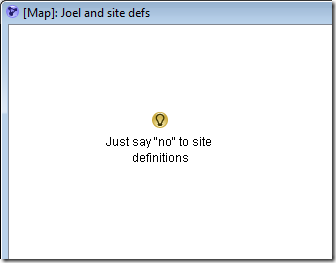
image

One of the rules in IBIS is that an idea is always an answer to a question. Sometimes that question can take a little while to tease out (and you may change the question a couple of times before it feels right), but it is very important that the root question be defined.

Why is this important? Well look at what happened – Joel eventually had to *clarify* his original post because of the fact that readers had different interpretations of the question he was answering. As a result, some missed the real message that he was trying to get across.

“After a lengthy conversation with all our favorite SharePoint MVPs from Andrew Connell, Robert Bogue, Todd Baginski… I need to soften some of the language here, but emphasizing in clarity what I’m concerned about in the spirit of this post”

Now, we have Joel’s “Just say no” comment captured as an idea. When you start using IBIS, you quickly find that a “comment” can take a couple of forms. As previously stated, it can simply be an idea, that is answering a question that hasn’t been specifically asked yet, but it can be a ‘bundled up’ question, idea and a supporting argument in one terse (or extremely verbose) statement.

Let’s think about the inferred question that Joel’s idea is answering. My guess is that the root question is along the lines of “What should the best practice be around SharePoint customisation?” I have worded the question quite deliberately and I’ll explain the logic a little later. I represent this new question on the issue map using the following IBIS notation.
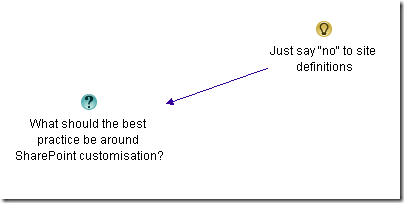
image

Joel made various arguments to support his position. Let’s see if we can disentangle his very first supporting paragraph into IBIS artifacts and issue based structure.

If you don’t need to modify [site definitions] don’t do it.  Consider them product code!  If you need to build something, do it in a feature, staple the feature and deploy it in a solution.  Site Templates as tough to work with as they are, are better than custom site definitions.  Even the use of site templates is controversial in the community due to the customizations that it causes in the database.  From an upgrade perspective, it’s Much Much easier to upgrade a site based on a site template than it is a site based on a custom site definition.  Now a site template based on a custom site definition is just as bad if not worse
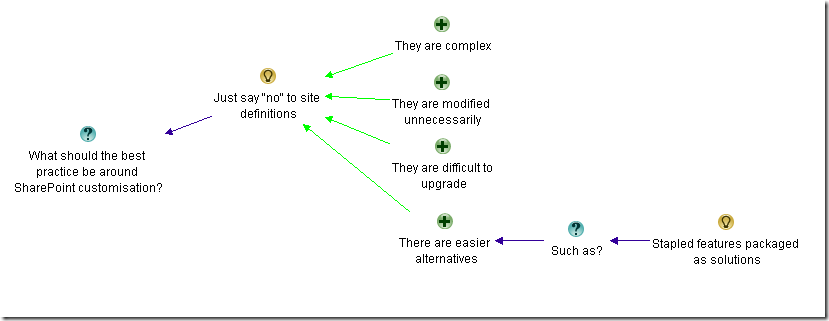
image

Above I have created 4 supporting arguments to support Joel’s idea of not using site definitions.

  • The statement “Site Templates as tough to work with as they are, are better than custom site definitions”, is really using the example of site templates to highlight that site definitions are complex.
  • “If you don’t need to modify them don’t do it.  Consider them product code!” is to me arguing that site definitions are used or modified unnecessarily.
  • “From an upgrade perspective, it’s Much Much easier to upgrade a site based on a site template than it is a site based on a custom site definition” is another example based proposition that site definitions are difficult to upgrade.
  • Finally, the suggestion “If you need to build something, do it in a feature, staple the feature and deploy it in a solution” is in fact one of those “bundled” statements that I mentioned before. Here, Joel is making a supporting argument that there are alternatives, and goes onto suggest an alternative. I captured that in IBIS by breaking up the statement “If you need to build something, do it in a feature, staple the feature and deploy it in a solution” into the supporting argument (pro) “There are easier alternatives”, followed up by a question “Such as” and the idea of using stapled features packaged as solutions.

Objectification is the name of the game!

Now step back and take a look at what we have done here. We have two major advantages over the original statement.

Firstly, participants now do not have to read a potentially convoluted set of paragraphs where the question being answered is subject to interpretation. The issue map above is simple to read, logical and easy to understand. Secondly, and most critically, I have objectified the whole thing. When you look at this map, it is pretty hard to get all fired up and defensive at it, because the root question that I placed onto the map is in effect, calling for ideas, of which Joel’s is simply one of those ideas.

Cool huh? Shall we do some more Issue Mapping?

Back to the map…

Here is Joel’s next 3 statements and the updated map

Ok so it’s easier to modify an existing site definition.  WRONG Answer!  You just broke the out of the box product and you will have a hard time getting support.  Maybe the dev support people will help you, but poor customer.  Poor support.  Poor everyone who has to pay to try to undo what’s taken place.

Don’t modify the out of the box site definitions unless you are following some MSDN article…  Even then, make sure there is no other way and you know what you are doing so you can back it out.  Always back it up.  You may even consider backing it up to disk so you’ve got it for later.

I had to listen to customers crying about what consultants came in and did to their environments in the name of “Good SharePoint Development.”  If you can, leave the site def alone, and package up your code so it can be added and later removed or replaced at least.

If you look at the map below, all I have done is reworded Joel’s idea and added a single additional supporting argument. Seems to me that the above three statements were really saying the same thing, that modifying the out of the box site definitions are unsupported by Microsoft. The rest of the arguments still fit within the first four that I captured previously.
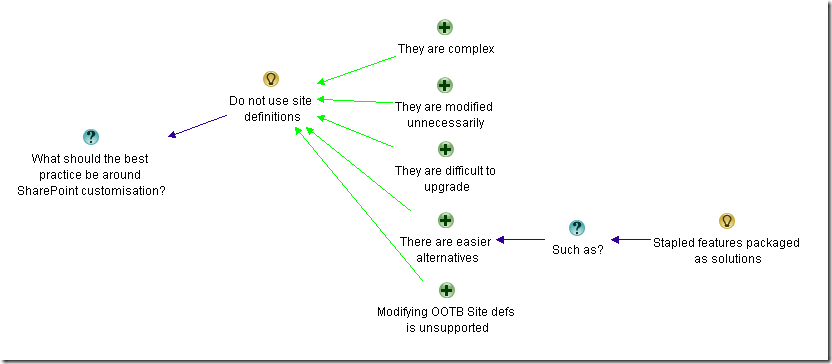
image

I need someone to give me a list of reasons WHY you need to mess around with the site definitions.  I’ve had a couple of devs take me up on it, but I still think it’s WAY better if you just leave it alone and pretend like you can’t.  It will keep you honest and it will make upgrade and support TONS easier.

You’ve recently seen me in favour of client side code running server side elsewhere.  That’s great.  See if you can take things to a higher level and go with a zero server footprint deployment.  Or go with Off the shelf code where you get support for upgrade from an outside company with assurance.

I’m not totally against custom code, but I do want to see it thought through.

I’m sure nearly all SharePoint Dev classes have info on creating custom site definitions.  You may even have something in the certification test on them.

Any SharePoint developer can create a custom site definition, but the challenge is to see if they can fulfill those same requirements without using a custom site definition (The albatross around an admins neck).

Worried about users turning off the features?  Make an STSADM extension for provisioning your special site that activates the hidden feature.  Or consider feature stapling.  Get creative and think outside the V2 Box.  If you’re building custom site definitions on a regular basis you haven’t learned how to do things in the new world.

Now things get interesting. To me, Joel actually contradicts himself a little without realising. We started out with the premise of “Just say ‘no’ to site definitions”, but here he is actually adding *more* good ideas around best practices for customising SharePoint sites and less about why you should say no to site definitions. Example?

  • “See if you can take things to a higher level and go with a zero server footprint deployment”
  • “Go with Off the shelf code where you get support for upgrade from an outside company with assurance”
  • “challenge is to see if they can fulfill those same requirements without using a custom site definition”

Remember that we now have a clear root question “What should the best practice be around SharePoint customisation?”.

I also adjusted the “They are difficult to upgrade” supporting argument to “They are difficult to upgrade and support”, acknowledging Joel’s “It will keep you honest and it will make upgrade and support TONS easier” comment.

Finally, Joel has actually offered us up two more alternative ideas, an STSADM extension, off-the-shelf code and he also mentioned again the option for feature stapling. I decided to capture these as separate ideas now and remove the “such as” argumentation that I previously used.

Below is my updated map that I think reflects where we are so far.
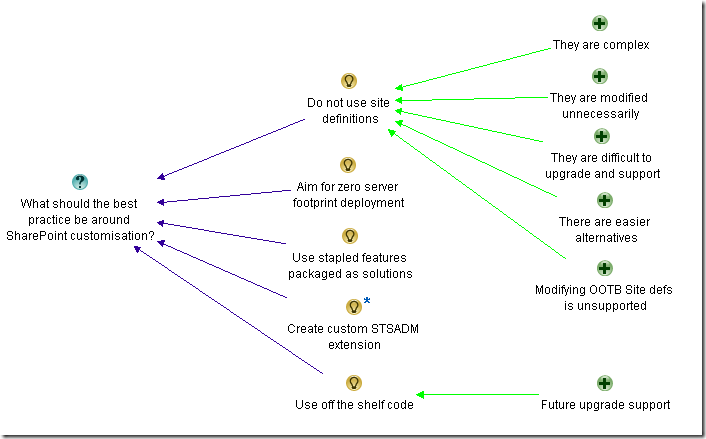
image

If you are *really* observant, then you may wonder what the little (*) is by the “Custom STSADM extension” node on the above map. All that it means is that I have more detail in that node as shown below.
image

Below is the rest of Joel’s opening salvo

Let’s continue to talk through the trade offs of site templates, feature stapling, and site definitions.  I think this is an important discussion.  In the future I’d love to see it to not be common at all when even hard things need to happen.

Ok, so developers don’t think much about upgrade, but let’s start preaching… Can we do this without custom Site Defs without a note from the teacher that agrees to says it’s a Requirement.  On the hierarchy of Scary Customizations.  The Custom Site Def is nearly the worst.  The only ones worse are customizing the out of the box site definitions and messing with the database and adding your own triggers and “fixing” the inefficient SharePoint stored procedures.

Todd Posts  “How to Create a Custom Site Definition” , but agrees we need to minimize what we do with them (see above).  Good job Todd, my friend, you show up as #1 using keywords… custom site definition)

I do think we need to see more about “How to NOT Create a Custom Site Definition” or

You don’t need to use Site Definitions (This is AC’s Love and the discussion) please point your devs to this one.  I continue to plan to point customers and developers to that one.

If you’re a lost developer or even one that’s looking to go through a ten step program, I recommend the Hippocratic Oath of SharePoint – First Do No Harm  (Thanks Woody).  There’s also SharePoint Dev guidance at by the Patterns & Practices Group. AC talks about it.  I’m anxious to see them provide guidance on when site definitions are necessary (yes as an IT pro, I want to see them used when features and solutions don’t do the job).

The first two paragraphs don’t really offer anything new to what has already been captured. But he then refers to Todd, Andrew and Woody’s posts. I have incorporated those URL’s into my map as reference material. If Joel had paraphrased specifically what their recommendations were, I would have created more idea or argument nodes in the map but for now, it if sufficient to simply reference those maps without linking them anywhere yet.

Remember, ideas can often “sit out there” for a while, before being worked into a cohesive issue map.
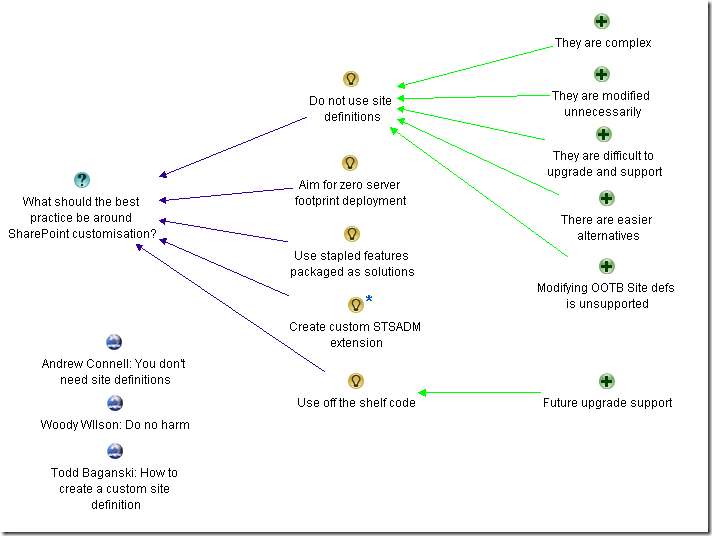
image

Conclusion

I believe that this issue map, as it stands, has captured the essence of Joel’s arguments thus far. As you might have guessed, part 5 is going to continue to dissect the site definition debate and continue to build out this issue map. As we delve deeper, the map will get frequently restructured. As a result, there will be lots of pretty map pictures. So, for all you readers who say you read playboy “just for the articles”, you can stop reading this series now :-).

Thanks for reading

Paul Culmsee

www.sevensigma.com.au



The one best-practice to rule them all – Part 3

Gollum the Ring (2)

This is the third post in a series that focuses on what I think is the Holy Grail of project success – particularly SharePoint projects. Like everybody else, I am a product of my experiences, and one of these experiences was a project that included one of my greatest career teachers – “SharePoint-vs-Skype guy”. If you have not yet heard of this luminary of SharePoint folklore, then I suggest you go back to Part 1 of this series and start there. Starting here at part 3 really makes no sense at all…seriously.

I’ve spent two posts explaining my so-called journey to enlightenment and in part 2 of this series, I made the assertion that the *true* root cause of failed projects is usually a lack of shared understanding (and therefore shared commitment) among project participants. This root cause is often misdiagnosed because it is reflected in more visible symptoms such as scope creep, vague/incomplete requirements, mismatched expectations and general all-round unpleasantness. I also spoke about my journey toward “problem fundamentalism”, where I have come to believe very strongly that if you can achieve and maintain that illusive “shared understanding” of a problem among participants, then the actual process that you adopt to implement the solution really doesn’t matter that much. In essence I am echoing the inventor Charles F. Kettering when he once said

A problem well stated is a problem half solved.

Let’s now turn our attention to the “how” of shared understanding.

“Inappropriate methods”

Rittel and Conklin say that many groups fail to recognise that they are dealing with a wicked problem, or a problem that has taken on wicked tendencies. As a result, they apply inappropriate methods to deal with them. There are a few reasons for this, but two major ones stick out in my mind.

The first reason is the “unconscious incompetency” factor, which is training speak for “you do not know what you do not know”. In other words, if you have never heard of wicked problems and their nature, how are you supposed to know how best to deal with them? Thus, like any other form of enlightenment, you have to move from unconsciously incompetent to consciously incompetent (you now know that you do not know) before anything else. This series of posts hopefully is doing the trick here.

The second reason is that the visible signs of wickedness manifest themselves as scope creep, incomplete requirements, wheel reinventing and the like. Since I have already asserted that these are actually symptoms and not the true root cause, the usual methods used to try and deal with them are treating those *symptoms* and not the true cause. At the very least, traditional techniques are inappropriate and at the very worst, they are going to make things significantly worse!

Jeff Conklin recently said this about shared commitment:

The ‘Holy Grail’ of effective collaboration is creating shared understanding, which is a precursor to shared commitment. If you accept that the crux of effective action is agreeing on what the problem is, then the challenge for organizations is coming to a shared understanding about what their particular dilemma is. Plenty has been written about how to get people ‘on board’ and create buy-in for a strategy; but the business of how to craft shared understanding – a deep and robust understanding of the circumstances – hasn’t been well understood. Shared understanding means that the stakeholders understand each other’s positions well enough to have intelligent dialogue about their different interpretations of the problem, and to exercise collective intelligence about how to solve it.

With Jeff’s quote in mind, let’s take a look at these traditional techniques and see how guilty we all are of using them 🙂 .

It’s the process stupid!

It is almost universal to blame all of the world’s faults on “process”. I went through this line of thinking as I was off in my “theory cave”, trying to make sense of “SharePoint vs Skype” guy and other mysteries of life. What logically follows from this is usually the implementation of some sort of best-practice methodology, in the guise of program or project management office. This in turn creates a lot of extra rigour around the activities and processes around *solving* problems. Don’t get me wrong. Process, structure and consistency are actually critical, but problem wickedness and shared understanding are in the *sensemaking* space. The problem is that most best-practice standards and methodologies are very much focused in the *solution space* and tend to work on a presumption of more shared understanding than is actually the case. Again, this is due to the focus on treating the symptoms of problem wickedness. For example: “You have a scope change? Well, let’s fill out a change request form then”.

As a result, the whole sensemaking half of the puzzle is entirely missing!

CleverWorkarounds’ Hindsight Rating: This is why a lot of SharePoint governance plans and information architecture exercises are misfocused or simply miss the point.

Nail the scope, baby!

The other common way to try and tame things is to restrict or lock down the scope. I’m sure all readers have engaged in this. The idea being that if we solve this smaller, more constrained bit of the problem, we can then solve the harder bits later. The great flaw in this logic is exposed once you understand the symbiotic relationship between problems and their solutions that I spoke about in part 2. To recap, each time you think of a potential solution, you will always have an effect on your understanding of the problem. This was Rittel’s first characteristic of a wicked problem and it fed the endless loop of the second wicked problem characteristic – the “no stopping rule”. Therefore, by restricting scope and implementing a smaller subset, you will likely significantly change the understanding of the problem among the participants to the point where you can be in an even more fragmented position than you were in the first place.

In other words, the goalposts have moved in the meantime and the scope is no longer relevant. Stakeholders with hindsight question the very logic of that original scope restriction!

CleverWorkarounds’ Hindsight Rating: It’s so easy in hindsight 🙂

The umpire is always right, right?

Sometimes a group will become so fragmented in their understanding of a problem and therefore become completely polarised on the various solutions. The positions become so intractable for some that even to talk about other options, gives those options more credence than deserved. For example, to an ardent mac or linux fanboy, Microsoft are so evil and nasty that you should not use their products like … ever, dude!

When this occurs, usually after a long, arduous and spiteful process of trying to reach consensus, parties will often give the problem to a “higher source” and agree to abide by their decision. This could be your mother, the CEO, or the International Court of Justice in the Hague. The point is that the decision process is transferred from many to a few. In doing so, we rely on the knowledge, expertise and authority of that higher source.

This does tend to speed things along because when buried in the mud of analysis paralysis (symptom of endless looping between problem and solution), the desire to “shut-up and make a decision already” can be very strong. The tradeoff with this approach however, is that the decision makers themselves are inherently subjective and may disregard what some see as critical considerations. Since this is a win/lose proposition, stakeholders can become disenfranchised and although the decision has been made, there is no true shared commitment to implementing that decision.

CleverWorkarounds’ Hindsight Rating: If there is no shared commitment then it doesn’t matter how technically valid the solution is. It’s still dead.

Selling Ice to Eskimos

Many organisations (and in particular, governments) use a competition based method to deal with complex problems. Just like the previous example with entrenched, seemingly intractable positions, outcome will be determined by the forces of competition. The theory is that the best ideas will stand up to scrutiny and rigour and via a process of natural selection, the best will survive.

This method of competition between potential solutions, and the stakeholders that propose them actually has some distinct benefits. For example, it can foster innovation, sharpen the sensemaking focus of participants and provide good solution choices.

Unfortunately, as with all forms of competition, someone has to lose, and as a result, people do not always like to play fair. Whether it is Olympic athletes drugging themselves with steroids or certain corporations taking illegal advantage of their dominant market position, competition is often a very dirty game. A great case in point is the debate around Intelligent Design. It is argued by some that intelligent design is a scientific theory and should be taught in schools. But critics argue that the concept is simply an ingenious way to get around the 1987 US Supreme court ruling that creationism based science being taught in science in public schools violated the constitution, because it advanced a particular religion. Whether the latter view is right or not, it is still a great case study in how the rules of the game can be manipulated.

CleverWorkarounds’ Hindsight Rating: Marketing has a lot to answer for!

The paradox of shared understanding

Given that complex problems have a lot of interlocking and multi-causal factors, combined with the social complexity of multiple stakeholders with different world views, is it any wonder that traditional methods of reining in haywire projects are largely ineffectual? Traditional thinking across many disciplines suggests that problem solving is a linear process. Whether you are trying to work out where to put a freeway offramp or install a SharePoint internet site, the process would usually start by defining the problem, gathering data, analysing that data and then planning and implementation of the solution. Call it “waterfall”, or the “scientific method” or whatever, this approach has been around since… forever.

I wrote in more detail about the perils of waterfall in the project fail series in the section “how we really solve problems”.

But here is the problem with that approach. Those complex, interlocking issues and social complexity cause significant differences in opinion on the best solution, yet we need all of the diverse views to really gain a true, deep understanding of the problem and obtain the critical shared commitment that we need. The “no stopping rule” means that it is exceedingly difficult to determine when participants have *sufficiently* defined the problem, gathered data or formulated a solution.

So, how can we reconcile this paradox?

Is it possible to have a holistic, systems approach to examining the deep structure of an issue, that somehow allows us all to see the illusive big picture, without the inefficiency of “analysis paralysis” and the endless loop of the “no stopping rule”? (not to mention and the other nine characteristics of wickedness that Rittel identified). How can we, as a diverse group of stakeholders, fully explore a problem and gain the deep understanding of an issue without social complexity and those wicked factors derailing everything?

This is a question that Horst Rittel spent a lot of time thinking about and by 1970, had developed a potential answer. In part 4 I will tell you what his answer was and what it has now become, thanks to Jeff Conklin.


Thanks for reading

Paul Culmsee


Functional consultants vs *great* functional consultants

Kristian Kalsing was written a really terrific post, not just because he quoted yet another bloody international standard that I will have to now read (ISO15489). But because, drawing on his experiences of the world of SAP, he has observed that there are some important lessons that can be learned for SharePoint engagements. SAP (okay, well Basis anyway) is a world that I experienced way back in 1999 and, boy, can I write some stories about social complexity and project failure about that era!

Kristian observes that on SAP projects, the roles of consultants are typically very clearly defined and discipline based. For example, there are infrastructure (Basis) consultants, developers and functional consultants. Even within functional consultants, there are sub-disciplines of expertise. (Hope you don’t mind me quoting you Kristian).

The point is that the consultant configuring the finance module is basically an accountant and the consultant configuring the HR module probably studied human resources at university. In the SAP world, it would be absurd to take someone who has configured materials management or plant maintenance with one client and ask them to configure HR with the next. In SAP, the specialisation does not stop with the functional areas of the product. There are also functional consultants building up experience in certain industries. E.g. supply chain management can be very different when talking coal mining compared to running supermarkets.

Kristian observed that this notion of functional consultants does not occur in the SharePoint world. However, he qualifies this by observing that SAP is much bigger than SharePoint and therefore a direct comparison is "bit of a stretch", yet lessons can be learned. On the ‘bigger’ point I actually disagree and think that the context of ‘bigger’ is relative (and I look forward to Kristians’ opinion on my take). SAP and ERP systems are massively bigger and more complex than SharePoint – without a doubt. SharePoint may not be as big as SAP in terms of feature-set and complexity, but it can actually be just as big as an ERP system in terms of the impact on the day-to-day workings of staff.

To paint a gross generalisation, with an ERP system, often all that many end-users will ever see is a system to enter their time-sheets and perhaps perform some HR functions such as apply for leave or check pay-slips. Not everyone directly sees or interacts with, say, financials, plant maintenance and the like. But you can be pretty damn sure that everyone saves files to G:\ drive on a daily basis. (Substitute whatever your drive letter is that represents your jungle that is the file system).

More staff = more social diversity = more differing opinions = more complexity = bigger scope = more options = even bigger scope = wicked problem

Therefore, it is not a case that "lessons can be learned from the SAP world", but it is a case of "lessons should be learned from the SAP world".

But here is one additional (admittedly subjective) point to consider.

ERP systems have a really bad failure rate. Does the fact that there are discipline specific functional consultants involved really hold the key to project success?

Don’t get me wrong. I think that SharePoint functional consultants are a critical piece of the puzzle and, by god, the world can do without Microsoft gold partners throwing one of their "technical" people at what is essentially a project with a huge training and advisory component. But succeeding in SharePoint – or any other discipline involving complexity and a large diversity of stakeholders, goes deeper than that.

The difference between a "functional consultant" and a "great functional consultant" is not only domain specific knowledge. It is the art of helping diverse stakeholders to disentangle complex problems from a cluttered maze of overlapping issues, the moving target of requirements into an environment where all participants have a shared understanding.

I’ll have more to say about this as I delve deeper into the "One best practice…" series.


Thanks for reading

Paul Culmsee


« Previous PageNext Page »

Today is: Wednesday 3 June 2026 -