Back to Cleverworkarounds mainpage
 

A tribute to the humble “leave form” – Part 3

[Note: It appears that SharePoint magazine has bitten the dust and with it went my old series on the “tribute to the humble leave form”. I am still getting requests to a) finish it and b) republish it. So I am reposting it to here on cleverworkarounds. If you have not seen this before, bear in mind it was first published in 2008.]

Hi and welcome to part 3 of a series of article that are dedicated to raising awareness of the plight of the much-misused leave form. Long has it been the favourite “real world” example of consultants and IT departments worldwide, to demonstrate how SharePoint product features can be used to achieve a utopian dream of reliable, consistent and optimised processes.

The leave form is a phenomena that is enigmatic. It’s simplicity and suitability to demonstrate the concepts of SharePoint cannot be denied. But at the same time, you need to be very careful since it can set expectations that can be difficult to meet when it comes to other business processes that are more complex and representative of more critical business function. In this series I am neither promoting nor dumping on the suitability of the leave form as a real-world example. Instead, I hope that the reader will be in a better position to make up their own mind as we progress through the series and it slowly gets tougher.

To that end, at the end of part 2, we were left with an incomplete InfoPath form for the Springfield nuclear power plant. This form was created by importing an MSWord version of the original form, along with a little graphical manipulation. So let’s pick up from where we left off …

The objective is part 3 is to get the form functional and into a form ready to be published to SharePoint.

InfoPath Next Steps – Adding Controls
image

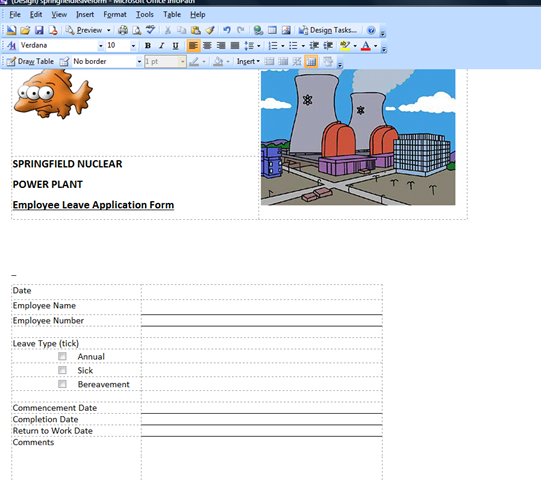
Okay so here is where we are at (click to see the large version of the form above). We have finished the graphics in the header of the form, and now we need to turn our attention to where the action happens. InfoPath attempts to automatically create form textboxes, checkboxes and buttons based on what is has gleaned from any MSWord or Excel based form that you have imported. In my Springfield Nuclear Plant form, during the import, it created checkboxes for us for the leave types, but did not create textboxes for the other fields that we require. What you will notice however, is that InfoPath created a table to hold this information as shown below.
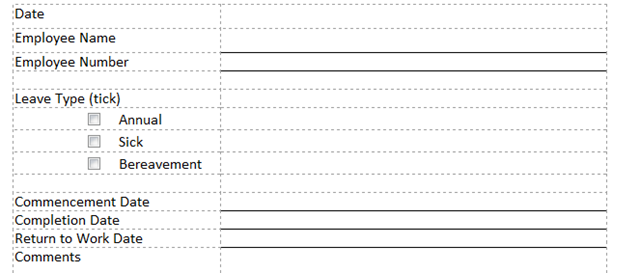
image

So we need to now create those fields (called “Controls”) to allow the user to fill in the form.
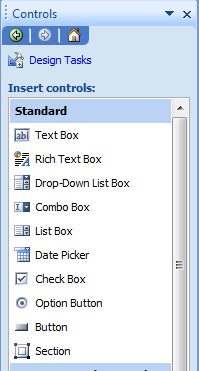
image

In the “Design Tasks” pane, click the “Controls” link, and you will be presented with the interface to add controls to the form (see the screengrab above). I am not going to explain the functionality of each InfoPath control in this article, but what I will say is that we will use three of controls from those available. The “Text Box”, the “Option Button” and the “Date Picker”.

TextBox Controls

First up, let’s deal with the “Employee Name” field. We will make this a text box so that an employee can enter their name.

Click on the “Text Box” control in the “Design Tasks” pane and drag it across to the blank cell next to the text “Employee Name”.

The result will be a fairly nondescript text box in that cell. InfoPath has named this cell “field4″, and if you try this yourself, you will receive a similar name.

image

Why is this control called “field4″? It is because the original import from MSWord created three checkboxes for the Leave type. Therefore they were named, “field1″, “field2″, and “field3″, respectively.

Now field4 is not a good name for a text box. So we will change its name to something that makes sense. (Why we do this will become apparent in future posts). Right click on the newly created text box and choose “Properties”. In the next dialog box, change the field name from “field4″ to “EmployeeName”.
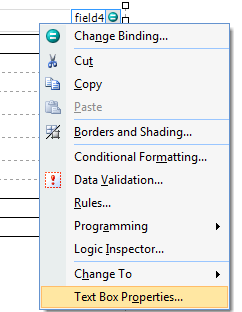
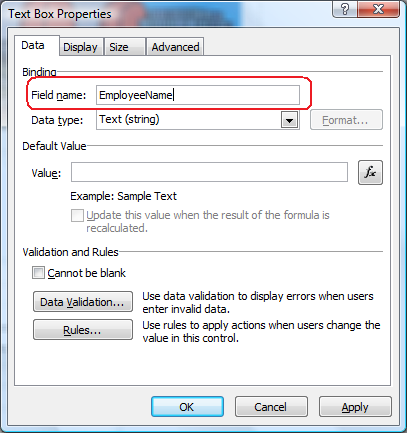
imageimage

While we have this dialog box open, it is worth examining some of the other options available here. We can

  • Set a default value for the text box
  • Set some validation properties. For example, ticking the “cannot be blank” box means that the form cannot be completed unless this textbox has been filled in. When you think about it, it doesn’t make a hell of a lot of sense to have a leave form without the employee name being mandatory (and therefore not blank).
  • Set some rules. Rules allow actions to be taken *after* data has been entered into the form. (We will be utilising rules very soon, and will examine this in more detail then)

We have some additional text boxes to create as well. The “Employee Number” and “Comments” fields will also require text box controls to be added to the form.

The steps are identical to what we just performed for the “Employee Name” field. Drag them to the form, and rename them via the properties menu.

Once the textbox controls have been added to the forms and renamed, the form now looks like screenshot below. (The “LeaveComments” textbox is a single line by default and has been resized)
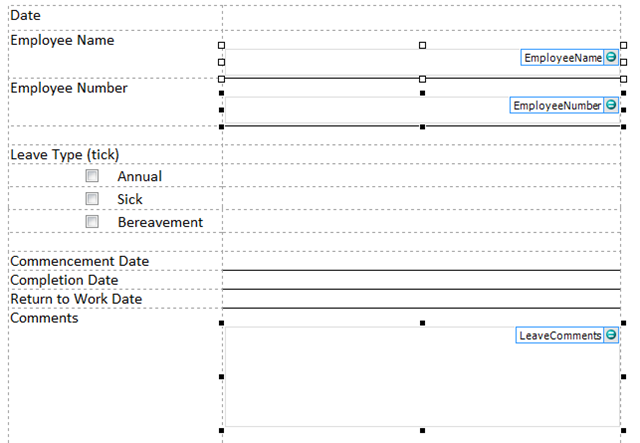
image

Date Picker Control

Usually by this time in a demonstration situation, clients are starting to get interested, as they can see where we are going with this. Have a guess what the “Date Picker” control does? By jove, it picks dates! Who would have thought?

Click on the “Date Picker” control in the “Design Tasks” pane and drag it across to the blank cell next to the text “Commencement Date”.

Do the same for “Completion Date” and “Return to Work Date”.

As per the textboxes, rename the controls to match the data being entered. So for the Commencement Date field, rather than “field6″, make it “CommencementDate”.

Below shows the result of performing this task on all three date fields.

image

Option Button Control

With the option boxes for the type of leave being requested, we have a little more work to do. When InfoPath imported the MSWord document, it decided to use checkboxes for the leave type. As it happens, this is not the behaviour that we want because checkboxes allow multiple selections.

Instead we want only one option to be selected. So we will delete the controls created by the import, and add back “option button” controls in their place.

Clicking on each checkbox on the form, we can delete the existing ones with a tap of the delete key.

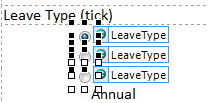
Now click on the “Option Button” control in the “Design Tasks” pane and drag it across to the the left of the word “Annual”. Unlike the other two controls that we have used, this time we need to supply more information before it gets added to the form. We have three types of leave on this form, and as it happens, InfoPath defaults to three option buttons.

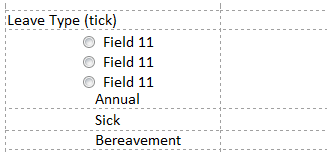
imageimage

Click OK, and you will see the screen is now slightly messy. We have our three option buttons, but they are all in the one cell, and are all labelled the same (Field11 in my example).

Why are they labelled the same you may ask? The reason is that although there are three option buttons, they are all linked as a single field. So if I right click on any one of the three option buttons and rename it via the properties dialog box, all three option buttons are renamed! If you are wondering why this is, consider that the whole point of using option buttons is because you can only select one option. If you can only select one option, then you only have one value to store.

Right click on the first option button and I will show you what I mean.

Below I have renamed the first option button to “LeaveType”. Look closely and you will see a “Value When Selected” text box.

I have changed the value to “Annual”, to represent annual leave being selected. I have also set it as the default value for the checkbox as most of the time leave is annual (vacation leave).

After cllicking OK, you will see that the other two controls are also now named “LeaveType”.
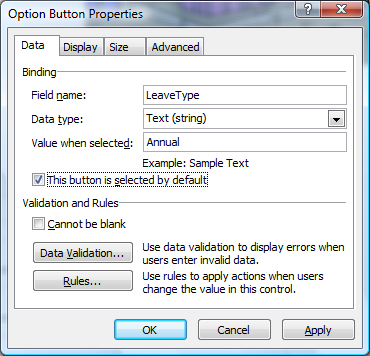
imageimage

Now right click on the second option button and examine its properties. You will see that it is named LeaveType. I have changed the “Value when selected” field to “Sick”, to represent sick leave. For the third option button I have labelled it “Bereavement”
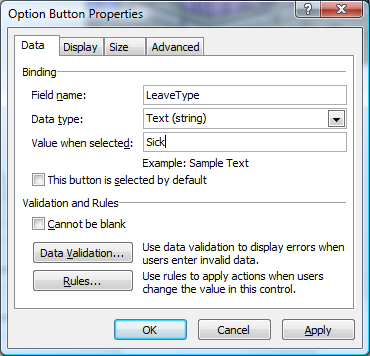
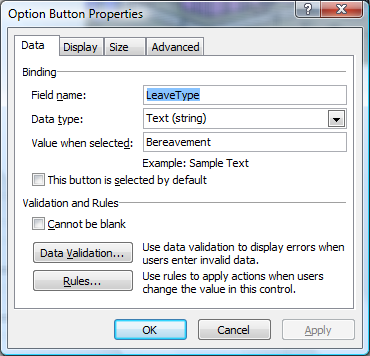
image image

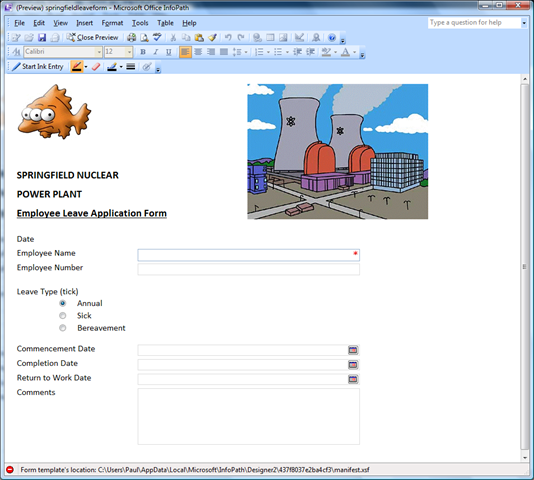
The final thing to do is now to move the last two option buttons into the proper cells and tidy it up. This is a straightforward drag and drop operation. While here I have also moved a few of the other cells around and resized them. At any time you can preview your work by clicking the “Preview” button on the InfoPath toolbar.

At this point, a preview looks like this:
image

Looks nice enough to me (but hey I’m not hired for my design skills!). Note that the Employee Name field is marked with a red asterisk, meaning that it must be filled in. Additionally the date fields now have buttons allowing you to easily pick a day from a calendar view.

Are we done yet? I wanna get to SharePoint…

So here we are with a semi-functional InfoPath form. At this point we haven’t really used SharePoint at all! So in the next article I will cover publishing the form in its current state into SharePoint and viewing the form within a browser.

We still have some significant work to do however, since we haven’t covered all many of the requirements yet. For example, we still haven’t covered data validation in the form. Additionally, we do not yet have a field on the form showing the number of days absent (incorporating the calculation of weekends). The form doesn’t automatically fill in your name when the form is loaded either. Finally, we will also want to add a SUMBIT and CANCEL button to the form.

Until then, thanks for reading

Paul Culmsee


A tribute to the humble “leave form” – Part 2

[Note: It appears that SharePoint magazine has bitten the dust and with it went my old series on the “tribute to the humble leave form”. I am still getting requests to a) finish it and b) republish it. So I am reposting it to here on cleverworkarounds. If you have not seen this before, bear in mind it was first published in 2008.]

Hi again and welcome to the next exciting instalment in the series that pays tribute to the consultant “get out of jail free” card that is the organisational “leave form”. My experience of SharePoint implementations may be somewhat skewed by regional and/or cultural bias of course, but many SharePoint installations tend to follow a script of something like

  • IT Manager attends an “information session” from a Microsoft Gold Partner, has one two many chardonnays and is convinced that SharePoint is the *answer*, but isn’t sure of the question just yet…
  • IT Manager calls aforementioned Microsoft Gold Partner and I am sent out to dazzle them with my wit, charm and technical brilliance
  • IT Manager agrees with me that SharePoint has to be sold to (and owned by) “the business”, so chooses the first candidate business process that pops into his head
  • All hail the mighty “leave form

Me sarcastic? never! :-)

image

Note: I was recently certified as a Microsoft Certified Trainer for SharePoint, and I am using this series as practice for my training material! Thus this entire series of articles is pitched at a very high (end user) level. Readers with some exposure to SharePoint may find this article from the series is particularly easy-going, but rest assured, by the time I am done, I will be delving into web services, code and all sorts of goodies. Writing that stuff for the non developer will be a challenge – so stay with me, I will slowly ramp up the concepts as we go on.

So to recap the introductory article, we have documented the leave application and approval process for the Springfield nuclear power plant, and they have kindly supplied us with their existing leave form that their employees print out and fill in by hand. So our very first job is to see how InfoPath handles importing this MSWord based form to InfoPath.

InfoPath 101

Even though InfoPath is part of MSOffice, many people do not know about it, let alone used it. If you have never seen InfoPath before now, then I suggest you do some reading about it and maybe even download the evaluation.  My one sentence explanation is that it allows you to create electronic forms for data entry or data collection. Among its features is that it can import Word or Excel documents to speed up the form creation process. So let’s do that first up.

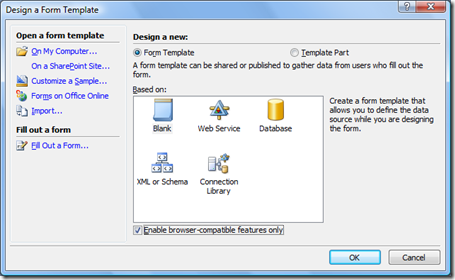
Upon starting up InfoPath 2007 we are presented with a “Getting Started” wizard. Our job is to design a new form, so the option to choose is to Design a Form Template as marked in the screen-grab below.

The next screen is to choose various options in relation to designing a form. We are starting from a completely blank form (which is the default option anyway), but this form is going to web browser based, so that people filling it in do not need InfoPath installed on their PC’s. SharePoint enterprise edition provides support for browser based forms via the “Forms Services” feature. InfoPath 2007 has built-in support for forms services, but the form must be marked as “browser compatible”.

This is not a default setting, so be sure to check the “Enable browser-compatible features only” box before clicking the OK button.

image image

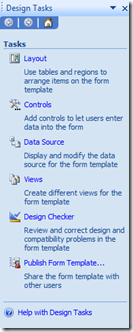
Now we are at the main form designer screen within InfoPath. Being part of the MSOffice suite, it has a set of toolbars that looks very much like the other applications in the MSOffice suite. To the right of the InfoPath screen is the “design tasks” tool pane. I’ve shown it below.

image

You will come to know the “design tasks” pane very well soon enough. From here we can perform all sorts of actions to construct a new electronic form such as create textboxes, buttons, drop down lists and the like. Not only that, but we can instruct InfoPath to connect to “data sources” to populate the values in say, a drop down list box. Imagine for example that all of your clients are listed in your CRM system. InfoPath has the capability to access those client details and display them on the form. Think of the data entry duplication that this will save,  not to mention the  maintenance of data accuracy, eh?

But hey, we are here to impress the clients with our technical wizardry and to show how InfoPath allows non-developers to create sophisticated electronic forms. So what we will do first-up is import the existing MSWord based leave document and see what we get out of the box.

Importing the old form

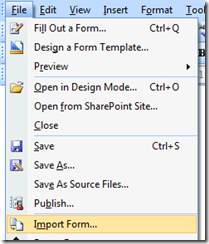
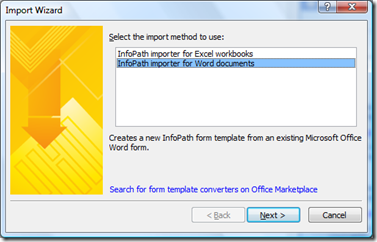
So, you should be at the main InfoPath screen to perform this action. From the “File” menu, choose “Import Form”. On the next screen, choose “InfoPath importer for Word documents” and click “next”

image   image

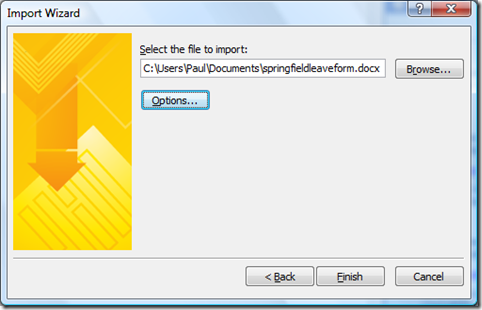
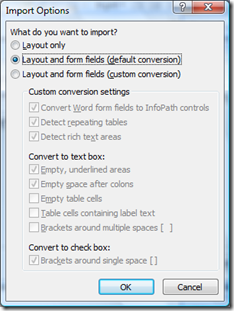
You will be prompted to browse to a file to import. In this example, I have chosen the “springfieldleaveform.doc”. The “options” button allows you to control the specifics of the import process. In this example, I will simply import the form with all of the default import settings.

image   image

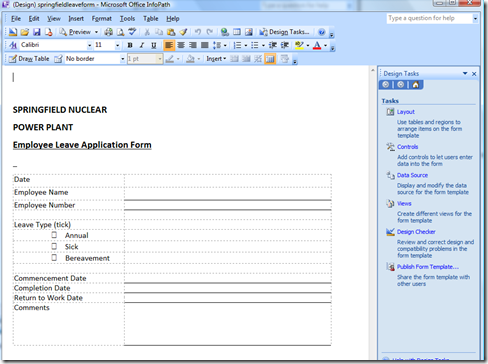
Click “Finish” and InfoPath will do its thing – viola! We have the beginnings of a leave form!

image

Graphics?

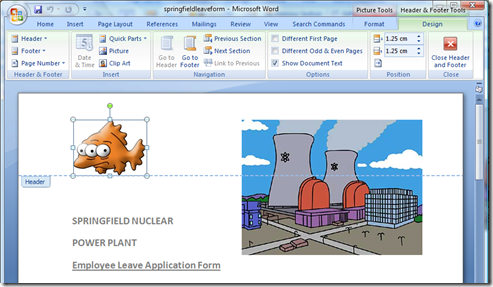
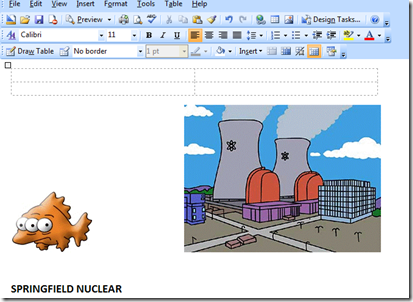
Ah, but wait, what happened to the graphics? The original MSWord form had two pictures in the header of the document – a 3-eyed fish and a picture of the towers. It turns out it seems, that graphics in the header or footer of an MSWord document do not get imported into InfoPath. Bummer – I really liked that 3-eyed fish!

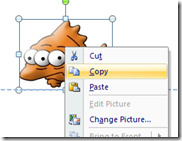
But fear not, importing graphics is as easy as a cut and paste. If I open my original word version of the form, I can double click near the top of the document, and the header/footer will now be available to edit as shown below.

image   image

Now you can click to highlight both images and they will paste into InfoPath. Not exactly earth shattering, is it?

image

It’s still not right…

Okay, so it wasn’t a perfect import. In fact I’d give it about a 6 out of 10. But the point is we have our images and our text inside InfoPath. Also to be fair, MSWord files were not designed for the web either, so it is unsurprising that it wasn’t flawless.

So, now we can use the native features of Infopath to tidy up this form. First, we will tidy up the arrangement of the two images, and then we will add some graphical elements like textboxes and option buttons to allow the form to be electronically filled in. We will create a table on the form that looks like this

image

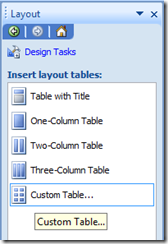
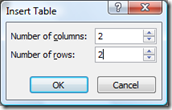
In the right-hand “design task” bar, we select “Layout” and then choose to create a “custom table”. Choose a 2*2 table and you should see the table as shown in the third image below (look above the fish graphic).

image  image image

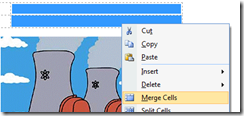
The next step is to format the table correctly. Highlight the two rightmost cells, right click on them and choose “merge cells”. The result should be a table looking like the rightmost image below.

image   image
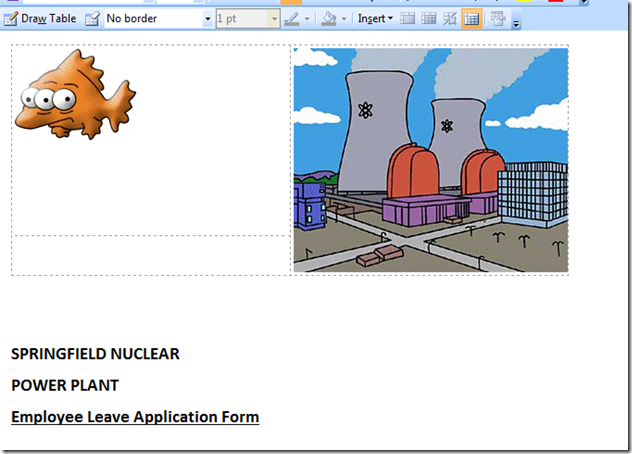
Now drag and drop the three-eye fish to the leftmost cell and the plant picture to the rightmost cell of the top row of the table. Your result should look something like this.

image

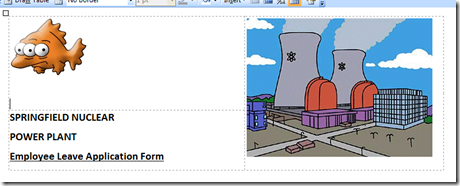
Now highlight the remaining title text, and then cut and paste it into the empty bottom left cell . Aha! We are starting to look better! A bit of resizing of the table cells width and it is looking more like the original.

image

Are we impressed yet?

Okay, sorry that is very much a rhetorical question, I know. I haven’t exactly written the most technically complex article ever.

But at least we have gotten the InfoPath version of the form to look much more like the MSWord version. If I had been running that as a client demonstration, it all in all would be around 2-3 minutes work. Is the client blown away in amazement and opening the chequebook yet?

Not exactly, but we haven’t gotten to the good stuff yet. In part 3, we will add some textboxes and other graphical elements (called “controls”) to the form, and then we will do some smart things to reduce manual data entry, as well as ensure that the data that we have collected is accurate.

Bye for now

Paul Culmsee

www.cleverworkarounds.com


A tribute to the humble “leave form” – Part 1

[Note: It appears that SharePoint magazine has bitten the dust and with it went my old series on the “tribute to the humble leave form”. I am still getting requests to a) finish it and b) republish it. So I am reposting it to here on cleverworkarounds. If you have not seen this before, bear in mind it was first published in 2008.]

Hi all. It’s a pleasure to be involved in the launch and first edition of SharePoint Magazine. My name is Paul Culmsee and I’ll be your host for this series of articles. If you have not read my stuff before, then I’ll say that I am an opinionated, underpaid and overworked SharePoint consultant based in Perth, Western Australia. clip_image001

I had previously decided to write an educational series of articles to pay tribute to the humble, good old leave (vacation) form and I think it is perfect fodder for SharePoint Magazine’s wide variety of audience.

Where would SharePoint consultants worth their grain of salt be without the leave form, eh? When all else is lost, there it is to save your ass from the wrath of the CIO who is wondering where his two hundred grand of license fees, hardware and programming went.

image

Why the leave form?

From a demo perspective the leave form is pure gold. You can knock out an InfoPath form in minutes, publish it to a SharePoint site using Forms Services and top it off with an easy-to-understand SharePoint Designer workflow that creates some tasks for the boss to approve the request and to notify payroll of the approval. All within the space of a 1 hour demo session. Genius! No wonder Microsoft sell all of those licenses!

For a client who is still coming to grips with the possibilities what forms and workflow offer, the leave form is an excellent starting point. It is a simple process and almost universally understood. There really aren’t that many owners/stakeholders involved in the process, and thus even the most extreme anal-retentive “process nazi” can’t really make it too onerous. So turning this process into a “non-programmer” workflow is not that hard.

Being a simple process, you can use SharePoint Designer workflows. Now some developers reading this will probably start protesting, and believe me I know where you are coming from. But let’s face it – you guys are damn expensive!

Thus, SharePoint Designer based workflows are a great *prototyping* tool. Non programmers can develop them, and making modifications and changes do not require a lot of time or cost. For an organisation unused to workflows and the inevitable “process debates” that arise as a result, delving straight into Visual Studio and expensive developers I do not recommend. Workflows tend to evolve fairly quickly at first as people learn more about them. Additionally, whatever you *think* you want in the first phase has a very high likelihood of being ripped out or seriously modified once it starts to get real-world use.

So in using the leave form, we are using a process that is well suited to a SharePoint Designer based workflow. Once the process is mature and you have enough SharePoint experience to appreciate the governance costs, then you can rewrite it as a “proper” Visual Studio based workflow template.

Why not the leave form?

The leave form unfortunately is not representative of the sort of process where automation or improvement justifies a SharePoint investment. If your company is suffering a cash-flow bleed because you can’t get your leave forms done, then I can say with some confidence that you are *seriously* screwed and SharePoint isn’t going to solve your issues.

The point is, the leave form is not going to have too much real business relevance in terms of tangible return on investment. In fact the leave form is *too easy*. As a demo, it can mislead an organisation into thinking that the answer to life, the universe and everything is contained within the everyday world of mere mortals armed with nothing more than InfoPath and SharePoint Designer.

The real life of organisational process and workflow is completely different. Most workflows tend to be more complex because they involve more teams and team members. Because they involve more teams, they have a tendency to be unoptimised, undocumented, inconsistently followed and over-complex, due in part to to past screwups, lack of co-operation and organisational mistrust and politics. This is a reflection of much bigger issues than SharePoint of course, but to entertain the notion that SharePoint is going to miraculously change cultural issues is about as ludicrous as suggesting that Guns N’ Roses will actually ever release their “Chinese Democracy” album anytime soon.

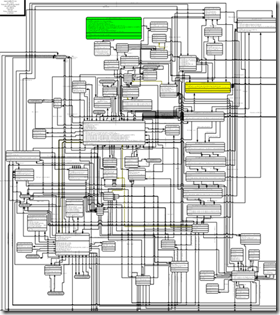
image

Believe it or not, the image above is a real workflow. Check out this story behind it here – it’s funny in a very scary kind of way. Whilst this may be an extreme example, it should hopefully make it clear that despite best intentions, your first few attempts at trying to improve something like this via SharePoint aren’t likely to go all that well if your process is crappy to begin with clip_image004

Why use the leave form an example then?

That’s easy! I actually want to finish this series of articles in a reasonable time!

Additionally, it still suffices to demonstrate fairly convincingly how it doesn’t take very long at all before we need to delve deeper into the potential no-mans-land of custom development. So the outcome of this series of articles is two-fold.

  1. Readers will get a good understanding of the tools and SharePoint features that combine to produce an automated version of the leave form process
  2. (But more importantly) They get a glimpse behind the virtual green door of InfoPath and SharePoint’s dirty little secrets.

Is it humanly possible to write a series articles for normal people *and* technical geeks? We shall soon find out!

A recent real-world engagement clip_image004[1]

The leave process that I have outlined here is going to have a little more depth to it than the sort that would be demonstrated in a pre-sales demo, but it is still not industrial strength. I’ve put enough in there to assist the reader to really understand just what it takes to implement a semi-real world case.

I hope that readers have watched the Simpsons!

Conveniently for all of us, my company Seven Sigma’s office in Springfield recently completed a SharePoint engagement for the local Nuclear Power Plant. After some initial requirements gathering, we ascertained that like most companies, the leave process for the plant was problematic. It was an MSWord file that employees have to open, print out, fill in and then hand to their boss. The boss (some old-dude named Burns) was an old-fashioned, unpredictable kind of guy and he tended to forget the names of particular employees. Thus sometimes applications went unprocessed, misfiled or inconsistently handled.

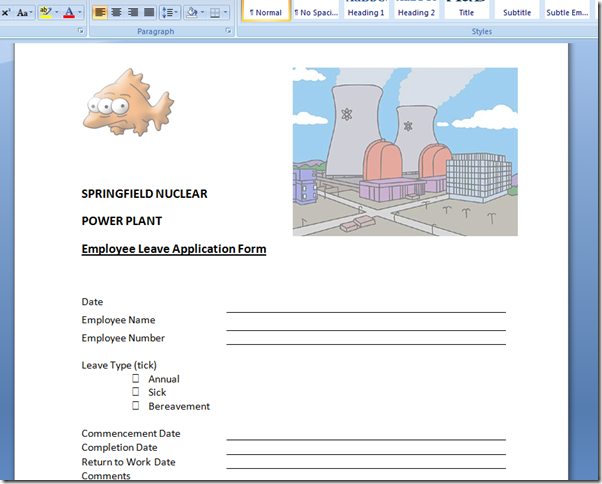
Below is the leave form in its original MSWord format.

image

After gathering requirements and running some workshops, we were able to determine what the client wanted with their automated leave form workflow…

The Requirements

Roles
Requestor Approver Payroll
image image image

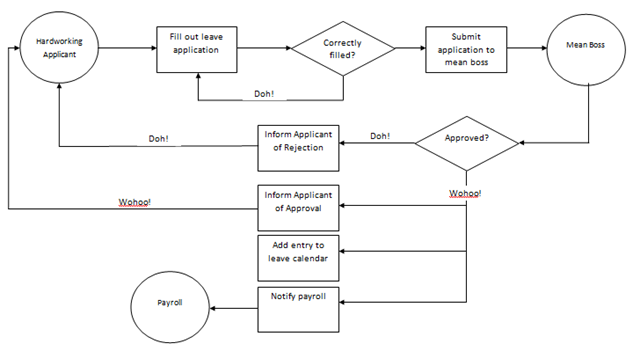
The leave workflow steps to be implemented are as follows.

image

  1. Hardworking and dedicated employee (Requestor) completes an online form to apply for hard earned leave. The form automatically identifies the requestor (a good thing because spelling your own name can be hard). Additionally, the type of leave (sick, annual, bereavement, etc), start date, end date and the return to work date are all entered into the form. Importantly, the number of days absent from work are automatically calculated to exclude weekends.
  2. The evil overlord boss (Approver), receives a task notification to approve an application for leave. The approver reviews the leave details and approves or rejects the leave application. If the leave is approved, proceed to the next step, otherwise the leave is rejected and proceed to step 8
  3. Evil overload boss curses industrial relations laws allowing employee leave in the first place, but belatedly marks the leave request as approved.
  4. Requestor is emailed a confirmation that his application has been approved
  5. The leave is added to the corporate leave calendar
  6. Blatant brown nosing suck-ups (Payroll) are notified by email of the approved leave and adjusts leave remaining in the HR system
  7. End of workflow
  8. The evil overlord boss (Approver) has had a call from the Nuclear safety watchdog and all safety inspectors need to be on-hand to hide the evidence. Thus the approver rejects the leave application
  9. Requestor is emailed a confirmation that his application has been rejected with the reason why
  10. End of workflow

From the above process, a number of key requirements are apparent and some more were determined.

  • Automatic identification of requestor
  • Reduce data entry
  • Validation of dates, specifically the automatic calculation of days absent (excluding weekends)
  • Mr Burns is not the only approver, we will need the workflow to route the leave approval to the right supervisor
  • We have a central leave calendar to update

Additionally, Mr Burns likes to keep an eye on things and has a large series of monitors in his office that he uses to watch what is going on around the plant. Thus, he requires a dashboard that shows him a birds-eye view of the leave process from end-to-end.

Next steps..

The first step is to convert the existing manual leave form into its InfoPath equivalent. So in the next exciting article, we will get to see just how easy (or not) InfoPath really is!

Thanks for reading

Paul Culmsee

www.cleverworkarounds.com


How not to troubleshoot SharePoint

Most SharePoint blogs tend to tell you cool stuff that the author did. Sometimes telling the dumb stuff is worthwhile too. I am in touch with my inner Homer Simpson, so I will tell you a quick story about one of my recent stupider moments…

This is a story about anchoring bias – an issue that many of us can get tripped up by. In case you are not aware, Anchoring is the tendency to be over-reliant on the some information (the “anchor”) when making subsequent decisions. Once an anchor is set in place, subsequent judgments are made by interpreting other information around the anchor.

So I had just used content deployment, in combination with some PowerShell, to push a SharePoint environment from the development environment to the test environment and it had all gone well. I ran through test cases and was satisfied that all was cool. Then another team member brought to my attention that search was not returning the same results in test as in development. I took a look and sure enough, one of the search scopes was reporting way less results than I was expecting. The issue was confined to one pages library in particular, and I accessed the library and confirmed that the pages had successfully migrated and were rendering fine.

Now I had used a PowerShell script to export the exclusions, crawled/managed properties and best bets of the development farm search application, subsequently import into test. So given the reported issue was via search results, the anchor was well and truly set. The issue had to be search right? Maybe the script had a fault?

So as one would do, I checked the crawl logs and confirmed that some items in the affected library were being crawled OK. I then double checked the web app policy for the search crawl account and made sure it had the appropriate permissions. it was good. I removed the crawl exclusions just in case they were excluding more than what they reported to be and I also I removed any proxy configuration from the search crawl account as I have seen proxy issues with crawling before.

I re-crawled and the problem persisted… hmm

I logged into the affected site as the crawl account itself and examined this problematic library. I immediately noticed that I could not see a particular folder where significant content resided. This accounted for the search discrepancy, but checking permissions confirmed that this was not an issue. The library inherited its permissions. So I created another view on the library that was set to not show folders, and when I checked that view, I could see all the affected files and their state was set to “Approved”. Damn! This really threw me. Why the hell would search account not see a folder but see the files within it when I changed the view not to include folders?

Still well and truly affected by my anchoring bias towards search, I started to consider possibilities that defied rational logic in hindsight. I wondered if there was some weird issue with the crawl account, so I had another search crawl account created and retested the issue and still the problem persisted. Then I temporarily granted the search account site owner permission and was finally able to view the missing folder content when browsing to it, but I then attempted a full crawl and the results stubbornly refused to appear. I even reset the index in desperation.

Finally, I showed the behaviour of the library to a colleague, and he said “the folder is not approved”. (Massive clunk as the penny drops for me). Shit – how can I be so stupid?

For whatever reason, the folder in question was not approved, but the files were. The crawler was dutifully doing precisely what it was configured to do for an account that has read permission to the site. When I turned on the “no folder” view, of course I saw the files inside the folder because they were approved. Argh! So bloody obvious when you think about it. Approving the folder and running a crawl immediately made the problem go away.

What really bruised my tech guy ego even more was that I have previously sorted out this exact issue for others – many times in fact! Everybody knows that when content is visible for one party and not others, its usually approvals or publishing. So the fact that I got duped by the same issue I  have frequently advised on was a bit deflating…  except that this all happened on a Friday and as all geeks know, solving a problem on a Friday always trumps tech guy ego. Smile

Thanks for reading

Paul Culmsee


Demystifying SharePoint Performance Management Part 11 – Tales from the Microsoft labs

Hi all and welcome to the final article in my series on SharePoint performance management – for now anyway. Once SharePoint 2013 goes RTM, I might revisit this topic if it makes sense to, but some other blogging topics have caught my attention.

To recap the entire journey, the scene was set in part 1 with the distinction of lead and lag indicators. In part 2, we then examined Requests per Second (RPS) and looked at its strengths and weakness as a performance metric. From there, we spent part 3 looking at how to leverage RPS via the Log Parser utility and a little PowerShell goodness. Part 4 rounded off our examination of RPS by delving deeper into utilising log parser to eke out interesting RPS related performance metrics. We also covering the very excellent SharePoint Flavored Weblog Reader utility, which saves a bunch of work and can give some terrific insights. Part 5 switched tack into the wonderful world of latency, and in particular, focused on disk latency. Part 6 then introduced the disk performance metrics of IOPS, MBPS and their relationship to latency. We also looked at typical SharePoint and SQL Server disk IO characteristics and then examined the pros and cons of RPS, IOPS, Latency, MBPS and how they all relate to each other. In part 7 and continuing into part 8, we introduced the performance monitor counters that give us insight into these counters, as well as introduced the SQLIO utility to stress test disk infrastructure. This set the scene for part 9, where we took a critical look at Microsoft’s own real-world findings to help us understand what suitable figures would be. The last post then introduced a couple of other excellent tools, namely Process Monitor and Windows Performance Analysis Toolkit that should be in your arsenal for SharePoint performance.

In this final article, we will tie up a few loose ends.

Insights from Microsoft labs testing…

In part 9 of this series, I examined Microsoft’s performance figures reported from their production SharePoint 2010 deployments. This information comes from the oft mentioned SharePoint 2010 Capacity Planning Guide. Microsoft are a large company and they have four different SharePoint farms for different collaborative scenarios. To recap, those scenarios were:

  1. Enterprise Intranet environment (also described as published intranet). In this scenario, employees view content like news, technical articles, employee profiles, documentation, and training resources. It is also the place where all search queries are performed for all of the other the SharePoint environments within the company. Performance reported for this environment was 33580 unique users per day, with an average of 172 concurrent users and a peak concurrency of 376 users.
  2. Enterprise intranet collaboration environment (also described as intranet collaboration). In this scenario, is where important team sites and publishing portals are housed. Sites created in this environment are used as communication portals, applications for business solutions, and general collaboration. Performance reported for this environment was double the first environment with 69702 unique users per day. Concurrency was more than double, with an average of 420 concurrent users and a peak concurrency of 1433 users.
  3. Departmental collaboration environment. In this scenario, employees use this environment to track projects, collaborate on documents, and share information within their department. Performance reported for this environment was a much lower figure of 9186 unique users per day (which makes sense given it is departmental stuff). Nevertheless, concurrency was similar to the enterprise intranet scenario with an average of 189 concurrent users and a peak concurrency of 322 users.
  4. Social collaboration environment. This is Microsoft’s My Sites scenario, connecting employees with one another and presenting personal information such as areas of expertise, past projects, and colleagues to the wider organization. This included personal sites and documents for collaboration. Performance reported for this environment was 69814 unique users per day, with an average of 639 concurrent users and a peak concurrency of 1186 users

Presented as a table, we have the following rankings:

Scenario Social Collaboration Enterprise Intranet Collaboration Enterprise Intranet Departmental Collaboration
Unique Users 69814 69072 33580 9186
Avg Concurrent 639 420 172 189
Peak  Concurrent 1186 1433 376 322

When you think about it, the performance information reported for these scenarios are lag indicator based. That is, they are real-world performance statistics based on a pre-existing deployment. Thus while we can utilise the above figures for some insights into estimating the performance needs of our own SharePoint environments, they lack important detail. For example: in each scenario above, while the SharePoint farm topology was specified, we have no visibility into how these environments were scaled out to meet performance needs.

Some lead indicator perspective…

Luckily for us, Microsoft did more than simply report on the performance of the above four collaboration scenarios. For two of the scenarios Microsoft created test labs and published performance results with different SharePoint farm topologies. This is really handy indeed, because it paints a much better lead indicator scenario. We get to see what bottlenecks occurred as the load on the farm was increased. We also get insight about what Microsoft did to alleviate the bottlenecks and what sort of a difference it made.

The first lab testing was based off Microsoft’s own Departmental collaboration environment (the 3rd scenario above) and is covered on pages 144-162 of the capacity planning guide. The other lab was based off the Enterprise Intranet Collaboration Environment (the 2nd scenario above) and is the focus of attention on pages 174-197. Consult the guide for full detail of the tests. This is just a quick synthesis.

Lab 1: Enterprise Intranet Collaboration Environment

In this lab, Microsoft took a subset of the data from their production environment using different hardware. They acknowledge that the test results will be affected by this, but in my view it is not a show stopper if you take a lead indicator viewpoint. Microsoft tested web server scale out initially by starting out with a 3 server topology (one web front end server, one application server and one database server). They then increased the load on the farm until they reached a saturation point. Once this happened, they added an additional web server to see what would happen. This was repeated and scaled from one Web server (1x1x1) to five Web servers (5x1x1).

The transactional mix used for this testing was based on the breakdown of transactions from the live system. Little indication of read vs. write transactions are given in the case study, but on page 152 there is a detailed breakdown of SharePoint traffic by type. While I won’t detail everything here, regular old browser traffic was the most common, representing 36% of all test traffic. WebDAV came in second (WebDAV typically includes office clients and windows explorer view) representing 28.12 of traffic and outlook sync traffic third at 7.04%.

Below is a table showing the figures where things bottlenecked. Microsoft produce many graphs in their documentation so the figures below are an approximation based on my reading of them. It is also important to note that Microsoft did not perform tests while search was running, and compensated for search overhead by defining a max CPU limit for SQL Server of 80%.

1*1*1 2*1*1 3*1*1 4*1*1 5*1*1
Max RPS 180 330 510 560 565
Sustainable RPS 115 210 305 390 380
Latency .3 .2 .35 .2 .2
IOPS 460 710 910 920 840
WFE CPU 96% 89% 89% 76% 58%
SQL CPU 17% 33% 65% 78% 79%

For what its worth, the sustainable RPS figure is based on the server not being stressed (all servers having less than 50% CPU). Looking at the above figures, several things are apparent.

  1. The environment scaled up to four Web servers before the bottleneck changed to be CPU usage on the database server
  2. Once database server CPU hit its limits, RPS on the web servers suffered. Note that RPS from 4*1*1 to 5*1*1 is negligible when SQL CPU was saturated.
  3. The addition of the fourth Web server had the least impact on scalability compared to the preceding three (RPS only increased from 510 to 560 which is much less then adding the previous web servers). This suggests the SQL bottleneck hit somewhere between 3 and 4 web servers.
  4. The average latency was almost constant throughout the whole test, unaffected by the number of Web servers and throughput. This suggests that we never hit any disk IO bottlenecks.

Once Microsoft identified the point at which Database server CPU was the bottleneck (4*1*1), they added an additional database server and then kept adding more webservers like they did previously. They split half the content databases onto one SQL server and half on the other. It is important to note that the underlying disk infrastructure was unchanged, meaning that total disk performance capability was kept constant even though there were now two database servers. This allowed Microsoft to isolate server capability from disk capability. Here is what happened:

4*1*1 4*1*2 6*1*2 8*1*2
RPS 560 660 890 930
Latency .2 .35 .2 .2
IOPS 910 1100 1350 1330
WFE CPU 76% 87% 78% 61%
SQL CPU 78% 33% 52% 58%

Here is what we can glean from these figures.

  1. Adding a second database server did not provide much additional RPS (560 to 660). This is because CPU utilization on the Web servers was high. In effect, the bottleneck shifted back to the web front end servers.
  2. With two database servers and eight web servers (8*1*2), the bottleneck became the disk infrastructure. (Note the IOPS at 6*1*2 is no better than 8*1*2).

So what can we conclude? From the figures shown above, it appears that you could reasonably expect (remember we are talking lead indicators here) that bottlenecks are likely to occur in the following order:

  1. Web Server CPU
  2. Database Server CPU
  3. Disk IOPS

It would be a stretch to suggest when each of these would happen because there are far too many variables to consider. But let’s now examine the second lab case study to see if this pattern is consistent.

Lab 2: Divisional Portal Environment

In this lab, Microsoft took a different approach from lab we just examined. This time they did not concern themselves with IOPS (“we did not consider disk I/O as a limiting factor. It is assumed that an infinite number of spindles are available”). The aim this time was to determine at what point a SQL Server CPU bottleneck was encountered. Based on what I have noted from the first lab test above, unless your disk infrastructure is particularly crap, SQL Server CPU should become a bottleneck before IOPS. However, one thing in common with the last lab test was that Microsoft factored in the effects of an ongoing search crawl by assuming 80% SQL Server CPU as the bottleneck indicator.

Much more detail was provided on the transaction breakdown for this lab. Page 181 and 182 lists transactions by type and and unlike the first lab, whether they are read or write. While it is hard to directly compare to lab 1, it appears that more traffic is oriented around document collaboration than in the first lab.

The basic methodology of this was to start off with a minimal farm configuration of a combined web/application server and one database server. Through multiple iterations, the test ended with a configuration of three Web servers, one application server, one database server.  The table of results are below:

1*1 1*1*1 2*1*1 3*1*1
RPS 101 150 318 310
Sustainable RPS 75 99 191 242
Latency .81 .85 .6 .8
Users simulated 125 150 200 226
WFE CPU 86% 36% 76% 42%
APP CPU NA 41% 46% 44%
SQL CPU 18% 32% 56% 75%

Here is what we can glean from these figures.

  1. Web Server CPU was the first bottleneck encountered.
  2. At a 3*1*1 configuration, SQL Server CPU became the bottleneck.  In lab 1 it was somewhere between the 3rd and 4th webserver.
  3. RPS, when CPU is taken into account, is fairly similar between each lab. For example, in the first lab, the 2*1*1 scenario RPS was 330. In this lab it was 318 and both had comparable CPU usage. The 1*1*1 test, had differing results (101 vs 180) , but if you adjust for the reported CPU usage, things even up.
  4. With each additional Web server, increase in RPS was almost linear. We can extrapolate that as long as SQL Server is not bottlenecked, you can add more Web servers and an additional increase in RPS is possible.
  5. Latencies are not affected much as we approached bottleneck on SQL Server. Once again, the disk subsystem was never stressed.
  6. The previous assertion that bottlenecks are likely to occur in the the order of Web Server CPU, Database Server CPU and then Disk subsystem appears to hold true.

Now we go any further, one important point that I have neglected to mention so far is that the figures above are extremely undesirable. Do you really want your web server and database server to be at 85% constantly? I think not. What you are seeing above are the upper limits, based on Microsoft’s testing. While this helps us understand maximum theoretical capacity, it does not make for a particularly scalable environment.

To account for the issue of reporting on max load, Microsoft defined what they termed as a “green zone” of performance. This is a term to describe what “normal” load conditions look like (for example, less than 50% CPU) and they also provided RPS results for when the servers were in that zone. If you look closely in the above tables you will see those RPS figures there as I labelled them as “Sustainable RPS”.

In case you are wondering, the % difference between sustainable RPS and peak RPS for each of the scenarios ranges between 60-75% of the peak RPS reported.

Some Microsoft math…

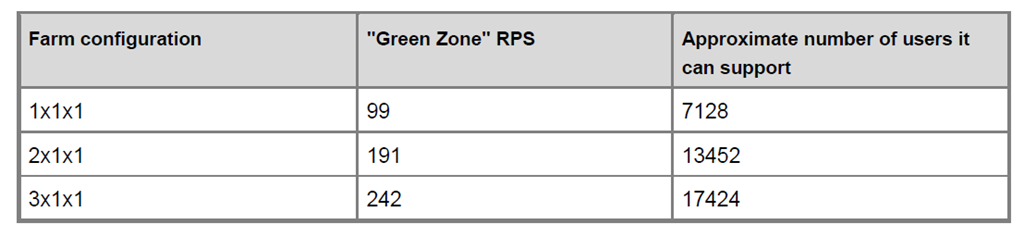
In the second lab, Microsoft offers some advice on how translate their results into our own deployments. They suggest determining a users to RPS ratio and then utilising the green zone RPS figures to estimate server requirements. This is best served via their own example from lab 2: They state the following:

  • A divisional portal in Microsoft which supports around 8000 employees collaborating heavily, experiences an average RPS of 110.
  • That gives a Users to RPS ratio of ~72 (that is, 8000/110). That is: 72 users will amount to 1 RPS.
  • Using this ratio and assuming the sustainable RPS figures from lab 2 results, Microsoft created the following table (page 196) to suggest the number of users a typical deployment might support.

image

A basic performance planning methodology…

Okay.. so I am done… I have no more topics that I want to cover (although I could go on forever on this stuff). Hopefully I have laid out enough conceptual scaffolding to allow you to read Microsoft’s large and complex documentation regarding SharePoint performance and capacity guide with more clarity than before. If I were to sum up a few of the key points of this 11 part exploration into the weird and wonderful world of SharePoint performance management it would be as follows:

  1. Part 1: Think of performance in terms of lead and lag indicators. You will have less of a brain fart when trying to make sense of everything.
  2. Part 2: Requests are often confused with transactions. A transaction (eg “save this document”) usually consists of multiple requests and the number of requests is not an indicator of performance. Look to RPS to help here…
  3. Part 3 and 4: The key to utilising RPS is to understand that as a counter on its own, it is not overly helpful. BUT it is the one metric that you probably have available in lots of detail, due to it being captured in web server logs over time. Use it to understand usage patterns of your sites and portals and determine peak usage and concurrent usage.
  4. Part 5: Latency (and disk latency in particular) is both unavoidable, yet one of the most common root causes of performance issues. Understanding it is critical.
  5. Part 6: Disk latency affects – and is affected by – IOPS, IO size and IO patterns. Focusing one one without the others is quite pointless. They all affect each other so watch out when they are specified in isolation (ie 5000 IOPS).
  6. Part 6, 7 and 8:  Latency and IOPS are handy in the  sense that they can be easily simulated and are therefore useful lead indicators. Test all SQL IO scenarios at 8k and 64K IO size and ensure it meets latency requirements.
  7. Part 9: Give your SAN dudes a specified IOPS, IO Size and latency target. Let them figure out the disk configuration that is needed to accommodate. If they can make your target then focus on other bottleneck areas.
  8. Part 10: Process Monitor and Windows Performance Analyser are brilliant tools for understanding disk IO patterns (among other things)
  9. Part 9 and 11: Don’t believe everything you read. Utilise Microsoft’s real world and lab results as a guide but validate expected behaviour by testing your own environment and look for gaps between what is expected and what you get.
  10. Part 11: In general, Web Server CPU will bottleneck first, followed by SQL Server CPU. If you followed the advice of points 6 and 7 above, then disk shouldn’t  be a problem.

Now I promised at the very start of this series, that I would provide you with a lightweight methodology for estimating SharePoint performance requirements. So assuming you have read this entire series and understand the implications, here goes nothing…

If they can meet this target, skip to step 8.  🙂

If they cannot meet this, don’t worry because there are two benefits gained already. First, by finding that they cannot get near the above figures, they will do some optimisation like test different stipe sizes and check some other common disk performance hiccups. This means they now better understand the disk performance patterns and are thinking in terms of lead indicators. The second benefit is that you can avoid tedious, detailed discussions on what RAID level to go with up front.

So while all of this is happening, do some more recon…

  • 4. Examine Microsoft and HP’s testing results that I covered in part 9 and in this article. Pay particular attention to the concurrent users and RPS figures. Also note the IOPS results from Microsoft and HP testing. To remind you, no test ever came in over 1400 IOPS.
  • 5. Use logparser to examine your own logs to understand usage patterns. Not only should you eke out metrics like max concurrent users and RPS figures, but examine peak times of the day, RPS growth rate over time, and what client applications or devices are being used to access your portal or intranet.
  • 6. Compare your peak and concurrent usage stats to Microsoft and HP’s findings. Are you half their size, double their size? This can give you some insight on a lower IOPS target to use. If you have 200 simultaneous users, then you can derive a target IOPS for your storage guys to meet that is more modest and in line with your own organisations size and make-up.

By now the storage guys will come back to you in shock because they cannot get near your 5000 IOPS requirement. Be warned though… they might ask you to sign a cheque to upgrade the storage subsystem to meet this requirement. It won’t be coming out of their budget for sure!

  • 7. Tell them to slowly reduce the IOPS until they hit the 8ms and 1ms latency targets and give them the revised target based on the calculation you made in step 6. If they still cannot make this, then sign the damn cheque!

At this point we have assumed that there is enough assurance that the disk infrastructure is sound. Now its all about CPU and memory.

  • 8. Determine a users to RPS ratio by dividing your total user base by average RPS (based on your findings from step 5).
  • 9.  Look at Microsoft’s published table (page 196 of the capacity planning guide and reproduced here just above this conclusion). See what it suggests for the minimum topology that should be needed for deployment.
  • 10. Use that as a baseline and now start to consider redundancy, load balancing and all of that other fun stuff.

And there you have it! My 10 step dodgy performance analysis method.  Smile

Conclusion and where to go next…

Right! Although I am done with this topic area, there are some next steps to consider.

Remember that this entire series is predicated on the notion that you are in the planning stage. Let’s say you have come up with a suggested topology and deployed the hardware and developed your SharePoint masterpiece. The job of ensuring performance will work to expectations does not stop here. You still should consider load testing to ensure that the deployed topology meets the expectations and validates the lead indicators. There is also a  seemingly endless number of optimisations that can be done within SharePoint too, such as caching to reduce SQL Server load or tuning web application or service application settings.

But for now, I hope that this series has met my stated goal of making this topic area that little bit more accessible and thankyou so much for taking the time to read it all.


Paul Culmsee

www.hereticsguidebooks.com

www.sevensigma.com.au


Demystifying SharePoint Performance Management Part 10 – More tools of the trade…

Hi all and welcome to the tenth article in my series on demystifying SharePoint performance management. I do feel that we are getting toward the home stretch here. If you go way back to Part 1, I stated my intent to highlight some common misconceptions and traps for younger players in the area of SharePoint performance management, while demonstrating a better way to think about measuring SharePoint performance (i.e. lead and lag indicators). While doing so, we examined the common performance indicators of RPS, IOPS, MBPS, latency and the tools and approaches to measuring and using them.

I started the series praising some of Microsoft’s material, namely the “Planning guide for server farms and environments for Microsoft SharePoint Server 2010.”, “Capacity Planning for Microsoft SharePoint Server 2010” and “Analysing Microsoft SharePoint Products and Technologies Usage” guides. But they are not perfect by any stretch, and in last post, I covered some of the inconsistencies and questionable information that does exist in the capacity planning guide in particular. Not only are some of the disk performance figures quoted given without any critical context needed to understand how to measure them in a meaningful way, some of the figures themselves are highly questionable.

I therefore concluded Part 9 by advising readers not to believe everything presented and always verify espoused reality with actual reality via testing and measurement.

Along the journey that we have undertaken, we have examined some of the tools that are available to perform such testing and measurement. So far, we have used Log Parser, SharePoint Flavored Weblog Reader, Windows Performance Monitor, SQLIO and the odd bit of PowerShell thrown in for good measure. This article will round things out by showing you two additional tools to verify theoretical fiction with hard cold reality. Both of these tools allow you to get a really good sense of IO patterns in particular (although they both have many other purposes). The first of which will be familiar to my more nerdy readers, but the second of which is highly powerful, but much lesser known to newbies and seasoned IT pros alike.

So without further adieu, lets meet our tools… Process Monitor and Windows Performance Analysis Toolkit.

Process Monitor

Our first tool is Process Monitor, also commonly known as Procmon. Now this tool is quite well known, so I will not be particularly verbose with my examination of it. But for the three of you who have never heard of this tool, Process Monitor allows us to (among many other things), monitor accesses to the file system by processes running on a server. This allows us to get a really low level view of IO requests as they happen in real time. What is really nice about Process Monitor is its granularity. It allows you to set up some sophisticated filtering that allows you to really see the wood from the trees. For example, one can create fairly elaborate filters that allow you to just see the details of a specific SQL database. Also handy is that all collected data can be saved to file for later examination too.

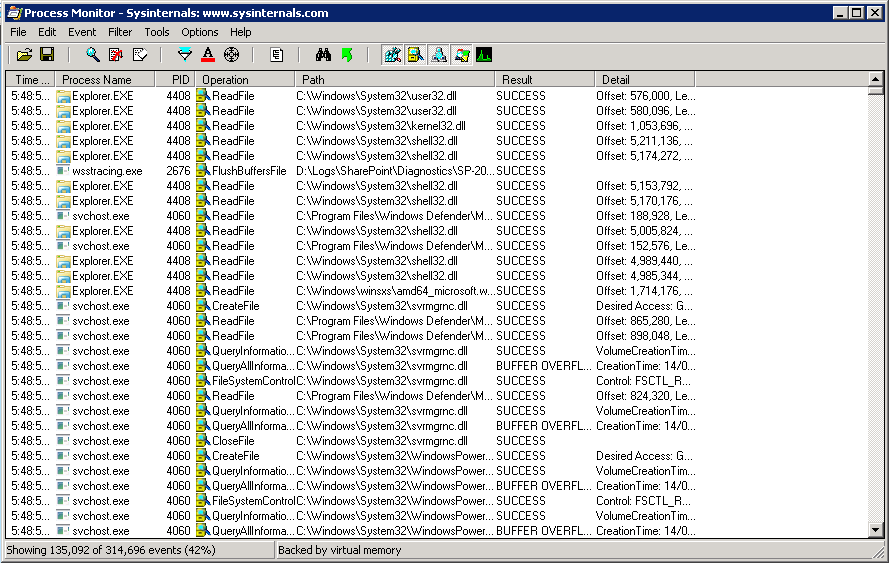
When you start Process Monitor, you will see a screen something like the one below. It will immediately start collecting data about various operations (there are around 140 monitorable operations that cover file system, registry, process, network and kernel stuff). When you launch Process Monitor it immediately starts monitoring file system, registry and processes. The default columns that are displayed include:

  • the name of the process performing the operation
  • the operation itself
  • the path to the object the operation was performed on
  • (and most importantly), a detail column, that tells you the good stuff.

image

The best way to learn Process Monitor is by example, so lets use it to collect SQL Server IO patterns on SharePoint databases when performing a full crawl in SharePoint (while excluding writes to transaction logs). It will be interesting to see the the range of IO request sizes during this time. To achieve this, we need to set up the filters for procmon to give us just what we need…

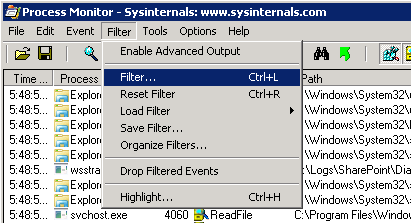
First up,  choose “Filter…” from the Filter menu.

image

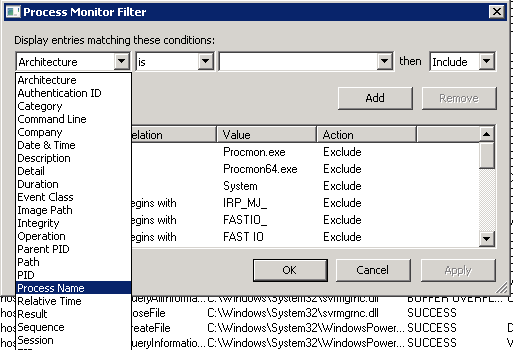
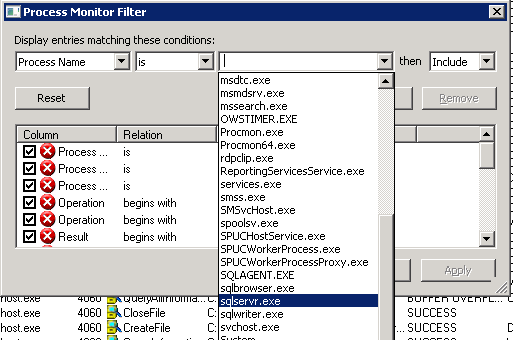
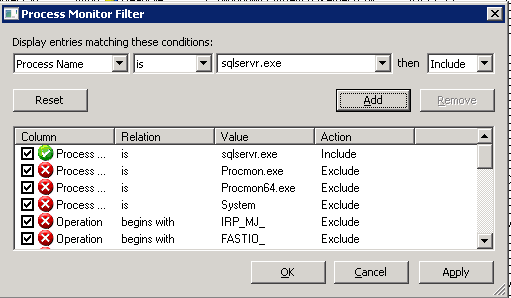
In the top left column, choose “Process Name” from the list of columns. Leave the condition field as “is” and click on the drop down next to it. It will enumerate the running processes, allowing you to scroll down and find sqlservr.exe.

image   image

Click OK and your newly minted filter will be added to the list (check out the green include filter below). Now we will only see operations performed by SQL Server in the Process Monitor display.

image

Rather than give you a dose of screenshot hell, I will not individually show you how to add each filter as they are a similar process to what we just did to include only SQLSERVR.EXE. In all, we have to apply another 5 filters. The first two filter the operations down to reading and writing to the disk.

  • Filter on: Process Name
  • Condition: Is
  • Filter  applied: ReadFile
  • Filter type: Include
  • Filter on: Process Name
  • Condition: Is
  • Filter applied: WriteFile
  • Filter type: Include

Now we need to specify the database(s) that we are interested in. On my test server, SharePoint databases  are on a disk array mounted as D:\ drive. So I add the following filter:

  • Filter on: Path
  • Condition: Contains
  • Filter applied: D:\DATA\MSSQL
  • Filter type: Include

Finally, we want to exclude writes to translation logs. Since all transaction logs write to files with an .LDF extension, we can use an exclusion rule:

  • Filter on: Path
  • Condition: Contains
  • Filter applied: LDF
  • Filter type: Exclude

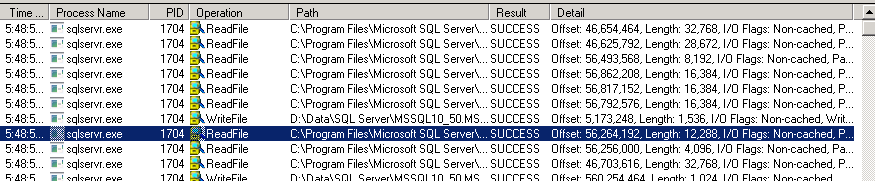
Okay, so we have our filters set. Now widen the detail column that I mentioned earlier. If you have captured some entries, you should see the word “Length :” with a number next to it. This is reporting the size of the IO request in bytes. Divide by 1024 if you want to get to kilobytes (KB). Below you can see a range of 1.5KB to 32KB.

image

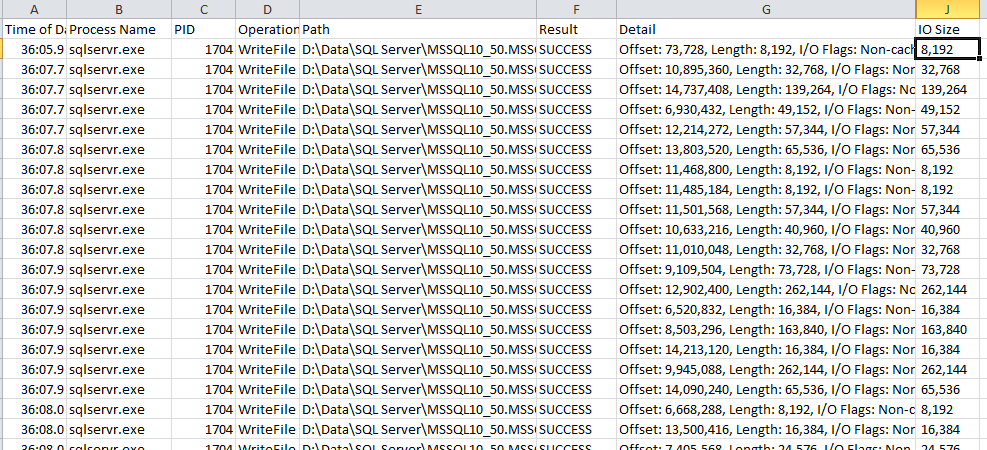
At this point you are all set. Go to SharePoint central administration and find the search service application. Start a full crawl and fairly quickly, you should see matching disk IO operations displayed in Process Monitor. When the crawl is finished, you can choose to stop capturing and save the resulting capture to file. Process Monitor supports CSV format, which makes it easy to import into Excel as shown below. (In the example below I created a formula for the column called “IO Size”.

image

By the way, in my quick test analysis of disk IO of a window during during part of the during a full crawl, I captured 329 requests that were broken down as follows:

  • 142 IO requests (42% of total) were 8KB in size for a total of 1136KB
  • 48 IO requests (15% in total) were 16KB in size for a total of 768KB
  • 48 IO requests (15% in total) were >16KB to 32KB in size for a total of  1136KB
  • 49 IO requests (15% in total) were >32KB to 64KB in size for a total of 2552KB
  • 22 IO requests (7% in total) were >64KB to 128KB in size for a total of 2104KB
  • 20 IO requests (6% in total) were >128KB to 256KB in size for a total of 3904KB

Windows Performance Analyser (with a little help from Xperf123)

Allow me to introduce you to one of the best tools you never knew you needed. Windows Performance Analyser (WPA) is a newer addition to the armoury of tools for performance analysis and capacity planning. In short, it takes the idea of Windows Performance Monitor to a whole new level. WPA comes as part of a broader suite of tools collectively known as the Windows Performance Toolkit (WPT). Microsoft describes the toolkit as:

…designed for analysis of a wide range of performance problems including application start times, boot issues, deferred procedure calls and interrupt activity (DPCs and ISRs), system responsiveness issues, application resource usage, and interrupt storms.”

If most of those terms sounded scary to you, then it should be clear that WPA is a pretty serious tool and has utility for many things, going way beyond our narrow focus of Disk performance. But never fear BA’s, I am not going to take a deep dive approach to explaining this tool. Instead I am going to outline the quickest and simplest way to leverage WPA for examining disk IO patterns. In fact, you should be able to follow what I outline here on your own PC if SharePoint is not conveniently located nearby.

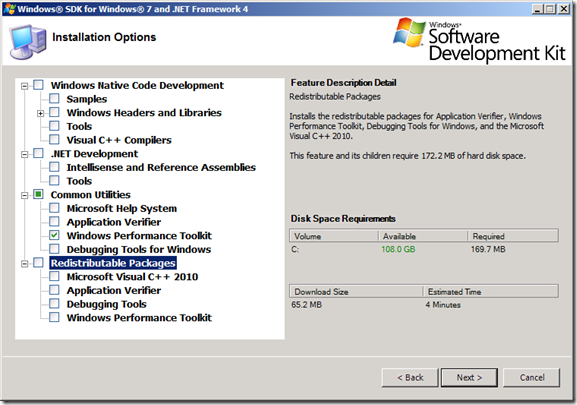
Now this gem of a tool is not available as a separate download. It actually comes installed as part of the Microsoft Windows SDK for Windows 7 and .NET Framework 4. Admins fearing bloat on their servers can rest easy though, as you can choose just to install the WPT components as shown below…

image_thumb6_thumb

By default, the windows performance toolkit will install its goodies into the C:\Program Files\Microsoft Windows Performance Toolkit” folder. So go ahead and install it now since it can be installed onto any version of Windows past Vista. (I am sure that none of you at all are reading this article on an Apple device right? :-).

Now assuming you have successfully installed WPT, I now want you to head on over to codeplex and download a little tool called Xperf123 and save it into the toolkit folder above. Xperf123 is a 3rd party tool that hides a lot of the complexity of WPA and thus is a useful starting point. The only thing to bear in mind is that Xperf123 is not part of WPA and is therefore not a necessity. If your inner tech geek wants to get to know the WPA commands better, then I highly recommend you read a highly comprehensive article written by Microsoft’s Robert Smith and published back in Feb 2012. The article is called “Analysing Storage Performance using the Windows Performance Analysis Toolkit” and it is an outstanding piece of work in this area.

So we are all set. Let’s run the same test as we did with Procmon earlier. I will start a trace on my test SharePoint server, run a full crawl and then look at the resulting IO patterns. Perform the following steps in sequence. (in my example I am using a test SharePoint server).

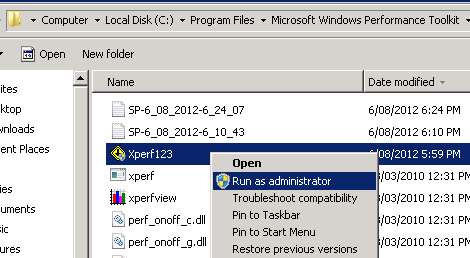
  1. Start Xperf123 from the WPT installation folder (run it as administrator).
  2. At the initial screen, click Next and then Next again at the screen displaying operating system details
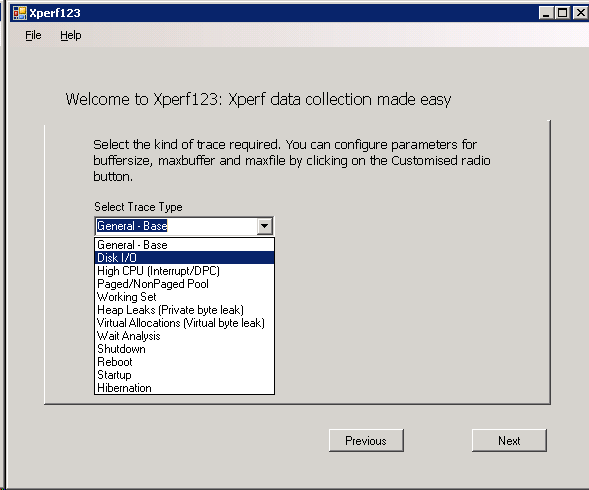
  3. From the Select Trace Type dropdown, choose Disk  I/O and press Next
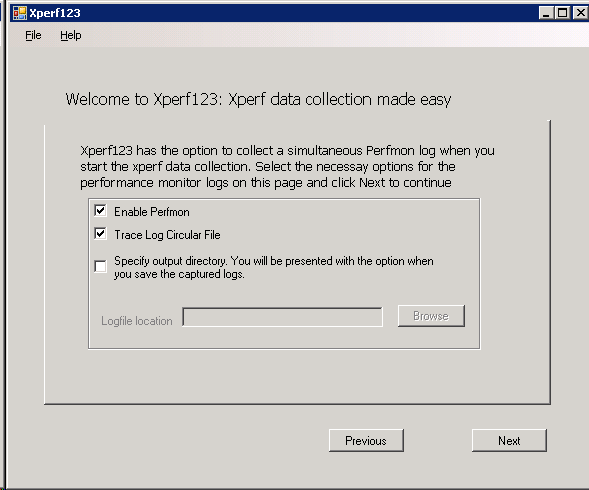
  4. Ensure that “Enable Perfmon”, “use Circular Logging” and optionally choose “Specify Output Directory”. Press Next
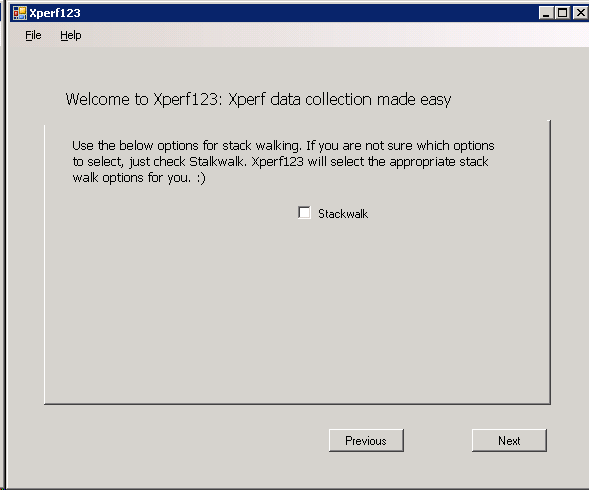
  5. Leave “Stackwalk” unticked and choose Next

image     image

image  image

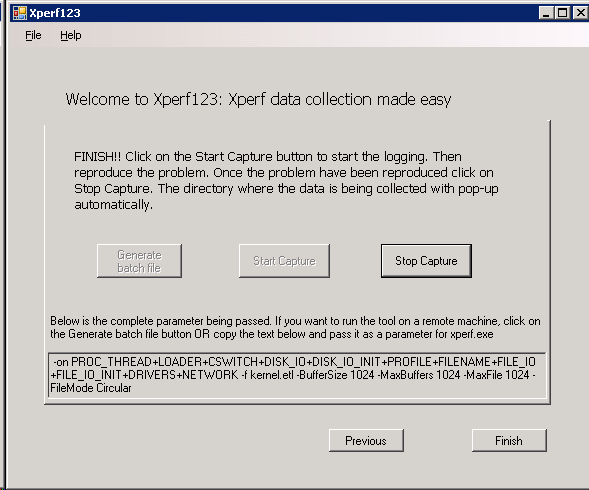
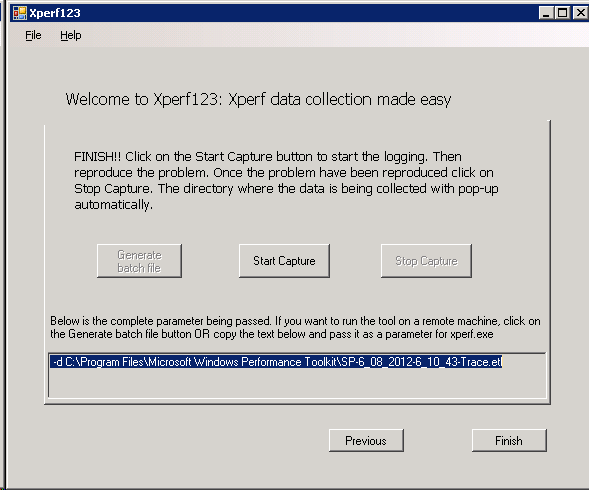
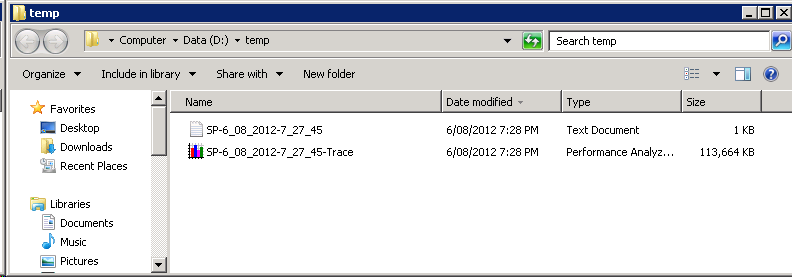
AllrIghtie then… we are all set! Click the Start Capture Button to start collecting the good stuff! Xperf123 will run the actual WPA command line trace utility (called xperf.exe if you really want to know). Now go to SharePoint central administration and like what we did with our test of Process Monitor, start a full crawl. Wait till the crawl finishes and then in Xperf123, click the Stop Capture Button. A trace file will be saved in the WPT installation folder (or wherever you specify). The naming convention will be based on the server name and date the trace was run.

image  image

image

Okay, so capturing the trace was positively easy. How about analysing it visually?

Double click on the newly minted trace file and it will be loaded into the Performance Analyser analysis tool (This tool is also available from the Start menu as well). When the tool loads and processes the trace file, you will see CPU and Disk IO counts reported visually. The CPU is the line graph and IO counts are represented in a bar graph. Unlike Windows Performance Monitor which we covered in Part 7, this tool has a much better ability to drill down into details.

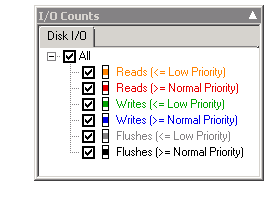
If you look closely below there are two “flyout” arrows. One is on the left side in the middle of the screen and applies to all graphs and the other is on the top-right of each graph. If you click them, you are able to apply filters to what information is displayed. For example: if you click the “IO Counts” flyout, you can filter out which type of IO you want to see. Looking at the screenshot below, you can see that the majority of what was captured were disk writes (the blue bars below).

image  image

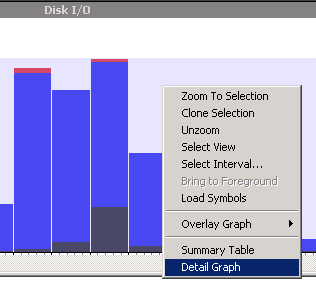
Okay so lets get a closer look at what is going on disk-wise. Right click somewhere on the Disk IO bar graph and choose “Detail Graph” from the menu.

image

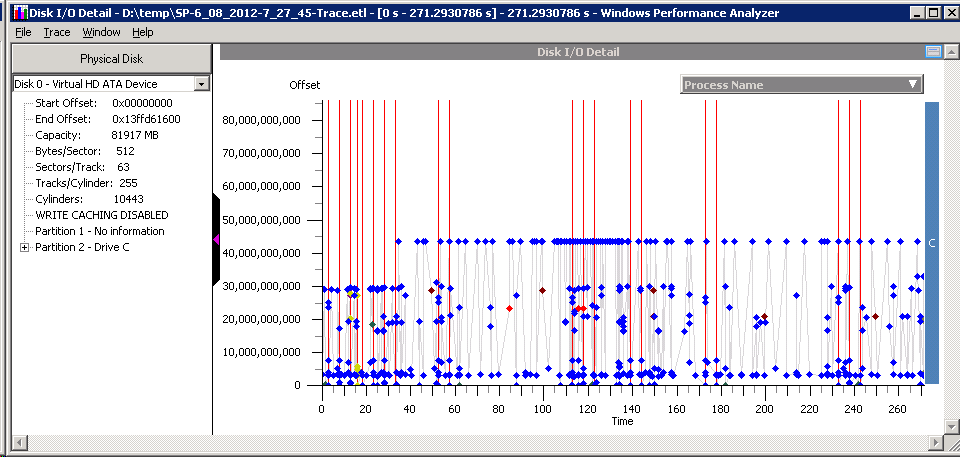
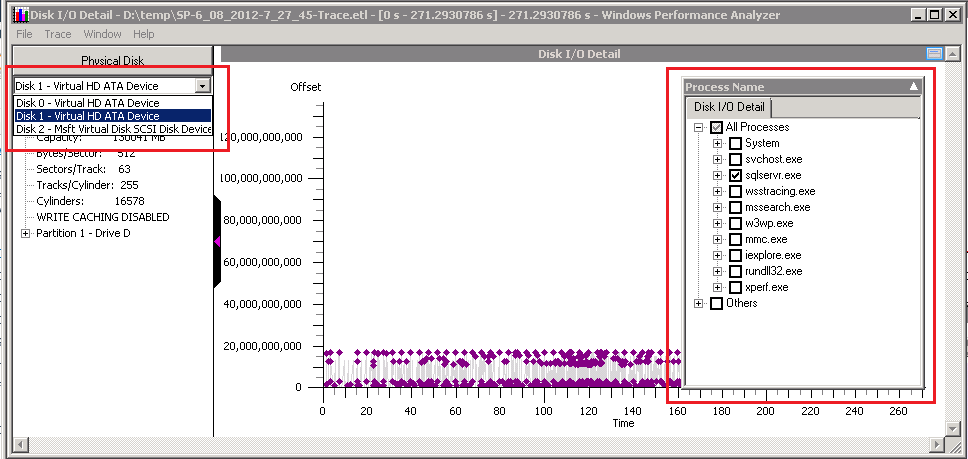
Now we have a very different view. On the left we can see which disk we are looking at and on the right we can see detailed performance stats for that disk. It may not be clear by the screenshot, but the disk IO reported below is broken down by process. This detailed view also has flyouts and dropdowns that allow you to filter what you see. There is an upper-left dropdown menu under the section called “Physical Disk”. This allows you to change what disk you are interested in. On the upper right, there is a flyout labelled “Process Name”. Clicking this allows you to filter the display to only view a subset of the process that were running at the time the trace was captured.

image

Now in my case, I only want to see the SQL Database activity, so I will make use of the aforementioned filtering capability. Below I show where I selected the disk where the database files reside and on the right I deselected all processes apart from SQLSERVR.EXE. Neat huh? Now we are looking at the graph of every individual IO operation performed during the time displayed and you can even hover over each dot to get more detail of the IO operation performed.

image

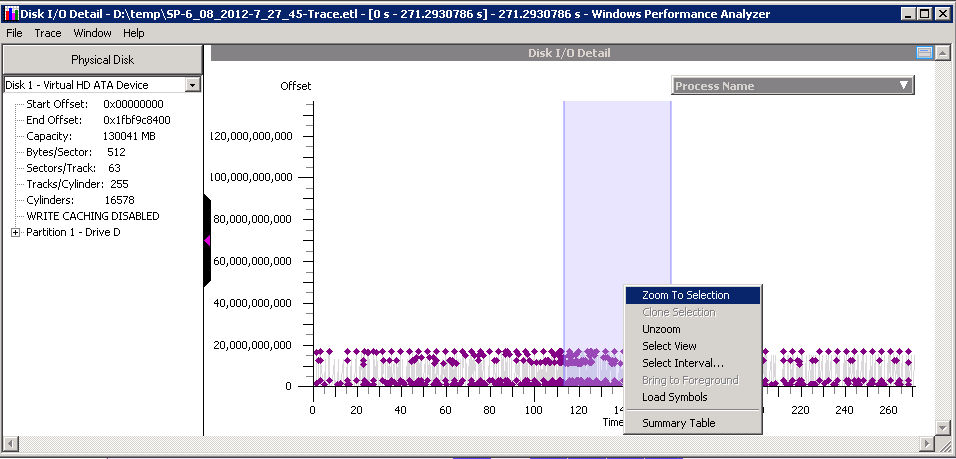
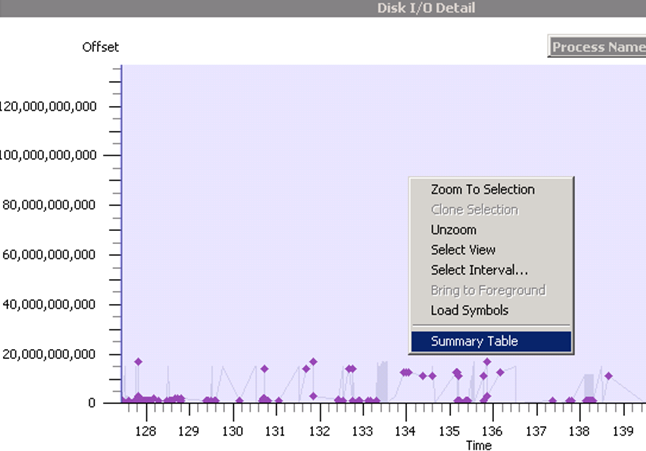
You can also zoom in with great granularity. Simply select a time period from the display using by dragging the mouse pointer over the graph area. Right click the now selected time period and choose “Zoom to Selection”. Cool eh? If your mouse has a wheel button, you can zoom in and out by pressing the Ctrl key and rolling the mouse wheel.

image

Now even for most wussy non technical BA reading this, surely your inner nerd is liking what you see. But why stop here? After all, Process Monitor gave us lots more loving detail and had the ability to utilise sophisticated filtering. So how does WPA stack up?

To answer this question, try these steps, Right click on the detail graph and this time choose “Summary Table”. This allows us to view even more detail of IO data.

image

image

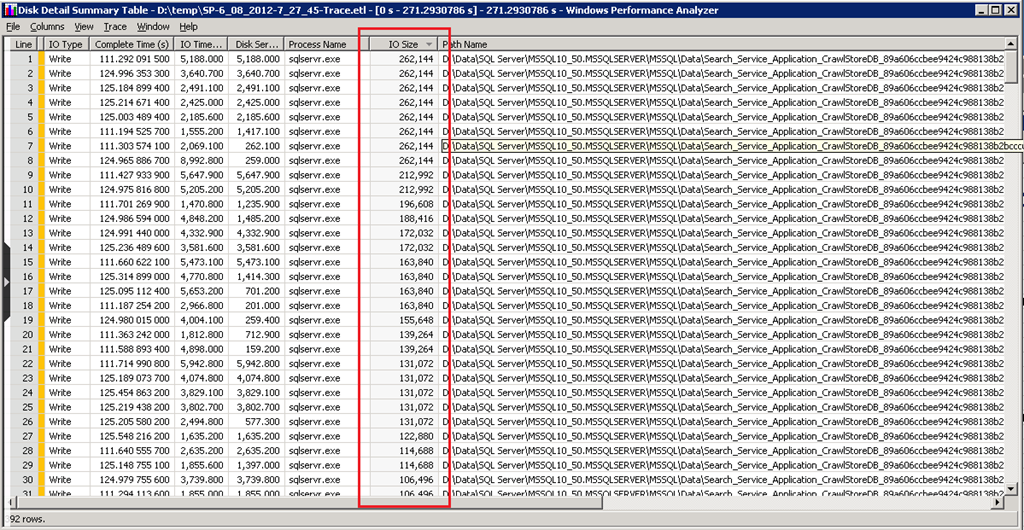
Viola! We now have a list of every IO transaction performed during the sample period. Each line in the summary table represents a single I/O operation. The columns are movable and sortable as well. On that note, some of the more interesting ones for our purposes include (thanks Robert Smith for the explanation of these):

  • IO Type: Read, Write, or Flush
  • Complete Time: Time of I/O completion in milliseconds, relative to start and stop of the current trace.
  • IO Time: The amount of time in milliseconds the I/O took to complete
  • Disk Service Time: The inferred amount of time (in microseconds) the IO operation has spent on the device (this one has caveats, check Robert Smiths post for detail).
  • QD/I: Queue Depth the disk , irrespective of partitions, at the time this I/O request initialized
  • IO Size: Size of this I/O, in bytes.
  • Process Name: The name of the process that initiated this I/O.
  • Path: Path and file name, if known, that is the target of this I/O (in plain English, this essentially means the file name).

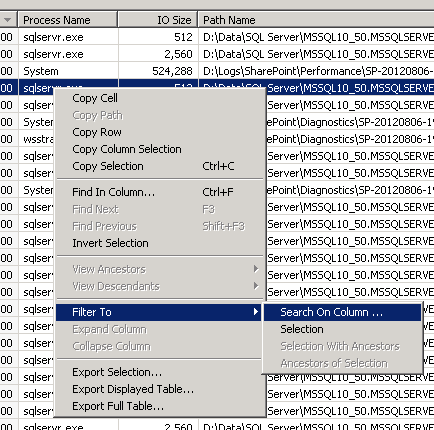
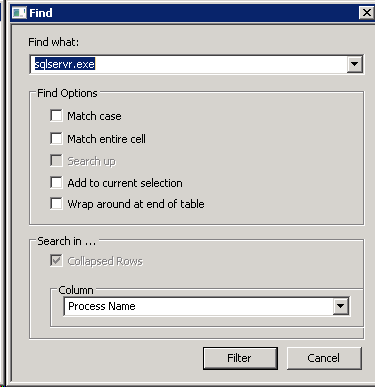
I have a lot of IO requests in this summary view, so let’s see how this baby can filter. First up, lets only look at IO that was initiated from SQL Server only. Right click on the “Process Name” column and choose “Filter To” –> “Search on Column…” In the resulting window, enter “SQLSERVR.EXE” in the “Find what:” textbox. Double check that the column name is set to “Process name” in the dropdown and click Filter.

image  image

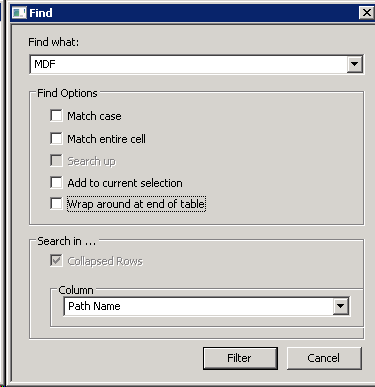
You should now see only SQL IO traffic. So let’s drill down further still. This time I want to exclude IO transactions that are transaction log related. To do this, right click on the “Path Name” column and choose “Filter To” –> “Search on Column…” In the resulting window, enter “MDF” in the “Find what:” textbox. Double check that the column name is set to “Path name” in the dropdown and click Filter.

image image

Can you guess the effect? Only SQL Server database files will be displayed since they typically have a file extension of MDF.

In the screenshot below, I have then used the column sorting capability to look at the IO sizes. Neat huh?

image

Don’t forget Performance Monitor…

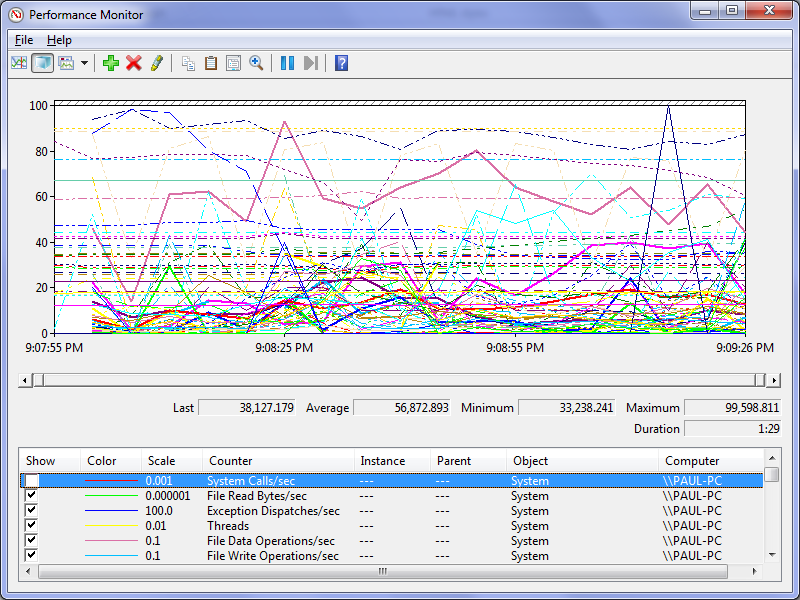
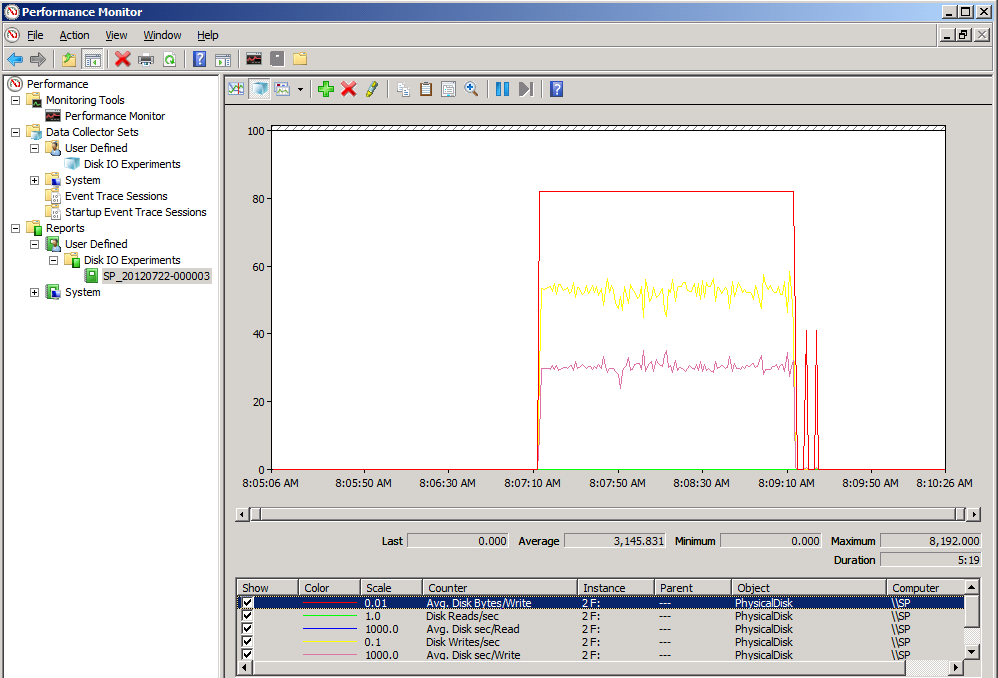
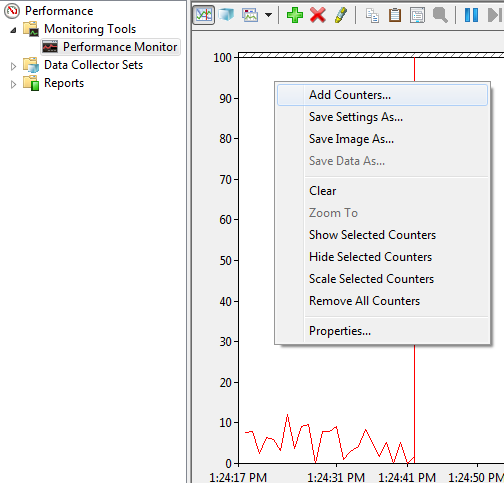
Just before we are done with Windows Performance Analysis Toolkit, cast your mind back to the start of this walkthrough when we used Xperf123 to generate this trace. If you check back, you might recall there was a tickbox in the Xperf123 wizard called “Enable Perfmon”. Well it turns out that Xperf123 had one final perk. While the WPA trace was made, a Perfmon trace was made of the system performance more broadly during the time. These logs are located in the C:\PerfLogs\ directory and are saved in the native Windows Performance Monitor format. So just double click the file and watch the love…

image

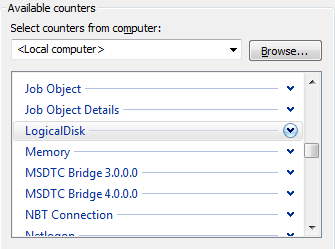
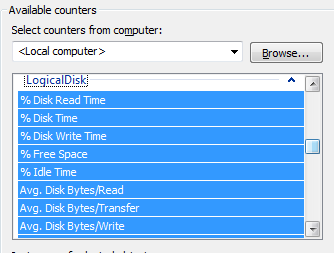
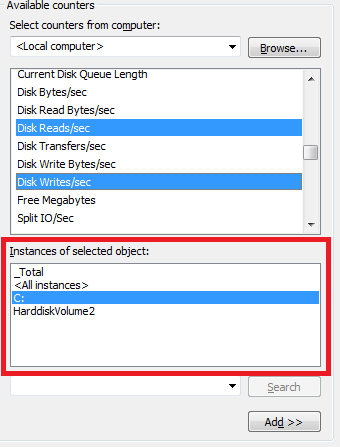
How’s that for a handy added bonus. It is also worth mentioning that the Perfmon trace captured has a significant number of performance counters in the categories of Memory, PhysicalDisk, Processor and System.

Conclusion and coming next…

Well! That was a long post, but that was more because of verbose screenshots than anything else.

Both Windows Performance Monitor and Windows Performance Analyser are very useful tools for developing a better understanding of disk IO patterns. While Procmon has more sophisticated filtering capabilities, WPA trumps Procmon in terms of reduced overhead (apparently 20,000 events per second is less than 2% CPU on a 2.0 GHz processor ). WPA also has the ability to visualise and drill down into the data better than Procmon can do.

Nevertheless, both tools have far more utility beyond the basic scenarios outlined in this series and are definitely worth investigating more.

In the next and I suspect final post, I will round off this examination of performance by making a few more general SharePoint performance recommendations and outlining a lightweight methodology that you can use for your own assessments.

Until then, thanks for reading…

Paul Culmsee

www.hereticsguidebooks.com


Demystifying SharePoint Performance Management Part 9 – Don’t believe everything you R/W

Hi and welcome to Part 9 (bloody hell… nine!) of my series on trying to demystify SharePoint performance management a bit. If by any chance you have been asked to provide some sizing information for your organisation and you are finding the resources online a bit overwhelming, this series is for you. If you have been a part of our varied journey so far, the last few posts have been all about Disk IO performance in the form of latency, IOPS and MBPS. In the last two articles, we have been learning about the different IO patterns that SQL Server is likely to utilise, as well as using the jackhammer known as the SQLIO utility, that is used to simulate those IO patterns on unsuspecting disk infrastructure.

Now just to set the scene for this post (and conveniently perform some product placement), I recently published a book called “The Heretics Guide to Best Practices”. Now being the author and all, I am going to suggest you buy it because it is a completely riveting read! :-).

Now apart from blatant product placement, the real reason I mention it is because one of the chapters is called “Myths, Memes and Methodologies”. In it, we examine why some ideas gain legitimacy, even though they are based on often completely dodgy foundations. I mention this here, because in terms of SQL disk IO sizing, something similar has happened with Microsoft’s published material on the topic. So the focus of this article is to finish off our discussion on understanding disk IO patterns, while lifting the lid on some of the inconsistencies in the material that that end up being repeated by SharePoint consultants as gospel to their unsuspecting disciples.

Now harking way back to part 1 to the notion of lead vs. lag indicators, our use of SQLIO thus far has essentially been used as a lead indicator. While SQLIO puts a real load on disk infrastructure and faithfully reports the resulting IOPS, latency and MBPS, the reality is it can never truly capture the nuances of a production SharePoint farm doing its thing. But in terms of a lead indicator that is okay. After all, a lead indicator by definition cannot guarantee an outcome. It can merely suggest that an outcome should be able to be met.

So while we are thinking about the lead indicator world view, some of you might have noticed that I have not yet made any suggestions what are the minimum conditions of satisfaction for disk infrastructure used to underpin SharePoint. This has been deliberate until now, because I felt that it was critical to understand the relationship between the size of a disk IO operation, and its effect on IOPS, latency and MBPS first. To that end, hopefully I have instilled a reflex in you where – if you are given an arbitrary latency, IOPS or MBPS figure that you have to meet – you immediately ask questions like, “What sort of IO patterns?” or “how large is the IO request typically going to be?” or “is the IO random or sequential?”

When whitepapers mislead…

Now we are about to get into one area where Microsoft’s published documentation is quite weak. Remember the 367 page “Capacity Planning for Microsoft SharePoint Server 2010” whitepaper? Starting at page 326, there is a section with the promising title of “Estimate Core Storage and IOPS needs” (this topic is also available separately as a technet article too). The problem is in despite that title, very little IOPS guidance actually is given. Instead the content in the section overwhelmingly speaks about estimating storage requirements. In fact the best you get is one explicit mention of IOPS in relation to the SharePoint Search service application which states the following:

The IOPS requirements for Search are significant.

  • For the Crawl database, search requires from 3,500 to 7,000 IOPS.
  • For the Property database, search requires 2,000 IOPS.

Note: For the purpose of the rest of this article, lets add the above figures together and simply say between 5,500 to 9000 IOPS for search.

Do you see the problem here? This is simply an arbitrary IOPS figure with no guidance as to the IO patterns underpinning it. What about latency or the IO request size that you need to assume? Unfortunately, no guidance is given for these questions which makes this quoted figure not overly helpful. Plus, as you will soon see below, Microsoft seemingly contradict themselves elsewhere in the same whitepaper…

So what are good numbers to use?

In the absence of any hard data, the best way to deal with storage requirements is to think in terms of lead indicators. Indicators from a lead point of view, can be framed as targets – something to aim for. Targets then can be broken down into different categories ranging from “cover your arse” to “above and beyond”:

  • Aspired target: The “this would be bloody fantastic if we could get there” target.
  • Agreed target: The “this is what we are going to deliver no matter what” target.
  • Minimum Condition of Satisfaction (MCOS) target: The “If we don’t achieve this we may as well pack up and go home” target.

So given these sorts of targets, what should the disk IO performance targets for SharePoint be? To work this out, we can utilise information already out there. Well…that is, we could if the information out there wasn’t so disparate and disconnected. So unfortunately, it takes some digging to you can find what you need.

Our first point of call in this regard is indeed Microsoft and the very same capacity planning and configuration guide that I criticised earlier for poorly dealing with IOPS. Hidden in the bowls of that document, the following statement is made on page 334 (emphasis mine):

Any storage architecture must support your availability needs and perform adequately in IOPS and latency. To be supported, the system must consistently return the first byte of data within 20 milliseconds.

So the way I look at it, a 20ms latency should be our MCOS target (see the explanation above for MCOS). If we consistently do worse than this, then we do not have a lot of assurance about the scalability of the disk IO subsystem being used for SharePoint. But like the arbitrary IOPS figure quoted in the previous section, I wonder if readers have spotted the problem with specifying this latency figure alone?

In both cases, don’t forget the almost symbiotic type of relationships between IO size, IOPS and latency. If we assumed that all IO operations were small (for example SQL’s page size of 8KB) then we could likely stay way under the 20ms limit with a more modest disk infrastructure. But to sustain the same latency with a larger IO size would require a faster disk subsystem. Why? Well as we discussed in part 6, if the size of the IO writes are larger, such as 64KB, then latency will go up because servicing larger requests takes longer than smaller ones. Therefore, if we were to assume a larger IO size, we would need more/faster disks to be able to meet the same 20ms latency KPI.

So what disk IO size should we assume to give context to a latency figure? Some insight can be found back in part 6, when we examined SQL IO characteristics and established that it will likely be much more varied than SQL’s base IO unit of 8KB pages. My suggestion therefore, is to test 8KB but also ensure that 64KB can meet the latency target. This is because 64KB represents a reasonable average size between the 8KB to 256KB range most SQL Server’s IO operations will fall within. Thus, if a SQLIO test using random read/writes at 64K indicates more than 20ms latency consistently, then you should probably ask your storage people to take another look at it.

By the way, if you really want to give your storage guys a challenge, keep jacking up the IO size!

What about aspired latency targets?

So if you are cool with the notion that the minimum condition of satisfaction for a random IO test using 64K size should be less than 20ms latency, what about aiming higher with agreed or aspirational targets?

Luckily for all of us, we can once again stand on the shoulders of giants. In this case, the Bob Duffy indirectly answers this question by providing what he considers to be the indicators for optimal SQL Server performance in general. In an excellent article with the rather appropriate title of “How to Specify SQL Storage Requirements to your SAN Dude” Bob makes the following recommendations:

  • SQL Data files must have a response time averaging about 8ms and a maximum response time of around 20ms using 64k size IOs and that are random in nature
  • SQL Log Files must have a write response time averaging from 1-5ms. use 64k IO size and are sequential in nature

The nice thing about specifying a target or benchmark like this, is that you are able to sidestep discussions on RAID levels, stripe sizes and many other things that SAN nerds find interesting. We keep things focused on the lead indicators and in effect state “If you can meet these figures, configure it any way you like.” This gives the SAN guys the freedom to do their job, while giving you an indicator that can give you confidence in the disk infrastructure. So if we were to distil the figures above into lead indicator targets for storage gurus, it might look something like this:

  • MCOS target: Less than 20ms latency for random IO requests of 64KB
  • Agreed target: Average 8ms latency for random IO requests of 64KB with no more than 20ms max latency. Less than 5ms latency for sequential log IO
  • Aspired target: No more than 8ms latency for random SQL IO requests of 64KB and average of 1ms latency sequential log IO with max never going above 5ms

Now in the ProData article, Bob made a slightly tongue in cheek point that sums up the above thinking really well, as well as giving insight to a critical aspect we have not considered so far…

Nowadays most SQL consultants try and not talk about RAID types and types of disk, it can be best to leave that up to the storage guys. If the storage team can meet my requirement for 5,000 random 64k read/write IOPs at 8ms latency by using 50 old SATA drives at 5,400 rpm in RAID 5 then knock yourself out – I’m happy. Well maybe I’m happy till we have that chat about Service Level requirements during a disk degrade event but that’s a different story…

If you look closely at Bob’s quote, you will see that he has also specified the last critical variable in the mix. Bob’s mention of “5000 random 64k read/write IOPS” is in reference to another point he makes. Without an IOPS figure to work from, the targets we have come up with are effectively meaningless. Quoting Bob:

The main thing to specify apart form your latency requirement is the throughput (IOPs). It is no good meeting the 8ms target for 100 IOPs and then finding your workloads needs 5,000 IOPs. You wont be able to meet the 8ms target!!

Consider it this way… a SharePoint site that services 100,000 users, will process a lot more IO requests than a site that services 10 users. With the latter, it is quite likely that the latency targets we have been talking about (even the aspirational ones) would be pretty easy to meet with a single disk. (To hark back to our shopping centre metaphor, one check out operator is all that is needed at a corner store, whereas many are needed at the supermarket). This is presumably why Bob has used a figure like 5000 IOPS for his post. It is probably a figure that conveniently represents some fairly heavy disk usage. But it does beg two question:

  • How much IOPS should we use to simulate SharePoint IOPS?
  • In the absence of anything else, perhaps 5000 IOPS is a good figure to go with?

Don’t believe all you read…

Now if you go back and read the start of this post, you will recall I mentioned that Microsoft stated some IOPS figures for the SharePoint search application databases ranged between 5,500 to 9000. That would indicate that Bob’s base figure of 5000 is a bit low, especially given that SharePoint has many other components beyond search that have not been taken into account. So to put Bob’s 5000 IOPS figure in perspective, let’s re-examine Microsoft’s trusty capacity planning whitepaper. One of the great things about this document is that Microsoft detailed the performance stats of a typical day in the life of their internal SharePoint environments. Since Microsoft are so large, they have different SharePoint farms for different collaborative scenarios. The scenarios they covered were:

  1. Enterprise Intranet environment (also described as published intranet). In this scenario, employees view content like news, technical articles, employee profiles, documentation, and training resources. It is also the place where all search queries are performed for all of the other the SharePoint environments within the company.
  2. Enterprise intranet collaboration environment (also described as intranet collaboration). In this scenario, is where important team sites and publishing portals are housed. They are typically used for enterprise collaboration, organizations, teams, and projects. Sites created in this environment are used as communication portals, applications for business solutions, and general collaboration. No custom code runs in these sites.
  3. Departmental Collaboration environment. In this scenario, employees use this environment to track projects, collaborate on documents, and share information within their department.
  4. Social Collaboration Environment. This is the My Sites scenario. These connect employees with one another and the information that they need. Employees use this environment to present personal information such as areas of expertise, past projects, and colleagues to the wider organization. The environment also hosts personal sites and documents for viewing, editing, and collaboration.

Now reading about these scenarios is highly interesting and Microsoft provides some nice nuggets of information that we will use in a future post. But for now I will stick purely to a disk IOPS perspective. To that end, below are a few fun-filled facts about the number of users in each of the four scenarios:

  1. Enterprise Intranet environment:  33580 unique users per day, with an average of 172 concurrent and a peak concurrency of 376 users.
  2. Enterprise intranet collaboration environment: 69702 unique users per day, with an average of 420 concurrent users and a peak concurrency of 1433 users
  3. Departmental Collaboration environment. 9186 unique users per day, with an average of 189 concurrent users and a peak concurrency of 322 users
  4. Social Collaboration Environment. 69814 unique users per day, with an average of 639 concurrent users and a peak concurrency of 1186 users

So now you have a sense of the size of these scenarios and as an added bonus, gotten a glimpse into the difference that usage patterns can make. For example: social collaboration and enterprise collaboration have similar number of unique users but social has more average concurrency but less peak. But what about IOPS?

In the document, IOPS is split into reads per second and writes per second, so I added them to estimate IOPS. The results are rather surprising…

Metric

Social Collaboration

Departmental Collaboration

Published intranet

Intranet Collaboration

Unique visitors

69814

9186

33580

69702

Average concurrent

639

189

172

420

Max concurrent

1186

322

376

1433

IOPS

941

74

409.66

409.66

Now while it might be tempting to ponder why social collaboration has over double the IOPS, yet half the concurrency of enterprise intranet collaboration, we are not going to worry about here. Besides, we actually covered some of it already when we used logparser to get insights of usage patterns. What I will instead do is draw your attention to is the fact that that none of the IOPS scenarios come anywhere near the 5000 IOPS figures cited by ProData or Microsoft’s 5500-9000 IOPS cited for search (in the very same capacity planning document I might add!)

So something is amiss. If an organisation the size of Microsoft can have almost 70000 unique users per day, with a peak concurrency of 1433 users and only total 410 IOPS, then where the hell did the 5500-9000 IOPS figure for search alone come from? Even if you take the scenario with the highest IOPS (the Social collaboration scenario with 941 IOPS), that’s still less than one fifth 5500 IOPS which was at the low end of the search IOPS figure.

Now I am also suspicious that two different case studies have the exact same IOPS figure. If you compare the “published intranet” scenario with the “intranet collaboration” scenario, one has half the visitors, yet both have precisely the same IOPS (right down to decimal places). That seems highly unlikely to me and I suggest that a mistake has been made. Given the intranet collaboration has the highest max concurrency figure, I would have expected IOPS to be a higher than it is. Hmmm…

What can we take away from this? For one, the capacity planning document could seriously do with a rewrite in this area. Secondly, I don’t have a lot of faith in those IOPS figures quoted (although I have more confidence in the case studies that the arbitrary figures specified for search).

So if we put aside the doubt created by the issues with the capacity planning guide, there is one really interesting fact that remains… none of the reported IOPS figures came anywhere near 5000 IOPS.

Insights from HP…

It turns out that Hewlett Packard also did some load testing of SharePoint 2010 (among other things) and published a whitepaper called the “HP performance and configuration guide for Microsoft SharePoint 2010“.  In this guide, they detail the results of a scenario they tested based on what they termed an “Enterprise Workload”. The guide covers definition of enterprise workload in loving detail, but the gist of it is that it covers the following areas:

  • Document Center (30% of operations) Check-out, download, upload and check-in documents
  • Team Sites – (20% of operations) work with calendars, discussions and documents
  • Portal SItes – (20% of operations) work with event, announcements and surveys
  • My Sites – (10% of operations) work with documents in personal documents library
  • Search – (20% of operations) Submit searches with random word or phrases

HP then simulates 500 concurrent users performing the actions above. In Table 13 of the report (page 28 of their document and reproduced below) , HP outline the performance and even break down the IO characteristics of each SharePoint database (which is really handy indeed). Adding up the last column of transfers/sec (which is essentially IOPS) we get a result of 1347.33 IOPS.

Thus we are still considerably under the 5000 IOPS that Bob Duffy suggests.

Conclusion…

Right! Remember our discussion above on MCOS, agreed and aspired targets? For an aspirational target, I think that we can reasonably use 5000 IOPS as a starting point for an enterprise organisation of Microsoft’s size. If we stick with 5000 IOPS, then my suggestion for an aspirational latency target would be:

  1. no more than 8ms latency for random SQL IO requests of 64KB
  2. average 1ms (and no more than 5ms max) latency of sequential log IO of 64KB

I think these figures are a pretty good test of a disk subsystem and think that Bob at ProData is therefore pretty close to the mark. Of course, you can use these figures to make your own judgement and adjust accordingly. Provided that you think of them as lead indicators that provide you a level of confidence in your disk infrastructure, you now have the tools and knowhow to run the tests too.

So if there was a moral of the story to this post, it would be to not believe everything you read and always verify espoused reality with actual reality via testing. On that note, the next post will finish off our examination of disk performance by going over 2 additional tools that I think are particularly good for testing assumptions. After that, we will be revisiting Microsoft’s case studies, as well as some findings, insights and recommendations from some additional lab scenarios that Microsoft conducted.

Thanks for reading

Paul Culmsee

www.sevensigma.com.au


Demystifying SharePoint Performance Management Part 8 – More on SQL and SQLIO

Well here we are at part 8 of my series on making SharePoint performance management that little bit easier to understand. What is interesting about this series is its timing. If by some minute chance that the marketing tsunami has passed you by at the time I write this, SharePoint 2013 public beta was released. Much is being made about its stated requirement of 24GB of RAM for a “Single server with a built-in database or single server that uses SQL Server”. While the reality is that requirements depends on what components that you are working with, this series of articles should be just as useful in relation to SharePoint 2013 as for any other version.

Now, if you have been following events thus far, we have been spending some time examining disk performance, as that is a very common area where a sub optimal configuration can result in a poor experience for users. In part 6, we looked at the relationship between the performance metrics of disk latency, IOPS and MBPS. We also touched on the IO characteristics (nerd speak for the manner in which something reads and writes to disk) of SQL Server and some SharePoint components. In the last post, we examined the windows performance counters that one would use to quickly monitor latency and IOPS in particular. We then finished off by taking a toe dip into the coolness of the SQLIO utility, that is a great tool for stress testing your storage infrastructure by pulverising it with different IO read and write patterns.

In this post, we will spend a bit of time taking SQLIO to the next step and I will show you how you can run a comprehensive disk infrastructure stress test. Luckily for the both of us, others have done the hard work for us and we can reap the benefits of their expertise and insights. First up however, I would like to kick things off by spending a little time showing you the relationship between SQLIO results and performance monitor counters. This helps to reinforce what the reported numbers mean.

Performance Monitor and SQLIO

In the previous post when we used Windows Performance Monitor, we plotted IOPS and Latency by watching the counters as they occurred in real-time. While this is nice for a quick analysis, nothing is actually stored for later analysis. Fortunately, performance monitor has the capability to run a trace and collect a much larger data set for a more detailed analysis later. So first up, lets use performance monitor to collect disk performance data while we run a SQLIO stress test. After the test has been run, we will then review the trace data and validate it against the results that SQLIO reports.

So go ahead and start up performance monitor (and consult part 7 of this series if you are unsure of how to do this). Looking at the top left of the performance manager, you should see several options listed under “Performance”. Click on “Data Collector Sets” and look for a sub menu called “User Defined”. Now right click on “User Defined” and choose “New –> Data Collector Set” as shown below:

image

This will start a wizard that will ask us to define what performance counters we are interested in and how often to sample performance. I have pasted screenshots of the sequence below (click to enlarge any particular one). First up we need to give a name to this collection of counters and as you can see below, I called mine “Disk IO Experiments”. Once we have given it a name, we have to choose the type of performance data we want to collect. Tick the “Performance counter” button and ensure the others are left unticked.

image  image

Next we need to pick what specific counters we need. We will use the same counters that we used in part 7, with the addition of two additional ones. To remind you of part 7, the counters we looked at were:

  • Avg. Disk sec/Read   – (measures latency by looking at how long in seconds, a read of data from the disk took)
  • Avg. Disk sec/Write  –  (measures latency by looking at how long in seconds, a write of data to the disk took)
  • Disk Reads/sec  –  (measures IOPS by looking at the rate of read operations on the disk per second)
  • Disk Writes/sec  – (measures IOPS by looking at the rate of write operations on the disk per second)

In addition to these counters, we will also add two more to the collector set

  • Avg. Disk Bytes/Read – (Measures size of each read request by reporting the number of bytes each used)
  • Avg. Disk Bytes/Write – (Measures size of each write request by reporting the number of bytes each)

We will use these counters to see if the size of the IO request than SQLIO uses is reported correctly.

Depending on your configuration, choose the PhysicalDisk or LogicalDisk  performance object (consult part 7 for the difference between PhysicalDisk and LogicalDisk). You will then find the performance counters I listed above. Before you do anything else, make sure that you pick the right disk or partition from the “Instances of selected object” section. We need to specifically pick the disk or partition that SQLIO is going to stress test. Now you select each of the aforementioned six performance counters and click the “Add” button. Finally, make sure that you pick the sample interval to be 1 second as shown below. This is really important because it makes it easy to compare to SQLIO which reports on a per second basis.

image  image

At this point you do not need to configure anything else, so click the “Finish” button, rather than the “next” button, and the collector should now be ready to go. It will not start by default, but since there is no fun in that, let’s collect some data. Right click on your shiny new data collector set and choose “Start”.

image  image

Once started, performance monitor is collecting the values of the six counters each and every second. Now let’s run a SQLIO command to give it something to measure. In this example, I am going to run SQLIO with random 8KB writes. But to make it interesting, I will use two threads and simulate 8 outstanding IO requests in the queue. If you recall by grocery check-out metaphor of part 6, this is like having 8 people with full shopping carts waiting in line for a single check-out operator. Since the guy at the back of the line has to wait for the seven people in front of him to be processed, he has to wait longer. So with eight outstanding IO requests, latency should increase as each IO request will be sitting in a queue behind the seven other requests.

By the way, if none of that made sense, then you did not read part 6 and part 7. I urge you to read them before continuing here, because I am assuming prior knowledge of SQLIO and disk latency characteristics and the big trolley theory..

Here is the SQLIO command and below is the result…

SQLIO –kW –b8 –frandom –s120 –t2 –o8 –BH –LS F:\testfile.dat

image

Now take a note of the results reported. IOPS was 526, MBs/sec was 4.11 and as expected, the average latency was much larger than the SQLIO tests we ran in part 7. In this case, latency was 29 milliseconds.

Let’s now compare this to what performance monitor captured. First up, return to Performance Monitor, and stop your data collector set by right clicking on it and choosing “Stop”. Now if you cast your eye to the top left navigation pane, you should see an option called “Reports” listed under “Performance”. Click on “Reports” and look for a sub menu called “User Defined”. Expand “User Defined” and hey presto! Your data collector set should be listed…

image  image

Expand the data collector set and you will find a report for the data you just collected. The naming convention is the server name and the date of the collection. Click on this and you will then see the performance data for that collection in the right pane. At the bottom you can see the six performance counters we chose and just by looking at the graph, you can clearly see when SQLIO started and stopped.

image

Now we have to do one additional step to make sure that we are comparing apples with apples. Performance monitor will calculate its averages based on the total time displayed. As you can see above, I did not run SQLIO straight away, but the performance counters were collected each second nonetheless. Therefore we have a heap of zero values that will bring the averages down and mislead. Fear not though, it is fairly easy (although not completely obvious) to zoom into the time we are interested in. If you look closely, just below the performance graph, where the time is reported, there is a sliding scale. If you click and drag the left and right boxes, you can highlight a specific time you are interested in. This will be shown in the performance graph too, so using this tool, we can get more specific about the time we are interested in. Then in the toolbar above the graph, you will see a zoom button. Click it and watch the magic…

image  image

As you can see below, now we are looking at the performance data for the period when the SQLIO was run. (Now it should be noted that windows performance monitor isn’t particularly granular here. I had to fiddle with the sliding scale a couple of times to accurately set the exact times when SQLIO was started and then stopped.)

image

Now let’s look at the results reported by performance monitor. The screenshot above is looking at the number of Disk Writes per second. Let’s zoom into the figures for the time period and example the average result over the sample period. To save you squinting, I have pasted it below and called out the counter in question. Performance monitor has reported average “Disk Writes/Sec” as 525.423. This is entirely consistent with SQLIO’s reported IOPS of 526.

image

Latency (reported in seconds via the counter Avg. Disk sec/Write) is also fairly consistent with SQLIO. The figure from performance monitor was 0.03 seconds (30 milliseconds). SQLIO reported 29 milliseconds.

image

What about IO size? Well, that’s what Avg disk bytes/write is for… Let’s take a look shall we? Yup.. 8192 kilobytes, which is exactly the parameters specified.

image

SQL IO characteristics revisited (and an awesome script)

Now that we understand what SQLIO is telling us via examining windows performance monitor counters, I’d like to return to the topic of SQL IO patterns. Back at the end of part 6, I spent some time talking about SQL and SharePoint IO characteristics. As a quick recap, I mentioned SQL reads and writes to databases via 8KB pages. Now based on me telling you that, you might assume that if you had to open a large document from SharePoint (say 1MB  or 1024KB), SQL would make 128 IO requests of 8KB each.

While that would be a reasonable assumption, its also wrong. You see, I also mentioned that SQL Server also has a read-ahead algorithm. This algorithm means that means SQL will try and proactively retrieve data pages that are going to be used in the immediate future. As a result, even though a single page is only 8KB, it is not unusual to see SQL read data from disk in a much wider range if it thinks the next few 8KB pages are likely to be asked for anyway. Now as an aside, if you are running SQL Enterprise edition, the possible read-ahead range is from 1 to 128 pages (other editions of SQL max out at 32 pages). Assuming SQL Enterprise edition, this translates to between 8KB and 1024KB for a single IO operation. Think about this for a second… based on the 1MB document example I used in the previous paragraph, it is technically possible that this could be serviced with a single IO request by an enterprise edition of SQL server.

Okay, so essentially SQL has varying IO characteristics when it comes to reading from and writing to databases. But there is still more to it. This is because there are a myriad of SQL IO operations that we did not even consider in part 6. As an example, we have not spoken about the IO characteristics of how SQL writes to transaction logs (which is sequential as opposed to random IO, and does not use 8k pages at all). Another little known fact with transaction logs is that SQL has to wait for them to be “flushed to stable media” before the data page itself can be flushed to stable media. This is known as Write Ahead Logging and is used for data integrity purposes. What is means though is that if logging has a lot of latency, the rest of SQL server can potentially suffer as well (and if it was not obvious before, yet another good reason why people recommend putting SQL data and log files on different disks).

Now I am not going to delve deep into SQL IO patterns any more than this, because we are now getting into serious nerdy territory. However what I will say is this: by understanding the characteristics of these IO patterns, we have the opportunity to change the parameters we pass to SQLIO and more accurately reflect real-world SQL characteristics in our testing. Luckily for all of us, others have already done the hard work in this area. First up, Bob Duffy created a table that summarises SQL Server IO patterns based on the type of operations being performed. Even better than that… Niels Grove-Rasmussen wrote a completely brilliant post, where not only did he list the IO patterns that SQL is likely to exhibit, he wrote a PowerShell script that then runs 5 minute SQLIO simulations for each and every one of them!

I have not pasted the script here, but you will find it at Niels article. What I will say though is that aside from the obvious 8KB random reads and writes that we have concentrated on thus far, Niels listed several other common SQL IO patterns that his SQLIO script tests:

  • 1 KB sequential writes to the log file (small log writes)
  • 64 KB sequential writes to the log file (bulk log writes)
  • 8 KB random reads to the log file (rollbacks)
  • 64 KB sequential writes to the data files (checkpoints, reindex, bulk inserts)
  • 64 KB sequential reads to the data files (read-ahead, reindex, checkdb)
  • 128 KB sequential reads to the data files (read-ahead, reindex, checkdb)
  • 128 KB sequential writes to the data files (bulk inserts, reindex)
  • 256 KB sequential reads to the data files (read-ahead, reindex)
  • 1024 KB sequential reads to the data files (enterprise edition read-ahead)
  • 1 MB sequential reads to the data files (backups)

The script actually handles more combinations than those listed above because it also tests for differing number of threads (-t ) and outstanding requests (-o ). All in all, over 570 combinations of IO patterns are tested. Be warned here… given that each test takes 5 minutes to run by default, with a 60 second wait time in between each test, be prepared to give this script at least 2 days to let it run its course!

The script itself is dead simple to run. Just open a powershell window, and save Niels script to the SQLIO installation folder. From there, change to that directory and issue the command:

./SQLIO_Batch.ps1

Then come back in 3 days! Seriously though, depending on your requirements, you can modify the parameters of the script to reduce the number of scenarios based on editing the first 7 lines of code which is quite self explanatory

$Drive = @('G', 'H', 'I', 'J')
$IO_Kind = @('W', 'R') # Write before read so that there is something to read.
$Threads = @(2, 4, 8)
#$Threads = @(2, 4, 8, 16, 32, 64)
$Seconds = 10*60 # Five minutes
$Factor = @('random', 'sequential')
$Outstanding = @(1, 2, 4, 8, 16, 32, 64, 128)
$BlockSize = @(1, 8, 64, 128, 256, 1024)

Now if this wasn’t cool enough, Niels also written a second script that parses the output from all of the SQLIO tests. This can produce a CSV file that allows you to perform further analysis in excel. To run this script, we need to know the same of the output file of the first script. By default the filename is SQLIO_Result.<date>.txt. For example:

./SQLIO-Parse.ps1 -ResultFileName ‘SQLIO_Result.2010-12-24.txt’

By default the parse script outputs to the screen, but modifying it to write to CSV file is really easy. All one has to do is comment out the second last line of code and uncomment the last one as shown below:

#$Sqlio | Format-Table -Property Kind,Threads,Seconds,Drive,Stripe,Outstanding,Size,IOs,MBs,Latency_min,Latency_avg,Latency_max -AutoSize

$Sqlio | Export-Csv SQLIO_Parse.csv

Below is an example of the report in Excel. Neat eh?

image

Conclusion and coming up next…

By now, you should be a SQLIO guru and have a much better idea of the sort of IO patterns that SQL Server has beyond just reading from and writing to databases. We have covered the IO patterns of transaction logs, as well as examined a terrific PowerShell script that not only runs all of the IO scenarios that you need to, but parses the output to produce a CSV file for deeper analysis. In short, you now have the tools you need to run a pretty good disk infrastructure stress test and start some interesting conversations with your storage gurus.

However at this point I feel there some pieces missing to this disk puzzle:

  1. We have not yet brought the discussion back to lead and lag indicators. So while we know how to hammer disk infrastructure, how can we be more proactive and specify minimum conditions of satisfaction for our disk infrastructure?
  2. Microsoft treatment of disk performance (and in particular IOPS and latency) in their performance documentation is inconsistent and in my opinion, confuses more than it clarifies. So in the next post, we are going to look at these two issues. In doing so, we are going to leave SQLIO and Performance Monitor behind and examine two other utilities including one that is lesser known, but highly powerful.

Until then, thanks for reading

Paul Culmsee

www.hereticsguidebooks.com


Demystifying SharePoint Performance Management Part 7 – Getting at Latency, IOPS and MBPS

Hi all, and welcome to part 7 of this series on SharePoint performance planning. This is the point of the series where I realise that I have much more to write about than I intended. Last time this happened I never got around to finishing the series (*blush* … a certain tribute to a humble leave form ). Like that series, I now have no idea how many posts I will end up doing, but I will keep soldiering on nonetheless.

Recapping the last two posts of this series in particular, we have been looking at the relationship between the performance measures of Disk latency, Disk I/O per second (IOPS) and Disk Megabytes transferred per second (MBPS). We spent most of part 6 looking at the relationship between these three performance metrics by specifically focusing on how the size of an IO request affects things. If you recall, a couple of key points were made:

  • In general, the larger the IO request being made, the more latency there will be, resulting in less IOPS but increased MBPS.
  • Latency is significantly affected by whether an IO requests is sequential or random. To demonstrate this, I used a tool called SQLIO to simulate disk IO to generate some performance stats that demonstrated both IOPS and MBPS improved by some 750% when compared to random IO.

We finished the post by examining the way SQL server performs IO requests and what SharePoint components are IOPS heavy. In short, SQL Server uses a range of request sizes for database reads and writes between 8K and 1024KB. The reason for the range (for reads anyhow) is the read-ahead algorithm (gory detail here), in which SQL attempts to proactively retrieve data that are going to be used in the immediate future. A read-ahead may result in a much larger I/O request being made than a single 8KB page, but much better performance because in effect, SQL is pulling more data from each I/O operation.

In this episode (and the next one)…

Our focus in this post and the next one is similar to part 3, in that we are now going to do some real work and some of it will involve the command line. Therefore also like part 3, if you are one of those project manager types who utilise the wussy “I’m business, not technical” excuse, I want you to persist and try this stuff out. Given that I wrote this series with you in mind, put that damn iPad down, get out your laptop and reload this article! You can try all of the steps below out on your PC while you are reading this.

Now for the tech types reading this, on account of my intention to “demystify” SharePoint performance, I will be more verbose that what you guys need. But consider it this way – I am doing you guys a favour because next time your PM or BA’s eyes start to glaze when you start explaining performance and capacity planning to them, you can point them to this series and tell them that there is no excuse.

This article is going to cover two areas. First up let’s look at what we can do with Windows inbuilt Performance Monitor tool in terms of monitoring Latency and IOPS in particular. Next we will look at a popular tool for stress testing disk infrastructure that gives us visibility into MBPS.

The basics: Performance Monitor 101

Just in case you have never done it before, type in PERFMON on any Windows box at the start button or the command line (by the way, I am assuming Windows 7 or Windows 2008 Server here).

image

If you did that, then you are looking at the classic tool used to understand how a PC or server is performing. Looking at the top left of the resultant window, you should see several options listed under “Performance”. Click on “Performance Monitor” and watch the magic. Congratulations… you now know how to measure CPU as that is the default performance counter displayed.

image

Performance monitor can easily be used to take a look at disk IOPS and latency. Right click on the graph and from the menu choose Add Counters… This will provide you with a long list of “performance objects” (a fancy word for a logical grouping of performance counters)

image

From the list of performance objects, scroll up and find “LogicalDisk”. Move your cursor to the arrow to the right of the LogicalDisk counters and click on it. You should see a list of disk related performance counters appear as shown below.

image   image

Note:  You could have chosen the performance object called PhysicalDisk instead of LogicalDisk. The difference between them is that physical disk counters only consider each hard drive, not the way it is partitioned. The Logical Disk performance object monitors logical partitions of a disk. As a general role (for non techy types reading this), go with LogicalDisk.

Right then… now currently, all of the possible performance counters for LogicalDisk are currently selected, but for now we are only interested in latency and IOPS, which are represented by four counters:

Latency: Avg. Disk sec/Read
Avg. Disk sec/Write
Measures the average time, in seconds, of a read of data to the disk. (Therefore 5ms will be shown as 0.005)
Measures the average time, in seconds, of a write of data to the disk

MS Technet Note: Numbers also vary across different storage configurations (SAN cache size/utilization can impact this greatly)
IOPS Disk Reads/sec:
Disk Writes/sec:
The rate of read operations on the disk per second.
The rate of write operations on the disk per second.
MS Technet Note: This number varies based on the size of I/O’s issued. Practical limit of 100-140/sec per disk spindle, however consult with hardware vendor for more accurate estimation.

Go ahead and select these four counters (use the Ctrl key and click each one to select more than one counter). Now we have to choose which disk or partition that we want to monitor. Below where you chose the performance counters, you will see a label with the suitably unclear title of “Instances of selected object” (I have highlighted it below). From here, choose the hard drive or partition you are interested in. Finally, click the “Add” button at the very bottom and you should see your selected counters listed in the “Added counters” window.

image   image

Click the OK button and you should now be seeing these counters doing their thing. Each performance counter you added is listed below the graph showing the performance data collected in real time. The display shows a time period of 100 seconds and is refreshed each second. Also, a neat feature that some people don’t know about it is to click on one of the counters and then hold down Ctrl and type the letter “H”. This is the shortcut key for highlighting the selected counter and the currently selected counter should now be black. Additionally, you should be able to now use the up and down arrow keys to cycle through the counters and highlight each.

image

At this point, try copying some files or open some applications and watch the effect. You should see a spike in disk related activity reflected in the IOPS and latency counters above. There you go business analysts, you officially have monitored disk performance! Wasn’t so hard was it?

Now that we are monitoring some interesting counters, how about we really give the disk something to chew on! Smile

Upping the ante with SQLIO

SQLIO is an old tool nowadays, but still highly relevant and extremely useful. Despite being named SQLIO, it actually has very little to do with SQL Server! It was provided by Microsoft to help determine the I/O capacity that a server can handle. SQLIO allows you to test a combination of I/O sizes for read/write operations, both sequentially and randomly. Thus, it is useful for stress testing the disk infrastructure for any IO intensive application. Now be warned… you can absolutely smash your disk infrastructure with this tool, so don’t go running this in production without some sort of official clearance. Furthermore, if you want to use SQLIO to test your SAN, be sure to consider the other servers and applications that might be using it. There is potential to adversely affect them.

You can download SQLIO from Microsoft here. It will run on any recent Windows OS, so you can try it on your own PC (now you know why I told you to put your iPad away earlier). Installing SQLIO is very simple, just run SQLIO.MSI and it will install by default into C:\Program Files(x86)\SQLIO folder.

Note: If you want a great tutorial on installing and using SQLIO, look no further than MCM Brent Ozar’s 2009 article entitled SQLIO Tutorial: How to Test Disk Performance).

SQLIO works by reading from and writing to one or more test files, so the first thing we need to do with SQLIO is to set up a configuration file that specifies the location and size of these test files. The configuration file is called PARAM.TXT and is found in the installation folder. Each line of the configuration file represents a test file, its size and a couple of other parameters. The options on each line of the param.txt file are as follows:

  • <Path to test file> Full path and name of the test file to be used.
  • <Number of threads (per test file)>
  • <Mask > Set to 0x0
  • <Size of test file in MB> Ideally, this should be large enough so that the test file will be larger than any cache resident on the SAN (or RAID controller).

Of these 4 parameters, only the first one (the location of the file) and last one (the size of the file) matters for now. Below is a sample param.txt that tests a 20GB file on the E:\ Drive.

image

The next step is to run a  quick SQLIO using sequential writes to create the test file. We are going to use the command-line to do this (although someone has written a GUI for the tool). So open a command prompt, change to the installation directory for SQLIO and type the command below (we will save an detailed explanation of the parameters for later).

sqlio -kW -s10 -fsequential -o8 -b8 -LS -Fparam.txt timeout /T 10

This command will create the file and run a 10 second test. The output will look something like what I have pasted below:

sqlio v1.5.SG

using system counter for latency timings, 2241035 counts per second

parameter file used: param.txt

     file e:\testfile.dat with 1 thread (0) using mask 0x0 (0)

1 thread writing for 10 secs to file e:\testfile.dat

     using 8KB sequential IOs

     enabling multiple I/Os per thread with 8 outstanding

size of file e:\testfile.dat needs to be: 20971520000 bytes

current file size:      104857600 bytes

need to expand by:      20866662400 bytes

expanding e:\testfile.dat …

SQLIO will stop here for a while, while your PC chugs away creating the 20GB test file. Once completed, it will run out quick 10 second test, but you can ignore the rest of the output because this test is  of no consequence.

Running a real test

The previous command was just the entre. We are not interested in the resulting data because the point of the exercise was to create the test file. Now it is time for the main course. Try this command. It will spend 2 minutes running a random IO write to the 20gig test file using a size of 8KB for each write.

sqlio -kW -b8 -frandom -s120 -BH -LS -Fparam.txt

Below is the output that summarises the configuration specified by the above command:

sqlio v1.5.SG

using system counter for latency timings, 2241035 counts per second

1 thread writing for 120 secs to file e:\TestFile.dat

using 8KB random IOs

buffering set to use hardware disk cache (but not file cache)

using current size: 20000 MB for file: e:\TestFile.dat

initialization done

For the next two minutes SQLIO will chug away, hammering the disk with writes. Once the test has been performed, SQLIO will report its findings. You will see IOPS, MBPS and a report of average/max/min latency. On top of this, a histogram showing the distribution of latency is provided. This histogram gives context to the “average latency” figure because it shows the shape of the latency that occurred throughout the test. I graphed the distribution in excel below the SQLIO results below:

CUMULATIVE DATA:

throughput metrics:

IOs/sec:   225.80

MBs/sec:     1.76

latency metrics:

Min_Latency(ms): 0

Avg_Latency(ms): 3

Max_Latency(ms): 111

histogram:

ms: 0  1  2  3  4  5  6  7  8  9 10 11 12 13 14 15 16 17 18 19 20 21 22 23 24+

%:  4  6  6 31 23 15  5  3  2  1  1  1  1  0  0  0  0  0  0  0  0  0  0  0  0

image

Running the numbers…

Now, before we get into a more detailed test, let’s examine some of the SQLIO parameters:

  • -k specifies whether to perform a read or write test (–kW for write and –kR for read)
  • -s specifies how long to run the test for. In the example above it ran for 2 minutes (120 seconds)
  • -f specifies whether to run a random or sequential IO operation (-frandom)
  • -b specifies the size of the IO operations (in the example above 8KB)
  • -t specifies the number of threads to use. A multi-cpu server should be able to utilise more threads than you have processors. If your storage can handle it, we can increase the number of threads and see what latency arises as a result.
  • -o specifies the number of outstanding requests. This simulates a sudden spike in load and gives an indication of how fast IO requests are being serviced. If you keep adding outstanding requests, latency will start to increase as the number of IO requests outstrips the disks ability to service them.
  • -LS means to capture the disk latency information. If you do not specify this you will not get any latency results

Okay, so how about we see what difference a queue of IO requests makes. Below is a SQLIO command with the addition of the –o parameter. Let’s see what a queue of 4 outstanding requests does and compare the historgram output…

sqlio -kW -b8 -frandom –s120 –o4 -BH -LS -Fparam.txt

And the result? Much more latency than our first example above but no real increase in IOPS or MBPS. Clearly we are already at the limit of what my laptop can handle (I stripped the hyperbole and pasted the counters only).

IOs/sec:   221.73

MBs/sec:     1.73

Min_Latency(ms): 0

Avg_Latency(ms): 17

Max_Latency(ms): 187


image

Now since I only changed 1 parameter and such a difference was seen, most people will use SQLIO with a batch file to test different parameters. For example, if you were to paste the commands below into a batch file, you would be running write tests using 16KB, 32KB and 64KB sizes.

sqlio -kW -b16 -frandom -s120 -BH -LS -Fparam.txt

sqlio -kW -b64 -frandom -s120 -BH -LS -Fparam.txt

sqlio -kW -b128 -frandom -s120 -BH -LS -Fparam.txt

For what it’s worth, here is the results for each of the above tests (including the 8KB one we stared with) showing the relationship of IOPS, MBPS and latency. As predicted by our exploration of the relationship between request size, IOPS and MBPS in part 6, latency was smallest with the 8KB option.

8KB write 16KB write 64KB write 128KB write
IOs/sec: 225.80

MBs/sec: 1.76

Avg_Latency(ms): 3

IOs/sec: 220.39

MBs/sec: 3.44

Avg_Latency(ms): 4

IOs/sec: 192.85

MBs/sec: 12.05

Avg_Latency(ms): 4

IO/Sec: 176.30

MB/sec: 22.02

Avg Latency(ms): 5

image

Now one quick note: If you want to play with the –t parameter and add more threads, you will  have to reference the test file directly and not refer to the parameters file. This is because the one of the settings in the param.txt file is the number of threads for each file. Not matter what you put in at the command line, it will be overwritten by what is specified in param.txt. Thus the command below would only run a single thread despite 8 threads being specified via the –t parameter.

sqlio -kW -b64 -frandom -s120 -t8 -o1 -BH -LS -Fparam.txt

sqlio v1.5.SG

using system counter for latency timings, 2241035 counts per second

parameter file used: param.txt

file c:\testfile.dat with 1 thread (0) using mask 0x0 (0)


To get around this issue, drop the –F parameter and refer to the test file directly as shown below:

sqlio -kW -b64 -frandom -s120 -t8 -o1 -BH -LS e:\testfile.dat

sqlio v1.5.SG

using system counter for latency timings, 2241035 counts per second

8 threads writing for 120 secs to file e:\testfile.dat


Conclusion (and coming up next)…

Phew! Okay, so apart from possibly whetting your appetite for smashing disk infrastructure, you might have also come to the realisation that there are many parameters to test in various combinations. In this entire article, I have assumed random writes to the disk, but what about sequential writes? For that matter, what about reads? What about multiple threads and more outstanding requests? What about longer tests or different sized test files?

These are all important questions and I will answer them… in the next post or two. This one is getting a little too long and I have plenty more to cover in this area.

So have a play with the parameters on SQLIO on your own hardware and in the next post, we will continue looking at SQLIO, plus some great work people have done to make your life much easier using it. I want to also return to PERFMON to show you the relationship between the PhysicalDisk and LogicalDisk counters and what SQLIO reports. Then we will examine two other tools, including one that is lesser known, but a very powerful way to measure disk performance. (That one will redeem me with the tech guys who will have no doubt found this article to be too light on 🙂

Subsequent to that, we hark way back to part 1 and return to a lead indicator point of view of disk IO performance and look at how you can nail the ass off your SAN vendor to ensure they do all the due diligence necessary that your Disk infrastructure will perform well.

Until then, thanks for reading

Paul Culmsee
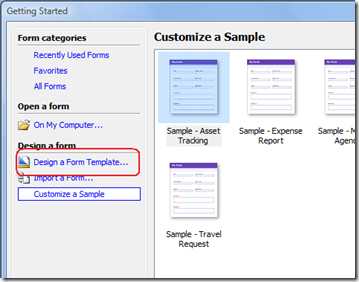
HGBP_Cover-236x300

www.sevensignma.com.au


Demystifying SharePoint Performance Management Part 6 – The unholy trinity of Latency, IOPS and MBPS

Hi all

Welcome to part 6 on my series in making SharePoint performance management that little more digestible. To recap where we have been, I introduced the series by comparing lead versus lag indicators before launching into an examination of Requests Per Second (RPS) as a performance indicator. I spent 3 posts on RPS and then in the last post, we turned our attention to the notion of latency. We watched a Wiggles Video and then looked at all of the interacting components that work together just to load a SharePoint home page. I spent some time explaining that some forms of latency cannot be reduced because of the laws of physics, but other forms of latency are man made. This is when any one of the interacting components are sub-optimally configured and therefore introduce unnecessary latency into the picture. I then asserted that disk latency was one of the most common area that is ripe for sub-optimal configuration. I then finished that post by looking at how a rotational disk works, the strategies employed to mitigate latency (Cache, RAID, SAN’s etc.)

Now on the note of Cache, RAID and SAN’s Robert Bogue who I mentioned in part 1, has also just published an article on this topic area called Computer Hard Disk Performance – From the Ground Up. You should consider Robert’s article part 5.5 of this series of posts because it expands on what I introduced in the last post and also spans a couple of the things I want to talk about in this one (and goes beyond it too). It is an excellent coverage of many aspects of disk latency and I highly recommend you check it out).

Right! In this post, where will look more closely at latency and understand its relationship with two other commonly cited disk performance measures: IOPS and MBPS. To do so, lets go shopping!

Why groceries help to explain disk performance

image

Most people dislike having to wait in a line for a check-out at a supermarket and supermarkets know this. So they always try and balance the number of open check-out counters so that they can scale when things are busy, but not pay the operators to standing around when its quiet. Accordingly, it is common to walk into a store when its quiet and only find only one or two check-out counter open, even if the supermarket has a dozen or more of them.

The trend in Australian supermarkets nowadays is to have some modified check-out counters that are labelled as “express.” In these check-outs, you can only use them if you are buying 15 items or less. While the notion of express check-outs has been around forever, the more recent trend is to modify the design of express check-out counters to have very limited counter space and no moving roller that pushes your goods toward the operator. This discourages people with a fully-loaded trolley/cart to use the express lane because there is simply not enough room to unload the goods, have them scanned and put them back in the trolley. Therefore, many more shoppers can go through express counters than regular counters because they all have smaller loads.

This in turn frees up the “regular” check-out counters for shoppers with a large amount of goods. Not only do they have a nice long conveyor belt with plenty of room for shoppers to unload all of their goods onto and rolls to the operator, but often there will be another operator who puts the goods into bags for you as well. Essentially this counter is optimised for people who have a lot of goods.

Now if you were to measure the “performance” of express lanes versus regular lanes, I bet you would see two trends.

  • Express lanes would have more shoppers go through them per hour, but less goods overall
  • Regular lanes would have more goods go through them per hour, but less shoppers overall

With that in mind, lets now delve back into the world of disk IO and see if the trend holds true there as well.

Disk latency and IOPS

In the last post, I specifically focused on disk latency by pointing out that most of the latency in a rotational hard drive is from rotation time and seek time. Rotation time is time taken for the drive to rotate the disk platter to the data being requested and seek time is how long it takes for the hard drive’s read/write head to then be positioned over that data. Depending on how far the rotation and head have to move, latency can vary. Closely related to disk latency is the notion of I/O per second or “IOPS”. IOPS refer to the maximum number of reads and writes that can be performed on a disk in any given second. If we think about our supermarket metaphor, IOPS is equivalent to the number of shoppers that go through a check-out.

The math behind IOPS and how latency affects it is relatively straightforward. Let’s assume a fixed latency for each IO operation for a moment. If for example, your disk has a large latency… say 25 milliseconds between each IO operation, then you would roughly have 40 IOPS. This is because 1 second = 1000 milliseconds. Divide 1000 by 25 and you get 40. Conversely, if you have 5 milliseconds latency, you would get 200 IOPS (1000 / 5 = 200).

Now if you want to see a more detailed examination of IOPS/ latency and the maths behind it, take a look at an excellent post by Ian Atkin. Below I have listed the disk latency and IOPS figures he posted for different speed disks. Note that a 15k RPM disk came in at around 175-210 IOPS which suggests a typical latency average of between 4.7 and 5.7 milliseconds. (1000/175 = 5.7 and 1000/210 = 4.7). Note: Ian’s article explains in depth the maths behind the average calculation in this section of his post.

image

The big trolley theory of IOPS…

While that math is convenient, the real world is always different to the theoretical reality I painted above. In the world of shopping, imagine if someone with one or two trolleys full of goods like the picture below, decided to use the express check-out. It would mean that all of the other shoppers have to get annoyed and wait around for this shoppers goods to be scanned, bagged and put back into trolley. The net result of this is a reduced number of shoppers going through the check-out too.

image

While the inefficiencies of a supermarket is something that is easy to visualise for most people, disk infrastructure is less so. So while the size of our trolley has an impact on how many people come through a check-out, in the disk world, the size of the IO request has precisely the same effect. To demonstrate, I ran a basic test using a utility called SQLIO (which I will properly introduce you to in part 7) on one of my virtual machines. Below is the results of writing data randomly to a 500GB disk. In the first test we wrote to the disk using 64KB writes and in the second test we used 4KB writes. The results are below:

Size of Write IOPS Result
64KB 279
4KB 572

Clearly, writing 4KB of data over time resulted in a much higher IOPS than when using 64KB of data. But just because there is a higher IOPS for the 4KB write, do you think that is better performance?

Disk latency and MBPS

So far the discussion has been very IOPS focussed. It is now time to rectify this. In terms of the SQLIO test I performed above, there was one other performance result I omitted to show you – the Megabytes per second (MBPS) of each test. I will now add it to the table below:

Size of Write IOPS Result MBPS Result
64KB 279 17.5
4KB 572 2.25

Interesting eh? This additional performance metric paints a completely different picture. In terms of actual data transferred, the 4KB option did only 2.25 megabytes per second whereas the 64KB transferred almost 8 times that amount! Thus, if you were judging performance based on how much data has been transferred, then the 4KB option has been an epic fail. Imagine the response of 500 SharePoint users, loading the latest 30 megabyte annual report from a document library if SharePoint used 4KB reads … Ouch!

So the obvious question is why did a high IOPS equate to a low MBPS?

The answer is latency again (yup – it always comes back to latency). From the time the disk was given the request to the time it completed, writing 4KB simply doesn’t take as long to write as 64KB does. Therefore there are more IOPS that take place with smaller writes. Add to that, the latency from disk rotation and seek time per IO operation and you start to see why there is such a difference. Eric Slack at Storage Switzerland explains with this simple example:

As an illustration, let’s look at two ways a storage system can handle 7.5GB of data. The first is an application that requires reading ten 750MB files, which may take 100 seconds, meaning the transfer rate is 75MB/s and consumes 10 IOPS. The second application requires reading ten thousand 750KB byte files, the same amount of data, but consumes 10,000 IOPS. Given the fact that a typical disk drive provides less than 200 IOPS, the reads from the second application probably won’t get done in the same 100 seconds that the first application did. This is an example of how different ‘workloads’ can require significantly different performance, while using the same capacity of storage.

Now at this point if I haven’t completely lost you, it should become clear that each of the unholy trinity of latency, IOPS and MBPS should not be judged alone. For example, reporting on IOPS without having some idea of the nature of the IO could seriously mislead. To show you just how much, consider the next example…

Sequential vs. Random IO

Now while we are talking about the IO characteristics of applications, two really important point that I have neglected to mention so far is the range of latency and the impact of sequential IO.

The latency math I did above was deliberately simplified. Seek and rotation time are actually across a range of values because sometimes the disk does not have to rotate the spindle/move the head far. The result is a much reduced seek latency and accordingly, increased IOPS and MPBS. Nevertheless, the IO is still considered random.

Taking that one step further, often we are dealing with large sections of contiguous space on the hard disk. Therefore latency is reduced further because there is virtually no seek time involved. This is known as sequential access. Just to show you how much of a difference sequential access makes, I re-ran the two tests above, but this time writing to sequential areas of the disk and not random. With the reduced seek and rotation time, the difference in IOPS and MBPS is significant.

Size of Write IOPS Result MBPS Result
64KB 2095 131
4KB 4152 16

The IOPS and subsequent MBPS has improved significantly from the previous test to the tune of a 750% improvement. Nevertheless, the size of the request and its relation to IOPS and MPBS still holds true. The smaller the size of the IO request being read or written, the more IOPS requests can be sustained, but the less MBPS throughput can be achieved. The reverse then holds true with larger IO requests.

One conclusion that we can draw from this is that specifying IOPS or MBPS alone has the potential to really distort reality if one does not understand the nature of the IO request in terms of its characteristics. For example: Let’s say that you are told your disk infrastructure has to support 5000 IOPS. If you assumed a 4K IO size that is accessed sequentially, then far fewer disks would be required to achieve the result compared to a 64KB IO accessed randomly. In the 64KB case, you would need many disks in an array configuration.

SQL IO Characteristics

So now we get to the million dollar question. What sort of IO characteristics does SQL and SharePoint have?

I will answer this by again quoting from Ian Atkin’s brilliant “Getting the Hang of IOPS” article. Ian makes a really important point that is relevant to SQL and SharePoint in his article which I quote below:

The problem with databases is that database I/O is unlikely to be sequential in nature. One query could ask for some data at the top of a table, and the next query could request data from 100,000 rows down. In fact, consecutive queries might even be for different databases. If we were to look at the disk level whilst such queries are in action, what we’d see is the head zipping back and forth like mad -apparently moving at random as it tries to read and write data in response to the incoming I/O requests.

In the database scenario, the time it takes for each small I/O request to be serviced is dominated by the time it takes the disk heads to travel to the target location and pick up the data. That is to say, the disk’s response time will now dominate our performance.

Okay, so we know that SQL IO is likely to be random in nature. But what about the typical IO size?

Part of the answer to this question can be found in an appropriately titled article called Understanding Pages and Extents. It is appropriate because as far as SQL server database files and indexes are concerned, the fundamental unit of data storage in SQL Server is an 8KB page. The important point for our discussion is that Disk I/O many read and write operations are performed at the page level. Thus, one might assume that 8KB should be the size assumed when working with IOPS calculations because it is possible for SQL to write 8KB to disk at a time.

Unfortunately though, this is not quite correct for a number of reasons. Firstly, eight contiguous 8KB pages are grouped into something called an extent. Given than an extent is a set of 8 pages, the size of an extent is 64KB. SQL Server generally allocates space in a database on a per-extent basis and performs many reads across extents (64KB). Secondly, SQL Server also has a read-ahead algorithm that means SQL will try and proactively retrieve data pages that are going to be used in the immediate future. A read-ahead is typically from 1 to 128 pages for most editions which translates to between 8KB and 1024KB. (for the record, there is a huge amount of conflicting information online about SQL IO characteristics. Bob Door’s highly regarded SQL Server 2000 I/O basics article is the place to go for more gory detail if you find this stuff interesting).

A read-ahead interlude…

Before we get into SharePoint disk characteristics, it is worthwhile mentioning a great article by Linchi Shea called Performance Impact: Some Data Points on Read-Ahead.  Linchni did an experiment by disabling read-ahead behaviour in SQL Server and measured the performance of a query on 2 million rows. With read-ahead enabled, it took 80 seconds to complete. Without read-ahead it took 210 seconds. The key difference was the size of the IO requests. Without read-ahead the reads were all 8KB as per page size. With read-ahead, it was over 350KB per read. Linchi makes this conclusion:

Clearly, with read-ahead, SQL Server was able to take advantage of large sized I/Os (e.g. ~350KB per read). Large-sized I/Os are generally much more efficient than smaller-sized I/Os, especially when you actually need all the data read from the storage as was the case with the test query. From the table above, it’s evident that the read throughput was significantly higher when read-ahead was enabled than it was when read-ahead was disabled. In other words, without read-ahead, SQL Server was not pushing the storage I/O subsystem hard enough, contributing to a significantly longer query elapsed time.

So for our purposes, lets accept that there will be a range of IO sizes for read/writes to databases between 8KB to 1024KB. For disk IO performance testing purposes, lets assume that much of this is across the extent boundaries of 64KB. Based on our discussion of latency and MBPS where the larger the IO being worked with, the lower the IOPS, we can now get a better sense of just how much disk might need to be put into an array to achieve a particular IOPS target. As we saw with the examples earlier in this post, 64KB IO sizes result in more latency and lower IOPS. Therefore SharePoint components requiring a lot of IOPS may need some pretty serious disk infrastructure.

SharePoint IO Characteristics

This brings us onto our final point for this post. We need to understand what SharePoint components are IO intensive. The best place to start to determine this is page 29 of Microsoft’s capacity planning guide as it supplies a table listing the general performance requirements of SharePoint components. A similar table exists on page 217 of the Planning guide for server farms and environments for Microsoft SharePoint Server 2010. We will finish this post with a modified table that shows all the SharePoint components listed with medium to high IOPS requirements from the capacity planning guide, along with some of the comments from the server farm planning guide. This gives us some direction as to the SharePoint components that should be given particular focus in any sort of planning. Unfortunately, IOPS requirements are inconsistently written about in both documents. Sad smile

Service Application

Service Description

SQL Server IOPS

SharePoint Foundation Service

The core SharePoint service for content collaboration.

Almost all of the IOPS occurs in SharePoint content databases. IOPS requirements for content databases vary significantly based on how your environment is being used, and how much disk space and how many servers you have. Microsoft recommends that you compare the predicted workload in your environment to one of the solutions that they have tested. I will be covering this in part 8.

XXX

Logging Service

The service that records usage and health indicators for monitoring purposes.

The Usage database can grow very quickly and require significant IOPS. Use one of the following formulas to estimate the amount of IOPS required:
115 × page hits/second
5 × HTTP requests

XXX

SharePoint Search Service

The shared service application that provides indexing and querying capabilities. There is a dedicated document that among other things that covers IOPS requirements.

For the Crawl database, search requires from 3,500 to 7,000 IOPS.
For the Property database, search requires 2,000 IOPS.

XXX

User Profile Service

The service that powers the social scenarios in SharePoint Server 2010 and enables My Sites, Tagging, Notes, Profile sync with directories and other social capabilities

No mention of IOPS is made in both the planning guides

XXX

Web Analytics Service

The service that aggregates and stores statistics on the usage characteristics of the farm.

The planning guide suggests readers consult a dedicated planning guide for web analytics, but unfortunately no mention of IOPS is made, let alone a recommendation 

XXX

Project Server Service

The service that enables all the Microsoft Project Server 2010 planning and tracking capabilities in addition to SharePoint Server 2010

No mention of IOPS is made in both the planning guides

XXX

PowerPivot Service

The service to display PowerPivot enabled Excel worksheets directly from the browser

No mention of IOPS is made in both the planning guides

XX

(In case it is not obvious, XX – Indicates medium IOPS cost on the resource and XXX indicates high IOPS cost on the resource)

Conclusion (and coming up next)

Whew! I have to say, that was a fairly big post, but I think we have broken the back of latency, IOPS and MBPS. In the next post, we will put all of this theory to the test by looking at the performance counters that allow us to measure it all, as well as play with a couple of very useful utilities that allow us to simulate different scenarios. Subsequent to that, we will look at these measures from a lead indicator perspective and then examine some of Microsoft’s results from their testing.

Until then, thanks very for reading. As always, comments are greatly appreciated.

Paul Culmsee

www.hereticsguidebooks.com


« Previous PageNext Page »

Today is: Wednesday 3 June 2026 -