Back to Cleverworkarounds mainpage
 

Why do SharePoint Projects Fail – Part 5

Hi again and welcome to this seemingly endless series of posts on the topic of SharePoint projects gone bad.

We spent a couple of posts looking at problem projects in general before focusing specifically on SharePoint. If you have followed the series closely, you will observe that haven’t talked much on technical aspects of the product yet. If you were expecting me to pick apart annoying aspects of the architecture then unfortunately, you will be disappointed because I really don’t believe that it is a big factor in why SharePoint projects fail. Besides which, 90% of SharePoint blogs are on technical/development content anyway.

So where am I going with part 5 then you ask?  I am indeed delving into technical aspects, but once again it is all about the people involved.

So now its time to take a few cheap-shots at the geeks. (After all, they are sensitive souls and we don’t want them to feel left out do we). For the purposes of this post, infrastructure people, tech support, system administrators can be lumped into the same ‘geek bucket’.

Geeks can also cop it like Project Managers do, when projects take on wicked tendencies. They will implement the agreed requirements, but the stakeholders feel that the end result isn’t what they wanted. In the ensuing fallout that happens when the project sponsor realises that say, half a million bucks has been blown with little to show for it, blame is inevitably directed their way, whether justified or not.

Continue reading “Why do SharePoint Projects Fail – Part 5”


Why do SharePoint Projects Fail – Part 3

This third post in the “Who do SharePoint Projects Fail” series has been hard to write, not because I am struggling with ideas, but because I have too many! It is hard to put all the reasons why SharePoint projects go wrong into a coherent chain of logic.

In the first two posts in this series, we did a basic examination of wicked problem theory.

Part 1 introduced you to tequila slammers, as well as the pioneering work by Horst Rittel and the concept of wicked problems.

Part 2 also delved into the murky depths of academic history to demonstrate that even back in the seventies when ABBA stole the hearts and minds of teenyboppers around the world, at least some people had time to look at wicked problems in relation to building IT systems.

If you take away anything from part 1 and 2, it is this.

  • Too many tequila slammers hurt
  • Before you blame the product, the project manager, the stakeholders, the nerds, the methodology or anything else in vicinity, go back to the problem you are solving and determine its ‘wickedness’

Now we will finally look at this large, complex, scary beast known as SharePoint. I have no means to quantify how much of a percentage of project problems arise from issues related to “the product”, but it definitely happens. Unsurprisingly enough, it is easy to argue that some of the areas that I highlight below are people issues, but we still get to indulge in Microsoft bashing – and who doesn’t enjoy a bit of that eh?

Continue reading “Why do SharePoint Projects Fail – Part 3”


SharePoint External Storage API – Crushing My Dream

When I read several months back, that Microsoft was going to supply an API for external storage in MOSS/WSS, I sprang from my desk and danced around the room and babbled incoherently as if I’d been touched by Benny Hinn.

Okay, well maybe I didn’t quite do that. But what I did do was forward the KB article to a colleague whose company is the leading reseller for EMC Documentum in my town. We’d previously had one of those conversations over a few beers where we questioned the wisdom of SharePoint’s potentially unwise, yet unsurprising use of SQL Server as the storage engine.

…so what’s wrong with SQL?

I am going to briefly dump on SQL here for a minute. But first, let me tell you, I actually like SQL Server! Always have. I hated other Office Server products like Exchange until the 2003 version and SharePoint until the 2007 version. But on the whole, I found SQL to be pretty good. So hopefully that will stop the SQL fanboys from flaming me!

Those readers who appreciate capacity planning issues would appreciate the challenges SQL based storage brings to the table.Additionally, those who have used Enterprise Information Management products like Documentum or Hummingbird (now OpenText) would nod as if Microsoft have finally realised the error of their ways with this updated API.

All of the SharePoint goodies like version control, full text indexing and records management come at a price. Disk consumption and performance drain.  Microsoft say to plan for 1.5 times your previous growth in disk usage. In my own real-world results it is more like 2.5 times previous growth. Disk I/O is also increased markedly.

“So what? Disk is cheap”, you reply. Perhaps so, but the disk itself was never the major cost. Given that this is a SQL database we are talking about, a backup of a 100 gigabyte SQL database could take hours and a restore possibly longer. A differential backup of a SQL database would be the entire 100 gig as it is generally one giant database file! So the whole idea of differential backups during the week and full backups on weekends suddenly has to be re-examined. Imagine a disk partition gets corrupted rendering the data useless. In a file server, this might mean 20% of shared files are unavailable while a restore takes place. In a SQL world, you have likely toasted the whole thing and a full restore is required. Often organisations overlook the common issue of existing backup infrastructure not being scalable enough to deal with SQL databases of this size.

“100 gig”, you scoff, don’t be ridiculous”. Sorry but I have news for you. At an application level, there is a scalability issue in that the lowest logical SharePoint object that can have its own database is a Site Collection, not an individual site. For many reasons, it is usually better to use a single site collection where possible. But if one particular SharePoint site has a library with a lot of files, then the entire content database for the site collection is penalised.

Now the above reasons may be the big ticket items that vendors use to sell SAN’s and complex Backup/Storage solutions, but that’s not the real issue.

The real issue (drumroll…)

It may come as a complete shock to you, but documents are not all created equal. No! Really? 🙂 If they were, those crazy cardigan wearing, file-plan obsessed document controllers and records managers wouldn’t exist. But as it happens, different content is handled and treated completely differently, based on its characteristics.

Case in point: Kentucky Fried Chicken would have some interesting governance around the recipe for its 11 herbs and spices, as would the object of Steve Balmer’s chair throwing with their search engine page ranking algorithms.

I picked out those two obvious examples to show an extreme in documents with high intrinsic value to an organisation. The reality is much more mundane. For example, you may be required by law to store all financial records for seven years. In this day and age, invoices can be received electronically, via fax or email. Once processed by accounts payable, invoices largely have little real value.

By using SQL Server, Microsoft is in effect allocating an identical cost of each document in terms of infrastructure cost. Since all documents of a site collection reside inside a SQL content database, you have limited flexibility to shift lower value documents to lower cost storage infrastructure.

How do the big boys do it then?

Documentum as an example stores the content itself in traditional file shares and then stores the name and location of that document (and any additional metadata) in the SQL database. Those of you who have only seen SharePoint may think this is a crazy idea and introduce much more complex disaster recovery issues. But the reality is the opposite.

Consider the sorts of things you can do with this set-up. You can have many file shares on many servers or SAN’s. Documentum for example, would happily allow an administrator to automatically move all documents not accessed in three months to older, slower file storage. It would move the files and then update the file location in SQL so the new location is hidden from the user and they don’t even know it has been moved. Conversely, documents on older, slower storage that have been accessed recently can be moved back to the faster storage automatically.

It also facilitates geographically dispersed organisations having a central SQL repository for the document metadata, but each remote site has a local file store, to make retrieval work at LAN speeds for most documents. This is a much simpler geographically dispersed scenario than SharePoint can ever do right now.

Restores from backup are quite simple. If a file server corrupts, it only affects the documents stored on that file server. Individual file restores are easy to perform and you don’t have to do a major 100gig database restore for a few files.

Furthermore, documents that have a compliance requirement, but do not need to be immediately available, can easily be archived off to read-only media, thus reducing disk space consumption. The metadata detail of the file can still be retrieved from the SQL database, but location information in the SQL database can now refer to a DVD or tape number.

For this reason, it is clear that SharePoint’s architecture has some cost and scalability limitations when it comes to disk usage and management, largely due to SQL Databases and the limitation of Site Collections for content databases.

So how can we move less valuable documents onto less expensive disk hardware? Multiple databases? Possibly, but that requires multiple site collections and this complicates your architecture significantly. (Doing that is the Active Directory equivalent of using separate forests for each of your departments).

Note to SharePoint fanboys: I am well aware that you can ‘sort of’ do some of this stuff via farm design, site design and 3rd party tools. But until you have seen an high end enterprise content management system, there is no contest.

So you might wonder why SharePoint is all the rage then – even for organisations that already have high end ECM systems? Well the short answer is other ECM vendors’ GUIs suck balls and users like SharePoint’s front end better. (And I am not going to provide a long answer 🙂 )

Utopia then?

As I said at the start of this post, I was very happy to hear about Microsoft’s external storage API. In my mind’s eye, I envisaged a system where you create two types of document libraries: ‘standard’ document libraries that use SQL as the store and ‘enhanced’ document libraries that look and feel identical to a regular document library, but it stores the data outside of SQL. Each ‘enhanced document library’ would be able to point to various different file stores, configured from within the properties of the document library itself.

Utopia my butt!

Then a few weeks back some more detail emerged in SDK documentation and my dream was shattered. This really smells like a “just get version 1 out there and we will fix it properly in version 2” release. I know all software companies partake in this sales technique, but it is Microsoft we are talking about here. Therefore it it my god given right…no…my god given privilege to whine about it as much as I see fit.

Essentially this new feature defines an external BLOB store (EBS). The EBS runs parallel to the SQL Server content database, which stores the site’s structured data. You will note that this is pretty much the Documentum method.

In SharePoint, you must implement a COM interface (called the EBS Provider) to keep these two stores in sync. The COM interface recognizes file Save and Open commands and invokes redirection calls to the EBS. The EBS Provider also ensures that the SQL Server content database contains metadata references to their associated BLOB streams in the external BLOB store.

You install and configure the EBS Provider on each Web front end server in your farm. In its current version, external BLOB storage is supported only at the scope of the farm (SPFarm).

Your point being?

If you haven’t realised why I marked the previous sentence in bold, it is this. Since this EBS provider can only be supported at farm scope, then every document library on every site on every site collection in your farm now saves its data via the EBS provider.

So there is utterly nil granularity with this approach. It’s an all or nothing deal. (There goes my utopian dream of two different types of document libraries). All of your documents in the farm are doing to be stored in this EBS provider!

But it gets worse!

The external BLOB storage feature in the present release will not remain syntactically consistent with external BLOB storage technology to be released with the next full-version release of Microsoft Office and Windows SharePoint Services. Such compatibility was not a design goal, so you cannot assume that your implementation using the present version will be compatible with future versions of Microsoft Office or Windows SharePoint Services.

So basically, if you invest time and resources into implementing an EBS provider, then you’re pretty much have to rewrite it all for the next version. (At least you find this out up front).

No utility is available for moving BLOB data from the content database into the external BLOB store. Therefore, when you install and enable the EBS Provider for the first time, you must manually move existing BLOBs that are currently stored in the content database to your external BLOB store.

Okay that makes sense. It is annoying but I can forgive that. Basically if you implement an EBS provider and enable it, your choices for migrating your existing content into it is a backup and restore/overwrite operation or simply wait it out and allow the natural process of file updates do the job for you.

When using an external BLOB store with the EBS Provider, you must re-engineer your backup and restore procedures, as well as your provisions for disaster recovery, because some backup and restore functions in Windows SharePoint Services operate on the content database but not on the external BLOB store. You must handle the external BLOB store separately.

I would have preferred Microsoft to flesh this statement out, as this will potentially cause much grief if people are not aware of this. It implies that STSADM isn’t going to give you the sort of full-fidelity backup that you expect. Yeouch! I feel I might get a few late night call-outs on that one!

Ah, but wait a minute there, sunshine, is that any different to now? STSADM backup and restore is not exactly rock solid now!

Any error conditions, resource drag, or system latency that is introduced by using the EBS Provider, or in the external BLOB store itself, are reflected in the performance of the SharePoint site generally.

Yeah whatever, this is code word for Microsoft’s tech support way of getting out of helping you. “I’m sorry sir, but call your EBS vendor. Thank you come again!”

Conclusion

I can’t say I am surprised at this version 1 implementation, but I am disappointed. If only the granularity extended to a site collection or better still an individual site, I could forgo the requirement to extend it to individual document libraries or content types.

So it will be interesting to see if this API gets any real uptake and if it does, who would actually use it!

later

Paul


SharePoint for Cisco FanBoys (final housekeeping) – Part 6

Hey there!

Sorry it has taken me a while to get back to the Cisco articles. The “choose your own adventure” post took longer than I thought it would and I also was side tracked blogging about annoying programming issues with XML and Javascript.

This is the last of the Cisco fanboy series of articles and really its more a tidying up of loose ends. To call this last article a Cisco fanboy article is a bit of a stretch actually, since we are now moving to a broader level of governance and accountability, and is therefore not really about Cisco, so I’ll start a new series more appropriately titled and continue from where this article leaves off. 

I started the series with the intent of starting with a seemingly innocuous scenario (Cisco TFTP backups), demonstrating how SharePoint can be leveraged as an okay point solution. I then tried to slowly expand the scope to the broader issues of complex infrastructure management management, while sticking to a Cisco/IP network oriented theme in an attempt to get technical thinkers (like Cisco guys) to think beyond nuts and bolts. This also demonstrated how thinking past ‘the point solution’ can being more substantive benefits. 

Continue reading “SharePoint for Cisco FanBoys (final housekeeping) – Part 6”


Sharepoint for Cisco Fanboys (beyond TFTP) – Part 5

Greetings SharePoint fans and Cisco people who are soon to be SharePoint fans! I’m back with part 5 of this series on leveraging features of MOSS 2007 and WSS 3.0 to help manage Cisco infrastructure.

For those of you who hate programming topics and have no interest in TFTP issues, we may well have finally gotten to a topic that you are interested in! For the rest of you, who have read the first four articles, we now shift our focus from getting Cisco configurations into SharePoint, to doing something useful with them once we have done so.

In this post, we will examine the out of the box capabilities of workflow in SharePoint and delve a little deeper into document libraries and content management. So this is more aimed at Cisco people than it is at SharePoint Pros. SharePoint people, much of the topics I cover in this article you may have seen before.

I personally don’t think this post has a high coffee requirement rating in terms of complexity of concepts, compared to the last two anyhow. However be prepared: it is a long read.

CleverWorkArounds Coffee requirement rating: imageimage

Continue reading “Sharepoint for Cisco Fanboys (beyond TFTP) – Part 5”


SharePoint for Cisco Fanboys (and more developers) – Part 4

Welcome to part 4 of my series on demonstrating SharePoint’s usefulness for storing Cisco configuration backups. What a hard slog it’s been! The last article (part 3) of this series focused on how to modify an open source C# TFTP server to upload files into a SharePoint document library using the SharePoint SDK.

Here is the quick recap on what we have covered so far

  • Part 1 illustrated how it it possible to use SNMP to tell a Cisco IOS device to dump its configuration to TFTP. We talked about the version control feature of SharePoint and why it makes sense to TFTP your configs to a SharePoint document library. We covered the WEBDAV network provider supplied with XP and Win2003 and finished off with a basic example using the TFTP server TFTPD32.
  • Part 2 went into more detail about the issues you can face when using the WEBDAV network provider. It also went into more detail on 3 TFTP server products (WinAgents TFTP, SolarWinds TFTP Server and TFTPD32 and why TFTPD32 ended up being the best choice for this purpose.
  • Part 3 then looked at a wonderful open source TFTP server written in C# called TFTPUtil. We modified the source code of this TFTP server to use the SharePoint SDK and upload files to a SharePoint document library.

Now both the WEBDAV and SDK methods had some issues. The WEBDAV method was obviously easy to set up because pretty much any application (theoretically anyway) can be made to work with it. I, however, had reliability issues with this method as part 2 detailed. The SDK method was much more reliable, but had its own problems. Many people would be uncomfortable with having to perform custom modification of an existing open source TFTP server, but more importantly, there are security implications with this method too.

So we have one remaining method that we can explore. This method is still based around modifications to the TFTPUtil source code but instead of using the SharePoint SDK, we instead use the SharePoint web services.

Continue reading “SharePoint for Cisco Fanboys (and more developers) – Part 4”


SharePoint for Cisco Fanboys (and developers) -Part 3

As I write this series, it is getting less and less about Cisco and more and more about SharePoint. This article is definitely developer centric, but since Cisco guys tend to be interested in the guts of the detail, I decided to keep going :-).

If you read my articles I tend to take the piss out of IT role stereotypes just to make it more entertaining reading. Sales guys and IT Managers tend to cop it the most, but I also like to have a dig at the expense of the nerds too. Cisco nerds on the whole are a great bunch, but I have to say, the scariest nerd I have ever met drank Cisco kool-aid in jumbo size!

If you have gotten to this article after reading the first two and you are scoffing at my audacity to suggest you TFTP your configs into SharePoint, chances are most people think you’re scary! If you are hitting this series of articles for the first time, go back and read part 1 and part 2 before being scary!

Seriously now, I thought that this would be a 2 part set of articles, but I got all bogged down in the methods of getting files into SharePoint. The WEBDAV based methods described in the previous article is easy to do, but ultimately is not the recommended method. So now, we will look at the ‘proper’ ways to do it and see if they are worth the effort. They work okay, but are more complex and I’m not convinced that the governance issues are necessarily worth it for many readers.

Degree of difficulty for this article is varied.

CleverWorkArounds Coffee requirement rating (for an application developer): image 

CleverWorkArounds Coffee requirement rating (for a non developer): image  image image image

Continue reading “SharePoint for Cisco Fanboys (and developers) -Part 3”


SharePoint for Cisco Fanboys (darn WEBDAV) – Part 2

imageHere I am back again, illustrating some of the interesting possibilities that SharePoint offers for Cisco people.

To recap my last post, I showed you a little perl script I wrote to get an IOS router or switch to dump its current configuration to a TFTP server. I then used one of several freeware TFTP servers to show how you can have a TFTP server save the captured file into a version enabled document library.

I then hit a snag in relation to using a Windows Service to do this task. In this article we will delve into this issue in more detail. In addition, I ended up delving much deeper than I intended. So, like my branding series, this is going to turn into a multi-part series too, covering some application development, configuration, security and governance issues. How many parts it will end up being is anybody’s guess!

This is a technically oriented series of articles for the most part, so for you people who like the governance and finance stuff, you may not get too much out of this one. Although this article (part 2) focuses on my issues and observations with the Windows WEBDAV client, if you are one of these people who have ‘special’ feelings when you see those pretty blue Cisco boxes like the image above, then you may find some useful content here. 🙂

SharePoint developers and architects may also find this of interest.

Continue reading “SharePoint for Cisco Fanboys (darn WEBDAV) – Part 2”


SharePoint for Cisco Fanboys – Part 1

Cisco nerds! This series is just for you! I know that you think you’re way too cool for collaborative portals, especially a Microsoft one at that. Instead you are more interested in delving into the IOS command line, to perform arcane arts such as debugging that OSPF route redistribution into BGP or getting off on planning and implementing a large scale DMVPN solution. Maybe you’re into QOS and VOIP and simply dig all of those DSCP-COS mappings, class and policy maps and the like.

Although packets, cells and frames are your world, *nix is cool, Nagios is your idea of a portal and anything remotely connected to Microsoft fills you with contempt and is beneath you right? 🙂

Well if this is you, I do understand your point of view because I was you once, but after some therapy, I’m now out of rehab and doing just fine!

Having Cisco/general networking expertise will help you with this article, so depending on who you are, the amount of caffeine required to follow this will vary:

CleverWorkArounds Coffee requirement rating (for a CCNP or CCIE): image 

CleverWorkArounds Coffee requirement rating (for a non Cisco person or CCNA 🙂 ): image  image image

Continue reading “SharePoint for Cisco Fanboys – Part 1”


SQL Logins and AD Accounts can bite

This one had me going for a while.

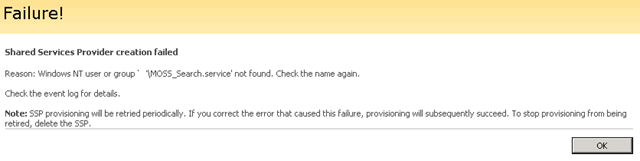
I was minding my own business doing a MOSS install. I successfully created the Office Server Search Service and onto the creation of the Shared Service Provider. Created the SSP and MySite Web Applications and then at the final step of creating the SSP, it bombed out after a long period of time with an error.

image

Reason: Windows NT user or group ‘MyDomain\MOSS_Search.service’ not found. Check the name again.

Continue reading “SQL Logins and AD Accounts can bite”


« Previous PageNext Page »

Today is: Wednesday 3 June 2026 -